


A retail media strategy for non-retailers is defined as the process by which companies without physical or digital retail sales functions build and operate commerce media networks, using first-party data and digital platforms to engage audiences and generate incremental advertising revenue. Retail media spend surpassed $60 billion in 2026, driven by networks like Amazon Advertising, Walmart Connect, and Instacart Ads. Non-retailers are now entering this space not as advertisers buying into those networks, but as network operators themselves. The opportunity is real, the infrastructure is accessible, and the brands that move early will own the audience relationships that define the next decade of digital marketing.
What is a commerce media network for non-retailers?
Commerce media networks (CMNs) are the non-retailer adaptation of retail media networks (RMNs). The distinction matters because it changes everything about how you build, operate, and measure the network. A traditional RMN like Walmart Connect or Kroger Precision Marketing sits on top of transactional retail data. Advertisers buy placements because Walmart knows what its shoppers purchase, when, and at what price point. That closed-loop transaction data is the spine of the entire value proposition.
A commerce media network operates without that retail sales layer. You are not selling products on your platform, so you cannot offer purchase-based attribution in the same direct way. What you can offer instead is something equally powerful: deep, behavioral first-party data built from your audience’s interactions with your content, services, tools, or community. Think of a financial services company, a travel brand, or a healthcare platform. Each of these businesses accumulates rich audience signals without a single SKU changing hands.

The advertising model inside a CMN also differs in one critical way: the split between endemic and non-endemic advertisers. Endemic advertisers sell products or services directly relevant to your audience. Non-endemic advertisers reach your audience because of who they are, not what they buy on your platform. Non-endemic advertising is the largest growth opportunity in 2026 for non-retail brands, particularly when physical foot traffic data is layered in for geographic precision targeting. This distinction shapes your entire ad sales strategy, your pricing model, and your measurement approach.
Pro Tip: Build your CMN taxonomy around audience intent signals, not content categories. A user comparing mortgage rates signals far more purchase intent than a user reading a general finance article. Advertisers will pay a premium for the former.
Understanding commerce media networks as an evolution of ecommerce advertising helps frame the strategic conversation internally. You are not launching a media company. You are monetizing an audience asset you already own.
How can non-retailers build an effective retail media strategy?
Building a commerce media network requires a structured approach. The strategic components below are not sequential steps so much as interdependent pillars. Weakness in one undermines the others.
1. Map audience overlap and shopper intent before selecting networks.
Audience-category fit drives efficient retail media investments far more than platform reach alone. Before you decide which external RMNs to participate in as an advertiser, or which advertisers to recruit into your own CMN, map your audience’s demonstrated purchase behaviors against category adjacencies. A travel brand whose users skew toward premium credit card holders is a natural home for financial services, luxury goods, and insurance advertisers. That overlap is your monetization thesis.
2. Use offline and online foot traffic data for geographic targeting.
Physical location data from providers like Placer.ai or Foursquare adds a targeting dimension that pure digital signals cannot replicate. If your audience concentrates in specific metros or retail corridors, that geographic intelligence becomes a premium product for advertisers running localized campaigns. This is particularly relevant for non-endemic advertisers who need proof that your audience actually shows up in their markets.
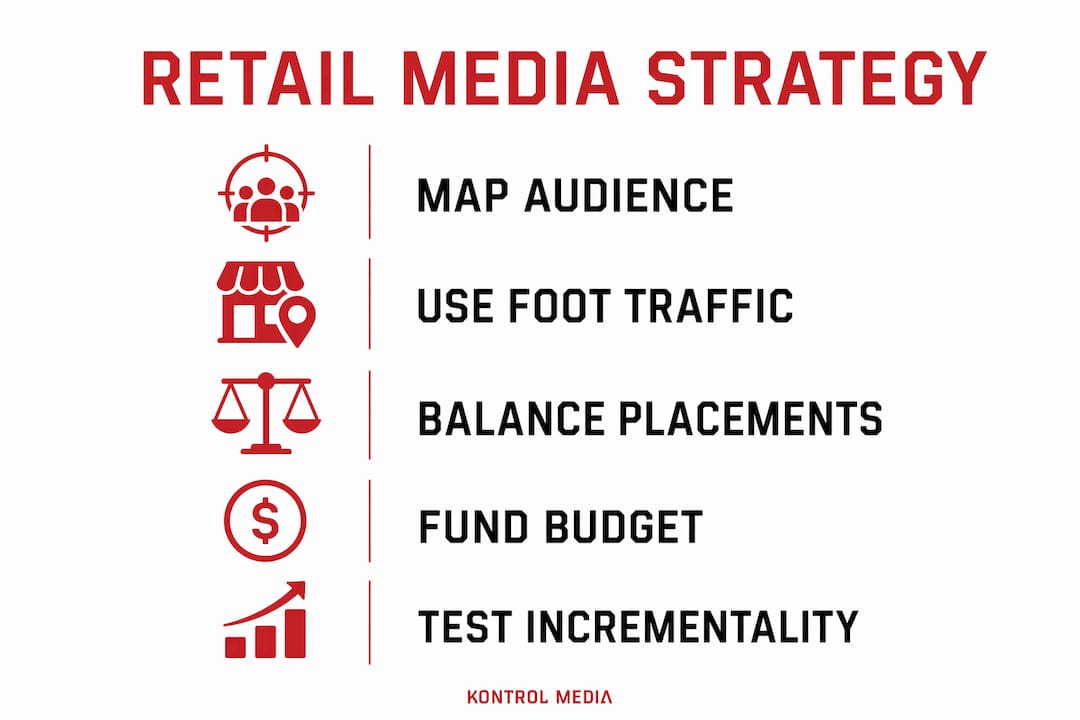
3. Balance onsite and offsite media placements across the full funnel.
Successful 2026 retail media strategies activate a hybrid onsite and offsite model, combining high-intent onsite placements with offsite programmatic reach powered by first-party data. For a CMN operator, this means selling both direct placements within your owned properties and extended audience segments that advertisers can activate through demand-side platforms like The Trade Desk or Google DV360. Top brands use a full-funnel multiscreen approach that targets awareness, consideration, and conversion simultaneously rather than treating each stage as a separate campaign.
4. Fund your network from the right budget pools.
RMN spend should come from trade spend and co-op pools, not from owned marketing channels like email or organic social. The same principle applies when you are building a CMN and recruiting brand advertisers. Help your prospective advertisers understand that their investment in your network belongs in their trade or co-op budget, not their brand marketing budget. That framing accelerates sales cycles considerably.
5. Reserve budget for incrementality testing from day one.
Brands that allocate 8 to 15% of channel revenue back into their RMN budget, with 10% of that reserved for incrementality holdout testing, consistently outperform those that optimize purely on last-click metrics. Build this discipline into your network’s measurement offering from launch. Advertisers who see true incrementality data renew. Those who only see impression reports churn.
Pro Tip: Avoid porting keyword lists from Google Ads or Amazon into your CMN’s search placements. Each network has its own search behavior ecosystem. Pull raw search term reports from your own platform analytics and build keyword strategy from actual user queries on your properties.
| Strategic component | Owned channel approach | Commerce media network approach |
|---|---|---|
| Audience data | CRM and email lists | First-party behavioral data monetized via ad placements |
| Revenue model | Product or service sales | Advertising revenue from endemic and non-endemic brands |
| Attribution | Direct conversion tracking | Incrementality testing and multi-touch measurement |
| Budget source | Marketing budget | Trade spend, co-op funds, dedicated CMN budget |
What operational tools and tactics support non-retail commerce media networks?
Operating a CMN at scale requires more than a sales team and an ad server. The operational layer is where most non-retailers underestimate the complexity.
AI-powered campaign bidding and automation tools are no longer optional. AI bidding tools are table stakes in 2026 for scaling retail media campaigns, and their effectiveness depends entirely on the quality of your underlying product and audience data. Garbage in, garbage out applies here with particular force. Before you activate any automated bidding, audit your data hygiene across every audience segment and placement type.
Closed-loop attribution requires third-party measurement layers when you lack retail transaction data. Platforms like Northbeam and Triple Whale provide unified analytics that pull together onsite engagement, offsite impressions, and conversion signals into a single view. For a CMN operator, offering advertisers access to these measurement integrations as part of your network’s standard package is a meaningful competitive differentiator.
SKU tiering, adapted for non-retail contexts, means prioritizing your highest-value audience segments for campaign focus rather than spreading inventory thin across every placement. Identify the segments that deliver the strongest advertiser outcomes and build your rate card around those. Lower-value inventory can be monetized through programmatic floor prices rather than direct sales.
Audience segmentation and creative messaging must align to funnel stage. An advertiser running a brand awareness campaign needs different creative specs, targeting parameters, and success metrics than one running a retargeting campaign against your most engaged users. Build these distinctions into your media kit from the start, because advertisers who receive funnel-appropriate guidance spend more and report higher satisfaction.
Vertical retail media networks with lower competition and CPMs are worth watching as distribution partners. Walmart Connect CPCs run 40 to 60% lower than Amazon equivalents in categories like home goods, sporting goods, and pet supplies. For non-retailers whose audiences overlap with these categories, participating in emerging vertical networks as an advertiser while building your own CMN creates a dual-channel presence that compounds brand authority.
How to measure success and prove ROI in retail media strategies for non-retailers?
Last-click attribution is inadequate for retail media measurement. This is not a nuanced opinion. It is a structural fact. Last-click models systematically overvalue bottom-funnel placements and undervalue the awareness and consideration work that makes those conversions possible. For CMN operators, relying on last-click data to prove network value to advertisers is a fast path to losing renewals.
Incrementality testing using geo-based holdout groups is the measurement standard that serious advertisers expect. You run your campaign in exposed markets and withhold it from matched control markets, then measure the difference in outcomes. This methodology isolates the true causal impact of your network’s placements from organic demand. Measurement maturity requires incrementality testing, impression and conversion data exports, and configurable attribution windows. Networks that cannot provide these capabilities are not ready for serious advertiser investment.
Visitation lift measurement adds a physical dimension that digital-only metrics miss. If an advertiser’s campaign on your platform drives measurable increases in store visits or location-based conversions, that data is extraordinarily persuasive in renewal conversations. Partner with foot traffic analytics providers to build this into your standard measurement suite.
Tracking organic search rank improvements for advertiser brands as a proxy for brand-building impact is an underused tactic. When your CMN drives meaningful impressions and engagement for an advertiser’s brand terms, that activity often correlates with improved organic search visibility. Documenting this connection gives advertisers a brand equity argument for their CMN investment that goes beyond direct response metrics.
Retail media for non-retailers is not a generic advertising channel. It is a first-party data play requiring third-party data integration for attribution. Treat your measurement infrastructure as a product, not an afterthought.
Pro Tip: Model your CMN spend as a blended cost of goods sold element rather than a pure marketing expense. Tracking RMN budget as blended COGS aligns incentives and reflects the true impact on unit economics, which makes the business case far cleaner for CFO conversations.
Key takeaways
Non-retailers that build commerce media networks on a foundation of first-party data, incrementality measurement, and audience-category fit will generate durable advertising revenue while deepening customer engagement.
| Point | Details |
|---|---|
| CMNs differ from RMNs | Commerce media networks lack retail transaction data, so audience behavioral signals replace purchase data as the core value. |
| Audience fit over platform reach | Map your audience’s category adjacencies before recruiting advertisers or selecting external networks to join. |
| Fund from trade and co-op budgets | Keeping CMN investment out of owned channel budgets preserves overall marketing health and accelerates advertiser buy-in. |
| Incrementality is non-negotiable | Networks without holdout testing, data exports, and configurable attribution windows will not retain serious advertisers. |
| Retail media is converging with CTV | Retail media integrating with connected TV creates upper-funnel brand awareness opportunities powered by rich shopper audience data. |
Why the non-retailer opportunity in retail media is bigger than most realize
I have spent a lot of time working with brands that sit outside traditional retail, and the conversation about retail media almost always starts the same way. Someone on the marketing team says, “We don’t sell products, so retail media isn’t really for us.” That framing is the single most expensive mistake I see non-retail marketing teams make.
The reality is that the most valuable asset in retail media is not the shelf space or the checkout page. It is the audience. And non-retailers, particularly those in financial services, travel, healthcare, and media, often hold audience data that is richer and more behaviorally specific than what most retailers can offer. A healthcare platform that knows a user is researching Type 2 diabetes management has a more actionable signal for a pharmaceutical advertiser than a grocery retailer that knows the same user bought sugar-free cookies.
What I find genuinely exciting about this moment is that the infrastructure to operationalize that audience value has finally caught up with the opportunity. Ad servers, clean room technology, and programmatic pipes that once required enterprise-scale investment are now accessible to mid-market companies. The window to build a defensible CMN before your category gets crowded is open right now, but it will not stay open indefinitely.
The brands I worry about are the ones treating their legacy owned channels as a substitute for a dedicated CMN investment. Email lists and organic social are valuable, but they are not a commerce media network. They do not generate advertising revenue, they do not attract brand partners, and they do not build the measurement infrastructure that makes your audience data a sellable product. Building a multi-network portfolio and investing in audience-first planning is the move. The brands that do it now will look very smart in three years.
— Mark Kapczynski
How Kontrol Media helps non-retailers build commerce media networks
Kontrol Media builds, operates, and drives revenue for retail media and commerce media networks. If you are a marketing professional at a non-retail company trying to figure out where to start, or how to scale what you have already built, that is exactly the work we do. From network architecture and advertiser acquisition to measurement frameworks and ongoing optimization, Kontrol Media provides both the strategy and the hands-on execution. Clients like Experian, BuzzFeed, and Enthusiast Gaming have worked with us to turn audience assets into revenue-generating media operations. Explore our commerce media network services or learn more about our strategic consulting approach to see how we can help you move from concept to operating network.
FAQ
What is a commerce media network?
A commerce media network is the non-retailer equivalent of a retail media network, built on first-party behavioral data rather than retail transaction data. Non-retailers use CMNs to generate advertising revenue from endemic and non-endemic brand partners without selling products directly.
How does a non-retailer monetize a commerce media network?
Non-retailers monetize CMNs by selling onsite ad placements, offsite audience segments, and sponsored content to brand advertisers whose target customers overlap with the CMN’s audience. Revenue scales with audience quality, measurement transparency, and the depth of first-party data available.
What budget should a non-retailer allocate to retail media?
Brands should allocate 8 to 15% of channel revenue back into their retail media network budget, with 10% of that reserved specifically for incrementality holdout testing. This budget should come from trade spend or co-op pools, not from owned marketing channels.
What is the difference between endemic and non-endemic advertising in a CMN?
Endemic advertisers sell products or services directly relevant to your audience’s demonstrated interests. Non-endemic advertisers reach your audience based on demographic or behavioral fit rather than category alignment. Non-endemic advertising represents the largest growth opportunity for commerce media networks in 2026.
How do you measure ROI for a non-retail commerce media network?
Effective measurement requires incrementality testing with geo-based holdout groups, configurable attribution windows, and raw impression and conversion data exports. Platforms like Northbeam and Triple Whale provide unified analytics that connect offsite impressions to onsite and offline conversion outcomes.
Recommended
- Retail Media Ad Sales: Strategic Guide for Marketing Pros in 2026 | Kontrol Media Consultancy
- The Shift in Advertising Spend – How Retail Media Networks Are Changing the Game | Kontrol Media Consultancy
- The Rise of Retail Media: How Commerce Media Is Powering the Next Ad Revolution | Kontrol Media Consultancy
- The Rise of Retail Media Networks by Kontrol Media | Kontrol Media Consultancy