


Retail media ad sales has quietly become one of the most consequential advertising channels in modern commerce, and the numbers back that up. US omnichannel retail media spend is projected to hit $69.33 billion in 2026, fueled by retailers’ access to first-party shopper data that no other channel can replicate. Yet for all that momentum, many marketing professionals and retailers find themselves stuck, wrestling with fragmented platforms, murky attribution, and organizational silos that make it genuinely hard to capture their share of that spend. This guide cuts through the noise and gives you a clear, practical path forward.
Table of Contents
- Key takeaways
- What retail media ad sales actually includes
- Common challenges in retail media ad sales
- Strategies to optimize ad sales and increase revenue
- The future of retail media: what to expect
- Practical steps to get started
- My take on what most people underestimate
- How Kontrol Media can help you scale faster
- FAQ
Key takeaways
| Point | Details |
|---|---|
| Retail media is a $69B channel | First-party shopper data makes it uniquely powerful, but operational complexity often limits who actually captures the revenue. |
| Measurement is the unlock | Moving beyond pilots to scalable ad sales requires credible, transparent attribution including incrementality testing. |
| Omnichannel is the baseline | Most shoppers move fluidly between digital and physical touchpoints, making siloed channel campaigns structurally inefficient. |
| AI accelerates but demands culture | AI-enabled activations like in-store audio networks add scale, but sustainable results require cross-team alignment. |
| Consult before you build alone | Operational friction is the most common barrier to growth; specialized expertise speeds up the path to monetization. |
What retail media ad sales actually includes
The industry term for this space is retail media, sometimes called commerce media when it extends beyond a retailer’s owned properties. Retail media ad sales refers specifically to the practice of retailers monetizing their audience and data assets by selling advertising inventory to brands and suppliers. That inventory spans several distinct formats, and understanding each one matters before you can optimize across them.
Onsite ads include sponsored product listings, banner placements, and digital shelf ads that appear on a retailer’s website or app at the exact moment a shopper is ready to buy. Offsite ads extend a retailer’s audience data to external platforms like connected TV, social media, and programmatic exchanges. In-store media campaigns cover digital screens, audio networks, and point-of-sale displays inside physical locations. The integration of all three is what makes retail media genuinely different from traditional display advertising.
Retail media networks (RMNs) are the structural engine behind all of this. They are the platforms retailers build or license to package their inventory, manage advertiser relationships, and report performance back to brands. Think of an RMN as the spine of a retailer’s ad sales operation. Without it, even the richest shopper data remains untapped.
The proximity-to-purchase signal is what separates retail media from almost every other ad channel. When a shopper searches for “laundry detergent” on a retail site, that signal carries far more purchase intent than a demographic profile alone ever could. That signal is the asset. Everything else, the technology, the measurement, the sales process, is how you monetize it.
Pro Tip: If you are evaluating an RMN investment, start by auditing the quality of your first-party data before worrying about ad formats. Clean, complete shopper data is the foundation that every format and measurement methodology depends on. Read more about first-party data’s role in powering commerce media networks.
Common challenges in retail media ad sales
Here is the honest reality that does not always make it into vendor pitch decks: many retail media networks remain under-monetized not because the demand is missing, but because execution and measurement gaps get in the way. That distinction matters enormously, because it means the problem is solvable.

The most common friction points you will encounter fall into a few categories:
Fragmented platforms and siloed workflows. Most RMNs were assembled from disparate tools, a CMS here, a DSP there, a billing system that does not talk to either. Operational friction across these systems directly limits the ability to automate targeting, pacing, and billing at scale.
Measurement that does not convince buyers. Brands will spend cautiously until they trust the numbers. In-store retail media often stalls at pilot until credible, transparent measurement is in place. Shared briefs, demographic indexing, and store-level comparisons are what move budget from test to committed.
Lack of standardized definitions. The industry has not fully converged on what counts as an impression, a conversion, or an incremental sale across different formats. This creates friction in every sales conversation with brand advertisers.
The omnichannel activation gap. Running onsite ads without coordinating in-store media campaigns or offsite retargeting leaves money on the table. Shoppers do not live in one channel, so campaigns that do tend to underperform.
“Retail media’s mid-moment may be its turning point, not because the opportunity is larger, but because the industry is finally getting serious about solving the measurement and execution problems that have held it back.” — Kiri Masters, The Drum
Dollar General’s expansion of its AI-enabled in-store audio network to 12,000 stores illustrates both the ambition and the complexity. Deploying localized, measurable audio ads at that scale requires POS data integration, vendor alignment, and a measurement framework that can prove causality. That is not a small operational lift, even for a retailer of Dollar General’s size.
Strategies to optimize ad sales and increase revenue
Getting from fragmented pilots to a scaled retail media ad sales operation requires deliberate sequencing. Here is a framework that actually works in practice:
Unify your platforms first. Before optimizing campaigns, fix the infrastructure. A unified ad server connected to your retail data and billing systems removes the manual handoffs that kill margin and slow sales cycles. Dollar General’s approach of unifying onsite and offsite activation through a single platform with Kevel and The Trade Desk demonstrates what this looks like at scale.
Adopt causal measurement methodologies. The IAB recommends incrementality testing through randomized control trials and geographic lift studies rather than relying solely on media mix modeling. This kind of deterministic measurement is what gives brand advertisers the confidence to grow their commitment.
Build omnichannel campaigns around shopper behavior. Omnichannel shopper behavior is the baseline now, not the exception. Campaigns that connect digital shelf ads, in-store touchpoints, and offsite placements outperform siloed single-channel programs because they match how people actually shop.
Use AI to personalize at scale, not just automate. Dollar General’s audio network uses AI to deliver localized messaging based on store-level POS data. That is personalization tied to real purchase signals, not just demographic targeting. The distinction matters for both relevance and measurement.
Align your internal teams around shared performance goals. Sales, marketing, and analytics teams each have a piece of the retail media operation. When they work from different dashboards and different definitions of success, you get inconsistent reporting and slow decision cycles.
Pro Tip: Do not wait until your measurement infrastructure is perfect before selling ad inventory. Start with the formats where you can demonstrate the clearest conversion signal, typically onsite search and sponsored products, and build measurement credibility from there.
| Approach | Best for | Key benefit |
|---|---|---|
| Onsite sponsored products | CPG and endemic brands | Highest purchase intent, easiest attribution |
| In-store media campaigns | Impulse categories, local brands | Physical proximity to transaction |
| Offsite programmatic | Upper-funnel brand awareness | Audience extension beyond owned inventory |
| AI-driven audio/video | High-traffic physical retailers | Scale with localized personalization |
The future of retail media: what to expect
The trajectory here is clear, and it is worth understanding so you can position your operation ahead of the curve rather than catching up to it.
AI-enabled measurement and activation will become table stakes, not differentiators. The IAB’s industry guidelines signal that the commerce media ecosystem is moving toward standardized, AI-assisted performance measurement. Retailers who build this capacity now will find advertiser conversations much easier in 2027 and beyond.
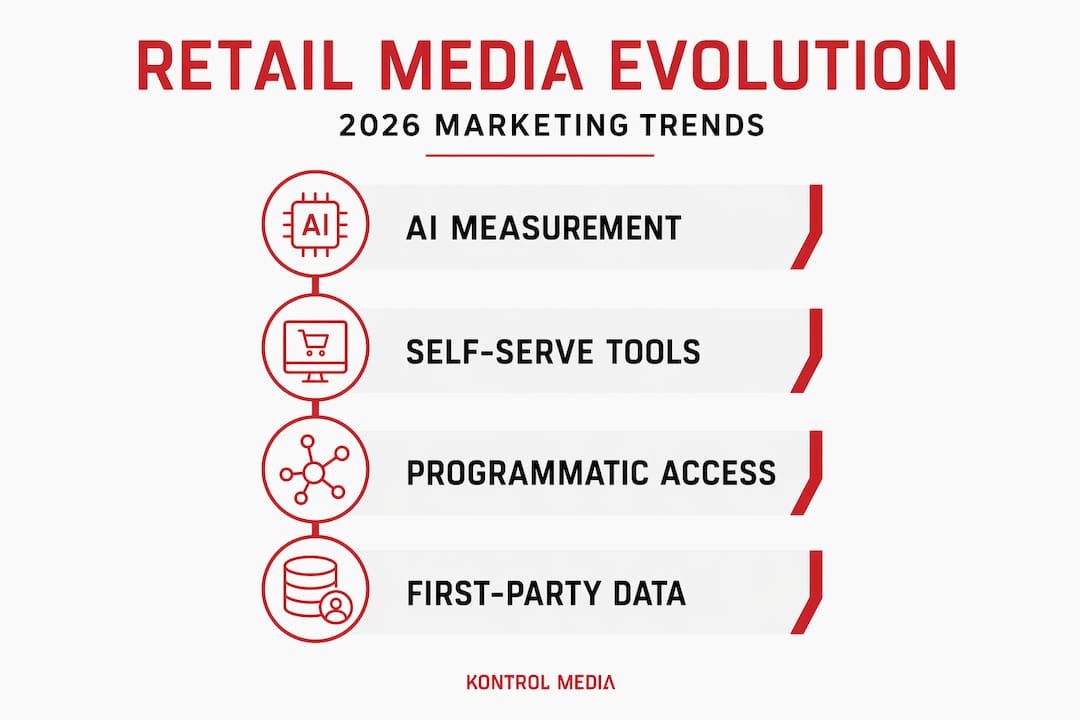
Self-serve and programmatic tools for RMNs are expanding access for mid-market advertisers who previously could not navigate the custom IO process that most retail media sales still require. This is meaningful because it broadens the advertiser base beyond the top ten CPG brands.
| Trend | Timeline | Impact on ad sales |
|---|---|---|
| AI-powered measurement | 2026 and beyond | Stronger attribution, faster optimization cycles |
| Self-serve RMN platforms | Accelerating now | Broader advertiser pool, higher volume |
| Omnichannel standardization | Mid-term | Reduced friction in cross-format campaign planning |
| Consolidation of smaller RMNs | Near-term | Fewer but more capable networks competing for spend |
Retail media is not a trend that will fade when macroeconomic conditions shift. It is structurally durable because it is built on the closest thing to a guaranteed purchase signal that advertising has ever had. The question is not whether this channel will grow. It is whether your organization will be positioned to capture that growth.
Practical steps to get started
Knowing the strategy and executing it are two different things. Here is how to close that gap in your own organization:
Assess your operational readiness honestly. Map every platform, tool, and workflow currently involved in your ad sales process. Identify where handoffs are manual, where data does not transfer cleanly, and where measurement breaks down. This audit is the starting point for every improvement that follows.
Prioritize measurement standardization before scale. Agree internally on what incrementality means for your network, which methodologies you will use, and how you will report results to advertisers. Without this, every sales conversation becomes a negotiation over whose numbers to trust.
Leverage your first-party data as a competitive asset. Your shopper data is the reason brands want to advertise with you. Make sure your data clean rooms, segmentation, and audience activation tools are actually connected to your ad server. Many retailers have the data but have not fully built the connective tissue to deploy it in campaigns. This is where commerce media network expertise becomes genuinely valuable.
Build a test-and-learn cadence into your operations. Retail media moves fast. Formats that underperform this quarter can be redesigned and relaunched next quarter if you have a structured learning loop. Organizations that treat every campaign as a test, not just a delivery vehicle, compound their performance advantage over time.
Consider external expertise for gaps you cannot close internally. The advertiser acquisition strategies and technical integrations required to scale an RMN are not things most retailers’ existing marketing teams were built to handle. Specialized consulting accelerates the path considerably.
My take on what most people underestimate
I have worked with retailers and media operators at different stages of building their ad sales functions, and the pattern I keep seeing is this: the demand is there, the data is there, and the technology is broadly available. What stalls growth almost every time is organizational alignment and measurement credibility. Not the fun stuff to fix, but the most consequential.
What I have found is that teams often sprint toward the newest ad format or AI capability before they have secured advertiser trust in their attribution. That sequence is backward. Brands will test anything once. They will scale only what they can measure. Getting rigorous, transparent measurement in place is the unlock that turns a pilot program into a committed budget line.
I am also genuinely optimistic about where AI fits into all of this. The Dollar General audio network expansion is a real-world proof point that AI-driven personalization at scale is no longer theoretical. But I have also seen clients try to layer AI onto broken workflows and wonder why results disappoint. The technology amplifies what is already there, good or bad.
The retailers and marketing professionals I have seen succeed treat this as a collaborative, cross-functional effort from day one. When the analytics team, the sales team, and the marketing team are working from a shared definition of success, things move remarkably faster. That sounds obvious. It rarely is in practice.
— Mark Kapczynski
How Kontrol Media can help you scale faster
Building a retail media ad sales operation that actually generates revenue at scale requires more than a technology stack. It requires the right strategy, the right measurement architecture, and a team that knows how to sell it to advertisers. That is exactly what Kontrol Media does.
Kontrol Media builds, operates, and drives revenue for retail media and commerce media networks. From auditing your current infrastructure and aligning your internal teams, to executing advertiser acquisition and designing the measurement frameworks that give brands the confidence to grow their spend, Kontrol Media brings both strategic thinking and hands-on execution. Clients like Experian, BuzzFeed, and West Monroe have seen what happens when strategic marketing consulting is applied with precision and accountability. If you are ready to move your retail media operation from pilot to profitable, explore what Kontrol Media can build with you. You can also learn more about retail media’s next chapter and how commerce media is reshaping advertising revenue for forward-thinking retailers.
FAQ
What is retail media ad sales?
Retail media ad sales is the practice of retailers monetizing their owned audience and first-party shopper data by selling advertising inventory to brands. Formats include onsite sponsored products, digital shelf ads, in-store media, and offsite programmatic placements.
How large is the retail media market in 2026?
US retail media ad spending is projected to reach approximately $69.33 billion in 2026, driven by retailer first-party data and strong proximity-to-purchase signals.
Why do most retail media networks fail to scale?
Most RMNs remain under-monetized due to execution gaps and measurement deficits rather than lack of advertiser demand, particularly in onsite search and video formats.
What measurement methods work best for retail media?
The IAB recommends incrementality and causal testing through randomized control trials and geographic lift studies as more reliable than media mix modeling alone for proving retail media’s incremental value.
What does omnichannel mean for retail media campaigns?
Omnichannel shopper behavior means between 80% and 94% of shoppers engage with both in-store and digital touchpoints, making connected campaigns across physical and digital formats far more effective than single-channel strategies.
Recommended
- Advertiser Acquisition Strategies for Media Networks in 2026 | Kontrol Media Consultancy
- The Rise of Retail Media: How Commerce Media Is Powering the Next Ad Revolution | Kontrol Media Consultancy
- The Shift in Advertising Spend – How Retail Media Networks Are Changing the Game | Kontrol Media Consultancy
- Commerce Media Networks: The Next Evolution in eCommerce Advertising | Kontrol Media Consultancy