


Marketing-sales alignment is defined as the formal unification of both teams under shared revenue goals, common definitions, and mutual accountability structures. When organizations align marketing sales revenue goals through enforceable agreements and integrated data, aligned teams achieve 208% higher marketing revenue contribution and 36% higher customer retention. That is not a marginal improvement. It is a structural advantage that separates high-growth organizations from those perpetually chasing their numbers. The enablers are specific: Service Level Agreements (SLAs), CRM platforms, Digital Sales Rooms (DSRs), and a shared Ideal Customer Profile (ICP). This article breaks down exactly how to build and sustain that alignment.
How to align marketing sales revenue goals: the foundational components
The industry term for this practice is Revenue Operations alignment, or RevOps alignment. It goes well beyond marketing and sales “getting along.” It requires shared definitions, quantitative scoring models, and legally binding internal contracts that both teams sign and leadership enforces.
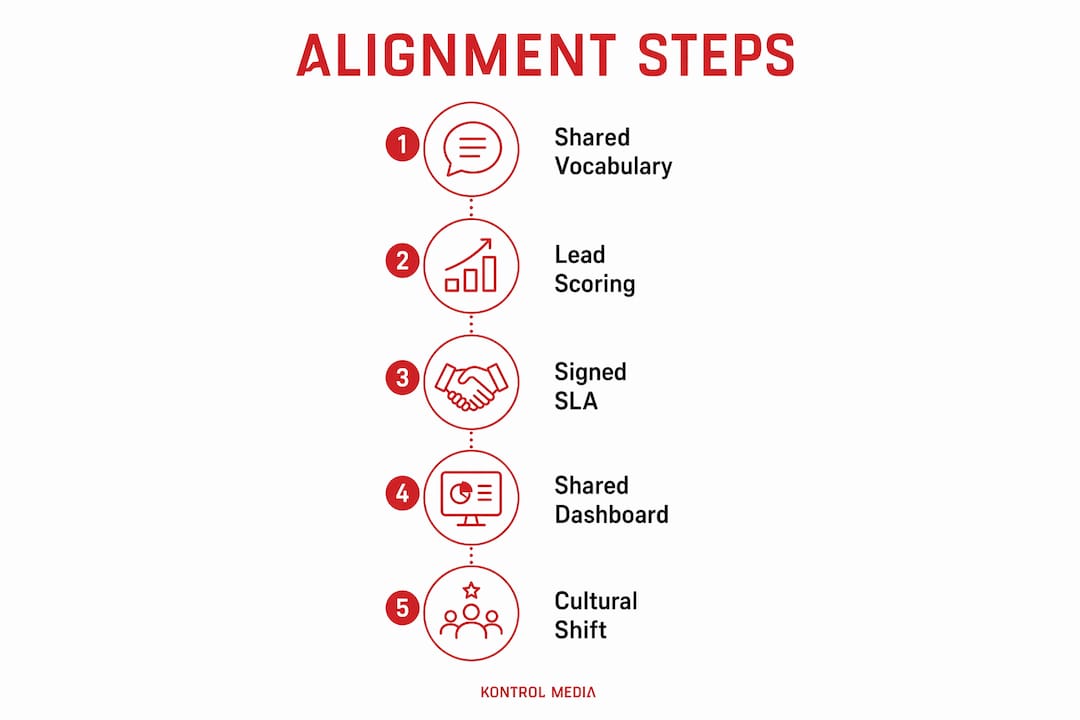
The first building block is a shared vocabulary. Without agreed definitions for Marketing Qualified Leads (MQLs), Sales Qualified Leads (SQLs), and Sales Accepted Leads (SALs), each team operates on different assumptions. Marketing celebrates MQL volume while sales dismisses those leads as off-target. Misaligned teams focus on different buyer personas and metrics, producing wasted effort and poor revenue outcomes. A shared ICP document, signed by both teams, eliminates that ambiguity at the source.
The second building block is a quantitative lead scoring model. Effective scoring combines firmographic factors (company size, industry, revenue band) with behavioral intent signals (content downloads, pricing page visits, demo requests). A prospect from a target account who visits the pricing page three times in a week scores differently than one who opened a single email. This precision protects sales from chasing low-probability leads and protects marketing from being blamed for poor conversion.

The third building block is the SLA itself. Without a formal SLA with measurable, enforceable terms, alignment efforts are mostly superficial. The SLA must specify lead volume commitments, quality thresholds, speed-to-lead requirements, and escalation procedures. It must be signed by leadership on both sides and reviewed on a fixed cadence.
Key components every alignment SLA must address:
- Shared definitions of MQL, SQL, SAL, and pipeline stages with numeric thresholds
- Lead volume targets by channel and segment, reviewed monthly
- Quality thresholds: minimum lead score, firmographic fit criteria, and intent signals required
- Speed-to-lead: maximum response time from MQL handoff to sales contact attempt
- Escalation procedures when thresholds are missed for two consecutive periods
- Reporting cadence: weekly dashboard review, monthly formal SLA audit
Pro Tip: Get the SLA signed by the CMO and CRO on the same day. Without dual leadership signatures, the document becomes a suggestion rather than a contract, and both teams will revert to old behaviors within 90 days.
How to set up an SLA that actually drives pipeline velocity
Before writing a single SLA clause, you need a data audit. 40 to 60% of MQLs may be touched late, rejected without a valid disposition code, or sourced from accounts that fall outside the ICP. Without that baseline, you are writing an SLA based on assumptions rather than reality.
Here is a practical sequence for building an SLA that holds:
- Audit lead handling data. Pull 90 days of lead records from your CRM. Measure time-to-first-touch, disposition codes, MQL-to-SQL conversion rate, and rejection reasons. Identify where the pipeline breaks.
- Define realistic volume and quality targets. Use the audit data to set targets that are achievable but require improvement. Aspirational targets with no historical basis create resentment, not performance.
- Write the lead definitions. Document MQL, SQL, and SAL criteria with numeric thresholds. Attach the ICP criteria directly to the MQL definition so there is no ambiguity about who qualifies.
- Set speed-to-lead requirements. Sales should accept or recycle every MQL within 24 business hours. Specify that recycled leads require a predefined disposition code, not a freeform note.
- Build the review trigger. If MQL-to-SQL conversion falls below 60% for two consecutive months, a formal ICP and lead scoring review is triggered within 14 days. This clause prevents slow decay from going unaddressed.
- Schedule the review cadence. Weekly SLA review meetings with live dashboard data. Monthly formal audits with written summaries distributed to both teams and leadership.
| SLA Component | Standard Benchmark |
|---|---|
| Speed-to-lead response | Within 24 business hours |
| MQL-to-SQL conversion floor | 60% minimum before review trigger |
| Lead follow-up sequence | 10 touches to maintain pipeline velocity |
| Review trigger timeline | Formal ICP review within 14 days of breach |
| Reporting cadence | Weekly dashboard, monthly written audit |
Pro Tip: Require disposition codes from a fixed dropdown list when sales recycles a lead. Freeform notes like “not interested” are useless for ICP refinement. Codes like “wrong company size,” “wrong title,” or “no budget cycle” give marketing the signal it needs to improve targeting.
What role does technology play in aligning revenue goals?
Technology does not create alignment. It makes alignment visible and enforceable. The CRM is the single source of truth, and every metric both teams report must trace back to it. When marketing pulls pipeline data from one platform and sales pulls it from another, you get competing narratives and no accountability.
Sales teams in aligned organizations are 103% more likely to exceed revenue goals. That performance gap is largely explained by shared visibility into the same data. When both teams see the same pipeline velocity numbers, the same CAC figures, and the same conversion rates, they stop arguing about whose fault the miss was and start solving the actual problem together.
The metrics that matter in an aligned organization shift away from vanity measures. Replacing “leads generated” with pipeline velocity, customer acquisition cost (CAC), and customer lifetime value (CLV) forces both teams to think about revenue rather than activity. For context, expansion revenue CAC is 5 to 10 times cheaper than acquiring new logos. That single data point should reshape how both teams prioritize retention and upsell motions alongside new business.
Digital Sales Rooms (DSRs) add a layer of visibility that most organizations have not yet operationalized. DSRs give marketing visibility into which assets buyers actually interact with, closing the feedback loop between content creation and sales usage. When marketing can see that a specific case study is opened by 80% of deals that close and ignored by deals that stall, content strategy becomes a revenue decision rather than a creative one.
Key technology components for a unified revenue stack:
- A single CRM (Salesforce, HubSpot, or equivalent) as the authoritative data source for both teams
- Marketing automation integrated directly with CRM lead records and scoring
- Conversation intelligence tools (such as Gong or Chorus) for real-time feedback on buyer objections and messaging gaps
- A shared revenue dashboard visible to both teams and updated in real time
- DSRs for tracking buyer engagement with sales and marketing content post-handoff
Moving from vanity metrics to revenue KPIs is the single most clarifying shift a leadership team can make. It removes the ambiguity that lets both teams claim success while the business misses its number.
Pro Tip: Build one shared dashboard that both the CMO and CRO review together every Monday. If they are looking at different reports, they are managing different realities.
How collaboration and culture shifts sustain alignment over time
Structure and technology create the conditions for alignment. Culture determines whether it lasts. The most common failure mode is not a bad SLA or the wrong CRM. It is two teams that return to siloed behavior the moment leadership attention moves elsewhere.
The shift that changes this is moving from a “marketing team and sales team” model to a single Revenue Team with shared ownership of the entire buyer journey. Alignment failures are often structural, requiring a transition from siloed departments to an integrated Revenue Team focused on total profitability and lifetime value. That framing matters because it changes what both teams are accountable for.
One of the most underused collaboration practices is engaging sales as subject matter experts in content creation. Sales reps hear objections, questions, and buying signals every day that marketing never captures. Aligning sales as content SMEs with marketing improves lead quality and the relevance of sales enablement materials. A blog post written with input from three sales reps who close deals in the target segment will outperform one written purely from a marketing brief. This is also a practical way to build a high-performing sales team that feels genuinely invested in marketing outcomes.
Structural practices that reinforce collaborative culture:
- Weekly Revenue Team meetings with both marketing and sales leads reviewing shared KPIs, not separate reports
- Quarterly joint planning sessions where both teams co-own pipeline targets and campaign priorities
- A formal content collaboration process where sales contributes objection data and buyer language to marketing briefs
- Leadership modeling of shared accountability by refusing to accept “that’s a marketing problem” or “that’s a sales problem” framing
- Recognition programs that reward cross-functional contributions, not just individual team metrics
The cultural shift from lead volume to pipeline quality requires leadership to actively deprioritize MQL count as a primary marketing KPI. When marketing is measured on MQL volume, it optimizes for volume. When it is measured on pipeline contribution and closed revenue, it optimizes for quality. That single change in measurement drives more behavioral change than any workshop or offsite.
Key takeaways
Aligning marketing and sales revenue goals requires enforceable SLAs, shared data infrastructure, and a Revenue Team culture that replaces siloed accountability with joint ownership of pipeline and closed revenue.
| Point | Details |
|---|---|
| Shared definitions are non-negotiable | MQL, SQL, SAL, and ICP criteria must be documented and signed by both teams before any SLA is written. |
| SLAs need teeth to work | Speed-to-lead, disposition codes, and a 60% MQL-to-SQL floor with a 14-day review trigger prevent slow decay. |
| Technology enables visibility | A single CRM and shared revenue dashboard remove competing narratives and force joint accountability. |
| Culture outlasts structure | Engaging sales as content SMEs and running joint Revenue Team meetings sustains alignment when leadership attention shifts. |
| Measure revenue, not activity | Replacing MQL volume with pipeline velocity, CAC, and CLV aligns both teams to the outcome that actually matters. |
What I’ve learned about alignment after watching it fail and succeed
I have sat in enough cross-functional planning meetings to know that most alignment initiatives die in the implementation, not the strategy. The deck looks great. The SLA gets drafted. Leadership signs off. And then, six weeks later, sales is still ignoring MQLs and marketing is still celebrating lead volume while the pipeline stalls.
The honest truth is that alignment fails when it is treated as a project rather than an operating model. You cannot run a two-day workshop, hand both teams a shared dashboard, and call it done. The behaviors that created misalignment took years to form. They do not change because someone updated the CRM.
What actually works, in my experience, is starting with the data audit before writing a single SLA clause. When you show a sales leader that 47% of MQLs were never touched within 48 hours, the conversation changes. When you show a marketing leader that 35% of rejected leads had no valid disposition code, the conversation changes again. Data removes the defensiveness that kills alignment conversations before they start.
I also think the industry underestimates how much the ICP drifts over time. Markets shift. Buyer personas evolve. A lead scoring model built 18 months ago may be optimizing for a customer profile that no longer converts at the same rate. Lead recycling data analyzed through fixed disposition codes is one of the most underused signals for catching ICP drift early. Most organizations are sitting on that data and not using it.
The teams I have seen sustain alignment over multiple years share one trait: leadership treats the Revenue Team meeting as non-negotiable. Not a nice-to-have. Not something that gets bumped when the quarter gets busy. The meeting happens, the data gets reviewed, and both teams leave with shared commitments. That discipline, more than any technology or framework, is what separates organizations that grow from those that plateau.
— Mark Kapczynski
How Kontrol Media helps you turn alignment into measurable growth
At Kontrol Media, we work directly with business leaders and marketing professionals to build the alignment infrastructure that drives real revenue outcomes. That means auditing your current lead handling data, designing enforceable SLAs with measurable thresholds, and building the shared reporting systems that keep both teams accountable to the same number. We do not hand you a framework and walk away. We sit inside the execution with you, from crafting an integrated marketing strategy to building the dashboards your CMO and CRO will actually use every week. If your marketing and sales teams are working hard but not working together, that is the problem we solve. Measure what matters and let us help you build the system that gets you there.
FAQ
What does it mean to align marketing and sales revenue goals?
Marketing-sales revenue goal alignment means both teams share ownership of pipeline targets, closed revenue, and customer retention under a formal SLA with enforceable definitions and reporting requirements. It is the foundation of a Revenue Operations model where neither team can claim success while the business misses its number.
How does an SLA improve marketing and sales collaboration?
An SLA specifies lead definitions, volume and quality commitments, speed-to-lead requirements, and escalation procedures that both teams are contractually bound to follow. Without enforceable terms, alignment efforts remain superficial and behaviors revert within weeks.
What metrics should aligned marketing and sales teams track?
Aligned teams replace vanity metrics like MQL volume with pipeline velocity, customer acquisition cost (CAC), customer lifetime value (CLV), and MQL-to-SQL conversion rate. These revenue-focused KPIs create shared accountability for outcomes rather than activity.
How do Digital Sales Rooms support revenue alignment?
DSRs give marketing visibility into which content assets buyers engage with during the sales process, creating a direct feedback loop between content strategy and deal outcomes. Assignment Selling, where prospects consume specific content before a sales meeting, improves close rates and shortens sales cycles.
How long does it take to see results from marketing-sales alignment?
Most organizations see measurable improvement in MQL-to-SQL conversion rates and pipeline velocity within 60 to 90 days of implementing an enforceable SLA with weekly review cadence. Sustained revenue impact typically compounds over two to three quarters as ICP refinement and shared reporting mature.
Recommended
- Your Sales Function, Without the Headcount | Kontrol Media Consultancy
- Building a High-Performing Sales Team: Strategies and Best Practices | Kontrol Media Consultancy
- Measuring the ROI of Your Marketing and Advertising Campaigns | Kontrol Media Consultancy
- Unlocking Business Potential: Strategic Marketing and Consulting for Growth | Kontrol Media Consultancy