


A go-to-market strategy is a launch-specific action plan that defines exactly who your customers are, how you reach them, what value you deliver, and how you convert interest into revenue. It is not a business plan, and it is not a marketing plan. The GTM strategy sits at the execution layer, translating product vision into concrete sales and marketing actions designed to acquire the first customers rapidly. Most product launches fail not because of product defects but because of unclear paths to the customer. A well-built go-to-market plan removes that ambiguity for every team involved, from sales and product to customer success.
What is a go-to-market strategy and what does it include?
A go-to-market strategy is defined as a cross-functional plan that consolidates six core decisions: your Ideal Customer Profile (ICP), value proposition, distribution channels, messaging narrative, sales motion and pricing, and measurable success metrics. Each decision area is interdependent. Get the ICP wrong, and your messaging will miss. Get pricing wrong, and your sales cycle will stall before it starts.
The ICP is the most foundational element. It is not the same as your Total Addressable Market. The ICP is a narrow, precise description of the customer most likely to buy quickly, see value fast, and renew or refer. When the ICP is defined precisely, sales reps can disqualify unfit leads without seeking management approval. That single capability accelerates pipeline efficiency more than most tactical improvements.
Your value proposition frames the product’s benefits as outcomes, not features. “We reduce customer acquisition cost by 30%” is a value proposition. “We have an AI-powered platform” is a feature claim. The difference matters enormously in competitive markets where buyers are evaluating multiple options simultaneously.

Distribution channels determine where and how customers encounter your product. The most common GTM mistake here is spreading resources across too many channels at launch. Salesforce, which has studied GTM elements extensively, identifies focused channel selection as a key driver of early revenue. Pick one or two channels where your ICP is most active, prove traction, then expand.
| GTM Component | Role in the Plan |
|---|---|
| Ideal Customer Profile | Defines who to sell to and who to disqualify |
| Value proposition | Frames product benefits as customer outcomes |
| Distribution channels | Determines where and how customers are reached |
| Messaging narrative | Aligns all customer touchpoints around one story |
| Sales motion and pricing | Shapes speed of adoption and deal structure |
| Success metrics | Tracks performance and triggers course corrections |
Pro Tip: Write your ICP as a one-page document that includes firmographic data, the buyer’s top three pain points, and the trigger event that makes them ready to buy. Give it to every team member touching the launch.
How does a GTM strategy differ from a marketing or business plan?
Confusing a go-to-market strategy with a marketing plan is one of the most frequent failure causes in product launches. The distinction is not semantic. It determines how you allocate budget, staff, and time in the critical weeks before and after launch.
A marketing plan covers ongoing demand generation and brand management across an entire product portfolio. It operates continuously, across quarters and years, and is managed primarily by the marketing team. A business plan is broader still. It captures the company’s vision, financial projections, operational structure, and long-term goals. Neither of these is built for the high-pressure, time-compressed reality of a single product launch.
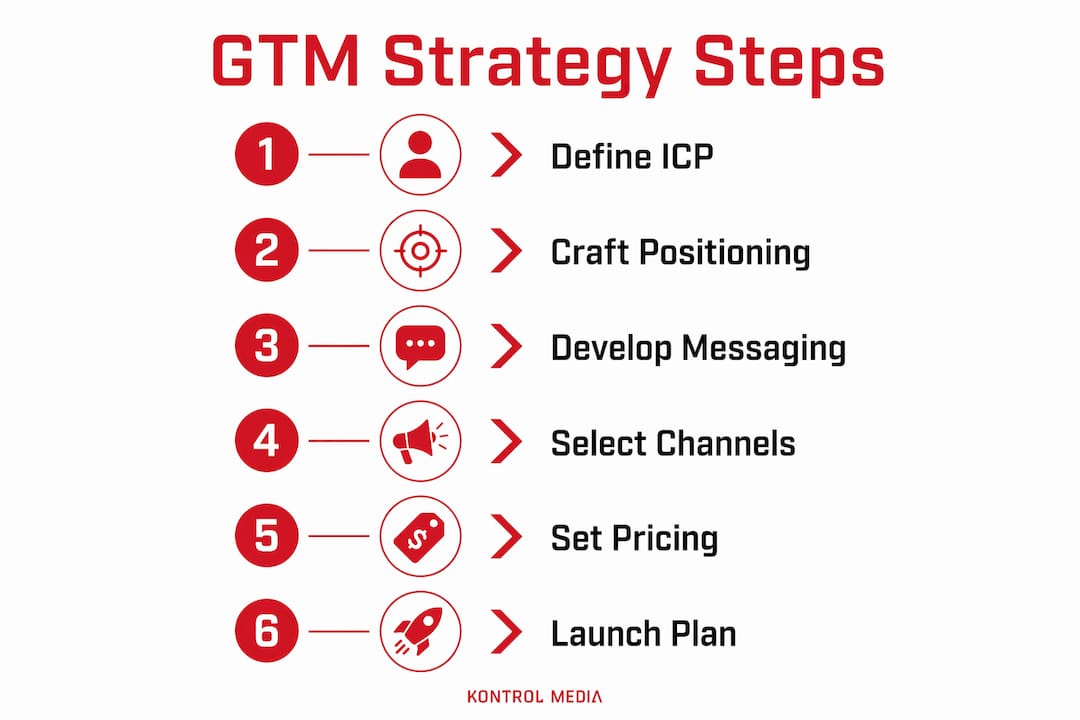
A GTM strategy is purpose-built for that pressure. It is execution-focused, launch-specific, and designed to align cross-functional teams around a single objective: generating revenue from a new product or market entry. Salesforce describes the primary purpose of a GTM plan as internal alignment to deliver the value proposition reliably from launch day forward.
| Plan Type | Scope | Timeframe | Primary Owner |
|---|---|---|---|
| GTM strategy | Single product or market entry | Launch window, first 90 days | Cross-functional |
| Marketing plan | Full portfolio, brand, demand gen | Ongoing, annual | Marketing team |
| Business plan | Company vision, financials, operations | Multi-year | Executive leadership |
The cross-functional nature of a GTM plan is what makes it distinct. Sales, marketing, product, and customer success all operate under one shared definition of success. When those teams use different definitions of a Marketing Qualified Lead or a Sales Qualified Lead, the customer experience fractures. A GTM framework forces those definitions to align before launch, not after the first churn spike.
For a deeper look at how marketing and sales alignment drives revenue, the connection to GTM execution becomes clear quickly.
What are the most common GTM pitfalls to avoid?
The most damaging GTM mistake is treating the strategy as a static document. A go-to-market plan is a series of hypotheses to test, validate, and revise based on real market feedback. Teams that finalize the plan in a conference room and execute it unchanged for six months are not running a GTM strategy. They are running a bet.
Pricing is the second most common failure point. Pricing too low signals low value to buyers and trains the market to expect discounts. Pricing too high extends the customer evaluation cycle and slows traction in the critical early weeks. Strategic pricing decisions must reflect perceived value, competitive positioning, and the speed of adoption you need to hit your launch targets.
Here are the pitfalls that consistently derail GTM execution:
- Defining the ICP too broadly, which forces sales to chase leads that will never close
- Skipping messaging alignment, so sales and marketing tell different stories to the same buyer
- Launching across five channels simultaneously with no clear primary channel
- Setting success metrics only in terms of revenue, ignoring leading indicators like pilot conversions and sales funnel velocity
- Treating pricing as a finance decision rather than a strategic GTM lever
And here is what separates the teams that get it right:
- They write the ICP before writing any messaging
- They run a messaging test with 10 real prospects before finalizing positioning
- They define MQL and SQL in writing, shared across sales and marketing
- They review GTM metrics weekly in the first 90 days, not monthly
Pro Tip: If your sales team is regularly escalating lead qualification decisions to management, your ICP is not specific enough. Tighten the profile until reps can disqualify confidently on their own.
Understanding why marketing strategies misalign with sales teams is often the first step toward building a GTM plan that actually holds together under launch pressure.
How to build a go-to-market strategy step by step
Building a go-to-market framework is a sequential process. Each step depends on the one before it. Skipping steps does not save time. It creates rework after launch, which costs far more.
Define your launch goals. Set revenue targets, pilot numbers, and sales funnel deal counts for the first 90 days. These numbers should be realistic, not aspirational. Tie them to your sales capacity and your channel reach.
Build your Ideal Customer Profile. Go beyond demographics. Identify the specific trigger event that makes a prospect ready to buy. A mid-market SaaS company that just lost a key enterprise client is a different buyer than one that just closed a Series B, even if both fit your firmographic criteria.
Craft and test your value proposition. Write three versions of your core value statement. Test each with five real prospects through discovery calls or structured interviews. The version that generates the most follow-up questions is usually the strongest.
Select your primary distribution channel. Choose one channel where your ICP is most active and most reachable. For B2B products, this is often direct sales or a partner channel. For B2C, it may be paid social or retail. Commit resources to that channel first. You can add channels once you have proof of traction.
Finalize your sales motion and pricing. Decide whether you are running a product-led, sales-led, or partner-led motion. Each requires different team structures and different pricing architectures. A product-led motion typically uses freemium or trial pricing. A sales-led motion requires a pricing structure that supports a consultative sales cycle.
Set your success metrics and feedback loops. Establish clear metrics including pilot conversions, sales funnel velocity, and revenue targets. Review them weekly. Build a standing meeting where sales, marketing, and product review the same numbers and agree on what to adjust.
For companies entering new geographies or segments, the strategies for expanding into new markets layer directly on top of this GTM framework. Market entry research from firms like Skopos can also sharpen your ICP and channel assumptions before you commit budget.
Key Takeaways
A go-to-market strategy is the execution layer between product vision and first revenue, built on six interdependent decisions that must be aligned across every team before launch day.
| Point | Details |
|---|---|
| GTM is launch-specific | It is not a marketing plan or business plan; it covers a single product launch window. |
| ICP precision drives efficiency | A narrow ICP lets sales reps disqualify leads independently, speeding up the pipeline. |
| Pricing is a strategic lever | Pricing too low or too high directly stalls market traction in the critical early weeks. |
| Cross-functional alignment is the goal | Sales, marketing, product, and customer success must share one plan and one set of definitions. |
| Treat it as a living hypothesis | Review GTM metrics weekly and revise assumptions based on real market feedback. |
Why most GTM strategies underperform before they even launch
I have worked with enough business leaders to say this plainly: the GTM strategy is the most underestimated document in a company’s launch process. Teams spend months on product development and two weeks on go-to-market planning. Then they wonder why the first quarter misses.
What I have seen consistently is that the failure is almost never about the product. It is about the clarity of the plan. When sales does not know exactly who to call, when marketing is writing for a different buyer than the one sales is pitching, when pricing was set in a spreadsheet without a single customer conversation, the launch is already in trouble before the first deal is signed.
The ICP is where I always start when I work with a leadership team. Not the product roadmap. Not the channel strategy. The ICP. Because once you know precisely who you are selling to and why they buy now, every other decision in the GTM framework becomes easier to make and easier to defend.
Pricing is the other area where I push back hardest. Most teams treat it as a finance function. It is not. It is a signal to the market about the value you believe you deliver. I have watched companies price a genuinely superior product 20% below market because they were afraid of losing deals, and that decision cost them credibility with the exact buyers they needed most.
The teams that execute GTM well treat the plan as a living document. They set a weekly rhythm for reviewing metrics, they run structured messaging tests before finalizing positioning, and they build in explicit decision points where they will either double down or pivot. That discipline is what separates a GTM strategy from a launch wish list.
— Mark Kapczynski
How Kontrol Media helps you build a GTM strategy that performs
Kontrol Media works directly with business leaders and marketing teams to build and execute go-to-market strategies that are grounded in real market data and cross-functional alignment. From defining your ICP to finalizing pricing architecture and channel selection, the work is hands-on and tied to measurable outcomes. Clients like Experian, REMAX, and West Monroe have worked with Kontrol Media to move from unclear market positioning to structured, revenue-generating launch plans. If you are preparing a product launch or entering a new market, start with a comprehensive business strategy built for execution, not just documentation. Explore Kontrol Media’s full business and marketing services to see where the work begins.
FAQ
What is a go-to-market strategy in simple terms?
A go-to-market strategy is a focused plan that defines who your customers are, how you reach them, and how you convert interest into revenue for a specific product launch. It is distinct from a marketing plan or business plan because it is built for a single launch window, not ongoing operations.
How long does a go-to-market strategy cover?
Most GTM strategies focus on the launch window and the first 90 days of market entry, with metrics reviewed weekly during that period. After the initial phase, the plan is revised based on actual market feedback and performance data.
What is the difference between a GTM strategy and a marketing plan?
A GTM strategy is launch-specific and cross-functional, covering a single product’s path to first revenue. A marketing plan manages ongoing demand generation and brand activity across a full product portfolio over a continuous period.
Why do go-to-market strategies fail?
GTM strategies most often fail because of an ICP that is too broad, misaligned messaging between sales and marketing, and pricing decisions made without customer input. Treating the plan as a static document rather than a testable hypothesis is the single most common execution error.
What is the most important element of a go-to-market plan?
The Ideal Customer Profile is the most critical element because every other GTM decision, including messaging, channel selection, and pricing, depends on knowing precisely who you are selling to and why they buy now.
Recommended
- What Is a Marketing Strategy? A Guide for Business Growth | Kontrol Media Consultancy
- What Is Marketing-Led Growth? A Strategic Guide | Kontrol Media Consultancy
- What Is Market Penetration Strategy? A Growth Guide | Kontrol Media Consultancy
- How Market Research Supports Strategy and Business Growth | Kontrol Media Consultancy