


Media buying is the tactical process of purchasing advertising space and time across digital and traditional platforms to reach your audience with precision and efficiency. It is the execution layer of advertising, distinct from media planning, which is the strategic blueprint that determines where and why you show up. Confusing the two is one of the most common and costly mistakes marketers make. Programmatic buying is projected to account for 87% of total digital ad spend in 2026, up from 84% in 2022. That number tells you everything about where the industry is heading and why getting your execution right has never mattered more.
What is media buying and how does it differ from media planning?
Media buying is the purchase of ad inventory across channels including display, video, audio, social, and out-of-home. Media planning is the upstream strategy that defines your audience, channels, timing, and goals. Planning without buying is theory. Buying without planning is waste. The two must work together, but they require different skills, tools, and mindsets.
The clearest way to think about it: media planning answers where should we be? Media buying answers how do we get there at the right price? A media planner at a brand like Experian or BuzzFeed sets the channel mix and audience parameters. The buyer then negotiates rates, activates programmatic platforms, and secures inventory. Both roles demand rigor, but the buyer lives in execution mode every single day.
Understanding this distinction prevents a specific failure pattern I see repeatedly. Brands assign one person to both functions without acknowledging the cognitive shift required. The result is a strategy that never gets pressure-tested against real inventory costs and a buy that drifts away from the original objectives. Defining the advertising role clearly, whether awareness, lead generation, or reactivation, is the first safeguard against that drift.
What tools and platforms are essential for effective media buying?
The media buying process in 2026 runs primarily through two channels: programmatic platforms and direct publisher deals. Each serves a different purpose, and the best buyers use both deliberately.
Programmatic platforms use real-time bidding to purchase ad impressions automatically across open exchanges and private marketplaces. Demand-side platforms like The Trade Desk, Google DV360, and Amazon DSP give buyers access to massive inventory pools with granular targeting. These tools are built for scale and speed. They are the right choice when you need to reach broad audiences efficiently and when first-party data can be activated for targeting.
Direct deals involve negotiating directly with publishers like The New York Times, Condé Nast, or a vertical media network. Direct buys offer premium, brand-safe inventory that open programmatic auctions simply cannot guarantee. Human-led deal architecture involving private marketplaces and direct buys secures quality that automated systems leave on the table. This is where experienced buyers earn their keep.
When evaluating any media buying platform or tool, look for these capabilities:
- Transparent reporting with impression-level data
- Brand safety controls and inventory quality filters
- Integration with your data management platform or customer data platform
- Frequency capping across devices and channels
- Support for private marketplace deal IDs
| Buying Method | Best For | Key Advantage | Key Limitation |
|---|---|---|---|
| Open programmatic | Scale and efficiency | Low CPMs, broad reach | Variable inventory quality |
| Private marketplace | Premium digital inventory | Better brand safety | Higher minimum spends |
| Direct publisher deals | High-impact placements | Full control and exclusivity | Time-intensive negotiation |
| Social platforms | Audience-based targeting | First-party data depth | Walled garden limitations |
Pro Tip: Blend programmatic with direct deals in every significant campaign. Use programmatic for reach and retargeting, and reserve direct deals for your highest-value placements where brand context matters most.
How to develop a strategic media buying plan for optimal budget allocation
Budget allocation is where strategy becomes real. The framework you choose signals whether you are playing offense or defense with your ad spend.
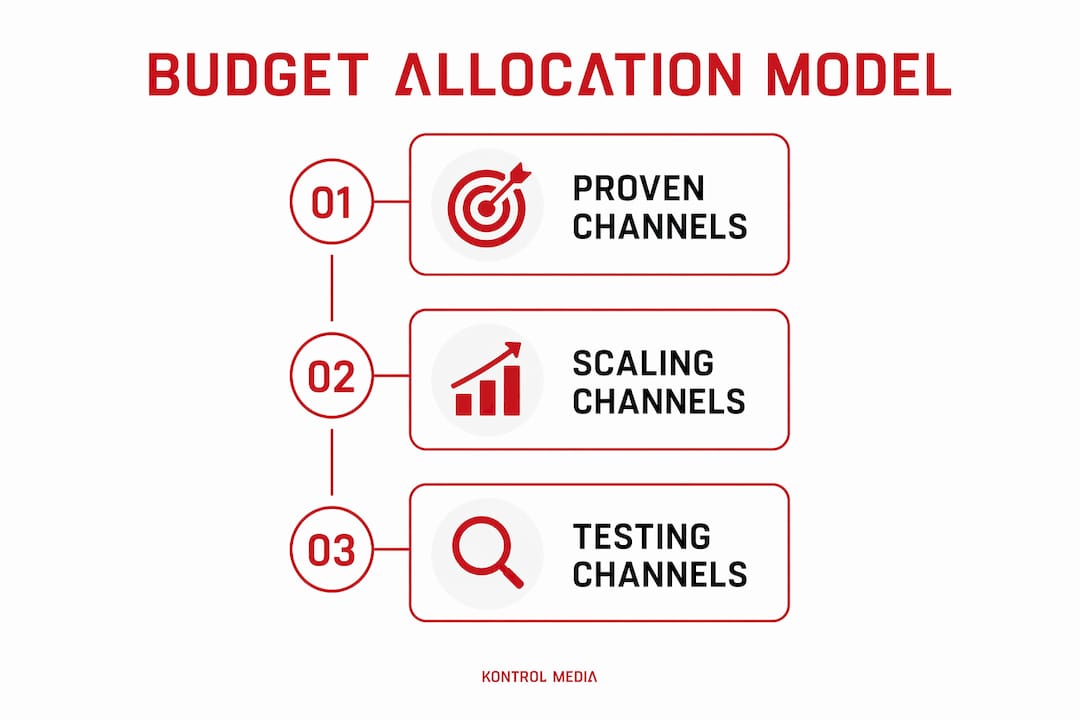
The 70/20/10 model is the most widely used framework. It directs 70% of budget to proven channels, 20% to scaling secondary channels, and 10% to experimental testing. This structure protects against channel fatigue, which is the gradual erosion of performance when audiences see the same ads in the same places too often. The 10% testing budget is not optional. It is how you find your next 70%.
For growth-stage businesses, a more aggressive split makes sense. The recommended 2026 allocation for growth companies is 40–50% to performance-driven advertising, 20–30% to brand equity, 15–20% to organic content growth, and 10–15% to new audience testing. This framework acknowledges that performance marketing drives near-term revenue while brand investment compounds over time. Cutting brand spend to chase short-term numbers is a trap that takes years to recover from.
Here is a practical process for building your budget plan:
- Define your advertising role first. Is this campaign driving awareness, generating leads, or reactivating lapsed customers? Each role requires a different channel mix and success metric.
- Map your funnel stages. Assign budget percentages to upper, mid, and lower funnel activity based on where your biggest growth opportunity sits.
- Identify your proven channels. These get the majority of your budget. Do not experiment with money that needs to perform.
- Allocate your testing budget. Pick one or two new channels or formats to test each quarter. Document your hypothesis before you spend.
- Set a reallocation cadence. Review performance weekly for in-flight campaigns and quarterly for strategic shifts.
Pro Tip: Treat your budget plan as a testable hypothesis, not a fixed commitment. Write down what you expect each channel to deliver before the campaign launches, then compare actuals against that prediction. The gap between expectation and reality is where your best optimization insights live.
Diversification also protects you from platform risk. Brands that concentrated spend on a single social platform in recent years learned this the hard way when algorithm changes and policy shifts wiped out performance overnight. Spread your paid media campaigns across at least three channels to build resilience.
Step-by-step process to execute paid media campaigns effectively
Execution is where most campaigns either gain traction or quietly fall apart. A clean process prevents the most common failure points.
Step 1: Map your audience to funnel stages. Before you touch a platform, define who you are reaching and where they are in the buying journey. A prospect who has never heard of your brand needs different messaging and inventory than someone who visited your pricing page last week.
Step 2: Select channels based on audience behavior, not habit. The channel you used last year is not automatically the right channel this year. Social media advertising on platforms like Meta, LinkedIn, and TikTok reaches different audiences with different intent signals. Match the channel to the audience, not to your comfort level.

Step 3: Negotiate and activate your inventory. For programmatic, set your targeting parameters, bid strategies, and frequency caps before launch. For direct deals, negotiate CPMs, placement specs, and performance guarantees in writing. Verbal agreements in media buying are a liability.
Step 4: Set your measurement framework before the campaign goes live. Decide which metrics define success. Revenue, cost per acquisition, and return on ad spend are business outcomes. Click-through rate and impressions are signals, not results. Focusing on business outcomes rather than vanity metrics is what separates effective buyers from busy ones.
Step 5: Monitor and optimize in real time. Check campaign pacing daily in the first week. Watch for delivery issues, frequency spikes, and underperforming placements. Shift budget toward what is working without waiting for the campaign to end.
| Campaign Phase | Key Actions | Metrics to Watch |
|---|---|---|
| Pre-launch | Audience mapping, deal negotiation, creative QA | N/A |
| Launch week | Pacing checks, frequency monitoring | Delivery rate, CPM |
| Mid-flight | Budget reallocation, creative rotation | CPA, ROAS, CTR |
| Post-campaign | Attribution analysis, learnings documentation | Revenue, ROI |
Pro Tip: Build a creative rotation schedule into every campaign brief. Running the same ad unit for more than three weeks without a refresh is the fastest way to accelerate audience fatigue and inflate your cost per result.
How to measure and optimize media buying performance for better ROI
Measurement is the discipline that turns a media buy into a learning system. Without it, you are just spending money and hoping.
The most important shift in measurement thinking is moving from channel metrics to business outcomes. Advertisers spent $57 billion on location-targeted campaigns in 2025, and nearly 90% of consumers prefer personalized ads. That level of investment demands accountability beyond impressions and clicks. Your CFO does not care about your click-through rate. They care about revenue per dollar spent.
Key metrics worth tracking by channel type:
- Performance channels (paid search, paid social): Cost per acquisition, return on ad spend, conversion rate by audience segment
- Brand channels (display, video, audio): Brand lift, search volume uplift, view-through attribution
- Direct deals and sponsorships: Share of voice, audience quality scores, engagement rate benchmarks
- Programmatic: Win rate, bid landscape data, invalid traffic percentage
Dynamic budget reallocation is the operational practice that compounds your results over time. Map consumer intent to funnel stages and reallocate budgets weekly rather than waiting for a campaign to end before making changes. A channel that is underperforming in week two is unlikely to recover by week eight without intervention.
Testing creative and audience combinations systematically is equally important. Run A/B tests on ad copy, visual formats, and audience segments with enough budget to reach statistical significance. Document every test result. Over time, this library of learnings becomes a competitive advantage that no competitor can easily replicate.
Finally, combine automated bidding with human oversight. Platforms like Google Ads and The Trade Desk offer smart bidding algorithms that optimize toward your stated goal. These tools are powerful, but they need guardrails. Set target CPA or ROAS floors, exclude low-quality inventory manually, and review automated decisions weekly. Automation without oversight is how budgets disappear into poor-quality placements.
Key Takeaways
Effective media buying requires a clear separation of strategy from execution, a disciplined budget framework, and a measurement system anchored in business outcomes rather than platform metrics.
| Point | Details |
|---|---|
| Separate planning from buying | Media planning sets strategy; media buying executes it. Conflating the two wastes budget and blurs accountability. |
| Use programmatic and direct deals together | Programmatic delivers scale; direct deals secure premium, brand-safe inventory that open auctions cannot match. |
| Apply a structured budget framework | The 70/20/10 model or a 40–50% performance split protects against channel fatigue and funds ongoing testing. |
| Measure business outcomes, not vanity metrics | Track cost per acquisition, ROAS, and revenue impact. Click-through rates are signals, not success measures. |
| Reallocate budgets dynamically | Review performance weekly and shift spend toward what is working rather than waiting for campaigns to end. |
Where media buying is heading and what I think you should do about it
I have spent years watching brands treat media buying as a procurement exercise rather than a strategic capability. The ones that win consistently do something different. They treat every campaign as a structured experiment, document their hypotheses, and build institutional knowledge from every dollar they spend.
The privacy shift is real and it is accelerating. Third-party cookie deprecation, signal loss on mobile, and tightening data regulations are making audience targeting harder across the open web. The brands that invested early in first-party data infrastructure, direct publisher relationships, and contextual targeting are now sitting on a genuine advantage. The ones that relied entirely on behavioral targeting through open programmatic are scrambling.
My honest observation is that most mid-market brands underinvest in the human side of media buying. They buy software and assume the platform will do the work. But the best results come from blending automated bidding with experienced negotiators who can secure private marketplace deals and direct inventory that algorithms never touch. That human layer is not a cost center. It is a margin driver.
I also think the 70/20/10 framework is underused by growth companies that should know better. Concentrating 80% or more of spend on one or two channels feels efficient until the platform changes its algorithm or a competitor floods your auction. Diversification is not a hedge. It is a growth strategy.
If I were advising a marketing team today, I would tell them to write down what they expect from every channel before they spend a dollar. Then compare that expectation to reality every single week. The gap between what you predicted and what happened is the most valuable data you have. Most teams never collect it.
— Mark Kapczynski
How Kontrol Media can help you build a stronger media buying strategy
Kontrol Media works with marketing teams and business owners who are serious about turning ad spend into measurable growth. From comprehensive business strategy to hands-on campaign execution, the team brings structure to the parts of media buying that most organizations leave to chance. That includes budget framework design, channel selection, publisher deal negotiation, and ROI measurement that connects campaign performance to actual revenue. Clients like Experian, BuzzFeed, and West Monroe have worked with Kontrol Media to regain visibility and drive customer acquisition with clarity and precision. If your current approach to paid media feels reactive, a focused strategy conversation is the right starting point.
FAQ
What is the difference between media buying and media planning?
Media planning is the strategic process of identifying which channels, audiences, and timing will achieve your advertising goals. Media buying is the tactical execution of purchasing that inventory at the right price and placement.
How does programmatic media buying work?
Programmatic buying uses automated platforms and real-time bidding to purchase ad impressions across digital inventory at scale. Demand-side platforms like The Trade Desk or Google DV360 evaluate and bid on impressions in milliseconds based on your targeting and budget parameters.
What budget allocation model works best for paid media campaigns?
The 70/20/10 model allocates 70% to proven channels, 20% to scaling secondary channels, and 10% to testing new ones. Growth-stage businesses may shift toward a 40–50% performance-first split to drive near-term revenue while maintaining brand investment.
What metrics should I track to measure media buying performance?
Track cost per acquisition, return on ad spend, and revenue impact as primary business outcomes. Use click-through rate, view-through attribution, and brand lift as supporting signals, not as primary success measures.
How do direct deals differ from open programmatic buying?
Direct deals involve negotiating inventory directly with publishers, offering guaranteed placements, brand-safe environments, and pricing certainty. Open programmatic auctions offer scale and efficiency but cannot guarantee the same inventory quality or contextual alignment.
Recommended
- Advertiser Acquisition Strategies for Media Networks in 2026 | Kontrol Media Consultancy
- The Shift in Advertising Spend – How Retail Media Networks Are Changing the Game | Kontrol Media Consultancy
- Retail Media Ad Sales: Strategic Guide for Marketing Pros in 2026 | Kontrol Media Consultancy
- Consumer Brand Media Network Best Practices in 2026 | Kontrol Media Consultancy