


Most marketing professionals and business strategists treat market research as a step in the process. Something you do before a launch, then move on from. That framing costs organizations enormously. Understanding how market research supports strategy means recognizing it as the spine of every meaningful business decision, not a checkbox activity. The organizations that get this right are 2.5x more likely to make faster, higher-quality decisions than those relying on sporadic intelligence. This article breaks down why, and more importantly, how to put that into practice.
Table of Contents
- Key takeaways
- How market research supports strategy development
- Why market research reduces strategic risk
- Building a research process that actually feeds strategy
- Aligning strategy with marketing through research
- The measurable impact of research on business outcomes
- My take on why research stays underutilized
- How Kontrol Media helps you turn research into results
- FAQ
Key takeaways
| Point | Details |
|---|---|
| Research shapes decisions, not just data | Market research reduces strategic risk by surfacing hidden assumptions before large investments are made. |
| Scope your questions first | Framing research around specific strategic decisions dramatically improves the usefulness of your findings. |
| Qualitative and quantitative work together | Combining both methods validates audience patterns and uncovers emotional motivations that numbers alone miss. |
| Strategy and tactics need different research | Market research defines where to compete; marketing research informs how to promote and price. |
| Formal processes outperform ad hoc efforts | Structured market analysis raises new market entry success rates by 67% compared to unplanned approaches. |
How market research supports strategy development
Market research is the systematic process of gathering, analyzing, and interpreting information about a market, its buyers, competitors, and the broader forces shaping demand. It encompasses both qualitative methods (interviews, focus groups, ethnographic observation) and quantitative approaches (surveys, transaction data, third-party analytics). Neither approach alone tells the full story.
What confuses many teams is the distinction between market research and marketing research. They sound almost identical, but they serve different masters. Market research operates at the macro level. It answers questions like: Is there sufficient demand here? Who else is competing for this space? What do customers actually value? Marketing research, by contrast, zooms in on execution. It informs messaging, pricing tests, and channel performance. Both disciplines serve different strategic roles, and conflating them leads to strategic plans built on the wrong foundation.
The role of market analysis in planning is to reduce the gap between what leadership believes is true and what the market actually reflects. A company might assume its product appeals to mid-market buyers, only to discover through research that its strongest demand signal comes from enterprise procurement teams. That insight changes the go-to-market model entirely. Without research feeding strategy, you are making expensive assumptions and calling them plans.

| Dimension | Market research | Marketing research |
|---|---|---|
| Focus | Macro: market size, demand, competitors | Micro: campaign performance, pricing, messaging |
| Strategic role | Defines “where to compete” and “what to sell” | Informs “how to promote” and at what price |
| Time horizon | Long-term strategic planning | Short to medium-term tactical optimization |
| Primary output | Market entry decisions, segmentation, positioning | Campaign briefs, A/B test results, pricing models |
Why market research reduces strategic risk
The most compelling case for embedding research into your strategy process is cost avoidance. Research before launch is significantly less costly than correcting a misaligned strategy after you have spent your budget. That is not a hypothetical. It plays out in product launches, market expansions, and brand repositioning projects repeatedly.
Here is what good market research actually does for strategy:
It surfaces hidden risks before they become visible problems. Leadership teams frequently carry assumptions about customer willingness to pay, competitive intensity, or channel preferences that research exposes as flat-out wrong. The cost of being wrong compounds quickly when those assumptions are baked into a 12-month plan.
It maps the competitive landscape with precision. This means going beyond direct competitors to reveal indirect competitors and substitutes, surfacing the real objections customers raise, and identifying the value thresholds that drive switching behavior. That level of detail is what separates a positioning strategy that holds from one that falls apart under pressure.
It identifies underserved segments. When you are evaluating a new geography or vertical, research identifies acquisition barriers and unmet demand signals that are invisible in aggregate data. A retail brand entering a new regional market, for example, might discover through interviews and local survey work that its pricing model is mismatched to local income distributions, something a top-down market sizing exercise would never catch.
It does not eliminate uncertainty. That is the honest truth. But market research makes risks visible and manageable, so your team proceeds with evidence rather than hope.
Pro Tip: When briefing a research project, write down the three decisions you will make differently if the results come back a certain way. If you cannot name those decisions, your research is not scoped tightly enough to be useful.
Building a research process that actually feeds strategy
The biggest failure mode in market research is not poor methodology. It is poor scoping. Treating research as a deliverable report rather than an input to a specific decision is how findings end up in a shared drive, unread, two months after the strategy was already set. The process below changes that.
Start with the strategic question, not the research method. Before you commission a survey or schedule focus groups, articulate the decision you are trying to inform. “We need to understand the market” is not a strategic question. “We need to know whether our current pricing is creating friction in the mid-market segment” is one.
Match methods to the question. Combining qualitative and quantitative methods leads to stronger findings because each approach compensates for the other’s blind spots. Qualitative research uncovers motivation and context. Quantitative research tells you how widespread those motivations are. Use both when stakes are high.
Build research into the planning calendar, not just pre-launch. Markets evolve. Competitors move. Consumer behavior shifts. A resilient business strategy treats research as an ongoing function rather than a project with a start and end date.
Translate findings into decisions. Research outputs need a clear owner and a direct line to a strategic choice. If your customer segmentation study does not change how you allocate budget or prioritize product features, something broke down between insight and action.
Pressure-test assumptions in the research brief. List your team’s existing beliefs before the research begins. Use the findings to confirm, refine, or challenge them explicitly. This prevents confirmation bias from filtering what gets heard.
Pro Tip: The framing of your research questions around specific strategic decisions dramatically improves the value you extract. A question like “What do customers want?” produces interesting reading. A question like “What would cause our target segment to switch from their current provider?” produces a competitive strategy.
Aligning strategy with marketing through research
Here is where many organizations leave significant value on the table. They treat market research and marketing research as separate workstreams owned by different teams, with findings that never cross-pollinate. The result is a strategy that knows where to compete but does not know how to show up effectively once it gets there.
The relationship between the two disciplines is genuinely complementary. Market research provides the macro view of “where to compete” and “what to sell.” Marketing research delivers the micro-level guidance on promotion and pricing. When both operate from a shared foundation, you get a marketing mix that is coherent from product definition through campaign execution.
Consider how this plays out in practice. A company conducting market research discovers a mid-sized professional services segment with unmet demand and weaker competitive presence. That finding shapes the strategy: build for this segment, price to their budget norms, and position around the service gaps competitors leave open. Marketing research then picks up the thread, testing which messaging resonates, which channels the segment actually uses, and what price sensitivity looks like in practice. The two streams of research form a closed loop rather than parallel tracks.
For a successful marketing mix, the product and distribution decisions need to be anchored in market research while pricing and promotional decisions draw on marketing research. That division of labor is not arbitrary. It reflects the different levels of certainty and time horizons each type of decision requires.
The integration also matters for persona development. Broad segmentation from market research gives you the structural categories. Qualitative research on attitudes, motivations, and friction points gives those personas weight and credibility. The combination produces personas that inform business development opportunities rather than just sitting in a brand guidelines document.
The measurable impact of research on business outcomes
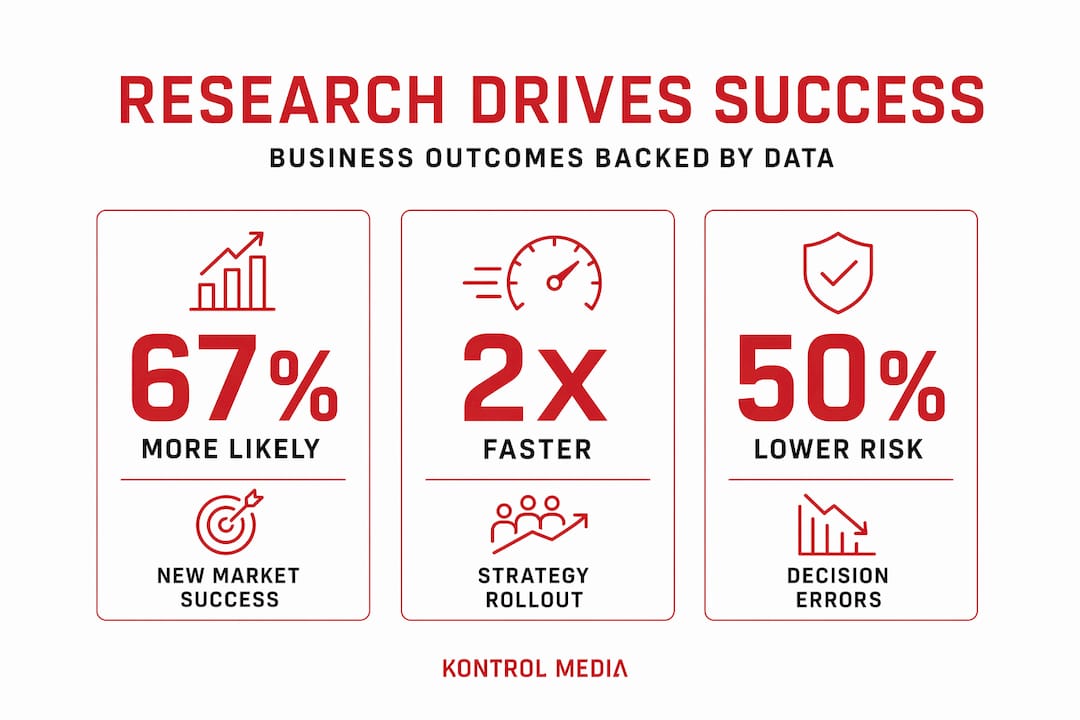
The numbers make a strong case on their own. Organizations using structured market analysis are 67% more likely to succeed when entering new markets compared to those without a formal research process. That is not a marginal edge. It is the difference between a calculated expansion and a costly misfire.
| Outcome | Without formal research | With formal research |
|---|---|---|
| New market entry success | Baseline | 67% higher success rate |
| Decision-making speed and quality | Ad hoc, inconsistent | 2.5x improvement |
| Cost of strategy correction | High (post-launch fixes) | Low (pre-investment alignment) |
| Competitive positioning | Assumption-based | Evidence-based and pressure-tested |
The financial logic is straightforward. Research investment is a fraction of the cost of executing a strategy built on bad assumptions. When a product team spends six months building toward a price point the market will not support, or when a market entry plan overlooks a dominant local incumbent, the correction is expensive. Earlier research prevents that entirely.
The impact of market research on strategy also shows up in resource allocation. When you know which segments represent real demand versus speculative opportunity, budget flows to higher-probability bets. That discipline, compounded across multiple planning cycles, creates a meaningful advantage over competitors operating on gut instinct and internal consensus.
My take on why research stays underutilized
I have watched organizations do everything right on the research side and still walk away without changing their strategy. The data was solid. The analysis was thorough. And then the executive team nodded, said “interesting,” and proceeded with what they had already decided to do.
That is the real problem, and it is not a research problem. It is a process problem. Research findings need to be connected to a specific decision owner and a specific choice point in the planning process. When they arrive as a presentation to an already-committed team, they function as decoration rather than direction.
What I have found actually works is integrating the research framing into the strategy brief from the beginning. Before the research is even commissioned, the team agrees on what decisions hinge on the findings. That agreement creates accountability. It makes it harder to ignore inconvenient results because the connection between the findings and the decision was made explicit in advance.
I am also candid about the tension between rigorous research and business agility. Markets move fast, and sometimes you cannot wait six weeks for a full study. That is real. But the answer is not to skip research. It is to get sharper about what minimum-viable research looks like for a given decision. A two-week qualitative sprint with a dozen customer interviews is vastly better than relying on last quarter’s assumptions.
Treat research as an operational system. Build it into the rhythm of planning. The organizations that use data analytics and market intelligence as a continuous function outperform those that treat it as a project. That is not idealism. It is what the data on effective decision-making consistently shows.
— Mark Kapczynski
How Kontrol Media helps you turn research into results
At Kontrol Media, we work with marketing leaders and business strategists who have good instincts but need the market intelligence and structured thinking to back those instincts up with execution. Our approach starts exactly where good strategy starts: with rigorous research translated directly into decisions.
Whether you are crafting a marketing strategy from the ground up, pressure-testing a market entry plan, or trying to understand why your current positioning is not converting, our team brings the analytical depth and executional muscle to move from insight to outcome. We have done it for organizations including Experian, REMAX, and BuzzFeed, among others.
We also help you measure the ROI of your marketing campaigns so research informs not just strategy but proof of performance. If you are ready to build strategy on something more reliable than assumptions, let us talk.
FAQ
What is the core role of market research in strategy?
Market research gives strategy its factual foundation by validating assumptions, mapping competitive landscapes, and identifying real customer demand before major investments are committed.
How do market research and marketing research differ?
Market research addresses macro decisions like where to compete and what to build. Marketing research handles tactical questions about pricing, messaging, and channel performance.
What questions should you ask in market research for strategy?
Frame questions around specific decisions, such as “What would cause our target segment to switch providers?” rather than broad questions like “What do customers want?” Specificity drives usefulness.
How does research improve new market entry success?
Businesses with a formal market analysis process are 67% more likely to succeed in new market entry by identifying underserved segments and acquisition barriers before committing resources.
How often should organizations conduct market research?
Research should be an ongoing operational function, not a one-time project. Building research cycles into the planning calendar produces better strategy over time than conducting studies only before major launches.
Recommended
- Crafting an Effective Marketing Strategy: From Research to Execution | Kontrol Media Consultancy
- Unlocking Business Potential: Strategic Marketing and Consulting for Growth | Kontrol Media Consultancy
- Maximizing Business Growth: Strategies for Success | Kontrol Media Consultancy
- Strategies for Expanding Your Business into New Markets | Kontrol Media Consultancy