


Consumer brand media networks are defined as owned and allied content distribution systems that push brand messaging across multiple publisher channels to maximize reach, ROI, and direct consumer engagement. The industry term for this model is “retail and commerce media networks,” though marketing leaders increasingly use the broader phrase “brand media networks” to capture the full scope. The numbers behind why consumer brands build media networks are hard to ignore. Multi-publisher alliances deliver 3.2x broader reach and 4x higher ROI than single-outlet placements. That performance gap is why brands from Chobani to Unilever are restructuring their entire marketing operations around this model.
Why consumer brands build media networks
The core reason is control. Brands that own or operate media networks stop renting attention from third parties and start building audience assets they compound over time. This is not a tactical shift. The winning brands of 2026 treat their organization as a media company with audience assets at the center of every growth decision. That mindset change is structural, and it separates brands that grow from brands that plateau.
Traditional paid advertising operates on a pay-to-play model where reach disappears the moment spend stops. A media network, by contrast, generates earned media, organic search authority, and first-party data that accumulate with every piece of content distributed. Kontrol Media works with brands at exactly this inflection point, helping them move from transactional ad spend toward durable media infrastructure.
The competitive pressure is real. Strategic media alliances secure 70% more earned media impressions and 40% higher engagement than paid ads. Brands that do not build these networks are ceding category share to those that do.
How do media networks boost brand visibility?
Coordinated content distribution is the engine. When a brand syndicates content across national outlets, regional publishers, and niche verticals simultaneously, it captures share of voice at a scale no single placement can match. One media alliance distributing content across 16 news sites tripled organic search traffic within 90 days, generating 48 high-authority backlinks and improving keyword rankings by 25 positions on average. That is not a paid media result. That is compounding organic authority built through network distribution.

Multi-publisher alliances also enable personalized messaging at scale. Different outlets serve different audience segments, so a single campaign can speak to a first-time homebuyer through one regional publisher and a seasoned investor through a national financial outlet. Real-time consumer feedback from these channels feeds back into content strategy, tightening relevance with every cycle.
The technical backbone matters here. Centralized syndication technology using RSS feeds and API pipelines with canonical tags prevents duplicate content penalties while boosting site authority across every partner domain. This is the infrastructure layer most brands overlook when they think about media networks.
Pro Tip: When selecting media partners, prioritize geographic coverage gaps and audience demographic fit over raw traffic numbers. A regional outlet with a highly engaged local audience often outperforms a national outlet with broad but shallow reach for conversion-focused campaigns.
Media networks vs. traditional advertising: which wins?
The performance data is clear. Media networks deliver 4:1 returns versus traditional advertising’s 2:1, driven by native content integration and significantly lower ad-block exposure. Traditional display advertising faces a 30% ad-block rate. Media network content, distributed as editorial or native formats, largely bypasses that friction entirely.
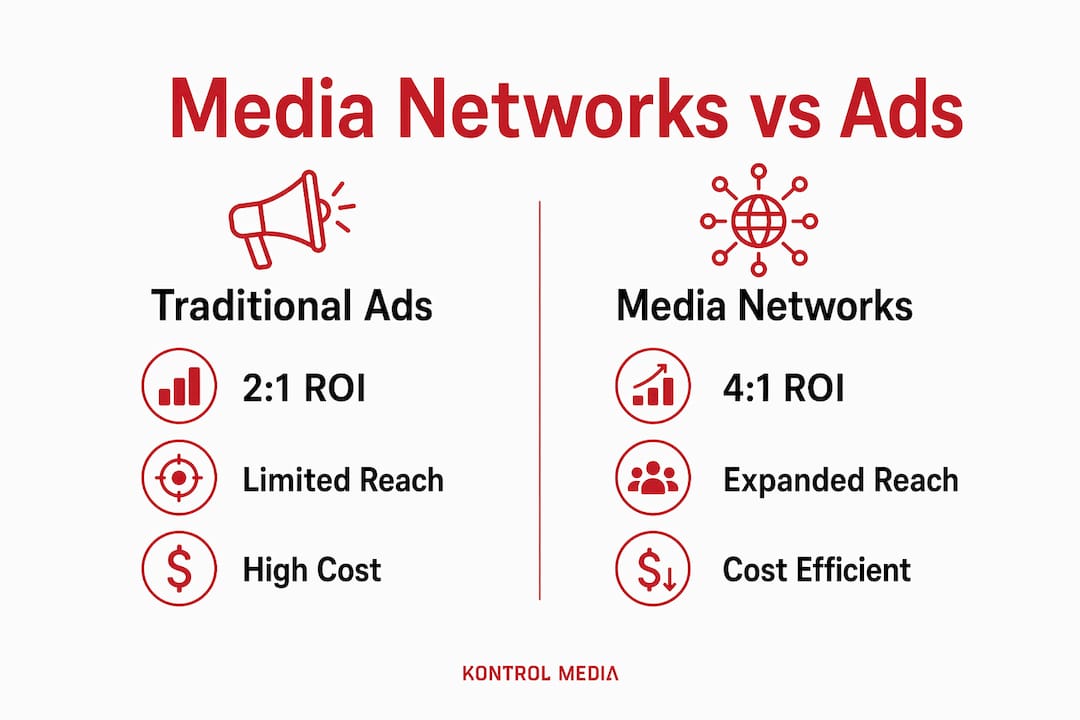
| Metric | Traditional Advertising | Media Network |
|---|---|---|
| ROI | 2:1 | 4:1 |
| Reach multiplier | 1x (baseline) | 3.2x broader |
| Click-through rate | Baseline | 15–20% higher |
| Customer acquisition cost | Baseline | Up to 42% lower |
| Earned media impressions | Baseline | 70% more |
The cookie deprecation reality makes this comparison even more stark. Traditional targeting relied on third-party cookies to identify and retarget audiences. That infrastructure is collapsing. Media networks built on first-party data and publisher relationships are not affected in the same way, because the audience relationship is direct and consensual.
Single-outlet placements also create concentration risk. One algorithm change, one publisher policy shift, or one audience migration can wipe out a campaign’s performance overnight. A distributed media network absorbs those shocks because no single node carries the full load.
Pro Tip: Run an incrementality test before fully committing budget to a media network build. Isolate a test market, run the network distribution model there, and compare customer acquisition cost and conversion rates against your control market running traditional placements. The data will make the business case internally far faster than any presentation.
What strategies do brands use to build media networks?
The most effective consumer brand media strategies follow a phased architecture. Brands that try to launch globally on day one almost always underinvest in the local relationships that make networks credible. The proven path runs from local to regional to global, with each tier adding publisher partners, data integrations, and content formats.
The foundational strategies break down into four areas:
- Form formal media alliances. Signed agreements with publisher partners define content rights, distribution terms, and performance expectations. Informal arrangements create ambiguity that erodes trust and performance over time.
- Integrate commercial teams. Unified teams spanning brand, trade, merchandising, and media convert every physical and digital touchpoint into a performance channel. Chobani demonstrated this by turning Walmart shelf space into a media channel through integrated team execution.
- Deploy centralized technology. API feeds, content management dashboards, and real-time analytics platforms allow brands to distribute, monitor, and optimize content across dozens of publisher partners without proportional headcount increases.
- Build creator ecosystems, not rosters. Consumers trust brands more when creators function as authentic storytellers rather than transactional reviewers. Unilever’s reach strategy demonstrated that authentic narrative integration increases brand lift and lowers advertising costs simultaneously.
The scaling phase is where most brands underestimate the opportunity. Scaling from one local partner to a global media network can increase lead volume by 450%, reduce cost per lead by 42%, and increase market penetration by 60%. Those numbers reflect what happens when the infrastructure is right and the partner relationships are managed actively.
Brands like Red Bull and BuzzFeed built in-house content studios years before the broader market caught on. The in-house entertainment studio model is now reaching mainstream adoption because the cost of content production has dropped while the value of owned audience relationships has risen sharply.
Pro Tip: Structure your media network partnerships in tiers. Tier one partners get exclusive content windows and co-branded placements. Tier two partners get standard syndication. Tier three partners get content access only. This tiering creates incentives for partners to perform and gives you negotiating leverage as the network grows.
How do you measure the impact of a brand media network?
The metrics that matter most are share of voice, engagement rate, organic search lift, and customer acquisition cost. Strategic media alliances enable brands to capture 60% or more share of voice in their category. That level of dominance accelerates market leadership by roughly 50% faster than traditional advertising timelines.
The measurement framework should track four layers:
- Impressions and reach: Total content views across all publisher partners, segmented by outlet tier and audience demographic
- Engagement and sentiment: Comments, shares, time-on-page, and sentiment scores from social listening tools like Brandwatch or Sprinklr
- Organic search performance: Keyword ranking movements, backlink acquisition rate, and domain authority changes tracked through platforms like Ahrefs or SEMrush
- Business outcomes: Conversion rates, sales lift by market, and customer acquisition cost compared to paid media benchmarks
The organic search multiplier is the metric most brands undervalue at the start. A well-structured media network does not just generate impressions. It builds a backlink profile that compounds search authority over months and years. The 48 high-authority backlinks generated by one 90-day media alliance campaign represent years of SEO value that paid advertising cannot replicate.
Cost efficiency at scale is the other underappreciated benefit. Shared infrastructure across a network of publisher partners means the marginal cost of reaching an additional audience segment drops significantly as the network grows. You are spreading fixed content production costs across an expanding distribution footprint.
Pro Tip: Use a real-time analytics dashboard that aggregates performance data from all publisher partners into a single view. Tools like Looker Studio or Tableau connected to your syndication API give you the signal speed to optimize content and partner allocation weekly rather than waiting for monthly reports.
Key takeaways
Consumer brands that build media networks consistently outperform those relying on single-outlet paid advertising across reach, ROI, engagement, and long-term search authority.
| Point | Details |
|---|---|
| ROI advantage is measurable | Media networks deliver 4:1 returns versus traditional advertising’s 2:1, with 3.2x broader reach. |
| Organic search compounds over time | One 90-day media alliance generated 48 backlinks and tripled organic traffic, a result paid ads cannot match. |
| Team integration drives results | Unifying brand, trade, merchandising, and media teams converts every touchpoint into a performance channel. |
| Scaling multiplies outcomes | Moving from one local partner to a global network can increase lead volume by 450% and cut cost per lead by 42%. |
| Creator authenticity is non-negotiable | Brands that integrate creators as storytellers rather than reviewers capture a measurable trust premium and lower ad costs. |
The shift i keep seeing in every boardroom
I have sat in enough strategy sessions with marketing leaders at companies like Experian, BuzzFeed, and Enthusiast Gaming to recognize a pattern. The brands that are winning right now are not the ones with the biggest ad budgets. They are the ones that made a decision, sometimes three or four years ago, to treat their brand as a media property rather than an advertiser.
That decision sounds philosophical until you see the numbers. A brand that owns its audience relationship does not panic when a platform changes its algorithm or when a major publisher raises rates. It has built something that belongs to it. The content, the backlinks, the first-party data, the creator relationships. These are assets on a balance sheet that most CFOs have not learned to value yet, but they will.
What I find genuinely encouraging is that the barrier to entry has dropped. You do not need Red Bull’s production budget to build a media network that performs. You need a clear content strategy, two or three strong publisher partnerships, and the organizational discipline to integrate your commercial teams around a shared distribution goal. The consumer brand media network best practices that were reserved for enterprise brands in 2020 are accessible to mid-market companies today.
The uncomfortable truth is that most brands are still buying attention they do not own. Every dollar spent on a platform that controls the audience relationship is a dollar that builds someone else’s asset. The brands I respect most have recognized this and started building their own spine. Not because it is trendy, but because it is the only model that compounds.
— Mark Kapczynski
How kontrol media helps brands build media networks
Kontrol Media builds, operates, and drives revenue for retail and commerce media networks. If you are a marketing leader or business executive ready to move from renting attention to owning audience assets, Kontrol Media brings the strategy and the execution together in one place.
From forming strategic media alliances to standing up a full retail or commerce media network, Kontrol Media has worked with brands including REMAX, West Monroe, and Enthusiast Gaming to build media infrastructure that delivers measurable growth. The process starts with a comprehensive business strategy that aligns your media network goals with your broader commercial objectives. Reach out to Kontrol Media to start that conversation.
FAQ
What is a consumer brand media network?
A consumer brand media network is an owned or allied system of content distribution channels that a brand controls to reach its audience directly. It includes publisher partnerships, syndication technology, creator relationships, and first-party data infrastructure.
How much ROI do media networks generate vs. traditional ads?
Media networks deliver 4:1 returns compared to traditional advertising’s 2:1, while also reducing customer acquisition costs by up to 42% through broader reach and native content integration.
How long does it take to see results from a media network?
One documented media alliance distributing content across 16 publisher sites tripled organic search traffic within 90 days and generated 48 high-authority backlinks. Results compound over time as the network scales.
What team structure do brands need to run a media network?
Effective media networks require unified commercial teams that span brand, trade, merchandising, and media functions. Siloed teams prevent the cross-channel coordination that makes media networks perform at their full potential.
Can mid-market brands afford to build a media network?
Yes. Scaling from a single local publisher partner to a broader network is a proven path that mid-market brands follow. Starting with two or three strong regional partnerships and centralized syndication technology keeps initial costs manageable while building the infrastructure for larger scale.
Recommended
- Consumer Brand Media Network Best Practices in 2026 | Kontrol Media Consultancy
- Advertiser Acquisition Strategies for Media Networks in 2026 | Kontrol Media Consultancy
- The Shift in Advertising Spend – How Retail Media Networks Are Changing the Game | Kontrol Media Consultancy
- Why Brands Belong in News | Kontrol Media Consultancy