


Marketing and sales misalignment is defined as the structural failure of two revenue-generating functions to share goals, definitions, and accountability. It is one of the most expensive and underdiagnosed problems in B2B organizations, and it is far more common than most leadership teams admit. Misalignment costs B2B companies approximately $1 trillion annually in wasted resources and lost revenue. Understanding why marketing strategies misalign with sales is the first step toward fixing a problem that quietly erodes pipeline, morale, and growth.
What are the core reasons for sales and marketing misalignment?
The reasons for sales and marketing misalignment almost always trace back to one structural reality: the two teams are measured on different things. Marketing tracks impressions, MQLs (marketing qualified leads), and campaign performance. Sales tracks pipeline, deal size, and closed revenue. When success looks different to each team, friction is not a personality problem. It is a design problem.
The most common causes break down into four categories:
Different KPIs and success definitions. Marketing fills the top of the funnel and reports on volume. Sales works the bottom and reports on quality. Neither metric is wrong, but without a shared definition of what a “good lead” looks like, the two teams will always be talking past each other. A marketing team celebrating 500 MQLs this quarter means nothing to a sales rep who closed only three of them.

Siloed communication and disconnected data. Separate CRMs and data systems create blind spots that make collaboration nearly impossible. When marketing cannot see which campaigns produce closed deals, and sales cannot see which content prospects consumed before the call, both teams operate on incomplete information. Decisions made from incomplete data tend to compound the original misalignment.
Conflicting customer definitions. Differing ideal customer profiles cause product demos, sales pitches, and marketing content to target entirely different buyers. A marketing team building content for a VP of Finance while sales pitches to a Director of Operations is not a coordination problem. It is a fundamental disagreement about who the customer is.
No shared SLAs or feedback loops. Without clear SLAs and joint accountability, marketing commits to lead volume and sales commits to deal closure, but neither side owns the full revenue outcome. Feedback from sales about lead quality rarely reaches marketing in a structured way, so the same misaligned campaigns run quarter after quarter.
Pro Tip: Run a joint audit once per quarter where both teams review the same five closed-lost deals together. The disagreements that surface in that room will tell you more about your misalignment than any dashboard.
How does misalignment create operational inefficiencies?
Misalignment between marketing and sales does not just create tension. It creates measurable drag on revenue operations. The inefficiencies show up in three specific places: lead handoffs, follow-up timing, and customer acquisition costs.
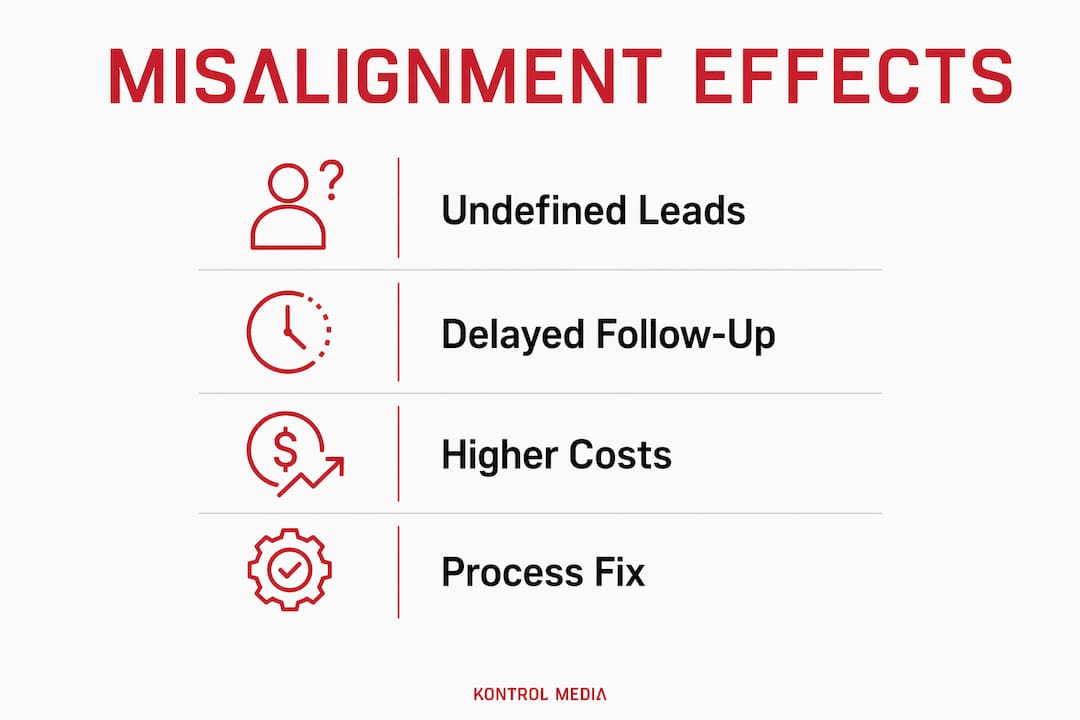
1. Undefined lead handoff criteria. When there is no agreed definition of a sales-ready lead, leads get dropped, recycled, or ignored. Sales reps receive contacts they consider unqualified and stop trusting the pipeline. Marketing sees low conversion rates and assumes sales is not working hard enough. Both conclusions are wrong, and both are predictable outcomes of an undefined process.
2. Delayed follow-up destroying conversion. A Harvard Business Review analysis of 2.24 million leads found that responding within five minutes versus thirty minutes produces a 21x difference in lead qualification rates. That gap exists in most organizations not because sales teams are slow, but because the handoff process itself introduces delay. A lead that sits in a queue waiting for manual review loses temperature fast.
3. Rising customer acquisition costs. When marketing runs campaigns without feedback from sales on which leads convert, spend accumulates in channels that look good on paper but produce poor revenue outcomes. The result is a steady increase in customer acquisition cost with no clear explanation. Organizations with poor alignment see 4% annual revenue decline on average, compared to 20% annual revenue growth at companies with strong alignment. That gap represents real money, not a theoretical benchmark.
The operational fix is not a new tool. It is a documented process. Shared lead definitions, agreed handoff criteria, and a feedback mechanism that routes sales outcomes back to marketing will resolve most of the inefficiency before any technology change is needed.
What impact does messaging inconsistency have on buyers and revenue?
Inconsistent messaging between marketing and sales is one of the most direct causes of stalled deals. Misaligned messaging across website, sales decks, demos, and case studies leads to procurement-stage confusion and delayed buyer decisions. A prospect who reads one value proposition on your website and hears a different one on a discovery call does not split the difference. They pause and reconsider.
The table below illustrates the most common messaging disconnects and their buyer-side impact:
| Touchpoint | Marketing message | Sales message | Buyer impact |
|---|---|---|---|
| Website homepage | “Platform for enterprise teams” | “Works great for SMBs too” | Buyer questions product fit |
| Case studies | Cost savings focus | Efficiency and speed focus | Buyer unsure which benefit applies |
| Demo | Feature-led walkthrough | ROI-led conversation | Buyer confused about product purpose |
| Proposals | Brand-level positioning | Deal-specific customization | Inconsistent perceived value |
The damage here is not just lost deals. It is eroded trust. Buyers who experience conflicting narratives from the same company begin to question whether the organization understands its own product. That doubt is very difficult to recover from in a competitive sales cycle. Building a unified messaging framework that both teams contribute to and agree on is the single most direct way to close this gap.
Which frameworks effectively align marketing and sales teams?
Alignment between marketing and sales does not happen through good intentions. It happens through documented agreements, shared metrics, and recurring rituals that keep both teams calibrated. The frameworks that work in practice share three characteristics: they are written down, they assign clear ownership, and they are reviewed regularly.
Shared ideal customer profiles (ICPs). A written ICP that both teams co-create and sign off on eliminates the most common source of misalignment at the source. The ICP should specify industry, company size, role, pain points, and disqualifying factors. When marketing builds content and sales builds pitches from the same document, the buyer experience becomes coherent.
Service-level agreements with accountability. An SLA with measurable commitments specifies lead quality thresholds, follow-up timelines, and documented rejection reasons. This is not a bureaucratic exercise. It is the mechanism that replaces finger-pointing with facts. Marketing knows exactly what sales expects, and sales knows exactly what marketing will deliver.
Aligned funnel stages and handoff criteria. Every stage of the funnel, from MQL to SQL to opportunity, should have a written definition that both teams agree on. Handoff criteria should specify what data must be present before a lead moves from marketing to sales. This eliminates the ambiguity that causes leads to fall through the cracks.
Joint meetings and shared dashboards. Alignment is not a one-time project. It requires recurring contact. Weekly or biweekly smarketing meetings (a term Salesforce and HubSpot both use to describe joint sales-marketing sessions) keep both teams aware of what is working and what is not. A shared dashboard that surfaces both marketing pipeline contribution and sales conversion rates gives both teams a common view of reality.
Pro Tip: When you build your first shared dashboard, include one metric that neither team currently tracks: revenue influenced by marketing content at each deal stage. That single addition changes how sales perceives marketing’s contribution.
Aligning marketing and sales around shared revenue goals, rather than departmental metrics, is the structural shift that makes all of these frameworks stick. When both teams are accountable to the same number, the incentive to collaborate becomes self-reinforcing.
The payoff is significant. 25% of sales professionals report an immediate improvement in lead quality when tighter coordination is achieved. That improvement does not require a new technology platform. It requires a shared definition of what good looks like.
Key takeaways
Sales and marketing misalignment is a structural problem that requires documented agreements, shared metrics, and recurring collaboration to resolve.
| Point | Details |
|---|---|
| Misalignment has a price tag | B2B organizations lose approximately $1 trillion annually to misaligned sales and marketing functions. |
| Different KPIs drive the core problem | Marketing optimizes for lead volume while sales optimizes for deal quality, creating built-in friction without shared definitions. |
| Speed of follow-up is a process issue | A 21x difference in qualification rates exists between five-minute and thirty-minute lead responses, driven by handoff delays. |
| Messaging inconsistency stalls deals | Conflicting narratives across website, demos, and proposals erode buyer trust at the procurement stage. |
| SLAs create accountability | Written service-level agreements with measurable commitments replace blame cycles with structured, shared ownership of revenue outcomes. |
What I’ve learned from watching alignment fail in real time
I have sat in rooms where the VP of Marketing and the VP of Sales were both convinced the other team was the problem. And honestly, they were both right. That is the uncomfortable truth about sales and marketing misalignment. It is rarely one team’s fault, but it almost always becomes one team’s problem to own.
What I have found, working with organizations from Experian to West Monroe, is that the companies who solve this fastest are not the ones with the best technology or the most sophisticated attribution models. They are the ones willing to get into a room together and agree on a definition. What is a qualified lead? Who is our ideal customer? What does a good handoff look like? Those conversations are uncomfortable because they expose assumptions that have been operating unchallenged for years.
The instinct is to fix alignment with a new CRM or a shared Slack channel. Neither works without the process underneath it. A shared tool with a broken process just makes the broken process more visible. The organizations that sustain alignment treat it as an operating discipline, not a project with a finish line. They review their SLAs quarterly, they run joint pipeline reviews, and they measure marketing’s contribution to closed revenue, not just to top-of-funnel volume.
Leadership buy-in is not optional here. If the CMO and CRO are not aligned on what success looks like, no amount of smarketing meetings will compensate. The tone gets set at the top, and it filters down fast. I have seen alignment initiatives collapse within ninety days because leadership reverted to siloed incentive structures the moment a quarter got difficult. The fix is not more meetings. It is making shared revenue the metric that both leaders are evaluated on.
— Mark Kapczynski
How Kontrol Media helps organizations close the alignment gap

At Kontrol Media, we work directly with marketing and sales teams to identify where their strategies are pulling in different directions and build the frameworks that bring them back into sync. That means co-creating ICPs, drafting SLAs with real accountability, and aligning funnel definitions so both teams are working from the same playbook. We do not hand over a deck and walk away. We stay in the execution alongside you. If your organization is ready to stop leaving revenue on the table, start with a comprehensive business strategy that treats sales and marketing as one revenue function. You can also explore our thinking on building effective marketing strategies that are built to support sales from the ground up.
FAQ
Why do marketing strategies misalign with sales goals?
Marketing strategies misalign with sales goals primarily because the two teams are measured on different KPIs. Marketing optimizes for lead volume and campaign performance, while sales optimizes for deal quality and closed revenue, creating structural friction without shared definitions or accountability.
What does sales and marketing misalignment cost?
B2B misalignment costs organizations approximately $1 trillion annually in wasted resources and lost revenue. Companies with poor alignment also experience an average 4% annual revenue decline compared to 20% growth at aligned organizations.
What is the fastest way to improve sales and marketing alignment?
The fastest improvement comes from establishing a written, co-created ideal customer profile and a service-level agreement that specifies lead quality thresholds, follow-up timelines, and rejection criteria. These two documents eliminate the most common sources of friction before any technology change is needed.
How do SLAs help resolve marketing and sales gaps?
A service-level agreement creates mutual accountability by specifying exactly what marketing will deliver and what sales will do with those leads, including follow-up timelines and documented reasons for rejection. This replaces blame cycles with a structured, measurable process that both teams own.
How does messaging inconsistency affect buyers?
When buyers encounter conflicting value propositions across a company’s website, sales calls, and proposals, they lose confidence in the vendor and delay or abandon purchase decisions. Unified messaging frameworks, built collaboratively by marketing and sales, prevent this trust erosion at the procurement stage.
Recommended
- Align Marketing and Sales to Hit Revenue Goals | Kontrol Media Consultancy
- Building a High-Performing Sales Team: Strategies and Best Practices | Kontrol Media Consultancy
- Crafting an Effective Marketing Strategy: From Research to Execution | Kontrol Media Consultancy
- Your Sales Function, Without the Headcount | Kontrol Media Consultancy