


For purchase-driven campus moments and sampling-led activation, Follett Media Network typically beats broad traditional media on cost efficiency and measurable conversion. For mass-news reach or general brand fame, TV, radio, and out-of-home still carry weight. The right call depends on where in the funnel you’re trying to win, and the evidence below breaks that down by objective, not by preference.
TL;DR:
- Follett Media Network excels at driving trial and purchase in campus retail environments through sampling, point-of-sale inserts, and targeted digital follow-up, with measurable transaction signals.
- Traditional media remains effective for broad awareness and brand recognition across larger regions, especially through television, radio, and out-of-home formats, but struggles with direct attribution and engaging the 18 to 24 demographic.
- Campaign timing is critical; Follett’s model benefits from aligning with the academic calendar, leveraging spikes around move-in, midterms, and finals, and requires six to eight weeks of lead time for logistics.
- Measuring success requires clear KPIs such as foot traffic lift, sampling engagement, and transaction redemptions, with location-level data preferred for optimizing future campaigns.
- Selecting the right channel depends on the objective: use campus retail for conversion-focused efforts and traditional media for broad awareness, with a combined approach often delivering the best overall results.
Table of Contents
- Traditional Media vs. Follett Media Network to Reach College Students: The Quick Comparison
- What Is Follett Media Network and How Do Campaigns Run?
- Which Traditional Media Channels Still Reach College Students?
- How Do College Students Actually Consume Media Today?
- How Do These Channels Perform by Funnel Stage?
- What KPIs Should Marketers Demand From Each Channel?
- How Do You Choose the Right Channel Mix?
- What Kontrol Media Has Learned Running Campus Retail Programs
- What Does Campus Retail Media Cost Compared to Traditional Buys?
- The Real Choice Isn’t Traditional vs. Campus Retail
- Sources
- FAQ
Traditional Media vs. Follett Media Network to Reach College Students: The Quick Comparison
I’ve watched marketers pour six-figure budgets into campus outreach and then argue for weeks about which channel actually moved the needle. The honest answer is that Follett Media Network and traditional media aren’t really competing for the same job. One wins trust and volume; the other wins the moment a student is standing in line with a debit card out.
Follett Media Network’s strengths:
- Reaches students inside campus bookstores and retail environments where purchase intent is already high.
- Sampling programs put product directly into a student’s hands, which on-campus activations consistently outperform many digital-only formats for driving research and purchase behavior.
- Operates inside a retail setting students already trust, rather than interrupting a feed or a commute.
- Delivers transaction-level signals (redemptions, foot traffic, email opt-ins) that most mass-media buys can’t produce.
Traditional media’s strengths:
- Still commands the largest share of political and current-events attention among U.S. adults overall, with 35% citing television as their top source for election news.
- Builds broad brand recognition across a wide non-campus audience, useful when a campaign needs to reach parents, alumni, or a metro area beyond one school.
- Print and broadcast formats carry an institutional credibility that newer channels haven’t fully replicated.
- Works at regional or national scale without needing campus-by-campus logistics.
Where each one falls short: Follett’s network is inherently local to participating campuses, so it can’t deliver the geographic sprawl of a national TV buy. Traditional media, meanwhile, struggles specifically with the 18 to 24 demographic, who consume far less appointment television and print than older cohorts. If your objective is “build category awareness across a state,” lean traditional. If it’s “get 500 students to try a product this month,” lean campus retail.
What Is Follett Media Network and How Do Campaigns Run?
Follett Media Network positions itself as a campus retail media network that combines in-store, digital, email, and sampling to reach students across the college bookstores and retail locations it operates. That combination matters more than any single channel in the mix. A poster in a bookstore window does little alone; paired with a sampling table and a follow-up email to opted-in students, it becomes a sequence rather than an impression.
The channel inventory typically includes:
- In-store signage and displays placed at checkout counters, entrances, and high-traffic aisles inside campus retail locations.
- Sampling programs where representatives or ambassadors hand out product samples, coupons, or trial-size offers during peak foot-traffic windows.
- Bag inserts that ride along with a student’s actual purchase, guaranteeing a physical touchpoint after the transaction.
- Campus digital screens running video or static creative in high-visibility retail zones.
- Email programs targeting students who’ve opted in at the register or through a campus portal.
- Event sponsorships tied to move-in weekend, welcome week, homecoming, or finals week giveaways.
Timing is where Follett’s model diverges most sharply from a traditional media flight. Campus retail traffic isn’t steady. It spikes hard around move-in, the first week of classes, midterms, and finals, then flattens during breaks. A campaign that ignores that rhythm wastes a large share of its budget on empty foot traffic. Brands that plan around the academic calendar, rather than a generic quarterly flight, see materially better sampling engagement because they’re showing up when students are actually walking through the store.
Deliverables partners typically request from a campus retail engagement include a defined sampling window (often two to four weeks), a reporting package on impressions and redemptions, and a follow-up digital retargeting plan for anyone captured through email or app-based opt-in. That last piece is often skipped by brands new to campus media, and it’s the single biggest lever for turning a one-time sample into a repeat customer. Sequencing an in-store moment with a digital retargeting push afterward is a pattern documented in Kontrol Media’s own campus advertising work, and it consistently outperforms a standalone sampling event.
One operational detail marketers underestimate: campus retail logistics require lead time. Booking sampling staff, coordinating with store management, and printing custom signage for a specific school’s bookstore branding isn’t something you finalize two weeks before launch. Plan a minimum six to eight week runway before your target activation date.
Which Traditional Media Channels Still Reach College Students?
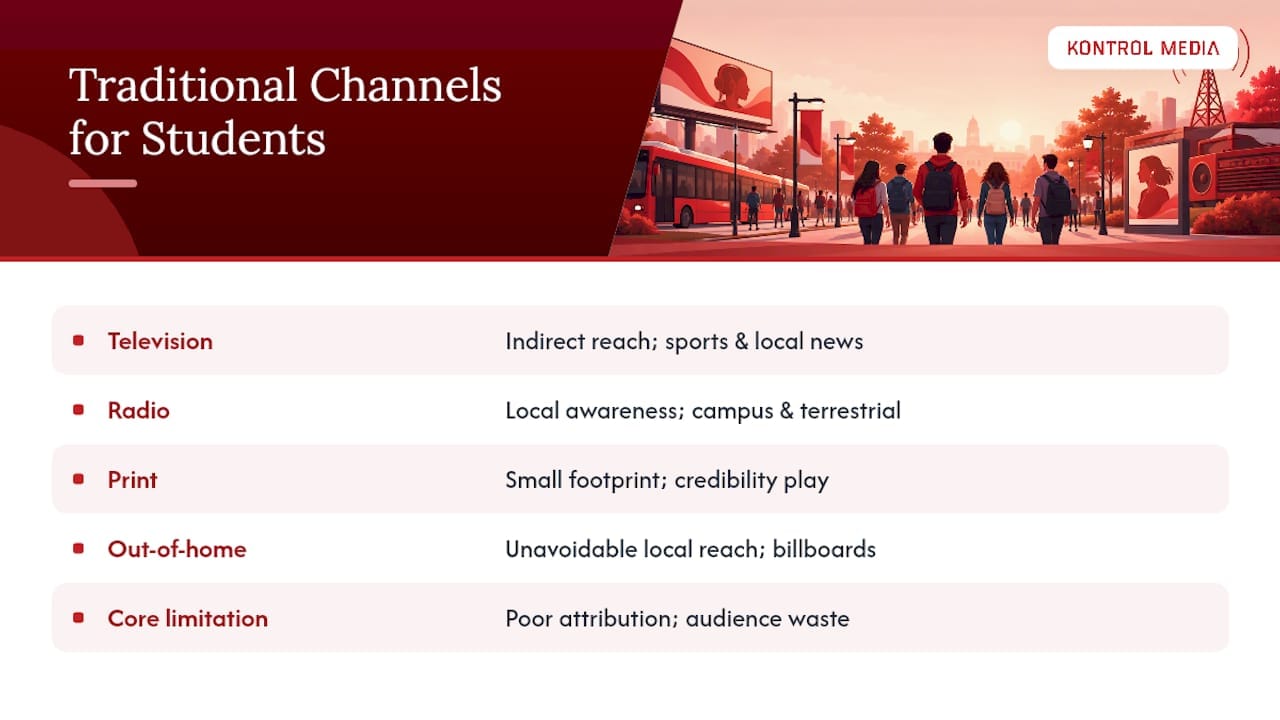
Traditional media hasn’t disappeared from student-targeted media plans, but its role has narrowed considerably. The channels marketers still buy against college audiences fall into four buckets, each with a specific job.
Television remains useful for reaching students indirectly, particularly through sports programming, streaming-adjacent ad inventory, and local news that parents and older students still watch. It’s a poor tool for reaching an 18-year-old freshman directly through appointment viewing, but it still has reach value in local markets around a university.
Radio, especially terrestrial and campus-adjacent stations, holds up better than most marketers expect for local awareness, particularly around events, concerts, and game-day promotions. It’s cheap relative to TV and can be geo-targeted to a college town.
Print has the smallest remaining footprint. Campus newspapers still exist at many schools, but circulation and readership have dropped sharply, and most marketers now treat print as a supplementary credibility play rather than a primary reach vehicle.
Out-of-home formats, including transit ads, billboards near campus, and posters in off-campus housing corridors, still perform reasonably well because they’re unavoidable in a way digital ads aren’t. A billboard on the main route to campus gets seen daily regardless of app usage.
The core limitation across all four: none of them were built to measure a transaction. A TV spot can drive brand recall, but tying that recall to an actual purchase requires a level of attribution modeling that most campus marketing budgets don’t support. Traditional media also can’t replicate the trust dynamic of a peer handing a friend a free sample in a dorm lobby, which matters given how much campus discovery still happens through word of mouth.
Traditional channels also carry a cost-efficiency problem specific to student audiences. You’re paying for a broadcast or print footprint that reaches a general population, when your actual target, the 18 to 24 demographic on one or two specific campuses, might represent a small fraction of that audience. The waste is built into the format.
How Do College Students Actually Consume Media Today?
Students don’t consume media the way the broader adult population does, and that gap is the entire reason campus retail networks exist as a category. Academic research on college media habits finds that social media and peer networks dominate how students discover news and information, while legacy print and broadcast get used far less frequently than they do among older adults.
The reach gap: Television leads overall U.S. adult election-news consumption at 35%, but that share skews heavily toward older demographics. Younger cohorts lean far more on personal networks and social platforms for the same information, according to research from Rutgers’ School of Communication and Information.
That age split isn’t a minor footnote. It’s the reason a media plan built for the general population routinely underperforms when the target skews 18 to 24. A campaign optimized for adults watching the evening news is optimized for the wrong audience if the buyer is a college junior.
Here’s what the research consistently shows about how students actually find brands and information:
- Peer recommendations and social feeds outrank institutional news sources for day-to-day discovery among college students.
- Platforms like TikTok, Instagram, and YouTube carry outsized influence over product discovery and purchase consideration for Gen Z audiences broadly, not just for entertainment content.
- Trust in legacy media hasn’t collapsed entirely. Some students report comparatively high trust in specific legacy outlets even while their daily habits run through social and peer channels.
- On-campus physical exposure, a poster, a sample, a friend’s recommendation from the bookstore line, still shapes attention in ways a banner ad rarely does.
That trust nuance matters for messaging strategy. Students can simultaneously distrust generic advertising and trust a specific outlet or a specific friend’s word. A campaign that leans on an ambassador or peer-style creative approach inside a trusted retail environment is playing directly into that dynamic, while a generic broadcast spot is fighting against it.
The practical implication for media planners: reach alone doesn’t equal attention. A TV buy might technically reach thousands of students’ households, but if those students are getting their actual information and purchase cues from a roommate’s Instagram story or a bookstore sampling table, the reach number is largely decorative. Attention and trust travel through different channels than raw impressions do, and campus media plans need to account for that split explicitly.
How Do These Channels Perform by Funnel Stage?
Mapping each approach against the marketing funnel clarifies why the “versus” framing in most industry conversations is slightly off. Follett Media Network and traditional media aren’t fighting for the same funnel stage most of the time.
Awareness stage: Traditional media, particularly TV and out-of-home, still has an edge here when the goal is broad category recognition across a metro area or a state. A regional TV buy timed to back-to-school season builds name recognition faster than a campus-only footprint can, simply because it reaches more households in a shorter window.
Consideration stage: This is where campus retail media starts to win. A student who’s seen a brand name on TV still needs a reason to actually consider it, and that’s exactly what in-store signage, sampling, and campus event sponsorships provide. Integrated campaigns that sequence campus awareness with digital retargeting consistently outperform single-channel approaches at this stage, because the retargeting closes the loop on someone who’s already been physically exposed to the brand.
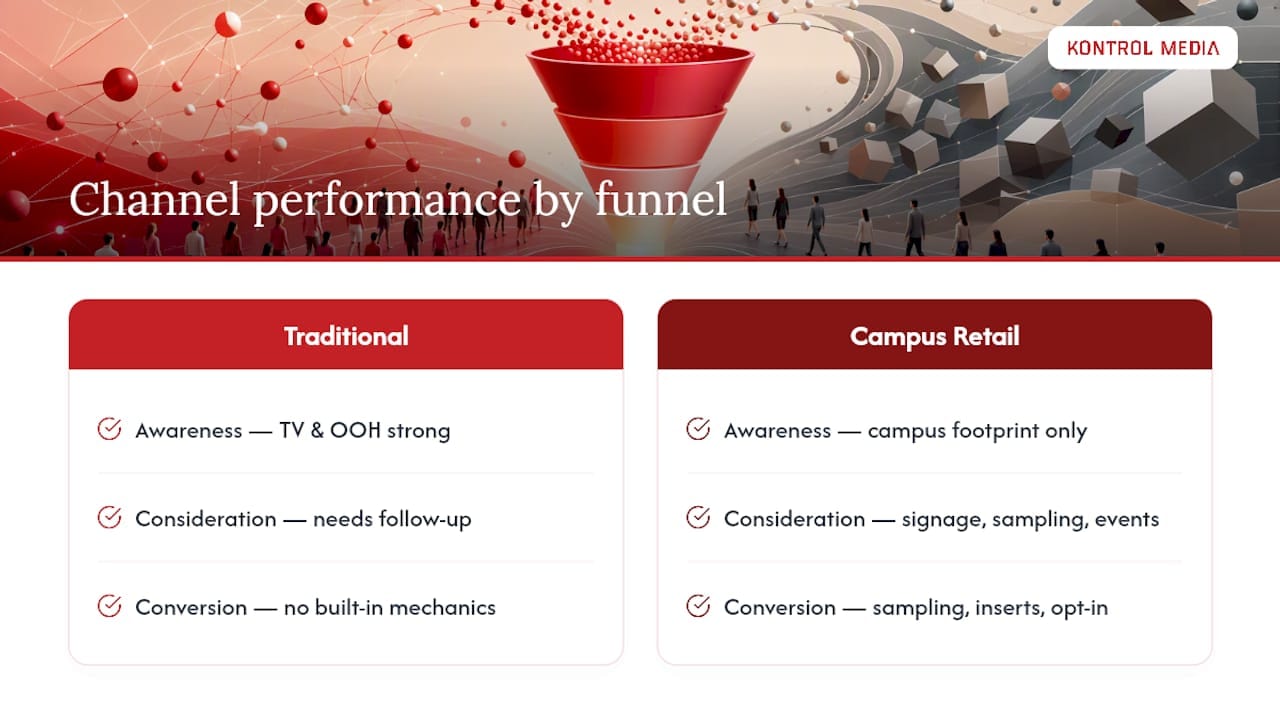
Conversion stage: Follett’s model dominates here almost by design. A sampling table at a bookstore checkout, a bag insert with a discount code, an email sent to someone who opted in at point-of-sale, these are conversion mechanics built directly into the retail moment. Traditional media has no equivalent unless it’s paired with a separate e-commerce or in-store tracking layer.
Real-world use cases bear this funnel logic out. Back-to-school sampling programs timed to move-in week consistently generate strong trial rates because students are actively stocking dorms and forming new purchase habits in a compressed window. A campus surround-sound program combining on-campus placements, digital, and event activations around a timed campus moment earned cross-channel attention that a single-format buy wouldn’t have matched. Mass-awareness buys, by contrast, still make sense for national brands entering a new market where no campus presence exists yet.
The most common pitfall: treating campus retail media as a standalone awareness tool instead of a conversion mechanism, and then judging it against reach metrics it was never built to win.
Pro Tip: Don’t run a campus sampling program in isolation. Pair it with a two-week digital retargeting flight aimed specifically at students who opted in at the point of sample, and you’ll typically see conversion rates that a standalone activation can’t touch.
What KPIs Should Marketers Demand From Each Channel?
Comparing campus retail activations against traditional buys fairly requires agreeing on KPIs and measurement techniques using AI analytics before the campaign launches, not after. Here’s a practical framework:
- Reach and impressions — Standard for both channels, but define whether “reach” means unique students, unique households, or gross impressions. These are not interchangeable numbers.
- Foot traffic lift — Compare in-store traffic during the activation window against a comparable pre-campaign baseline period at the same locations.
- Sampling engagement rate — The percentage of foot traffic that actually engages with a sample or offer, typically ranging from 10% to 30% depending on the offer and how compelling it is.
- Transactions and coupon redemptions — The clearest conversion signal available, and one traditional media almost never produces on its own.
- Site visits and digital retargeting response — Track whether in-store exposure translates into post-visit web or app activity.
Attribution gets murkier than most vendor decks admit. A TV spot’s contribution to a sale is genuinely hard to isolate, and even campus retail data has limits since not every transaction ties back to a tracked exposure. The realistic fix is a simple lift test: run the campus activation in a subset of participating locations, hold out a comparable set of locations as a control, and compare foot traffic and transaction lift between the two groups over the same window. It’s not laboratory-grade science, but it’s far more defensible than eyeballing a pre/post comparison with no control group.
Ask any campus media partner for a reporting package broken out by location, not just network-wide averages. Aggregate numbers hide underperforming campuses, and a clear ROI framework applied at the location level tells you where to reallocate budget for the next cycle.
How Do You Choose the Right Channel Mix?
Start with the objective, not the channel. A checklist keeps the decision honest:
- Objective: Is this campaign built for awareness, consideration, or direct conversion?
- Geography: Single campus, regional cluster, or national footprint?
- Purchase intent: Are you selling something students buy on impulse (snacks, personal care) or something with a longer consideration cycle (electronics, financial services)?
- Logistics: Do you have six to eight weeks of lead time for sampling staff and campus coordination, or are you working on a compressed timeline that favors a media buy over an activation?
- Measurement: Can your team support location-level reporting and a basic lift test, or do you need a simpler reach-based metric?
For budget and timing, treat campus retail activations as a shorter, more concentrated spend, often two to four weeks tied to a specific academic-calendar moment, while traditional media flights typically run longer and at broader geographic scale. Neither is inherently cheaper; they’re built for different jobs and different timeframes.
A sample brief for a campus-focused activation might look as follows:
| Element | Example specification |
|---|---|
| Objective | Drive trial and first purchase among students during welcome week |
| Target | Undergraduates at participating campuses |
| Channels | In-store sampling, bag inserts, email to opt-ins, digital retargeting |
| Creative | Simple offer-led messaging, mobile-first for retargeting assets |
| Measurement | Foot traffic lift, sampling engagement rate, redemption count, post-visit site traffic |
- Define the single primary objective before selecting any channel.
- Match the geography to the objective, campus-specific for conversion, broader for awareness.
- Confirm lead time supports sampling logistics if campus retail is in the mix.
- Lock measurement KPIs and a control group before launch, not after results come in.
- Build the digital retargeting sequence into the plan from day one, not as an afterthought.
What Kontrol Media Has Learned Running Campus Retail Programs
Standing up and operating a retail media network isn’t the same skill set as buying media against one. The two most common failure modes we see in campus programs are under-sequencing, where a sampling event runs with no digital follow-up, and under-planning logistics, where a brand tries to launch a multi-campus activation with two weeks of lead time.
Sequencing matters more than creative polish. Run the on-campus presence, sampling table, bag inserts, event sponsorship, for a tight two-to-four-week window tied to a real academic-calendar moment like welcome week or a home football game. Then move fast: deploy digital retargeting to anyone captured through email or app opt-in within days, not weeks, of the physical touchpoint. Layering student ambassadors into that window, real students who already shop at the location, tends to lift engagement further because the interaction reads as peer recommendation rather than paid promotion.
On reporting, set expectations early. A well-run pilot typically produces measurable footfall lift and a healthy sampling engagement rate within the activation window, but a durable sales lift almost always requires that second wave of digital reinforcement. Clients who expect a single sampling event to permanently shift purchase behavior are usually disappointed. Clients who treat it as the first touch in a two-part sequence tend to see the numbers they were hoping for.
Pro Tip: If you’re new to campus retail media, run your first pilot on three to five campuses before committing to a full network rollout. It’s enough scale to get a real read on engagement and redemption rates without overcommitting budget to a format you haven’t validated yet.
— Mark Kapczynski
What Does Campus Retail Media Cost Compared to Traditional Buys?
Traditional media buys, particularly regional TV and print, generally require larger minimum spends to achieve meaningful reach, since you’re paying for a broadcast footprint that includes far more than your actual student target. That inefficiency is baked into the format: a portion of every dollar reaches viewers who will never set foot on a campus.
Campus retail activations tend to concentrate spend more tightly. A sampling program and in-store presence running for two to four weeks across a defined set of campuses puts budget directly against the audience you’re trying to reach, with less waste on off-target impressions. The tradeoff is scale. You’re not buying a metro area; you’re buying a specific set of retail environments.
ROI comparisons come down to what you’re measuring. If the KPI is broad brand recall, traditional media’s cost-per-impression math can look reasonable at scale. If the KPI is trial, redemption, or foot traffic lift, campus retail activations typically deliver more measurable return per dollar spent, because the transaction signals exist in a way they simply don’t for a TV spot. Neither format wins on ROI universally. The honest comparison requires defining the KPI first, then evaluating cost against that specific outcome rather than a generic “which is cheaper” framing that ignores what each channel is actually built to do.
The Real Choice Isn’t Traditional vs. Campus Retail
The framing of this decision as a binary “versus” undersells how these channels actually work together. Traditional media still earns its place when the job is broad category awareness across a market that extends beyond campus boundaries. Campus retail media, Follett Media Network chief among the named players, wins decisively once the objective shifts to trial, consideration, or direct conversion among students. Test both against clear KPIs before committing a full budget to either one, and let the location-level data, not the channel’s reputation, decide where next quarter’s spend goes.
Kontrol Media works with brands and agencies to stand up and operate retail and commerce media networks, including campus-focused programs, when a company wants to build that capability rather than rent it campaign by campaign.
Sources
The Pew Research Center’s data on election news sources remains the clearest benchmark for understanding where traditional media still holds ground against digital and social channels. For campus-specific behavior, the Rochester Institute of Technology thesis on student media use and the Inside Higher Ed survey on student media literacy offer grounded, non-vendor perspectives on how students actually consume news. For vendor-specific capability details, Follett Media Network’s own site lays out its channel mix directly, and the Refuel Agency playbook offers a useful industry lens on what drives conversion in college advertising specifically.
- Where Americans turn for election news — Pew Research Center
- College Students’ Use of Digital and Traditional Media — Rochester Institute of Technology thesis (Kelly M. Bodine)
- Which channels win at colleges advertising? A brand’s complete playbook — Refuel Agency
- Follett Media Network – Helping brands reach students
FAQ
Is Social Media Better Than Traditional Media for Reaching Students?
For day-to-day discovery and peer-driven influence, yes. Academic research shows college students rely far more heavily on social media and peer networks than on print or broadcast. Traditional media still holds an edge for broad-scale brand awareness and news consumption among the general adult population, so the better channel depends entirely on the objective.
Where Do College Students Get Their News?
Students lean heavily on social platforms and peer networks rather than legacy print and broadcast sources. Younger audiences in particular rely more on personal networks than older adults do, even though television remains the top source for the general U.S. adult population overall.
What Are the Advantages and Disadvantages of Traditional Media?
Traditional media offers broad, fast reach and institutional credibility, making it effective for mass awareness and news consumption across a wide population. Its main disadvantage for student-targeted campaigns is weak attribution and low direct engagement with the 18 to 24 demographic specifically, since most of that budget reaches people outside the target audience.
What Are the Key Differences Between Traditional Media and New Media?
Traditional media (TV, radio, print, out-of-home) delivers broad, largely unmeasurable reach and works best for awareness at scale. Campus retail and digital-native channels like Follett Media Network deliver narrower but measurable reach, tied directly to transactions, sampling engagement, and foot traffic within a defined environment.
When Should a Marketer Choose Follett Media Network Over Traditional Media?
Choose campus retail media when the objective is trial, conversion, or purchase-driven engagement within a defined set of campuses. Choose traditional media when the goal is broad brand awareness across a market that extends well beyond a college campus footprint.