


An enterprise sales motion is the repeatable, buyer-centric play a company runs to win large, multi-stakeholder deals. It works when it orchestrates every channel and every stakeholder toward consensus, not just when a rep pushes harder. Get it right and you get predictable big deals, faster time to agreement, and renewal rates that actually hold.
TL;DR:
- Building an enterprise sales motion requires an average deal size of over six figures and a forecastable sales cycle of several months.
- Mapping and engaging a buying group of about 13 stakeholders with clear roles and influence is essential for success, not relying on a single champion.
- A structured pilot with specific KPIs like pipeline velocity and time-to-consensus helps validate the motion before broader rollout.
- Organizing omnichannel buyer engagement through self-service content and triggered seller interventions optimizes both digital and human interactions.
- Preparing negotiation assets and defining internal thresholds in advance reduces cycle time and preserves margins during complex enterprise deals.
Table of Contents
- What an Enterprise Sales Motion Covers and When to Adopt It
- Core Components and Stages of a Repeatable Enterprise Sales Motion
- How to Map and Engage Buying Groups the Right Way
- Designing Seller and Digital Orchestration With AI
- Piloting the Motion: KPIs, Cadence, and Governance
- Negotiation, Procurement, and Legal Playbooks That Shorten Cycles
- How Kontrol Media Approaches Motion Design in Practice
- Three Strategic Trade-Offs Every Leader Must Choose
- How Kontrol Media Can Help You Build This Motion
- Research Behind This Guide
- Sources
- FAQ
What an Enterprise Sales Motion Covers and When to Adopt It
An enterprise sales motion is the operating system behind every six and seven-figure deal your company closes: how you identify the right accounts, engage the people who influence the decision, and move a room full of skeptics toward a signature. It differs from a transactional or SMB motion in one fundamental way. You’re not selling to a person. You’re selling to a committee that has to agree with itself before it agrees with you.
That distinction is why so many companies jump into “enterprise” before they’re ready and stall out. A motion built for a five-person buying group behaves nothing like one built for a single decision-maker with a credit card.
Before you build one, check whether you actually have the raw material for it:
- Average deal size that justifies a longer, higher-touch sales cycle (usually six figures or more annually)
- A sales cycle you can reasonably forecast in months, not days
- A repeatable ideal customer profile, not a handful of lucky wins across unrelated verticals
- Internal capability to support multi-threaded deals: sales engineering, legal, customer success, and executive sponsorship on call
The most common false start is chasing a single whale account and mistaking it for validation of an enterprise motion. Landing one big logo through founder relationships doesn’t mean you have a motion. It means you have an anecdote. The second most common mistake is hiring “enterprise” account executives before the ICP and buying committee patterns are documented, which just gives expensive reps nothing repeatable to execute.
Core Components and Stages of a Repeatable Enterprise Sales Motion
A motion is really a chain of five modular stages, and each one needs its own design decisions rather than a generic playbook borrowed from your SMB team.
- ICP and addressable buying unit. Define not just company size and industry, but who actually sits in the room: typical titles, department structures, and how many people historically touch the deal. This is your blueprint for every later stage.
- Demand to qualification. Marketing and sales need a shared definition of what counts as a qualified enterprise opportunity, since a lead that’s perfect for a self-serve motion often isn’t ready for a six-month enterprise cycle at all.
- Discovery design. Enterprise discovery has to surface the priorities of multiple functions at once. A discovery call that only asks about technical requirements will miss the budget-holder’s real constraint, which is usually risk, not features.
- Consensus orchestration. This is the stage most companies skip entirely, treating the buying committee as a formality instead of the actual product being sold. You’re not selling your software here. You’re selling internal agreement.
- Proposal, negotiation, close, and expansion. Enterprise deals rarely end at signature. The motion has to extend into onboarding, renewal, and expansion, because renewal ownership is shifting toward sales and dedicated growth teams at a growing number of organizations, and building expansion incentives into seller compensation tends to improve those outcomes.
Treat these stages as a system you audit quarterly, not a document you write once. The companies that scale enterprise revenue predictably are the ones that keep refining stage two and stage four long after the motion first works, because those are where deals actually die.
How to Map and Engage Buying Groups the Right Way
Enterprise deals rarely die because the product was wrong. They die because nobody mapped who actually had to say yes. The average B2B buying group involves about 13 people, which means a motion built around a single champion is a motion built to lose.
Start every opportunity by mapping roles against influence, not just titles against an org chart:
- Identify the economic buyer who owns the budget and the risk of the decision
- Find the technical evaluators who can veto on capability or security grounds, even without formal authority
- Locate the day-to-day users whose adoption resistance can quietly kill a deal after signature
- Confirm you have a genuine internal champion, someone who wins personally if the deal closes, not just someone friendly
Discovery has to be built to surface where these stakeholders disagree, not just where they agree with you. Gartner’s research on B2B buying frames this well: buyers loop through distinct buying jobs like problem identification, requirements building, and supplier selection, often revisiting jobs out of order as internal politics shift. Ask each stakeholder what success looks like from their seat, and you’ll usually hear three different answers to the same question.
Pro Tip: Run a “pre-mortem” with your champion before the final proposal meeting. Ask directly: “If this deal fell apart in committee, what would be the reason?” The answer almost always surfaces an objection nobody has voiced yet.
Set a meeting cadence that matches the stakes: a kickoff with the full committee if possible, individual follow-ups with each stakeholder type, and a clear decision checkpoint before you invest in a full proposal. Bring collateral suited to each audience. A one-page ROI summary for the economic buyer looks nothing like the technical architecture document your evaluator needs.
Designing Seller and Digital Orchestration With AI
The instinct to build an “enterprise sales motion” as an all-human, high-touch operation is outdated. B2B buyers use an average of 10 interaction channels across a single purchase, moving between your website, a rep call, a peer review site, and a vendor comparison tool without much regard for which channel you’d prefer they use.
Companies that master this shift see real financial upside: sellers who deliver a seamless omnichannel experience achieved 13.5% EBIT growth compared with 1.8% for less digitally enabled competitors.
Buyer preference is more contradictory than most sales leaders assume. Three-quarters of buyers say they prefer a rep-free experience, yet those same buyers are 2.3 times more likely to feel confident in their choice after a conversation with a rep than after browsing digital content alone. The design implication is clear: let buyers self-serve early, and insert your best sellers precisely where their judgment adds value, not everywhere at once.
Build the motion around that split:
- Self-service content and product tours for early-stage exploration, so buyers can move without waiting on a calendar invite
- Rep intervention triggered by specific signals, like a champion requesting a technical deep dive or a procurement contact entering the picture
- A shared data layer connecting marketing, sales, and success so every stakeholder sees consistent messaging regardless of channel
- Guided-selling tools that flag next-best-actions for reps carrying a heavy multi-threaded pipeline
Generative AI’s real contribution here is narrower than the hype suggests. Its near-term value is automating routine research and drafting tasks and surfacing contextual nudges for sellers, not replacing the judgment calls a stakeholder negotiation demands. Only a minority of organizations have scaled it beyond pilots, so treat AI as a productivity layer under the motion, not the motion itself.
Piloting the Motion: KPIs, Cadence, and Governance
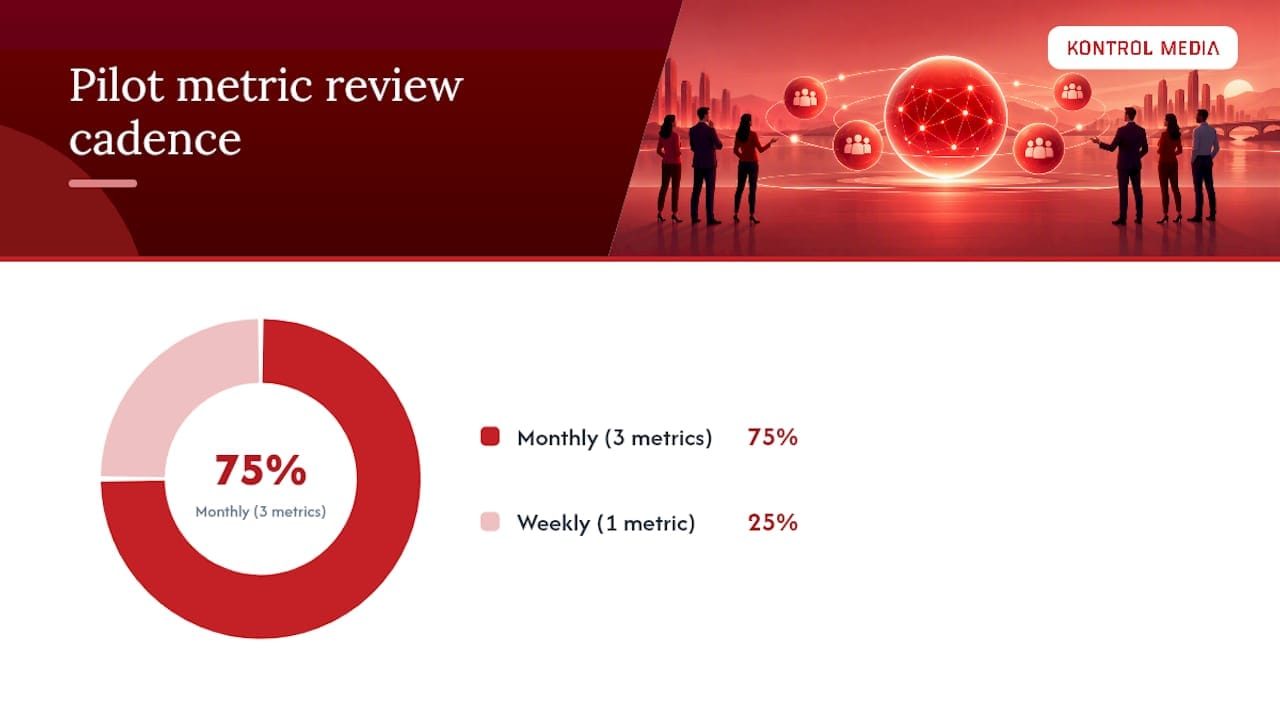
Skip the company-wide rollout. Pick a narrow slice: 8 to 15 target accounts inside a single vertical, a documented discovery script, a fixed collateral set, and a 90-day window before you decide whether to scale or rebuild. That pilot-first discipline is what separates a motion that compounds from one that quietly fails and gets blamed on the market.
Measure the pilot against KPIs that actually predict enterprise health, not vanity numbers:
- Pipeline velocity, tracked stage by stage rather than as one blended average
- Win rate broken out by ICP archetype, since a single blended win rate hides which segment is actually working
- Average deal size and how it trends against your original ICP assumptions
- Time-to-consensus, meaning how long it takes a buying committee to reach internal agreement once discovery starts
- Message consistency across stakeholders, checked through post-call surveys or win/loss interviews
| Metric | What it reveals | Suggested review cadence |
|---|---|---|
| Pipeline velocity by stage | Where deals stall inside the motion | Weekly |
| Win rate by ICP archetype | Which segments the motion actually fits | Monthly |
| Time-to-consensus | How efficiently buying groups reach agreement | Monthly |
| Net-new pipeline influenced | Whether the pilot is generating real demand, not recycling existing deals | Monthly |
Govern the pilot with a cross-functional deal review, not just a sales team standup. Marketing, sales engineering, and customer success all touch the buying committee at some point, and a governance rhythm that excludes them will miss half the signal. The discipline that matters most is running narrow pilots tied to a small number of metrics and doubling down only on the plays that visibly move win rate and time-to-consensus, rather than declaring victory on gut feel.
Negotiation, Procurement, and Legal Playbooks That Shorten Cycles
Enterprise negotiations follow patterns you can prepare for well before the term sheet arrives. Procurement teams routinely ask for volume discounts, extended payment terms, and liability caps, and sellers who haven’t pre-decided their fallback positions end up conceding all three in the same call.
Protect margin and cycle time with a few practical assets built before you need them:
- A commercial one-pager that states your standard terms clearly, so procurement isn’t negotiating from a blank page
- Pre-approved contract language for your most common redlines, cutting legal review time from weeks to days
- A documented list of contract red flags that trigger automatic escalation, like unlimited liability clauses or auto-renewal removal
- Clear approval thresholds so a director doesn’t need a VP’s sign-off for a routine 5% discount, and a VP doesn’t approve a custom SLA alone
The goal isn’t to win every negotiation. It’s to make every negotiation predictable enough that your legal and finance teams stop being the bottleneck.
How Kontrol Media Approaches Motion Design in Practice
This consultancy builds enterprise motions by combining strategy and execution in-house rather than handing off between teams. They have experience working with a range of organizations, including private equity portfolio companies and public middle-market businesses.
Some companies need a full motion built from scratch. Others just need sales execution without the headcount while they figure out whether enterprise is even the right lane. Both are legitimate starting points, and the right one depends on how much internal capability you already have.
Three Strategic Trade-Offs Every Leader Must Choose
Most enterprise motion failures trace back to three decisions leaders never made explicitly. The first is breadth versus depth in your ICP. Chasing every logo that could theoretically buy dilutes your discovery scripts and your stakeholder maps until neither works for anyone. Narrow the ICP further than feels comfortable, and the motion gets sharper.
The second is automation versus bespoke seller time. Every enterprise team wants both, but every hour a seller spends on a task a tool could handle is an hour not spent reading the room in a committee negotiation. Automate the research. Protect the judgment calls.
The third is bookings versus renewal orientation. A motion optimized purely for new logos will always look better in a quarterly board deck and always underperform on lifetime value. The strongest motions I’ve seen build renewal incentives into seller compensation from day one, not as an afterthought once churn shows up.
— Mark Kapczynski
How Kontrol Media Can Help You Build This Motion
If you’ve read this far and recognized your own company in the false starts, you don’t need another framework. You need someone who has actually built the discovery scripts, stakeholder maps, and pilot structures described above, and who can sit inside your sales process rather than hand you a slide deck and walk away.
Kontrol Media pairs strategy work with hands-on execution across sales, marketing, and business development, which means the motion we help you design is one we’ll also help you run. That’s a different engagement than hiring a strategy firm and a separate outsourced sales team and hoping they talk to each other. For companies whose enterprise buyers touch retail or commerce channels, we also stand up and operate retail media networks as part of the broader growth motion.
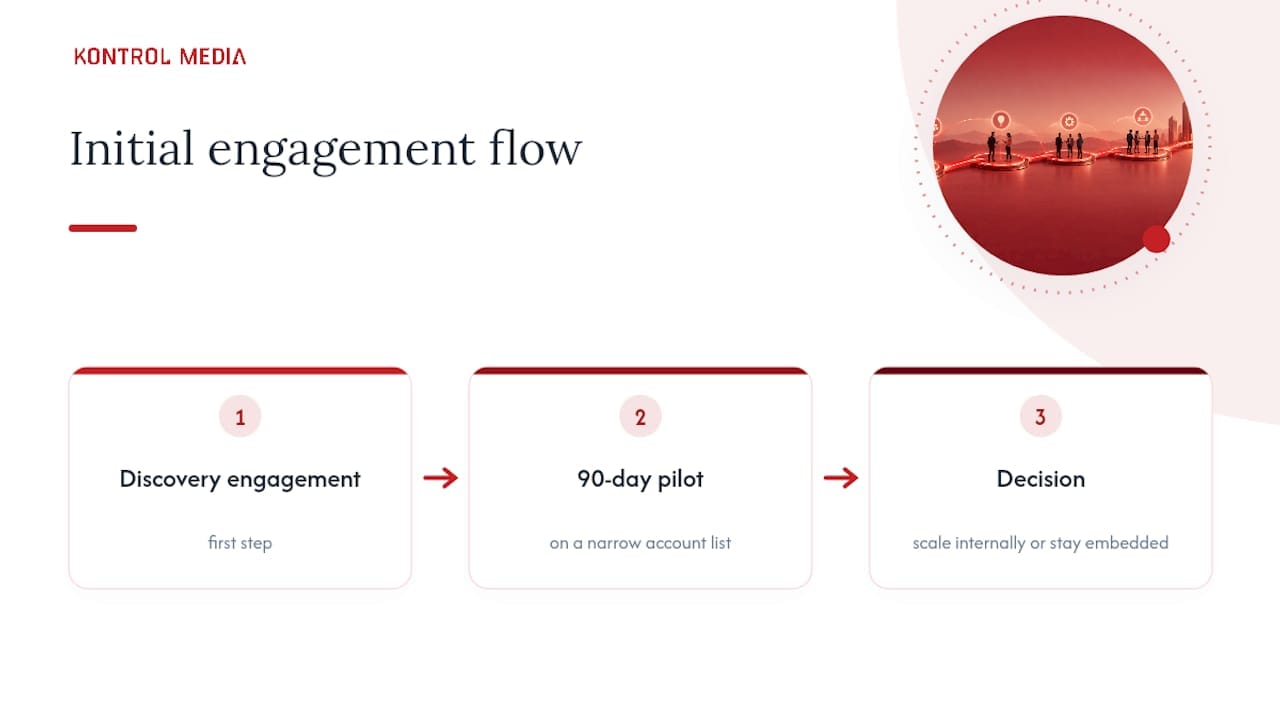
A typical first step looks like a discovery engagement followed by a 90-day pilot on a narrow account list, the same structure described in the pilot section above. From there, you decide whether to scale internally or keep us embedded. Visit our services overview to see the full range of engagements and start a conversation about where your motion actually stands today.
Research Behind This Guide
The buying group and stakeholder guidance draws on Forrester’s research on buying groups and Gartner’s B2B buying journey framework. The omnichannel and EBIT figures come from McKinsey’s analysis of B2B growth, and the AI scoping is grounded in McKinsey’s outlook on generative AI in B2B sales. For broader omnichannel design thinking, see this primer on unifying customer experience.
Sources
- Five fundamental truths: how B2B winners keep growing — McKinsey
- Gartner B2B buying report — Gartner
- Buying groups for the win — Forrester
FAQ
What Does “Sales Motion” Mean?
A sales motion is the repeatable process a company uses to move a buyer from first contact to signed deal, including the channels, stakeholders, and stages involved. An enterprise sales motion specifically refers to the version of that process built for large, multi-stakeholder, high-value deals rather than single-decision-maker transactions.
What Is the 3-3-3 Rule in Sales?
Definitions of the 3-3-3 rule vary across sales teams, and there’s no single canonical version tied to enterprise motion design. Most commonly it refers to a prospecting cadence, such as three touches across three channels over three days, rather than a formal framework for enterprise buying committees.
What Is the 30-60-90 Rule in Sales?
In an enterprise context, ramping a new sales hire usually needs to extend well beyond three months given longer sales cycles and multi-threaded stakeholder mapping.
How Much Is a Business Worth With $1,000,000 in Sales?
Business valuation depends far more on profitability, growth rate, and industry multiples than on revenue alone, so the valuation can vary widely depending on margins and sector. A services or consulting business with strong recurring revenue, for instance, often commands a different multiple than a low-margin product business at the same revenue level.
How Do I Know if I’m Ready to Build an Enterprise Sales Motion?
You’re ready when you have a repeatable ideal customer profile, deal sizes that justify a multi-month sales cycle, and internal capability like sales engineering and customer success to support multi-threaded deals. If your only proof point is one large deal won through a personal relationship, you likely need more validation before investing in dedicated enterprise headcount.