


Retail media advertiser education trains marketers to plan, buy, and measure retail media campaigns that use a retailer’s first-party data to drive measurable commerce outcomes. Amazon Ads alone reaches an estimated 300 million active users, a scale that makes literacy in this channel unavoidable for anyone managing brand budgets. Some firms build and operate these programs directly, and that execution experience shapes much of what follows.
TL;DR:
- Retail media ad spend in the U.S. is forecasted to reach over $69 billion in 2026, mainly driven by Amazon and Walmart, with smaller networks focusing on niche data relevance.
- Proper audience segmentation relies on first-party purchase signals rather than general demographics, making the strategic choice of network critical based on data compatibility.
- Creative assets must align with format specifications, especially for shoppable videos, connected TV, and in-store signage, to avoid inefficiencies and maximize conversions.
- Incrementality testing and closed-loop reporting are essential to accurately measure true campaign lift beyond platform-reported ROAS, which often overstates results.
- Compliance with FTC disclosure rules for native ads, boosted posts, and loyalty data promotions remains mandatory and must be clearly communicated to consumers.
Table of Contents
- What Retail Media and RMNs Actually Mean
- Why Retail Media Deserves Real Budget Attention in 2026
- The Ad Formats and Activation Options You Need to Know
- Building an Activation Plan That Actually Holds Up
- Measuring Retail Media Without Fooling Yourself
- Privacy, Disclosures, and the Rules You Can’t Skip
- Building a Training Program That Sticks
- What Execution-First Operators Learn That Slide Decks Don’t Teach
- Where This Channel Goes Next and How to Get Ahead of It
- Get Retail Media Operations Support From Kontrol Media
- Sources
- FAQ
What Retail Media and RMNs Actually Mean
I’ve watched the term “retail media” gets stretched to cover almost anything a retailer sells to a brand, so it helps to draw the lines clearly before going further. Retail media is advertising sold by a retailer, using that retailer’s own first-party shopper and purchase data, placed where the retailer already has an audience—on its site, in its app, on its owned media, or through its data extended into outside channels. A retail media network, or RMN, is the retailer’s structured program for selling that inventory, typically with its own sales team, ad platform, and reporting layer.
Three related structures tend to get confused with each other:
- Retailer-owned networks sell inventory that the retailer controls directly, such as Amazon Ads or Walmart Connect.
- Commerce media extends retail-style targeting to non-retail properties, letting brands use purchase data outside the retailer’s own site.
- DSP-based activations let advertisers buy offsite impressions programmatically while still using the retailer’s first-party audience signals for targeting.
Typical inventory spans sponsored product listings, onsite display banners, offsite programmatic placements, connected TV, and increasingly, in-store screens and loyalty app placements. Marketers who can name these categories correctly move faster in vendor conversations, because retail media sales teams assume a baseline vocabulary that many client-side buyers still lack.
Why Retail Media Deserves Real Budget Attention in 2026
The business case for treating retail media as a core discipline, not a side experiment, comes down to where the money is actually moving. eMarketer forecasts U.S. advertisers will spend $69.33 billion on retail media in 2026, up from $58.79 billion in 2025, and much of that increase concentrates at the largest networks rather than spreading evenly across the field.
That concentration matters for planning. A few forces explain it:
- First-party purchase and loyalty data lets retailers target shoppers based on what they actually buy, not just what they browse, which sharpens both targeting and measurement.
- Amazon and Walmart capture most of the incremental dollars, according to eMarketer’s forecast, which means brands allocating new budget need a reason to look past the two biggest players.
- Smaller and mid-tier networks compete on data specificity, category relevance, or lower activation minimums rather than raw reach.
None of this means every brand should chase the largest network by default. A grocery-adjacent brand may get more relevant signal from a network built on loyalty card data than from a generalist marketplace, even if that marketplace has a larger audience. The strategic question isn’t “which network is biggest,” it’s “whose first-party data actually predicts my customer’s next purchase.” Our guide to retail media strategy for brands outside the retail category itself goes deeper into how non-retailers should think about this allocation question.
The Ad Formats and Activation Options You Need to Know
Every advertiser briefing a retail media network needs a working sense of what’s actually available to buy, because format literacy determines whether a creative team builds the right assets the first time.
Onsite inventory is the foundation: sponsored product listings that appear in search results, promoted listings that boost visibility within category pages, and onsite display banners placed across the retailer’s own site and app. These formats convert closest to the point of purchase, which is part of why they carry a premium.
Offsite formats extend the retailer’s audience data beyond its own properties. This includes DSP-based display bought programmatically and retargeting that follows a shopper’s on-site behavior into other publishers’ inventory. The appeal here is scale: a brand can reach a retailer’s shopper base without being confined to that retailer’s pages.
Emerging inventory is where the format map is still shifting fastest:
- Shoppable video lets viewers act on a product without leaving the content, collapsing the gap between awareness and purchase.
- Connected TV shoppable placements bring the same idea to streaming, pairing a big screen with a small, immediate path to buy.
- In-store digital signage and loyalty-based offers connect a physical moment, someone standing in an aisle, to a digital identity the retailer already recognizes.
Creative requirements vary sharply by format. Sponsored product listings often demand strict image and copy specs tied to the retailer’s catalog structure, while shoppable video needs a clean call-to-action moment built into the edit itself. Briefing a creative team without knowing these constraints in advance is one of the most common causes of wasted production cycles in this channel.
Building an Activation Plan That Actually Holds Up
A retail media plan that survives contact with an actual campaign starts with a genuinely clear objective, not a vague aspiration to “drive sales.” Awareness, consideration, conversion, and new-to-brand acquisition each call for a different mix of formats and a different measurement approach, so naming the objective first prevents a lot of downstream confusion.
- Define the primary objective and write it in a sentence a retailer’s ad rep could repeat back accurately.
- Segment the audience using loyalty and purchase signals rather than generic demographic proxies, since that first-party data is the entire premise of retail media’s targeting advantage.
- Set a channel mix rule: lean onsite when the goal is conversion near the point of purchase, and lean offsite or CTV when the goal is reaching a shopper before they’ve started their retail journey.
- Reconcile trade budget, the money that funds shelf placement and promotions, with media budget, the money that funds advertising, so the two teams aren’t reporting different numbers to the same executive.
Pro Tip: Ask your retail media rep for the data retention window in writing before signing anything. Some networks limit how far back historical reporting goes, which quietly breaks year-over-year analysis later.
Governance is the part teams underestimate most. When trade teams own the RMN relationship and pay the fees while media teams own the ROI conversation, the two groups often measure success differently and argue about numbers that were never meant to be compared. A joint business plan that both sides sign off on, with agreed KPIs and a shared reporting cadence, heads off most of that friction before it starts.

Measuring Retail Media Without Fooling Yourself
Retail media reporting is generous with numbers and stingy with truth, so advertisers need to know which metric answers which question. ROAS tells you revenue relative to spend within the platform’s own attribution window, impressions tell you reach, sales lift tells you the incremental effect of the campaign, CAC tells you acquisition cost, and CLTV tells you whether that acquired customer was worth pursuing at all. Confusing any of these for another leads to decisions built on the wrong evidence.
Platform-reported ROAS alone is insufficient to prove a campaign worked, a point industry panels on measuring causal impact in retail media return to consistently, because platform attribution tends to credit itself for sales that would have happened anyway.
That’s where incrementality testing earns its place in the process:
- Experimental tests use randomized holdout groups to isolate the ad’s true effect, while observational methods infer effect from patterns and carry more risk of bias.
- Sample size and holdout selection are commonly mis-specified, so advertisers should insist on a statistically powered sample calculation before launch, not after.
- Cross-exposure between control and test groups quietly invalidates results, so plan the holdout structure with that risk named explicitly.
- Closed-loop reporting, where sales data ties directly back to ad exposure, is the standard to ask for, and a third-party validator is worth the cost on any campaign large enough to matter to the budget review.
Our guide to key retail media metrics breaks each of these terms down further for teams building their own measurement templates.
Privacy, Disclosures, and the Rules You Can’t Skip
Retail media’s targeting advantage rests entirely on first-party data, which means the compliance obligations around that data aren’t a footnote, they’re the foundation. The FTC’s native advertising guidance requires that native ads and endorsements carry disclosures that are clear and conspicuous enough for an ordinary consumer to recognize commercial content when they see it.
In practice, that shows up in a few recurring situations:
- Sponsored product listings need labeling that a shopper would notice without hunting for it, not a faint “Ad” tag buried in gray text.
- Influencer content boosted through paid media needs its disclosure to survive the boost, since a caption disclosure that worked organically can disappear once the post becomes an ad unit. Guidance on influencer disclosure timing covers this gap in more detail.
- In-app promotions built on loyalty data need consent language that matches how the data is actually being used, not a generic privacy policy link.
When a campaign combines first-party data, an influencer partnership, and a paid boost in the same unit, that’s the moment to loop in legal or compliance review rather than assume marketing judgment alone covers it.
Building a Training Program That Sticks
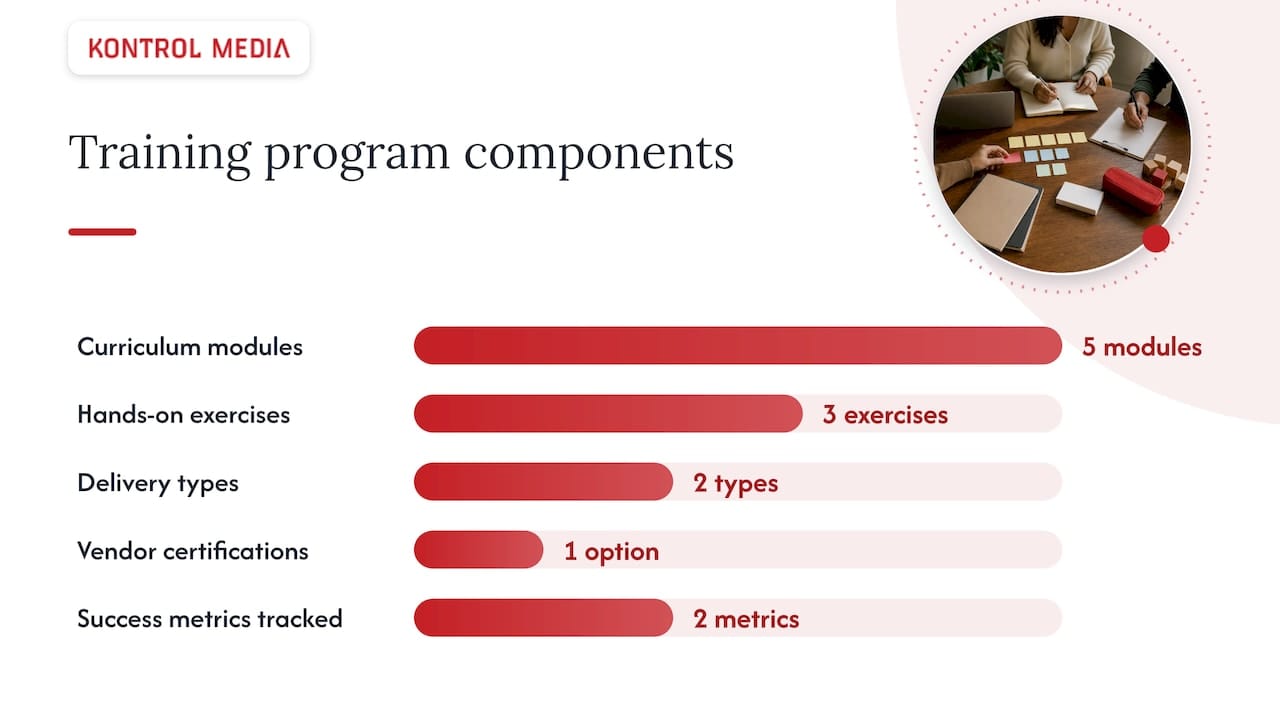
Most retail media education fails not because the content is wrong but because it never gets tested against a real campaign. A curriculum worth running covers five modules: platform mechanics for the major networks, format and creative requirements, measurement and incrementality, privacy and disclosure, and vendor management, meaning how to negotiate terms and read a media plan critically before signing it.
Three exercises turn that curriculum into a skill rather than a memory:
- Write a full campaign brief for a single RMN, including objective, audience segment, format selection, and budget, then have a colleague critique it against the checklist above.
- Design a lift test plan for a hypothetical campaign, specifying sample size, holdout structure, and the cross-exposure risks to guard against.
- Build a closed-loop reporting readout template that separates platform-reported ROAS from incremental lift, and present it to a non-marketing stakeholder for clarity.
Delivery works best as short, focused workshops paired with a sandbox campaign, a small real budget run under supervision, rather than a single long seminar. Some networks also offer vendor certifications worth pursuing for teams buying at scale. Measure success the way you’d measure any skill: track whether pilot campaigns designed by trained staff show better lift results and fewer measurement disputes than campaigns run before the training.
What Execution-First Operators Learn That Slide Decks Don’t Teach
Running a retail media program, rather than just studying one, exposes gaps that education alone rarely surfaces. Work standing up and operating retail and commerce media networks consistently comes back to the same build versus buy question: whether a retailer builds internal ad tech and sales capability or partners with an operator who already has both.
A short operational checklist that holds up regardless of that choice:
- Governance: who owns the RMN relationship, and who’s accountable when trade and media budgets disagree.
- Data access: confirm retention windows and export rights in the contract, not after a dispute.
- Measurement: insist on incrementality testing, not platform ROAS alone, before scaling spend.
- Sales enablement: make sure the retailer’s own sales team can explain the ad product to suppliers accurately.
A sensible first engagement moves through discovery, a scoped pilot, then scale, with a clear deliverable at each stage rather than an open-ended retainer. Our build versus buy breakdown for RMN setup walks through that decision in more depth.
Where This Channel Goes Next and How to Get Ahead of It
The retail media landscape is quietly bifurcating. A handful of networks are consolidating scale and data sophistication, while a longer tail of smaller retailers either partners with an operator or risks falling behind on measurement credibility. Academic research from Walton College backs this up: RMNs succeed when they convert first-party data into genuinely actionable insight and treat measurement transparency as a trust-building exercise with suppliers, not a compliance formality.
That transparency is becoming the real competitive edge. A network that can prove incrementality convincingly will out-compete one that only offers a polished dashboard, because sophisticated buyers have started asking harder questions before they renew.
Three moves worth making this quarter: audit which of your current RMN partners can produce a real lift test versus platform-reported ROAS only, put a data retention clause in your next contract renewal, and pilot one incrementality test on a mid-size campaign before the budget planning cycle locks in for next year.
— Mark Kapczynski
Get Retail Media Operations Support From Kontrol Media
Building the internal literacy this article covers is the first step. Operating a retail media program well, with the governance, measurement discipline, and vendor relationships to back it up, is a different and harder problem, and it’s where Some operators focus on building, operating, and driving revenue for retail and commerce media networks, bringing hands-on execution experience rather than a slide deck of best practices.
A typical engagement starts with a discovery conversation about where your current program stands, moves into a scoped pilot with defined measurement, and scales once that pilot proves out. If you’re deciding whether to build an RMN internally or bring in an operator who already has the infrastructure, our retail and commerce media network setup page walks through what that looks like in practice. Reach out through our services page to start that conversation.
Sources
- Retail media and creator marketing analysis | Spiegel, Medill Northwestern
- Retail media ad spending forecast and trends H2 2025 | eMarketer
- Native Advertising Guide for Business | FTC
- What makes retail media networks work? | Walton College
- Measuring causal impact in retail media | ANA webinar
FAQ
What Is Retail Media Advertising?
Retail media advertising is advertising sold by a retailer using its own first-party shopper and purchase data, placed on its site, app, or extended into outside channels. Major examples include Amazon Ads, Walmart Connect, Target Roundel, Instacart, and Kroger Precision Marketing, each built around that retailer’s own audience data.
What Is Retail Education in a Marketing Context?
In this context, retail education means training marketers to understand retail media platforms, formats, and measurement well enough to plan, buy, and evaluate campaigns competently. It typically covers platform mechanics, ad formats, incrementality testing, and disclosure compliance as core modules.
What Are the Top Retail Media Networks Advertisers Should Know?
The networks most frequently cited by scale and adoption are Amazon Ads, Walmart Connect, Target Roundel, Instacart, and Kroger Precision Marketing. Amazon leads by reach, with an estimated 300 million active users, while the others compete on category-specific loyalty and purchase data.
How Do Advertisers Prove a Retail Media Campaign Actually Worked?
Platform-reported ROAS alone doesn’t prove incremental impact, since it tends to credit sales that might have happened without the ad. Advertisers need incrementality or lift testing, using a properly sized holdout group, to isolate the campaign’s true effect, a practice emphasized in industry discussions on causal measurement.
What Disclosure Rules Apply to Sponsored Retail Media Content?
The FTC requires clear and conspicuous disclosure on native ads and endorsements so an ordinary consumer recognizes commercial content. That applies to sponsored listings, boosted influencer posts, and in-app promotions built on first-party data alike.