


Retailer data partnerships connect a retailer’s first-party purchase and loyalty signals with a brand’s media and measurement systems, turning transaction history into targeting, activation, and attribution that both sides can trust. The outcome is practical: better-aimed campaigns, closed-loop sales reporting, and new revenue for the retailer. Groups like the ANA and the IAB have spent the last two years building the measurement scaffolding that makes this possible, and specialized firms now operate inside that scaffolding daily.
TL;DR:
- Retailer data partnerships enable more precise targeting and measurement by linking purchase and loyalty signals with media efforts, improving attribution and efficiency.
- The most common models are on-site activation within retailer environments, off-site activation across other channels, and clean room collaborations that protect data privacy.
- Successful pilots depend on quick, small-scale testing with high-value use cases, clear data governance, established technical readiness, and measurable early ROAS.
- Infrastructure such as identity resolution and clean rooms must be reliably in place before launching campaigns to avoid technical delays and ensure data accuracy.
- Building a partnership faster relies more on rapid implementation and testing than on complex capability, with negotiation focus shifting after initial proof of concept.
Table of Contents
- What retailer data partnerships are and the common partnership models
- The business case: revenue, insight, efficiency, and alignment
- The technical backbone: identity, clean rooms, and data feeds
- Where the data gets used: activation, optimization, and incrementality
- A checklist for piloting without stalling
- A 90-day view from inside retail media operations
- What the data actually tells us about this market
- How Kontrol Media supports retailer data partnerships
- Sources
- FAQ
What retailer data partnerships are and the common partnership models
A retailer data partnership is any structured arrangement where a retailer shares permissioned purchase, loyalty, or audience signals with a brand, agency, or platform, usually to power advertising, measurement, or product decisions. The shape of that arrangement varies widely, and the shape determines everything downstream: cost, speed, and what you can legally do with the output.
Three models dominate the market today.
- On-site activation runs inside the retailer’s own environment: sponsored product listings, onsite display, and search placements managed through the retailer’s media network (RMN).
- Off-site activation extends retailer audience segments into channels the retailer does not own, such as connected TV, social, or digital out-of-home.
- Clean room collaboration lets both parties match exposure and transaction data without either side seeing the other’s raw records, producing aggregated or deidentified outputs instead of record-level files.
Commercial terms generally fall into data licensing fees, revenue share on media sold against the retailer’s audience, or flat activation fees per campaign. Most mature partnerships blend more than one.
The business case: revenue, insight, efficiency, and alignment
The appeal of these partnerships is not theoretical. Retailers monetize audiences they already own, and brands get sales attribution that ties ad exposure directly to a purchase instead of a proxy metric.
- Closed-loop attribution lets brands see which impressions actually drove a basket, not just a click, because the retailer holds the transaction record.
- Audience enrichment improves targeting precision by layering permissioned purchase history onto media plans instead of guessing from third-party cohorts.
- Efficiency gains follow naturally: Forrester’s analysis of data collaboration through clean rooms and identity matching found brands reduced wasted spend and gained transparency once exposure and transaction data were matched through a shared identity backbone.
- Cross-organizational alignment improves too, since marketing, sales, and merchandising teams start working from the same purchase-truth dataset instead of three disconnected reports.
None of this requires a massive rebuild. It requires picking the right model and the right partner, which is where most programs stall.
The technical backbone: identity, clean rooms, and data feeds
Underneath the partnership sits a stack that has to work reliably before any campaign does. Identity resolution is the connective layer: it maps a retailer’s loyalty ID or hashed email to a brand’s CRM record or a media platform’s device ID without exposing raw personal data to either side. Several identity providers now serve as this common currency across retail media deals, and the choice of provider often outlasts any single campaign.
Data clean rooms sit on top of that identity layer. They take inputs from both parties, match them inside a controlled environment, and release only aggregated or deidentified outputs, never the underlying records. The IAB’s retail media measurement guidance describes clean rooms as the central privacy-safe environment for analytics, measurement, profile augmentation, and campaign planning.
Integration sources typically include:
- Point-of-sale and transaction feeds.
- Loyalty program records.
- CRM and customer data platform exports.
- Activation APIs that push segments into media buying platforms.
Pro Tip: Test your schema mapping with a small sample file before committing to a full data feed. Schema mismatches and refresh-cadence lag are the two most common reasons pilots stall past their first 30 days.
Where the data gets used: activation, optimization, and incrementality
Once the pipes are built, the work shifts to campaigns. Onsite activation covers sponsored listings and display inside the retailer’s digital properties, while off-site activation pushes retailer-informed audiences into connected TV, social, and digital out-of-home buys.
- In-flight optimization uses refreshed purchase signals to adjust targeting mid-campaign rather than waiting for a post-mortem report.
- Incrementality testing, including randomized controlled trials, match-market testing, and marketing mix modeling, answers the harder question: did the ad cause the sale, or would it have happened anyway.
- Standardized measurement windows matter because comparing results across retailers without them produces numbers that look precise but mean different things.
A reported partnership between WunderKIND Ads and Attain’s commerce data solution delivered attributable sales worth multiple millions of dollars and a substantial ROAS improvement against benchmark for a retailer campaign, using permissioned, live purchase data to optimize in real time. That kind of result depends entirely on the measurement discipline behind it, not just the data feed.
A checklist for piloting without stalling
Most programs fail at the negotiation table or in integration purgatory, not because the idea is bad. A disciplined pilot avoids both traps.
- Pick one or two high-value use cases and a small set of pilot partners instead of trying to stand up an enterprise-wide program on day one.
- Lock contract essentials early: permitted uses, service provider or processor language, and a clear opt-out handling process.
- Define data governance before the first file moves: schema, refresh cadence, suppression rules, and logging for audit trails.
- Confirm tech readiness: an identity backbone, working API endpoints, and a reporting SLA that both sides have tested, not just signed off on.
- Negotiate the commercial model with measurement SLAs attached, so revenue share or licensing fees are tied to something verifiable.
Pro Tip: Ask any prospective retailer partner for their last integration timeline with a brand your size. If they cannot answer specifically, budget extra weeks for engineering, not fewer.
Our retail media network operations playbook walks through this sequencing in more operational detail, and the build versus buy guidance is worth reading before signing anything.
A 90-day view from inside retail media operations
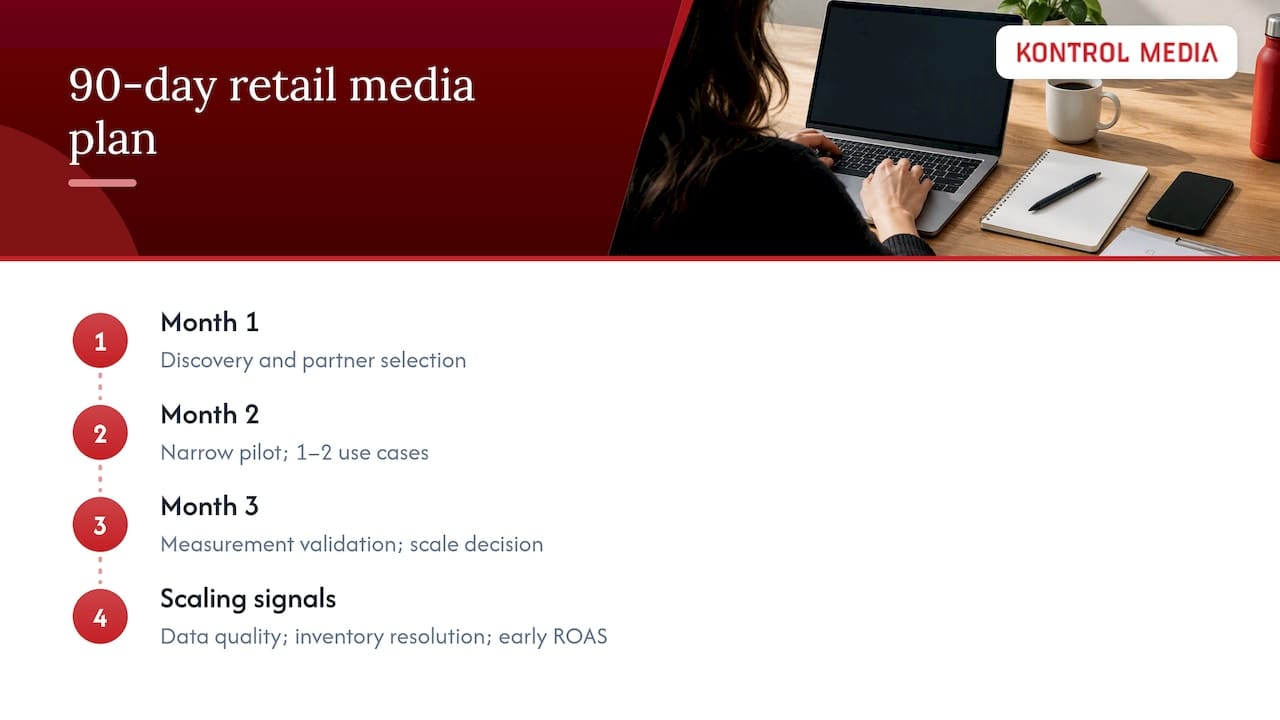
Certain consultancies run retail and commerce media networks for brands and retailers, which means watching this exact sequence play out on a clock. A workable 90-day plan looks like discovery and partner selection in the first month, a narrow pilot with one or two use cases in month two, and measurement validation feeding a scale decision in month three.
The signals that determine whether a pilot scales are consistent: data quality in the first integration test, how much of the partner’s inventory and audience actually resolves against your identity backbone, and early ROAS against a defined benchmark. When those three line up, scaling is a commercial conversation. When they do not, the problem is almost always technical readiness, not the partnership concept itself.
What the data actually tells us about this market
The conventional advice treats retailer data partnerships as a measurement upgrade, a better way to prove what campaigns already worked. That undersells it. The real shift is that purchase data is becoming the planning input, not just the report card, and brands that still treat these partnerships as an attribution bolt-on are leaving the better half of the value on the table.
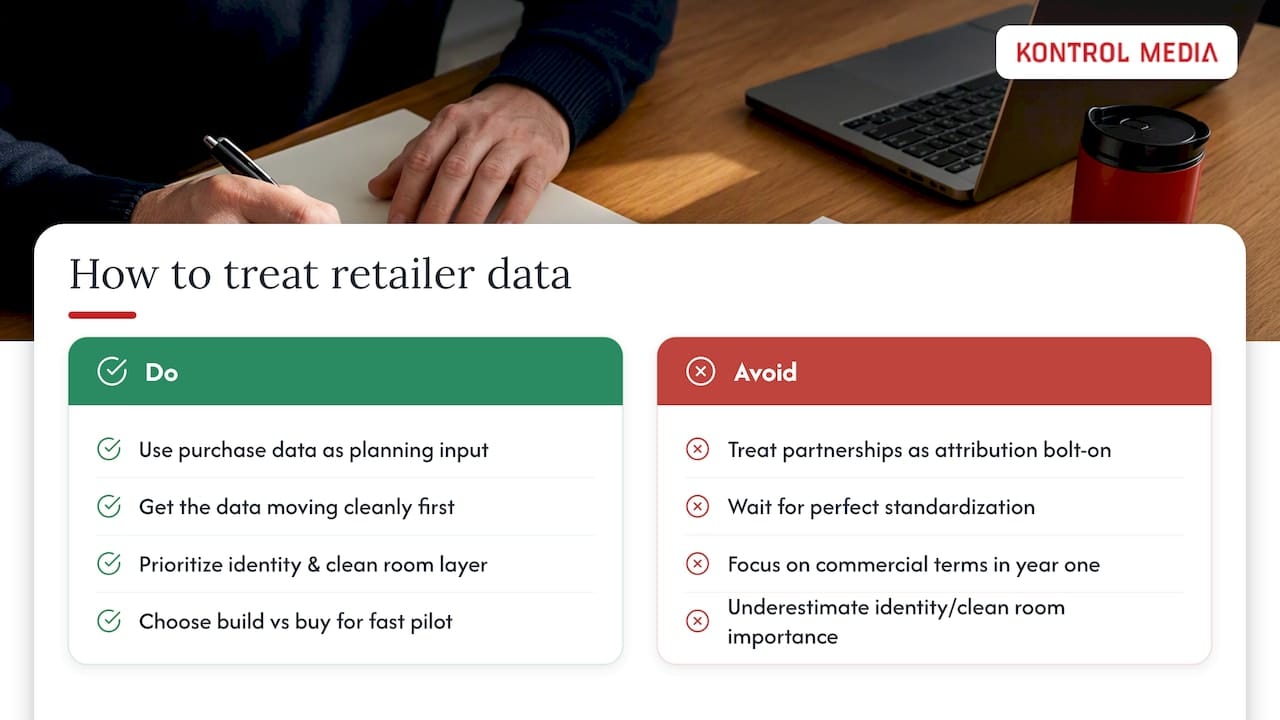
The ANA’s work with the Media Rating Council on measurement standards exists because the industry spent years running retail media deals without a shared definition of what a clean comparison even looks like. That gap is closing, but slowly, and any brand waiting for perfect standardization before acting will watch competitors capture the audience precision first.
My honest read: build vs. buy is less about capability and more about speed to a working pilot. Most teams underestimate how much the identity and clean room layer determines everything else, and overestimate how much the commercial terms matter in year one. Get the data moving cleanly first. Negotiate harder once you can prove it works.
— Mark Kapczynski
How Kontrol Media supports retailer data partnerships
Standing up these partnerships well usually takes more hands than a marketing team has free, which is where a focused build-or-operate partner earns its keep. Some firms build, operate, and drive revenue for retail and commerce media networks, including the identity integration and measurement structure this article describes.
- We help retailers and brands design the commercial model behind a data partnership, not just the technical pipes.
- Our retail media network operations service handles day-to-day execution once a program moves past pilot.
- For teams starting from zero, our stand up a retail or commerce media network service covers the full build.
If complex integrations or monetization planning are slowing your timeline, talk to us about standing up your network.
Sources
- ANA: Lack of measurement standards across retail media networks
- IAB | Retail Media Advanced Measurement and Data Collaboration
- Forrester TEI: Data collaboration benefits and measurement (LiveRamp case examples)
- WunderKIND Ads & Attain commerce data solution delivers measurable ROI
FAQ
What are retail partnerships?
Retail partnerships are formal arrangements between retailers and brands, agencies, or platforms to share audience, transaction, or media inventory for mutual benefit. In the context of data, they typically involve permissioned purchase or loyalty data used to power advertising, attribution, or product decisions.
What are the top retail analytics companies?
The retail analytics space includes identity resolution providers, clean room vendors, and measurement platforms, each handling a different piece of the data partnership stack. Rather than naming a fixed leaderboard, it’s more useful to evaluate vendors by their integration coverage, clean room capability, and measurement rigor against IAB guidance.
What are the 5 P’s in retail?
The 5 P’s of retail marketing are typically listed as product, price, place, promotion, and people, a framework describing the core levers retailers manage. Retailer data partnerships mainly affect promotion and people, since they improve targeting precision and personalization using permissioned purchase signals.
What are the 7 types of retailers?
Common retail classifications include department stores, specialty stores, supermarkets, convenience stores, discount stores, warehouse clubs, and e-commerce retailers, though definitions vary by source. Retailer data partnerships apply across most of these formats wherever a retailer collects transaction or loyalty data it can permission for sharing.
How do data clean rooms protect consumer privacy?
Data clean rooms match brand and retailer data inside a controlled environment and release only aggregated or deidentified results, never raw records, which keeps personal data from passing between parties. The IAB’s legal analysis of clean rooms under U.S. state privacy laws notes that outputs tied to individual-level data rather than deidentified aggregates can still be treated as a sale under some state rules unless contracts are carefully structured.