


Yes, branded content is a viable revenue stream for publishers — but only when three conditions are in place: a defined, reachable audience with first-party data, a sales team or process capable of packaging and closing deals, and a distribution infrastructure that can deliver guaranteed outcomes to brand partners.
Digiday research shows branded content ranked as publishers’ second-largest revenue source in recent surveys, with 94% of publishers earning some revenue from it as of Q1 2025. That is not a niche experiment. Publishers who are already building direct relationships with advertisers, own an engaged audience, and can measure outcomes are the ones capturing the most value.
Publishers who should hold off: those with smaller or less engaged audiences, no dedicated sales capacity, and no ability to produce or distribute content at a repeatable quality level. Branded content rewards operational maturity. Without it, the economics rarely work.
- Audience quality and size: A defined, engaged, first-party audience is the core asset brands are buying access to.
- Sales and productization capability: Packaged offerings with clear deliverables, pricing, and SLAs close faster and at better margins than custom scopes.
- Distribution and measurement: Owned channels plus a reporting framework that proves outcomes are what justify premium pricing.
Table of Contents
- Is branded content a viable revenue stream for publishers — what the format actually is
- Why publishers invest: the revenue and audience case
- How branded content performs vs. display: metrics that matter
- Business models and pricing: how publishers charge for branded content
- How to productize branded content: the operational playbook
- Production and operations: in-house studio, agency, or partnership?
- Distribution strategy and measurement frameworks that make branded content sellable
- Risks, editorial safeguards, and legal considerations
- Short examples of branded content that moved revenue
- Decision checklist: is branded content right for your publication?
- Key Takeaways
- The case for treating branded content as a product, not a project
- Kontrol Media helps publishers build branded content as a revenue line
- Authoritative sources and further reading
Is branded content a viable revenue stream for publishers — what the format actually is
Branded content is sponsored editorial storytelling produced in partnership with a brand, published under the publisher’s editorial standards, and distributed through the publisher’s owned channels. The brand funds it; the publisher shapes it. That distinction separates it from content marketing, native advertising, and display.
- Branded content: — A brand sponsors a piece of editorial storytelling. The publisher controls the voice and format; the brand provides the brief and budget. Example: a sponsored video series on a finance publisher’s newsletter, covering retirement planning with a wealth management firm as the partner.
- Native advertising: — Paid ad units designed to match a publication’s editorial look and feel, but clearly labeled as ads. Less editorial depth than branded content; typically bought programmatically.
The practical difference matters for pricing and measurement. Branded content commands a premium because it delivers audience trust, editorial credibility, and deeper engagement that display cannot replicate. Publishers who conflate it with native ads consistently underprice it.
Why publishers invest: the revenue and audience case
The commercial upside for publishers is real and growing. Branded content studios reported 18% year-over-year revenue growth in 2025, and 55% of studios surpassed their revenue targets that year. Those numbers reflect a structural shift in where brand budgets are going, not a single-year spike.
The revenue advantages over display are meaningful:
- CPM uplift: Branded content packages typically command significantly higher effective CPMs than programmatic display, because publishers are selling outcomes and audience trust, not raw impressions.
- Project margins: Well-productized branded content campaigns carry higher margins than custom editorial projects because the scope is defined upfront.
- Recurring partnerships: A brand that sees measurable outcomes from one campaign has strong incentive to renew. Recurring partnerships are the real prize, and they compound over time.
On the audience side, branded content done well tends to increase time on page and deepen reader trust, provided the editorial standards are maintained and the content genuinely serves the reader. When it reads like an ad in disguise, it erodes both. The trust transfer only works when the publisher’s voice is authentically present.
Advertisers are spending more than $85 billion annually on content marketing in North America, with 77% of that going to digital channels. Many advertisers using content marketing rate it effective — and many report they believe they are underspending in the category. Publishers who understand how to capture that budget are sitting on a significant opportunity.

How branded content performs vs. display: metrics that matter
The performance gap between branded content and display is most visible in engagement, not impressions. Here is how the two formats compare across the dimensions that matter most for a publisher’s commercial pitch:
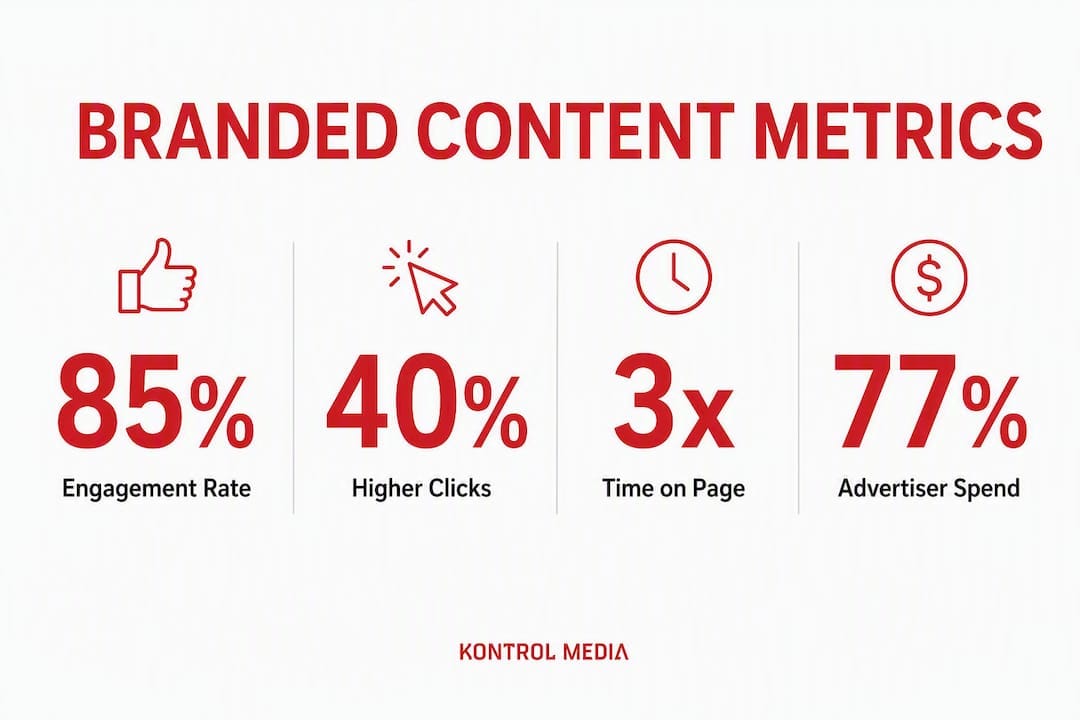
| Dimension | Branded Content | Display Advertising |
|---|---|---|
| Engagement uplift | High — longer time on page, higher scroll depth | Low — banner blindness is widespread |
| Pricing model | Flat fee per asset, package/series, or retainer | CPM, CPC, or programmatic floor |
| Time to launch | 2–6 weeks for standard pieces; 8–12 weeks for flagship | Hours to days |
| Scalability | Moderate — requires editorial and sales capacity | High — programmatic scales automatically |
| Primary distribution | Owned channels (newsletter, hub, social) | Paid/programmatic network |
The KPIs brands want to see from branded content campaigns are different from display metrics. Publishers need to report on a minimum set:
- Time on page: Benchmark against editorial average; branded content should meet or exceed it.
- Click-through rate (CTR): From content to brand destination; typically 1–3% for well-targeted pieces.
- Lead rate or conversion event: For performance-oriented campaigns, tracked via UTM parameters and landing page analytics.
- Viewability and completion rate: For video assets, completion rate above 50% is a credible benchmark.
- Brand lift indicators: Survey-based or panel-based measurement for awareness and purchase intent, typically reserved for larger campaigns.
Publishers who can report against this set consistently are the ones who convert one-off campaigns into annual partnerships. Measurement is not a reporting afterthought; it is a sales tool.
Business models and pricing: how publishers charge for branded content
Pricing branded content is one of the areas where publishers most consistently leave money on the table. The format supports several models, and the right one depends on the publisher’s audience size, production capacity, and the brand’s objective.
- Flat fee per asset: A single price for a defined deliverable — one article, one video, one podcast episode. Predictable for both sides; works well for pilots and first-time partners.
- Package or series subscription: A bundled price for a defined number of assets over a set period, often three to six months. Encourages recurring relationships and simplifies the sales conversation.
- Revenue share or performance model: The publisher earns a base fee plus a variable component tied to leads, conversions, or traffic delivered. Appropriate when the publisher has strong attribution capabilities and the brand is performance-oriented.
- Studio retainer: A monthly fee for ongoing creative and distribution services. Suits brands that want a consistent content presence without managing production themselves.
What drives rate? Three factors dominate: audience size and quality (a 500,000-subscriber newsletter commands more than a 50,000-subscriber one), production complexity (a six-part video series costs more than a single article), and distribution guarantees (a publisher who can promise newsletter placement to a defined segment charges more than one offering run-of-site placement).
Timeline expectations are equally important to set upfront. A quick-turn sponsored article can go from brief to live in two weeks. A flagship branded content series — with video, custom design, and multi-channel distribution — typically requires eight to twelve weeks from kickoff to launch. Brands that have not done this before often underestimate the approval cycles alone.
How to productize branded content: the operational playbook
Publishers that productize their offerings — selling predefined packages instead of negotiating custom scopes for every deal — avoid the cost of complexity and maintain higher margins. This is the single most important operational shift a publisher can make when building a branded content business.
Here is the productization checklist:
- Define two to three standard packages with fixed deliverables, pricing, timelines, and distribution guarantees. Name them clearly (e.g., “Sponsored Story,” “Content Series,” “Brand Studio Partnership”).
- Set SLAs for each package: approval windows, revision rounds, reporting cadence, and go-live timelines.
- Attach KPIs to each package so the brand knows what outcomes to expect before signing.
- Build a standard SOW template that covers deliverables, timelines, approval process, content ownership, FTC disclosure requirements, and reporting format.
- Create a sales deck that leads with audience data, engagement benchmarks, and past campaign outcomes — not just reach.
- Establish an outreach cadence for new brand partners: initial pitch with audience data, follow-up with a sample asset or case study, proposal within five business days of expressed interest.
The sales pitch that works is built on first-party audience data and guaranteed distribution. Brands are not buying a vague editorial halo; they are buying access to a specific audience, delivered through a specific channel, with a specific reporting outcome. Publishers who package strategy, storytelling, and distribution together tend to capture more advertiser spend than those selling impressions alone.
On team structure: a dedicated branded content seller is worth the investment once you have two or more packages defined and a pipeline of at least ten qualified brand prospects. Before that threshold, a senior editorial or commercial leader can carry the sales motion. The margin trap to avoid is assigning custom project management to every campaign — that overhead erodes the economics faster than most publishers realize.

Pro Tip: Build your SOW template before you close your first deal, not after. The approval and revision clauses are where most branded content campaigns stall, and having them defined upfront protects both your timeline and your margin.
For publishers building their advertiser acquisition pipeline, the productization step is what separates a repeatable revenue line from a series of one-off projects.
Production and operations: in-house studio, agency, or partnership?
The production model you choose shapes your cost structure, your quality ceiling, and how fast you can scale. There is no universally right answer, but the trade-offs are clear.
| Model | Cost | Speed | Quality Control | Scalability |
|---|---|---|---|---|
| In-house studio | High fixed cost; lower per-unit cost at volume | Fastest for revisions and approvals | Highest — full editorial oversight | Strong once team is built |
| White-label agency | Lower fixed cost; higher per-unit cost | Moderate — dependent on agency capacity | Moderate — requires clear briefs and review cycles | High — agency scales with demand |
| Joint partnership | Shared cost; revenue share or co-investment | Variable | Shared — requires defined editorial standards | Moderate — dependent on partner alignment |
Operationally, the details that kill campaigns are rarely creative. CMS integration, asset storage, legal signoff workflows, and analytics continuity are where production breaks down. Custom-coded CMS solutions for branded content often fragment analytics and harm SEO; middleware or native visual editor integrations preserve tracking continuity and CMS stability. That is a technical decision with direct commercial consequences.
AI is being used primarily for efficiency in branded content production — drafting, transcription, image sourcing, and workflow automation. Human creativity and editorial judgment remain the core value proposition. Publishers who use AI to reduce production time on commodity tasks while keeping human editors in control of voice and standards are the ones getting the efficiency gains without the quality risk. For a deeper look at applying AI without compromising brand integrity, the Kontrol Media guide on AI and brand is worth the read.
Pro Tip: Avoid building bespoke front-end code for each sponsored asset. A middleware layer or a visual editor that sits on top of your existing CMS preserves your SEO equity, keeps your analytics intact, and saves your engineering team from a maintenance burden that compounds with every new campaign.
For publishers evaluating creative production partners, Hala Creative Agency’s production workflow offers a useful reference for how agency handoffs and approval cycles can be structured.
Distribution strategy and measurement frameworks that make branded content sellable
Owned channels first. That is the principle that protects both your margins and your reader trust. A newsletter placement to a defined segment, a dedicated hub page, or a featured slot in a weekly digest delivers better engagement metrics than run-of-network paid amplification — and it costs you less to execute.
The distribution priority order:
- Owned channels: Newsletter, editorial hub, homepage feature, podcast mention. Highest trust, best engagement, lowest incremental cost.
- Paid amplification: Social promotion, content discovery networks, or programmatic native. Extends reach beyond your owned audience; adds cost but can be included in the package price.
- Partner syndication: Co-distribution with complementary publishers or platforms. Useful for flagship campaigns that need broader reach.
The measurement framework you offer to brand partners is what justifies premium pricing. A basic reporting template should include:
| Metric | Definition | Reporting Cadence |
|---|---|---|
| Time on page | Average session duration on branded content URL | Weekly during campaign |
| CTR to brand destination | Clicks from content to brand URL / total sessions | Weekly |
| Lead or conversion rate | Defined conversion event / total sessions | Weekly |
| Newsletter open and click rate | For email-distributed pieces | Per send |
| Brand lift (if applicable) | Survey-based awareness or intent shift | End of campaign |
Attribution windows matter. A 30-day post-click window is standard for most branded content campaigns; for awareness-focused work, a 14-day view-through window is reasonable. Define these in the SOW before the campaign launches, not after, because post-hoc attribution debates are the fastest way to lose a renewal.
For publishers building out their marketing ROI measurement approach, the same incrementality testing principles that apply to paid media apply here. Baseline the metric before the campaign, measure during, and report the delta.
Risks, editorial safeguards, and legal considerations
The FTC requires clear and conspicuous disclosure for all sponsored content in the United States. “Sponsored by” or “Paid partnership with” placed above the headline, in a font and color that is clearly visible, meets the standard. Burying disclosure in a footer or using ambiguous language like “presented by” in small gray text does not. The risk is not just regulatory; undisclosed sponsored content, when readers notice it, damages the trust that makes branded content worth buying in the first place.
Brand safety and editorial integrity require a separate signoff process. The brand approves the brief and the final asset; the publisher controls the voice, the framing, and the editorial standards. Those two approval tracks should never merge into a single “brand edits the article” process. When a brand starts rewriting editorial copy, the content stops being branded content and becomes an advertorial — which carries different reader expectations and different FTC treatment.
Red flags that should stop a deal:
- A brand requesting removal of FTC disclosure language or asking for disclosure to be placed below the fold.
- Claims in the brief that are not substantiated or that conflict with your editorial standards (e.g., health claims without clinical backing).
- A brand that cannot define a measurable campaign objective — “just get our name out there” is not a KPI.
- No defined approval window in the contract, which creates unlimited revision cycles.
- Conflicts of interest between the brand’s category and your editorial coverage (e.g., a financial publisher running sponsored content from a company it also covers critically in news).
66% of brand-publisher partnerships in early 2026 were net-new, which means publishers cannot rely on repeat clients to fill the pipeline. That reality makes the deal qualification process more important, not less — a bad deal costs more in editorial credibility than it earns in revenue.
Short examples of branded content that moved revenue
Three cases illustrate what measurable outcomes look like at different scales and formats.
Sponsored newsletter series, B2B publisher: A mid-sized B2B technology publisher packaged a six-part sponsored newsletter series for a SaaS brand targeting IT decision-makers. The series ran over eight weeks, with each edition featuring one sponsored article and one brand-hosted resource. The campaign delivered a 2.4% CTR from newsletter to brand landing page, and the brand reported a 31% increase in demo requests during the campaign window compared to the prior eight-week baseline. The lesson: defined audience segments and guaranteed newsletter placement are what justify the premium over display.
Branded video hub, lifestyle publisher: A lifestyle publisher built a custom content hub for a consumer packaged goods brand, featuring six short-form videos and supporting articles. Distribution ran across owned social, newsletter, and the hub page. Average video completion rate reached 58%, and time on page for the hub averaged 3 minutes 42 seconds against the site’s editorial average of 1 minute 55 seconds. The brand renewed for a second series at a higher fee. The lesson: completion rate and time on page are the metrics that convert a one-off deal into a recurring partnership.
Sponsored podcast integration, regional news publisher: A regional news publisher added a branded content segment to its weekly podcast, sponsored by a local financial services firm. The segment ran for 12 episodes over three months. Post-campaign listener survey data showed a 22-point lift in brand awareness among regular listeners. The lesson: audio formats with loyal, habitual audiences can deliver brand lift metrics that written content rarely achieves, and those metrics open conversations with brand managers who care about awareness over clicks.
Decision checklist: is branded content right for your publication?
Before committing budget and team capacity, work through this checklist. It is designed to give you a clear go, pilot, or defer decision.
- Audience size and quality: Do you have at least 50,000 monthly uniques or 20,000 newsletter subscribers in a defined, addressable segment? If not, the audience is too thin to justify a brand’s investment.
- First-party data: Can you describe your audience with demographic, behavioral, or intent data beyond basic pageview analytics? Brands are buying precision, not just reach.
- Sales capacity: Do you have someone who can own the outreach, proposal, and close process? Branded content does not sell itself.
- Production capability: Can you produce a branded article, video, or podcast episode at a quality level consistent with your editorial standards, within a defined timeline?
- Distribution guarantees: Can you commit to specific placements — newsletter slot, hub page, social post — with defined reach minimums?
- Measurement infrastructure: Do you have UTM tracking, session analytics, and a reporting template ready to deliver to a brand partner?
- Legal and editorial process: Do you have an SOW template, FTC disclosure language, and a defined approval workflow?
A simple ROI model for a pilot campaign: take the expected flat fee (e.g., $8,000 for a sponsored article plus newsletter distribution), subtract production cost (e.g., $2,000 for writing, design, and project management) and amplification spend (e.g., $500 for paid social), and you have a gross margin of $5,500 on a single asset. At three campaigns per quarter, that is $16,500 in gross margin from a single package tier. The question is whether your sales capacity can close three deals per quarter at that price point.
If you pass six of the seven checklist items, launch a pilot with two to three brand partners before building a full studio. If you pass four or fewer, invest in the gaps first. Hiring a dedicated branded content seller makes sense once you have a defined package, a pipeline of ten or more qualified prospects, and at least one successful campaign to reference.
For publishers also evaluating adjacent revenue models, retail and commerce media networks are worth understanding as a parallel path, particularly for publishers with strong purchase-intent audiences.
Key Takeaways
Branded content is a viable and growing revenue stream for publishers who have the audience quality, sales capacity, and measurement infrastructure to productize and deliver it at scale.
| Point | Details |
|---|---|
| Industry adoption is high | 94% of publishers earned some branded content revenue in Q1 2025, making it the second-largest publisher revenue source. |
| Productization drives margins | Predefined packages with fixed SLAs and KPIs reduce the cost of complexity and protect margins better than custom scopes. |
| Owned distribution is the margin protector | Newsletter and hub placements deliver better engagement metrics and lower incremental cost than paid amplification. |
| Measurement converts deals to renewals | A standard reporting template covering time on page, CTR, and lead rate is what turns one-off campaigns into annual partnerships. |
| Kontrol Media accelerates the path | Kontrol Media helps publishers build the strategy, sales process, and operational model to launch and scale branded content as a repeatable revenue line. |
The case for treating branded content as a product, not a project
The publishers who are winning with branded content are not the ones with the biggest audiences or the most sophisticated studios. They are the ones who made a deliberate decision to treat it as a product line, not a one-off service.
That distinction sounds simple, but it changes everything downstream. When branded content is a product, you have a price list, a sales process, a defined deliverable, and a reporting template. When it is a project, you have a negotiation, a custom scope, a margin leak, and a renewal conversation that starts from zero every time.
The industry data backs this up. Studios that hit 18% year-over-year growth in 2025 were not doing it by being more creative than their competitors. They were doing it by being more systematic. 55% of branded content studios exceeded their revenue targets in 2025. Productization is what separates the publishers who are building a durable revenue line from the ones who are running a very expensive content agency for brands, one deal at a time.
There is also a timing argument. Digiday’s research on publisher revenue priorities shows direct-sold ads and branded content at the top of publishers’ near-term growth plans. The brands are ready to spend. The question is whether your commercial infrastructure is ready to capture it.
One more thing worth saying plainly: branded content is not a rescue strategy for a publisher with a declining audience. It amplifies what is already working. If your audience is engaged, your editorial standards are high, and your first-party data is clean, branded content can become the highest-margin revenue line you operate. If those foundations are shaky, no amount of productization will fix the underlying problem.
Kontrol Media helps publishers build branded content as a revenue line
Publishers who know branded content is the right move but are not sure where to start — or where they are stalling — are exactly who Kontrol Media works with. The work is not theoretical. Kontrol Media brings hands-on execution to the commercial and operational challenges that keep publishers from turning branded content into a repeatable, scalable revenue line.
The engagements typically cover the areas where publishers get stuck: defining the right package structure and pricing, building the sales process and outreach cadence, setting up the measurement framework that justifies premium rates, and aligning the editorial and commercial teams around a shared workflow. For publishers also considering adjacent revenue models, Kontrol Media’s work in retail and commerce media network strategy offers a parallel path worth exploring.
If you are ready to move from ad-hoc branded content projects to a productized revenue line, start with a strategy conversation to map where your biggest gaps and opportunities are.
Authoritative sources and further reading
The following sources informed this article and are worth bookmarking for ongoing research into branded content strategy and publisher revenue models.
- Branded Content Project: The $85 Billion Opportunity — The best single source for understanding the scale of the content marketing budget that publishers are competing for, and why productization is the key to capturing it.
- Digiday: Branded content rebounds as a top publisher revenue source — Survey-based data on publisher revenue mix and branded content’s position within it; useful for benchmarking your own revenue diversification.
- Digiday: How publisher revenue streams are shifting in 2026 — Covers near-term revenue priorities across major publishers; good context for where branded content sits relative to subscriptions and programmatic.
- Native Advertising Institute: State of Native Advertising and Branded Content 2026 — The most comprehensive annual industry report; covers studio growth, AI’s role in production, and advertiser sentiment.
Recommended
- Why Brands Belong in News | Kontrol Media Consultancy
- Unlocking New Revenue Streams: The Power of Commerce Media for Your Business | Kontrol Media Consultancy
- Consumer Brand Media Network Best Practices in 2026 | Kontrol Media Consultancy
- Do Brands Still Advertise on News Sites? A CMO’s Guide | Kontrol Media Consultancy