


Yes, brands still advertise on news sites, and the smartest ones are increasing that spend. The one move we’d recommend to any CMO right now: run a short, transparent pilot with contextual controls rather than defaulting to broad blocklists that quietly kill your best inventory. Stagwell research shows exclusive news followers grew from 11.1% to 13.8% of U.S. adults, and General Motors increased news investment double digits over three years, citing incremental, unduplicated reach as the driver. The IAB’s News Trust Halo study found most consumers say their trust in a brand stays the same or increases when they see its ad next to news content. That’s not a niche finding. That’s a channel signal worth acting on.
Table of Contents
- Do brands still advertise on news sites, and why does it matter now?
- Brand safety versus suitability: why the distinction changes everything
- How to design a 60–90 day news pilot that actually teaches you something
- Measurement that proves news-site impact to your CFO
- Common mistakes that quietly kill news campaigns
- Four steps CMOs can delegate today
- Key Takeaways
- The news channel deserves a second look
- Kontrol Media helps you run the pilot and build the playbook
- Useful sources and further reading
Do brands still advertise on news sites, and why does it matter now?
The short answer is yes, and the more interesting question is why so many brands pulled back in the first place. The retreat was largely driven by automated brand-safety tools and agency risk aversion, not by actual consumer data. News audiences are among the most valuable in digital advertising, and the performance evidence has been building for years.
News audiences over-index on exactly the demographics retail and real estate advertisers want. Stagwell’s research puts Gen X news readers at 64% versus 58% for the general population, college-educated at 51% versus 38%, and six-figure earners at 37% versus 28%. For a brand trying to reach home buyers or high-income retail customers, those numbers represent a targeting advantage most channels can’t replicate.
“Ads placed adjacent to stories covering politics or gun shootings perform as effectively as ads placed next to a positive business story, on par with spots and entertainment — there’s only a four-percentage-point gap in buyer intent between ‘safe’ content and impactful news coverage.” — Stagwell, The Future of News
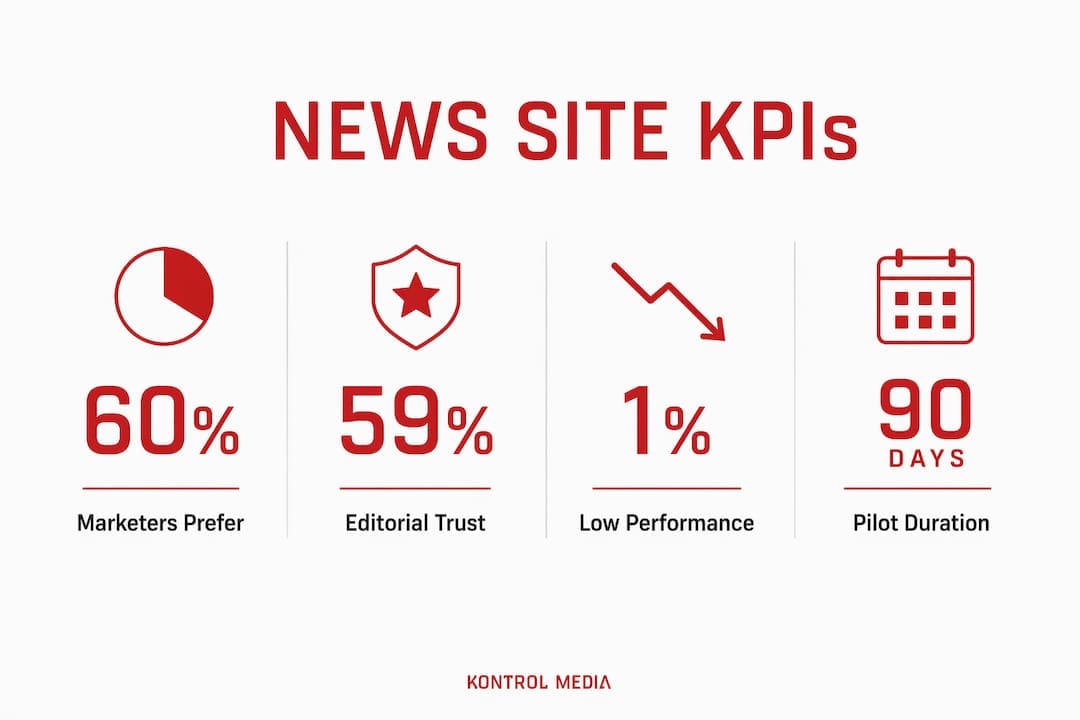
The credibility effect is real, too. INMA reporting cites editorial media trust at 59% versus 10% for social platforms. Brands that advertise on news sites aren’t just buying impressions. They’re borrowing the credibility of the editorial environment around them.
A DoubleVerify/AdPulse survey found that 60% of marketers say news placements outperform digital baselines, and only 1% consider all news content unsuitable for their brand. The data is consistent: news is an underpriced channel that many brands have abandoned based on outdated fears rather than current performance evidence.
Brand safety versus suitability: why the distinction changes everything
Brand safety and brand suitability are not the same thing, and conflating them is the single most expensive mistake in news advertising. Safety is objective: your ad should not appear next to hate speech, illegal content, or graphic violence. Suitability is subjective: it reflects your brand’s specific values and the context that fits your audience.
The problem is that most automated tools apply a blunt safety filter to what is actually a suitability question. ThinkNewsBrands CEO Vanessa Lyons has called directly for a rethink of keyword blocklists, warning that automated exclusions routinely remove ads from trusted journalism. Hearst’s own analysis found that blunt keyword lists can incorrectly flag a substantial portion of legitimate local newspaper impressions as unsafe.
“Marketers should demand visibility into excluded keywords. Safety is objective, but suitability must be decided by the brand with human oversight.” — ThinkNewsBrands
Pro Tip: Ask your agency or DSP for a full CSV export of your current keyword blocklist. Then run it against a sample of premium news URLs you’d actually want to be on. The overlap is usually eye-opening.
A practical suitability framework for CMOs:
- Separate your blocklist into two tiers: hard safety exclusions (non-negotiable) and soft suitability flags (brand-specific, reviewed quarterly).
- Apply page-level contextual analysis rather than domain-level bans.
- Require human review for edge-case categories like breaking news, crime, and politics.
- Set tiered adjacency policies: homepage placements, section-level buys, and article-level contextual units each carry different risk profiles.
- Review your HuffPost, BuzzFeed, and major digital news publisher settings separately from local news inventory, since brand safety on platforms like HuffPost requires a different calibration than a local newspaper site.
How to design a 60–90 day news pilot that actually teaches you something
A pilot without a hypothesis is just spending. Define what you’re testing before you buy a single impression.
1. Set your pilot goals upfront. Target incremental reach among your defined audience (home buyers, high-income retail shoppers), a measurable brand lift in awareness or consideration, and a CAC comparison against your current best-performing channel.
2. Choose your formats deliberately. Homepage placements deliver scale and brand visibility. Local news contextual units deliver unduplicated reach. Native content units in high-attention sections (business, real estate, personal finance) deliver engagement. Run at least two formats to understand what the channel does for you at different funnel stages.

3. Structure your buys across three partner types. Publisher direct buys give you transparency and premium placement. Programmatic with contextual targeting gives you scale. For real estate and retail advertisers, retail and commerce media partnerships can layer audience data on top of news inventory for tighter targeting.
4. Follow a clear timeline.
- Weeks 1–2: Finalize creative, set blocklist parameters, confirm supply-path transparency with your DSP.
- Weeks 3–6: Run the test with matched control groups; collect publisher reporting weekly.
- Weeks 7–8: Analyze incremental reach, brand lift survey results, and CAC data.
- Weeks 9–12: Scale what’s working, cut what isn’t, and document suitability rules for the always-on phase.
5. Demand transparency at every step. Require line-item reporting for local news placements, supply-path reports for all programmatic buys, and a blocklist audit before the campaign launches.
Pro Tip: Isolate your news inventory from the rest of your programmatic buy during the pilot. Mixing it in makes attribution nearly impossible and obscures the incremental value news actually delivers.
Measurement that proves news-site impact to your CFO
The measurement plan matters as much as the pilot design. News advertising’s value shows up across multiple metrics, and relying on last-click attribution alone will consistently undervalue it.
| KPI | What It Measures | Recommended Approach |
|---|---|---|
| Incremental reach | Unduplicated audience not reached by other channels | Unique overlap analysis vs. social/search |
| Brand lift | Awareness and consideration shifts | Third-party brand-lift survey (pre/post) |
| CPM efficiency | Cost per thousand vs. channel benchmarks | Publisher reporting + verification vendor |
| CAC/ROAS | Direct performance for lower-funnel campaigns | Multi-touch attribution with weighted credit |
| Audience quality | Demo match to target (income, homeownership) | First-party data overlay + publisher data |
For long-term value, media-mix modeling is the right tool. For the 90-day pilot, a combination of brand-lift surveys and unique-reach analysis gives you enough signal to make a scale decision. Verification vendors add a layer of confidence on impression quality, particularly for local news inventory where misclassification risk is highest.
Common mistakes that quietly kill news campaigns
Most news campaigns underperform not because news doesn’t work, but because of avoidable operational errors.
- Overbroad blocklists that exclude entire news categories rather than specific unsafe content. This is the most common and most costly mistake.
- Black-box exclusions set by agencies without brand review. Surveys show agencies cite controversial adjacency fears up to 20% more than brands themselves, meaning your agency may be more conservative than you actually need to be.
- Ignoring local news, which consistently delivers the highest incremental reach for retail and real estate advertisers but gets swept up in automated exclusions.
- No transparency demand on supply path or exclusion lists. If you can’t see where your ads ran and what was excluded, you can’t improve.
“The average programmatic ad campaign appears on a very large number of websites, meaning CEOs and CMOs often have limited visibility into where their ads are running.” — Association of National Advertisers
Four steps CMOs can delegate today
1. Audit your current exclusions. Request a full blocklist export from every agency and platform running your media. Compare it against a list of premium news publishers you’d actually want to be on.
2. Stand up a 60–90 day pilot. Use the framework above. Define KPIs before you spend a dollar, and isolate news inventory from your broader programmatic buy.
3. Require third-party verification and brand-lift measurement. Don’t accept publisher-only reporting. Use a verification vendor and run a brand-lift study in parallel.
4. Scale into an always-on news layer. Successful pilots should graduate into a permanent news allocation with quarterly suitability reviews, not a one-time test that gets shelved.
Key Takeaways
Brands that treat news as a strategic channel with clear suitability controls consistently find incremental reach, stronger brand perception, and more efficient CPMs than those relying on broad exclusions.
| Point | Details |
|---|---|
| News audiences are high value | News readers over-index on Gen X, college-educated, and six-figure earners versus the general population. |
| Trust halo is measurable | 84% of consumers say brand trust stays the same or increases when ads appear next to news content. |
| Safety and suitability differ | Safety is objective; suitability is brand-specific. Conflating them costs reach and performance. |
| Pilot before scaling | A 60–90 day isolated test with brand-lift measurement is the right entry point before committing a budget. |
| Kontrol Media | Kontrol Media designs and executes news pilots, suitability audits, and retail media integrations for mid-market and enterprise brands. |
The news channel deserves a second look
Here’s what I keep seeing: brands that pulled out of news three or four years ago did so because their agencies flagged adjacency risk, and nobody pushed back. The blocklists went in, the impressions dried up, and the channel got written off. What those brands missed is that the risk calculus changed. The tools got better, the data got clearer, and the audience got more valuable.
The “unintentional boycott” of news is a real phenomenon, and it’s costing brands reach they can’t recover elsewhere. When we look at the clients who’ve run controlled pilots in news environments, the pattern is consistent: incremental reach goes up, CPMs come in below social benchmarks, and brand perception metrics move in the right direction. The hesitation is almost always agency-driven, not data-driven.
For real estate and retail advertisers specifically, local news is the underutilized asset. The audience overlap with active home buyers and high-income shoppers is strong, and the inventory is often available at a fraction of what comparable social placements cost. The brands that figure this out first will hold that position for a while.
Kontrol Media helps you run the pilot and build the playbook
Brands that want to reintroduce news into their media mix often know the “why” but get stuck on the “how.” Kontrol Media handles both. We run suitability audits, design and execute 60–90 day pilots, negotiate publisher and programmatic deals, and build the measurement programs that turn a test into a scalable channel. For real estate and retail advertisers, we layer in home buyer channel strategies and retail media network integration so news doesn’t sit in isolation. It becomes part of a connected media architecture that actually compounds.
Our clients include Experian, BuzzFeed, HuffPost, RE/MAX, and Enthusiast Gaming. We’ve seen what happens when a brand runs a disciplined pilot versus a sloppy one, and the difference is almost entirely in the setup. If you want a pilot that teaches you something and scales, talk to Kontrol Media about a suitability audit and pilot design engagement.
Useful sources and further reading
The claims in this article draw from the following research and industry reporting. For executives who want to go deeper before briefing an agency or approving a pilot budget, this is the recommended reading order:
Start with the performance case:
- Everything You Know About News Advertising Is Wrong — Adweek/Stagwell. Covers audience demographics, the trust halo, and the agency-brand risk gap.
- Marketers Have Spoken: News Sites Outperforms the Rest of Digital — AdPulse/DoubleVerify. Survey data on marketer sentiment and performance benchmarks.
- Research shows the case for news continues to grow — INMA. Editorial trust data and viewership share across markets.
Then the safety and suitability mechanics:
- ThinkNewsBrands calls for rethink of keyword blocklists — Mediaweek. Vanessa Lyons on the blocklist problem and what marketers should demand.
- Hearst rethinks brand safety to unlock news ad yield — Digiday. Practitioner-level detail on false-flagging rates and contextual alternatives.
Then the advertiser behavior evidence:
- As News Advertising Gets Safer, Brands Cash In — Adweek. General Motors case and the technology improvements driving renewed investment.
Kontrol Media reference pages:
- Why Brands Belong in News — Kontrol Media’s methodology and client approach for news advertising.
- Advertising on HuffPost.com: A Brand Safety Guide — Platform-specific brand safety guidance with practical controls.