


A commerce media network (CMN) is any organization that monetizes its first-party transactional data by selling advertising to brands that want to reach buyers at or near the moment of purchase. That definition matters because it extends well beyond the grocery aisle. Commerce media is an umbrella category that includes retail media networks as a subset and reaches into banks, travel platforms, delivery apps, and anywhere else a company owns a rich ledger of purchase intent.
The six main types of commerce media network models are:
- Retail media networks (RMNs): SKU-level purchase data from a single retailer’s ecosystem. Best for: CPG and endemic brands targeting in-aisle conversion. Example: Instacart Ads.
- Financial media networks: Cross-merchant spending history from banks and payments platforms. Best for: non-endemic brands seeking wallet-share signals. Examples: Chase Media Solutions, PayPal Ads, Klarna.
- Travel and hospitality media networks: Booking, loyalty, and itinerary data. Best for: travel-adjacent advertisers and destination brands. Examples: Marriott Media, United Airlines Kinective Media, Expedia / Booking.com.
- Delivery, rideshare, and QSR networks: Real-time location and order data. Best for: local and restaurant brands. Examples: Uber Advertising, DoorDash Ads.
- Marketplace and platform networks: Aggregated seller and buyer signals across a digital marketplace. Best for: multi-category brands and D2C sellers.
- White-label and agency-built networks: Productized CMN infrastructure operated on behalf of a brand or publisher. Best for: organizations that own audience data but lack media operations.
Retail media ad revenue is forecast to surpass TV ad revenue within the coming years, which signals just how much advertiser budget is migrating toward purchase-signal-driven media. Understanding the distinctions between these models is the first step toward allocating that budget wisely.
Table of Contents
- How commerce media differs from retail media in practice
- 1. Retail media networks: the SKU-level foundation
- 2. Financial media networks: cross-merchant purchase signals
- 3. Travel and hospitality media networks: intent at the destination
- 4. Delivery, rideshare, and QSR networks: real-time location and order data
- 5. Marketplace and platform networks: aggregated multi-category signals
- 6. White-label and agency-built networks: productized CMN infrastructure
- How commerce media networks actually operate
- Benefits, risks, and operational challenges of commerce media networks
- Build vs. join: a decision framework for CMOs and media leaders
- Key Takeaways
- A practitioner’s view on where commerce media is actually headed
- Kontrol Media builds and operates commerce media networks for growth-focused organizations
- Authoritative sources and further reading
How commerce media differs from retail media in practice
Retail media is a subset of commerce media, not a synonym. The clearest one-sentence separation: retail media networks are bounded by a single retailer’s data and inventory, while commerce media networks can aggregate transactional signals across merchants, categories, and channels.
That distinction has real operational weight. When a CPG brand runs a sponsored-product campaign on a retailer’s onsite search, it is buying SKU-level conversion signals tied to that retailer’s catalog. The measurement is tight and closed-loop, but the audience is limited to shoppers already inside that retailer’s ecosystem. According to Forrester, data source and control are the key differentiators: RMNs are constrained to a single retailer’s data, while CMNs can aggregate broader footprints for cross-platform targeting.
Consider two brief scenarios. A beverage brand running on a grocery RMN can optimize against add-to-cart and purchase events for its exact SKU, but it cannot see whether that same shopper also buys the same product at a competing retailer. A financial media network like Chase Media Solutions, by contrast, can show that shopper’s cross-merchant spending history, letting the brand understand wallet share and conquest opportunity across the entire category, not just one store.
The practical implication for media planners: RMNs win on conversion precision; CMNs win on audience breadth and cross-merchant intent. 58% of brands and 51% of agencies have expressed interest in retail-like media offerings from non-retail verticals, which tells you the market has already recognized this gap. Mature RMNs have also extended offsite, into CTV and programmatic placements, but they remain anchored to retailer-owned data. Commerce media networks, built by data-rich enterprises outside retail, tend to be more media-centric and interoperable from the start.
1. Retail media networks: the SKU-level foundation
Retail media networks are the most mature model in the commerce media taxonomy. They sit inside a retailer’s owned properties, onsite search, category pages, and display placements, and extend offsite through programmatic and CTV when the network has scaled. The data is SKU-level and closed-loop: a brand can trace an impression directly to a purchase within the same retailer’s transaction record.
Instacart Ads is a strong North American example. Instacart’s grocery delivery data gives CPG brands granular basket-level signals, and its sponsored-product and display formats sit directly in the purchase path. The audience is highly intentional, but it is also bounded: you are reaching Instacart shoppers, not the broader grocery universe.
Best for: Endemic brands (CPG, health, beauty, electronics) that need SKU-level ROAS and closed-loop attribution within a single retailer’s ecosystem.
Operationally, RMNs require close coordination with the retailer’s category management team, and measurement is typically proprietary. Incrementality testing is available at the more mature networks, but standardization across networks remains inconsistent.
2. Financial media networks: cross-merchant purchase signals
Financial media networks are the most data-rich model in the commerce media space, and arguably the most underutilized by North American media planners. Banks and payments platforms see customers’ entire spending history across merchants, giving advertisers a view of wallet share that no single retailer can match.
Chase Media Solutions launched as one of the first bank-owned media networks in North America, using Chase’s cardholder transaction data to serve targeted offers and ads. PayPal Ads operates similarly, leveraging PayPal’s cross-merchant payment graph to reach buyers based on verified purchase behavior. Klarna brings a buy-now-pay-later lens, with intent signals that surface at the moment a consumer is actively financing a purchase decision.
The signal type here is fundamentally different from SKU-level retail data. A financial network can tell you that a shopper spent $400 at a competitor last quarter, that they are a frequent traveler, and that they have not purchased in your category in six months. That is conquest and reactivation intelligence that RMNs simply cannot provide.
Best for: Non-endemic brands, financial services advertisers, and any brand that needs cross-merchant attribution or category-level conquest targeting.
One caveat worth noting: financial networks operate under stricter privacy and regulatory frameworks than retail networks, which affects how audience segments are constructed and shared. Data governance conversations with these partners need to happen before the media plan is written.
3. Travel and hospitality media networks: intent at the destination
Travel and hospitality companies sit on some of the richest intent data available: booking windows, destination preferences, loyalty tier, co-traveler profiles, and ancillary spend patterns. That data is now being productized into media businesses.
Marriott launched its media network to let travel-adjacent brands (car rentals, luggage, dining, experiences) reach guests at verified booking and stay moments. United Airlines Kinective Media uses flight booking and MileagePlus loyalty data to reach travelers across digital touchpoints, from booking confirmation emails to in-flight entertainment. Expedia and Booking.com operate media businesses that let hotels, airlines, and destination brands bid for placement within the booking funnel, where purchase intent is at its highest.
The placement inventory here spans onsite (search results, property pages), email, app notifications, and offsite programmatic. The audience is defined by travel intent and verified booking behavior, which makes it highly valuable for premium brands and destination marketers.
Best for: Travel-adjacent advertisers (rental cars, insurance, dining, experiences), luxury brands, and destination tourism boards.
According to eMarketer’s commerce media explainer, travel and hospitality are among the verticals actively building commerce media businesses, with Marriott and United among the named examples. Measurement maturity in this vertical is still developing, and only 13% of commerce media networks qualify as “trailblazers” across strategy, technology, measurement, and operations, so pilot design and measurement SLAs matter more here than in retail.
4. Delivery, rideshare, and QSR networks: real-time location and order data
Delivery and rideshare platforms have a data advantage that is easy to overlook: they know where you are, where you are going, what you ordered, and how often. That combination of real-time location and verified transaction data creates a media model that is genuinely different from both retail and financial networks.
Uber Advertising uses trip data, destination patterns, and Uber Eats order history to serve ads across the Uber app, including in-trip placements and post-order screens. DoorDash Ads operates a sponsored-listing and display business within its delivery app, with closed-loop attribution tied directly to order events.
The ad formats in this model tend to be more contextual and moment-specific than in other CMN types: a restaurant brand can reach a rider who is two miles from one of its locations, or a CPG brand can appear on the post-checkout screen after a relevant grocery order. The audience is urban-skewed and mobile-first, which suits certain categories well and others less so.
Best for: Restaurant brands, local retailers, CPG brands with delivery channel presence, and any advertiser targeting urban, mobile-first consumers.
Measurement in this model is typically closed-loop within the platform (order attribution), but cross-channel incrementality testing is less standardized than in mature RMNs.
5. Marketplace and platform networks: aggregated multi-category signals
Marketplace media networks operate across a broad catalog of sellers and buyers, giving them a multi-category purchase signal that neither single-retailer RMNs nor vertical CMNs can replicate. The data is wide rather than deep: you see purchase behavior across many categories, but you may lack the SKU-level granularity of a grocery RMN or the cross-merchant financial view of a bank.
These networks typically offer sponsored listings, display, and offsite programmatic placements, with attribution tied to marketplace transactions. The audience scale is large, and the targeting can be layered across category, price point, brand affinity, and purchase recency.
Best for: Multi-category brands, D2C sellers, and advertisers seeking broad reach with purchase-intent signals across a diverse buyer base.
The operational challenge here is inventory competition: because the marketplace is also the retailer, there is an inherent tension between organic ranking and paid placement. Brands need to understand how the network’s auction mechanics interact with their organic presence before committing significant budget.
6. White-label and agency-built networks: productized CMN infrastructure
White-label and agency-built networks represent the newest and most flexible model in the commerce media taxonomy. Here, a technology provider or consultancy builds and operates a CMN on behalf of a brand, publisher, or non-retail organization that owns first-party data but lacks the media operations infrastructure to monetize it independently.
This model is particularly relevant for mid-market companies, regional retailers, and data-rich enterprises outside traditional retail (utilities, healthcare systems, financial institutions) that want to participate in commerce media without building a full media business from scratch. The white-label operator handles identity resolution, ad serving, measurement, and advertiser sales, while the data owner retains control of its audience and revenue share.
Best for: Organizations with valuable first-party data but limited media operations capability; brands that want to test a commerce media model before committing to a full internal build.
Kontrol Media’s retail media strategy guide for non-retailers covers this model in depth, including the governance and tech stack decisions that determine whether a white-label approach is the right entry point.
How commerce media networks actually operate
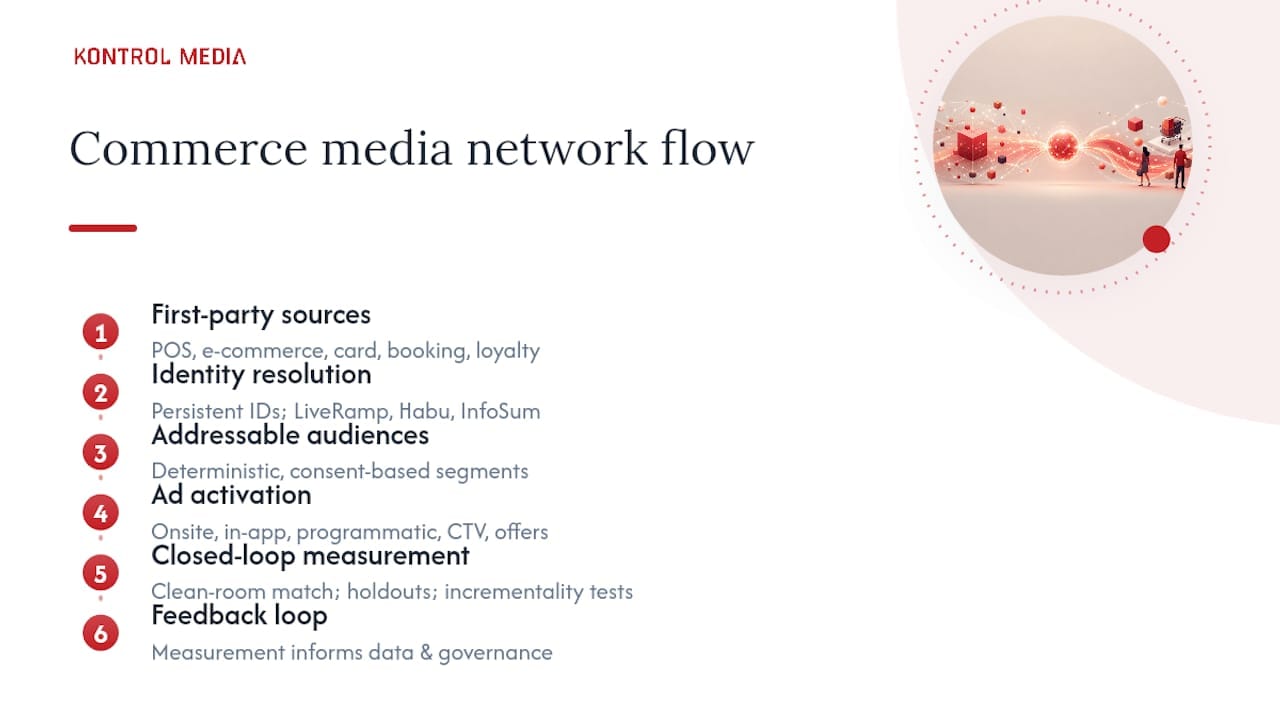
The core operational flow of any CMN follows the same spine: first-party transactional signals feed into an identity resolution layer, which connects those signals to addressable audiences, which are then activated across ad formats and measured against closed-loop transaction outcomes.
First-party data sources vary by model. A retailer uses point-of-sale and e-commerce transaction logs. A bank uses card transaction records. A travel platform uses booking and loyalty data. What they share is that the data is deterministic, consent-based, and tied to real purchase events, not modeled proxies.
Identity resolution and clean rooms are where the operational complexity lives. Matching a shopper’s in-store purchase to an online ad exposure requires a persistent identifier, and doing that at scale without exposing raw PII requires a clean room environment (LiveRamp, Habu, or InfoSum are common infrastructure choices in North America). First-party data governance is the foundation that makes this layer work.
Ad formats and placements span the full funnel. Onsite formats (sponsored listings, banner display, native) capture in-session intent. In-app placements (delivery, rideshare, travel booking) reach consumers in high-intent moments. Offsite programmatic and CTV extend reach to audiences identified by the network’s first-party data but served across the open web or connected TV. Offer and cashback placements, common in financial networks, blend advertising with direct incentive.
Measurement flow connects ad exposure to transaction outcome. Mature networks use clean-room matching to link impression logs to purchase records without sharing raw data. Holdout and incrementality tests isolate the causal lift of the campaign from baseline purchase behavior. Pixelless linking, common in financial and travel networks, uses transaction-level matching rather than browser-based tracking, which makes it more durable in a post-cookie environment.
Pro Tip: When evaluating a CMN partner, ask specifically whether incrementality testing is available as a standard deliverable or requires a custom engagement. Networks that cannot run a holdout test are selling reach, not outcomes.
Benefits, risks, and operational challenges of commerce media networks
The core value of CMNs is deterministic: purchase signals tied to real transactions, not modeled audiences. That means closed-loop measurement, cross-channel attribution, and the ability to connect ad spend directly to revenue outcomes. For brands that have been buying audience proxies on social and display, that shift in signal quality is significant.
The primary risks cluster around three areas:
- Privacy and regulatory exposure: Financial and healthcare-adjacent CMNs operate under stricter data governance frameworks (GLBA, HIPAA adjacency, state-level privacy laws). Audience construction and data sharing must be reviewed by legal before any campaign goes live.
- Measurement fragmentation: Each network reports differently. Without a standardized incrementality methodology, comparing performance across a financial network, a delivery platform, and a retail RMN is an apples-to-oranges exercise.
- Audience overlap: A shopper who is a Chase cardholder, an Instacart user, and a frequent DoorDash customer will appear in multiple networks’ audience pools. Without deduplication, you are paying to reach the same person three times and attributing the conversion to each network independently.
Operationally, the challenges are just as real. Legacy organizational incentives often work against media monetization: a retailer’s category management team and its media sales team have different KPIs, and that tension slows down advertiser onboarding and measurement access. Forrester notes that RMNs often suffer from being run by retail-incentivized teams rather than media-centric operations, and the same dynamic can appear in any CMN that is built as a side project rather than a core business.
Risk mitigation in practice:
- Require data processing agreements and privacy review before signing any CMN contract.
- Design phased pilots with defined holdout groups before scaling budget.
- Standardize incrementality testing methodology across all CMN partners so you can compare results.
- Use clean-room partnerships to deduplicate audiences and reconcile attribution across networks.
- Include a North America privacy compliance review (CCPA, state-level equivalents) as a standard step in any new CMN onboarding.
Pro Tip: Prioritize network partners by measurement maturity first, reach second. A network with 10 million users and no incrementality testing is a worse investment than a network with 3 million users and clean-room access. Reach without proof is just spend.
Build vs. join: a decision framework for CMOs and media leaders
The one-sentence answer: build your own CMN if you own exclusive, high-volume transactional data and have the organizational capacity to run a media business; join an existing network if you need speed, scale, or measurement infrastructure you cannot build in 12 months.
The decision turns on five practical criteria:
Data depth and exclusivity. If your first-party data is genuinely differentiated (cross-merchant, high-frequency, or category-exclusive), building gives you a competitive moat. If your data overlaps significantly with existing networks, joining is faster and cheaper.
Customer base scale. A minimum viable commerce media network requires enough addressable audience to offer advertisers meaningful reach. Below a certain threshold, you are better off licensing your data to an existing network than standing up your own ad stack.
Transaction ownership. If you are the transaction owner (the bank, the retailer, the delivery platform), you have the signal. If you are a partner in someone else’s transaction (a brand, an agency), you are a buyer, not a builder.
Speed-to-market. Building a CMN with identity resolution, ad serving, measurement, and a sales motion takes 12–24 months at minimum. Joining an existing network can generate campaign results in 60–90 days.
Core competencies. Running a media business requires media ops talent, data engineering, privacy counsel, and an advertiser sales team. If those capabilities do not exist in-house, the build path carries significant execution risk.
Sample pilot KPIs for a minimum viable network: match rate above 60% on identity resolution, CPM benchmarks validated against comparable networks, incremental conversion lift measured via holdout test, and time-to-first-campaign under 90 days from contract signature.
When the build path is right but internal capacity is limited, managed support from a specialist like Kontrol Media compresses the timeline and reduces execution risk. Commerce media network setup and operation is a core service offering, covering everything from data governance to advertiser onboarding.
Key Takeaways
Commerce media networks extend retail media logic to any organization with first-party transactional data, and the six model types differ most consequentially on data granularity, measurement maturity, and advertiser use case.
| Point | Details |
|---|---|
| CMNs extend beyond retail | Financial, travel, delivery, and platform networks all qualify as CMNs when they monetize first-party transaction data. |
| Data signal drives strategy | RMNs offer SKU-level conversion data; financial networks offer cross-merchant wallet-share signals. Choose based on your attribution goal. |
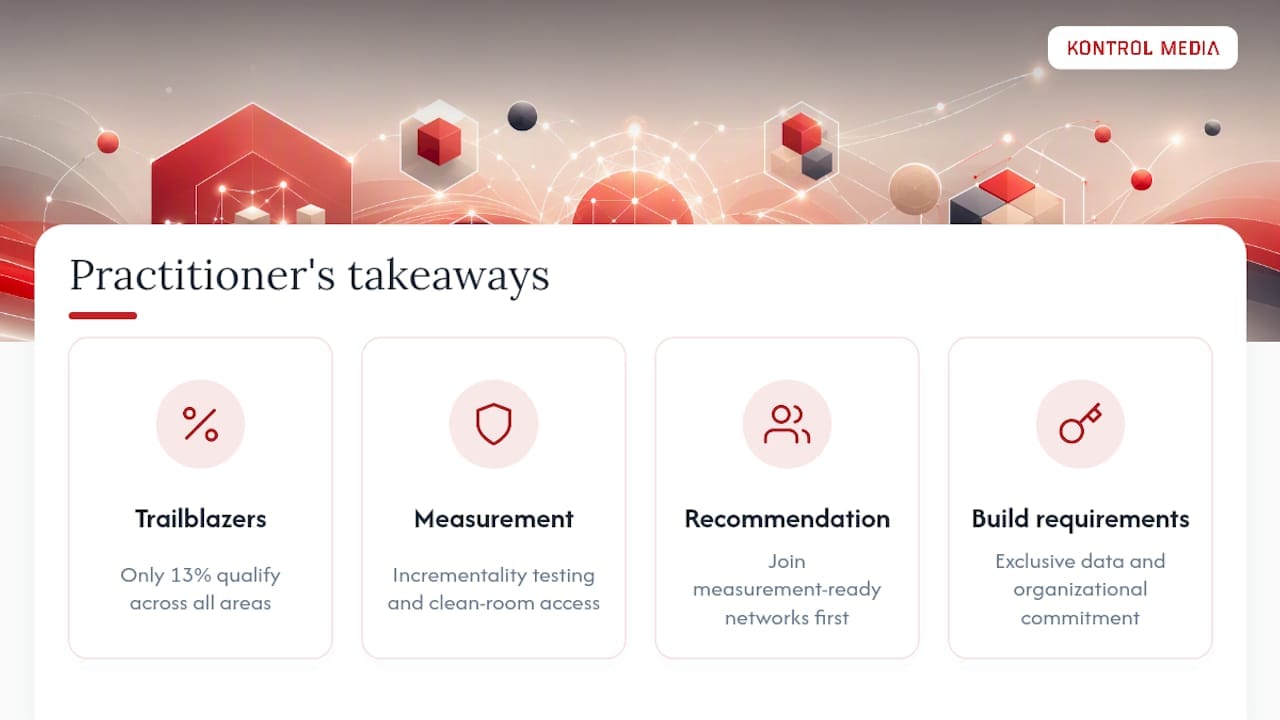
| Measurement maturity varies widely | Only 13% of CMNs qualify as trailblazers across strategy, tech, and measurement; require incrementality testing and clean-room access in every contract. |
| Build vs. join is a capacity question | Build if you own exclusive, high-volume transaction data and can staff a media business; join if you need speed or infrastructure you cannot build in 12 months. |
| Kontrol Media accelerates both paths | Kontrol Media builds, operates, and drives revenue for retail and commerce media networks, compressing the timeline from strategy to first campaign for mid-market and enterprise clients. |
A practitioner’s view on where commerce media is actually headed
The taxonomy above is useful, but I want to be direct about something the category conversation tends to gloss over: most commerce media networks are not ready for the measurement conversations advertisers are starting to demand.
The excitement around financial and travel CMNs is real and justified. Cross-merchant purchase signals and verified booking intent are genuinely superior data assets for certain advertiser use cases. But the gap between the data asset and a productized, measurable media business is wider than most network operators acknowledge. Only 13% of commerce media networks qualify as trailblazers across strategy, technology, measurement, and operations. That is not a knock on the category; it is a realistic picture of where most networks are in their maturity curve.
What I see consistently is that organizations treat CMN launch as a technology project when it is actually a go-to-market problem. The data exists. The identity infrastructure can be procured. What is harder to build is the advertiser sales motion, the measurement story, and the internal alignment between the team that owns the data and the team that needs to sell media against it. Those are organizational and strategic challenges, and they do not get solved by adding another ad tech vendor.
The networks that will win over the next three years are the ones that invest in measurement as a core product capability, not a reporting afterthought. Incrementality testing and clean-room access are the table stakes for any network that wants to hold budget against mature RMNs. Advertisers have learned to ask for proof, and the networks that can provide it will capture a disproportionate share of the budget shift away from traditional media.
For CMOs evaluating whether to build or join, the honest answer is that most organizations should start by joining a network that has already solved the measurement problem, then build their own capability once they understand what “good” looks like from the inside. The build path is worth it when the data is genuinely exclusive and the organizational commitment is real. When either of those conditions is missing, the white-label or managed-support path gets you to market faster and with less execution risk.
Kontrol Media builds and operates commerce media networks for growth-focused organizations
If you have read this far and are weighing whether to build a commerce media network or join an existing one, that decision deserves more than a framework on a page. Kontrol Media works directly with mid-market and enterprise CMOs and heads of growth to stand up and operate retail and commerce media networks, from data governance and identity resolution through advertiser sales and closed-loop measurement. The difference from a typical agency engagement: Kontrol Media handles execution, not just strategy, which means your first campaign can go live in weeks rather than quarters.

Clients include Experian, BuzzFeed, RE/MAX, and West Monroe, organizations that needed a media business built and run, not just advised on. If your organization owns first-party transaction data and wants to know whether a commerce media network is the right next move, contact Kontrol Media to start the conversation.
Authoritative sources and further reading
The sources below are the primary references used in this article. Each is worth bookmarking for procurement, executive briefings, and ongoing measurement conversations.
| Source | Publisher | Why it’s useful |
|---|---|---|
| Commerce media explainer 2024 | eMarketer | Taxonomy, vertical examples, and advertiser interest data (58% of brands, 51% of agencies) across non-retail CMN types. |
| Commerce media: financial vs. retail differences | eMarketer | Explains how financial networks’ cross-merchant data differs from SKU-level retail signals; core reading for financial CMN strategy. |
| From walled gardens to working media: the rise of commerce media | Forrester | Operational and strategic distinctions between RMNs and CMNs; covers data source, control, and media-centric operations. |
| FAQ on commerce media: how to capitalize on growth beyond retail | eMarketer | Maturity benchmarking (trailblazer classification), measurement gaps, and pilot design guidance for emerging CMNs. |
| Retail media ad revenue forecast to surpass TV by 2028 | Reuters | Market-sizing context for the broader commerce and retail media growth story. |
| Commerce media versus retail media: guide to differences | Epsilon | Inventory breadth, offsite activation, and how RMNs extend beyond onsite while remaining retailer-data bound. |
| Is it retail media or commerce media — and why it matters? | MyTotalRetail | Measurement best practices: incrementality testing, clean rooms, and holdout methodology for CMN buyers. |