


Retail media audience data activation is the process of taking shopper signals — transactional records, loyalty behavior, on-site browsing — and converting them into live, addressable audience segments that drive targeted advertising across retail media networks (RMNs), DSPs, CTV, and in-store digital placements. Done well, it closes the loop between media spend and verified purchase outcomes, which is the core promise of retail media that most brands are still struggling to fully collect on.
Here is where to start:
- Audit your data sources. Inventory transactional, loyalty, CRM, and behavioral data and identify gaps before touching any platform.
- Define seed audiences. Pick two or three high-value segments (brand loyalists, lapsed buyers, category shoppers) to test first.
- Choose an identity approach. Decide whether you will use a clean room, hashed identifiers, or bid-stream attributes — each carries different match-rate and privacy trade-offs.
- Set up a measurement plan before launch. Define your holdout group, your incrementality method, and your primary KPI (incremental ROAS, cost per incremental household) before a single impression runs.
- Gate vendor selection on measurement transparency. Ask every RMN partner for match-rate reporting, audience refresh cadence, and closed-loop attribution support before signing.
TL;DR: Brands that activate audience data inside retail media programs reduce wasted impressions, improve incremental ROAS, and gain closed-loop measurement that ties media spend directly to verified sales. The bottleneck is almost never the data itself — it is the engineering, governance, and measurement infrastructure around it.
Table of Contents
- What does retail media audience data activation actually mean?
- How does the activation workflow actually run?
- What activation strategies actually move the needle?
- What does the activation stack actually need to include?
- How do you measure whether audience activation is working?
- What do real activation use cases look like?
- How do you launch your first audience activation program?
- How Kontrol Media helps brands activate retail audience data
- Integrating with major North American retail media networks
- Key Takeaways
- The pitfalls nobody warns you about until it’s too late
- Kontrol Media can stand up your retail audience activation program
- Useful sources and further reading
What does retail media audience data activation actually mean?
Audience data activation, in the retail media context, is the operational workflow of transforming raw shopper data into live, targetable audience segments and pushing those segments to specific media endpoints where they drive campaign delivery. It is distinct from generic data activation, which typically refers to moving data between systems (ETL pipelines, data lake exports, API feeds) without necessarily producing an addressable audience on the other end.
The distinction matters because retail media networks operate on deterministic purchase signals. A loyalty ID tied to a verified transaction is not the same as a probabilistic demographic inference. When you activate audience data inside an RMN, you are working with signals that are far more precise than what most programmatic channels offer, and the governance, match-rate mechanics, and privacy requirements reflect that precision.
Three things separate retail media audience activation from generic data activation:
- Who does the work: Generic activation is often owned by data engineering. Retail media activation requires marketing, data, legal, and commercial teams working in parallel.
- What outcome it delivers: Generic activation moves data. Audience activation produces a segment that changes how a campaign bids, targets, and measures.
- Why privacy architecture differs: RMNs require clean rooms or hashed-ID matching precisely because the underlying signals are deterministic and commercially sensitive — retailers will not expose raw purchase data to advertisers directly.
How does the activation workflow actually run?
The end-to-end flow has five stages, and the handoffs between them are where most programs stall.

Stage 1: Data sources
Retail activation draws from four primary data types: transactional records (purchase history, basket composition, SKU-level data), loyalty program behavior (frequency, recency, tier status), on-site behavioral signals (search queries, product page views, cart abandonment), and CRM or partner enrichments (email engagement, demographic overlays, third-party category data). Most retailers sit on massive, fragmented datasets scattered across ecommerce, loyalty programs, and in-store transactions — the challenge is unifying them at the customer level before any activation can happen.
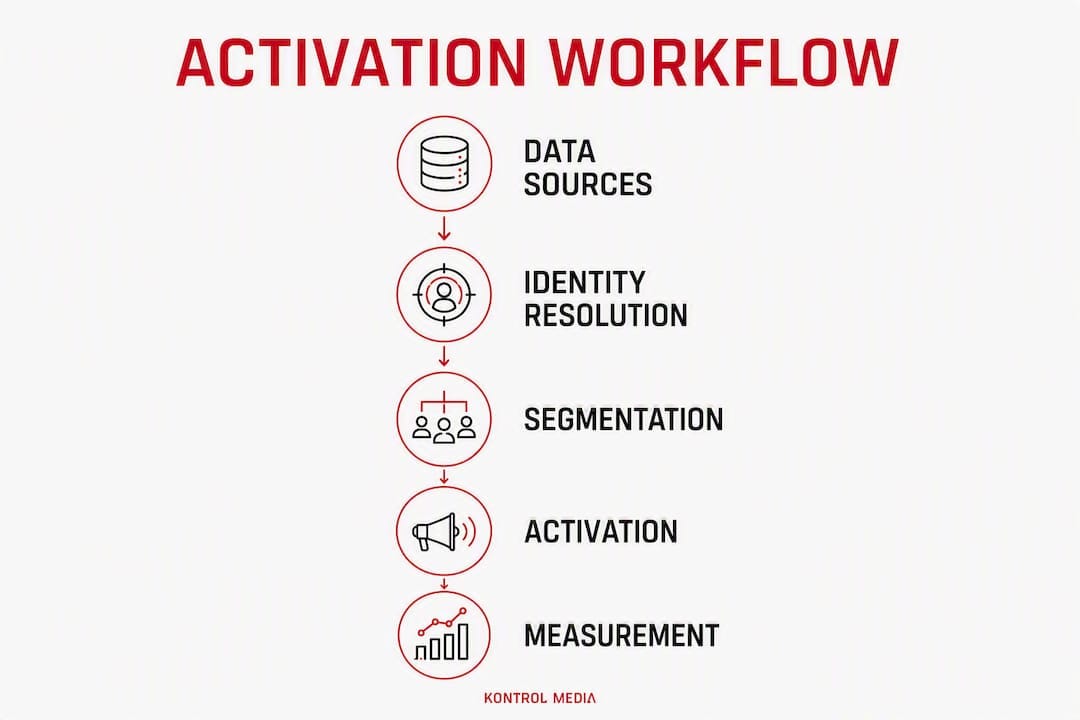
Stage 2: Identity resolution
RMNs use three dominant identity approaches, each with different reach and privacy trade-offs:
| Identity Approach | How It Works | Match Rate | Privacy Model |
|---|---|---|---|
| Clean room processing | Brands and retailers match hashed IDs in a privacy-safe environment; no raw data leaves either party | High (deterministic) | Strongest — no raw exposure |
| Hashed identifiers | Email or loyalty ID hashed and passed to DSP or RMN for matching | Medium-high | Moderate — depends on hash consistency |
| Bid-stream attributes | Audience signals appended to bid requests at impression time | Variable | Weakest — contextual, not deterministic |
Different RMNs expose audience data through these three models, and your identity strategy needs to match the model your target RMN supports.
Stage 3: Segmentation
Behavioral segmentation outperforms demographic targeting in retail media because purchase history is a far stronger predictor of future behavior than age or income. The core segment types are brand loyalists (high frequency, high share of wallet), category shoppers (buying the category but not your brand), and competitive buyers (verified purchasers of a named competitor). Lookalike seeding extends any of these segments by finding statistically similar shoppers in the RMN’s broader audience pool. Churn and lapse windows — typically 60–90 days of inactivity for a replenishable category — create reactivation audiences with strong conversion intent.
Stage 4: Activation endpoints
Retail data can be activated across the full funnel, not only at the point of purchase. The endpoint determines the format, latency, and measurement model:
- On-site RMN placements (sponsored products, display): lowest latency, highest purchase intent, closed-loop measurement native to the platform.
- DSP / programmatic off-site: extends reach to open web and social; requires hashed-ID or clean-room match to maintain audience fidelity.
- CTV: best for awareness seeding with verified buyer audiences; measurement relies on household-level matching.
- In-store digital (digital shelf, end-cap screens): proximity-triggered, often matched to loyalty ID at point of sale.
Stage 5: Measurement handoffs
Closed-loop attribution requires that the RMN or clean room can match an exposed shopper back to a verified purchase event. The data handoff at this stage — typically a hashed purchase record matched against an exposed audience list — is what enables incrementality testing and iROAS calculation. Without this handoff defined upfront, measurement becomes post-hoc rationalization rather than a designed experiment.
What activation strategies actually move the needle?
Shifting from demographic-led targeting to behavior-first segments is the single highest-leverage change most retail media programs can make. Here is how the core strategies work in practice.
Behavioral segmentation with matched creative. Brand loyalists respond to loyalty rewards and early access offers. Category shoppers need a reason to switch — trial offers, comparison messaging, and social proof. Competitive buyers require a direct value proposition, not brand storytelling. Running the same creative across all three segments wastes budget and dilutes the signal you need for measurement.
Loyalty-data-first activation. Your loyalty file is your highest-quality seed audience. VIP tiers, replenishment windows (based on average purchase cycle), and membership-only offers all perform better when the audience is built from verified purchase cadence rather than modeled behavior. Replenishment audiences in particular — shoppers who bought a consumable product 45–60 days ago — tend to show strong response rates because the timing aligns with actual need.
Omnichannel sequencing. Full-funnel retail media audience targeting assigns explicit roles to audiences across awareness, consideration, conversion, and loyalty stages, then aligns bidding, creative, and placement to each role. A practical sequencing model looks like this:
- Awareness: CTV or open-web display using lookalike audiences seeded from verified buyers.
- Consideration: On-site sponsored brand or category page placements for category shoppers.
- Conversion: Sponsored product placements for high-intent shoppers with recent category engagement.
- Retention: Loyalty-triggered offers for lapsed buyers within the replenishment window.
Real-time triggers. True real-time activation in retail media is rare — most “real-time” triggers are actually predictive models that score propensity based on recent behavior and update audience membership on a 24–48 hour refresh cycle. The trade-off between latency and precision is real: faster refresh cycles require more engineering investment and can introduce noise if the underlying signal is thin.
Pro Tip: Never reuse the same audience list across multiple funnel stages. A shopper who converts after seeing a conversion-stage ad should be moved to a retention audience immediately — leaving them in the conversion pool wastes spend and distorts your incrementality measurement.
What does the activation stack actually need to include?
The technical and governance requirements for scalable retail media audience activation are more demanding than most marketing teams anticipate. Advanced brands build a brand-owned unified data layer to harmonize data before pushing it into individual retailer clean rooms — a practical response to the fragmentation across 200-plus networks that would otherwise require repeated reconciliation work for every RMN relationship.
The core stack components:
- Unified data layer: A brand-controlled environment where transactional, loyalty, CRM, and behavioral data are harmonized at the customer level before any RMN interaction.
- ETL/streaming pipeline: Moves data from source systems to the unified layer on a defined refresh cadence (daily minimum; near-real-time for trigger-based activation).
- Identity graph: Maps customer identifiers across touchpoints — email, loyalty ID, device ID, hashed signals — to enable consistent audience membership across endpoints.
- Audience builder: Applies segmentation rules, lookalike models, and suppression logic to produce clean, deduplicated audience lists.
- Activation API/connectors: Pushes audience lists to RMN platforms, DSPs, and clean rooms on a scheduled or event-triggered basis.
- Measurement and reporting hub: Aggregates match-rate data, delivery metrics, and closed-loop sales outcomes across all active RMN relationships.
For identity orchestration across these layers, tools like Valiz address the interoperability challenges that arise when a brand is managing multiple RMN relationships with different identity requirements.
Governance is where most programs develop commercial risk. Data contracts per demand partner need to specify permitted downstream uses and match-rate SLAs — without these commercial guardrails, technical match-rate issues become contractual disputes. The governance checklist for legal and commercial teams should cover:
- Permitted downstream use of matched audience data (activation only vs. modeling vs. enrichment).
- Match-rate SLA thresholds and remediation process if rates fall below agreed levels.
- Data retention and deletion timelines for matched records.
- Privacy compliance review for CCPA and applicable state-level regulations in North America.
Pro Tip: Most teams underinvest in automating audience refresh and match-rate monitoring. A manual refresh process that takes two weeks to update an audience list effectively kills campaign agility — by the time the segment is live, the behavioral signal that defined it may be stale.
The operational workflow that sustains activation at scale requires three recurring routines: audience refresh on a defined cadence, automated audience pushes to active endpoints, and reconciliation checks that compare expected match rates against actual delivery. Automating these workflows is the difference between a program that scales and one that requires constant manual intervention.
How do you measure whether audience activation is working?
Measurement is where retail media audience activation either proves its value or gets defunded. Retail media provides largely deterministic purchase signals, and closed-loop measurement ties campaign exposure directly to in-store and online sales — which is the measurement advantage that justifies the additional complexity of activation.
Primary KPIs:
- Incremental sales lift: The additional revenue attributable to the activated audience, net of what would have occurred without the campaign.
- Incremental ROAS (iROAS): Revenue generated per dollar spent, measured only on the incremental portion — not total attributed sales.
- Cost per incremental household: How much you are spending to bring a new or reactivated buyer into the franchise.
- Match rate and audience health: The percentage of your pushed audience that the RMN can match to a known shopper — a leading indicator of whether your identity approach is working.
- Retention and lifetime value signals: Repeat purchase rate and average order value among activated audiences versus control.
Incrementality methods by use case:
- Holdout testing: Randomly suppress a portion of the target audience from seeing the campaign; compare purchase behavior between exposed and holdout groups. Best for large audiences with sufficient statistical power.
- Geo-based lift: Run the campaign in matched geographic markets and compare sales outcomes. Useful when audience-level suppression is not technically feasible.
- Matched-cohort analysis: Match exposed shoppers to unexposed shoppers with similar purchase history and compare outcomes. Practical for smaller audience pools.
- Time-based experiments: Compare purchase behavior in pre- and post-campaign windows for the same audience. Weakest method — susceptible to seasonality — but useful as a directional check.
A practical 6–8 week test plan:
- Weeks 1–2: Define business objective, select test and holdout audiences, confirm match-rate baseline with the RMN.
- Weeks 3–6: Run the campaign; monitor delivery, match rate, and pacing weekly.
- Week 7: Pull closed-loop sales data from the RMN or clean room; calculate incremental lift and iROAS.
- Week 8: Compare against holdout; document findings and set the next test hypothesis.
For a deeper look at the KPI frameworks that support this measurement model, retail media measurement guides cover the full metric stack from match rate to lifetime value attribution.
What do real activation use cases look like?
These four use cases cover the scenarios most brand teams encounter in North American retail media programs.
New product launch. Seed a lookalike audience from verified buyers of your most similar existing SKU. Activate awareness via CTV using the lookalike, then retarget on-site with sponsored product placements for shoppers who viewed the new product page. Measure trial rate among the activated audience versus a holdout. The key input is a clean verified-buyer seed list of at least 10,000 households to produce a statistically meaningful lookalike.

Lapsed buyer reactivation. Define lapse as 90 days of inactivity for a replenishable category. Build the audience from loyalty records, suppress current active buyers, and activate with a replenishment offer via on-site display and email. Creative should acknowledge the gap (“It’s been a while”) rather than treat the shopper as a new prospect. Measure reactivation rate and compare average order value of reactivated buyers against the control group.
Competitive conquesting. Use category purchase signals — shoppers who bought the category but not your brand — to build a conquesting audience. Activate with a trial offer or comparison message. The critical constraint here is retailer rules: most North American RMNs prohibit using a competitor’s brand name in creative served against category audiences, so the offer must lead with your product’s value rather than the competitor’s weakness.
Loyalty-first retention. Build a VIP audience from your top loyalty tier and activate with membership-only offers and upsell sequences (e.g., a shopper who buys Product A regularly gets an offer for the premium version). Sequence the creative from awareness of the upgrade to a direct conversion offer over a 3–4 week window. Measure upsell conversion rate and change in average basket size among the activated group.
For teams that need help reaching the right audiences across these scenarios, audience targeting support is a core part of how Kontrol Media structures activation engagements.
How do you launch your first audience activation program?
Eight steps, in order. Each one has a clear owner and a clear output.
- Define the business objective. Marketing lead owns this. Output: a single measurable goal (e.g., reactivate 15% of lapsed buyers in Q3).
- Audit data sources. Data engineering owns this. Output: an inventory of available data assets, their refresh cadence, and their identity coverage.
- Select seed audiences. Marketing and data jointly own this. Output: two or three prioritized segments with defined inclusion/exclusion rules.
- Choose your identity approach. Data engineering and legal own this. Output: a documented decision on clean room, hashed ID, or bid-stream, with privacy review sign-off.
- Set up match-rate testing. Data engineering owns this. Output: a baseline match-rate report for each target RMN before campaign launch.
- Build audience pushes and automation. Data engineering owns this. Output: automated audience refresh and push workflows with defined cadence.
- Run the pilot. Marketing owns this. Output: a live campaign with a defined holdout group and a measurement plan in place from day one.
- Measure and iterate. Analytics owns this. Output: an incrementality report with iROAS, match-rate performance, and the next test hypothesis.
Vendor evaluation questions to ask every RMN, clean-room provider, and activation partner:
- What is your data access model — clean room, hashed ID, or bid-stream — and what match rates should we expect for our audience size?
- How frequently do you refresh audience membership, and can we trigger an out-of-cycle refresh?
- What closed-loop measurement support do you provide, and can we run holdout tests natively?
- What is your pricing model for audience activation — CPM, data fee, or revenue share?
- What are your data retention and deletion policies for matched audience records?
For teams evaluating commercial and partnership structures alongside technical requirements, retail media ad sales frameworks provide useful context on how RMNs structure their data access agreements.
How Kontrol Media helps brands activate retail audience data
Kontrol Media builds and operates retail media and commerce media networks, which means the activation work we do is not advisory — it is hands-on execution alongside the brand’s marketing and data teams. The engagement typically spans six capability areas: strategy and audience design, data engineering and unified layer setup, clean-room orchestration, activation execution across RMN and DSP endpoints, measurement design, and ongoing program optimization.
Engagement models are structured around where the client is in their activation maturity:
- Project-based setup: For brands standing up activation for the first time — covers data audit, identity approach selection, seed audience design, and a pilot campaign with measurement.
- Retainer for ongoing activation ops: For brands with an active program that needs consistent audience refresh, match-rate monitoring, and iterative test-and-learn management.
- White-glove managed activation: For brands that want Kontrol Media to own the full activation workflow — from audience design through measurement reporting — while internal teams focus on creative and commercial strategy.
Clients like Experian and West Monroe have worked with Kontrol Media on data-driven growth programs where the underlying challenge was not strategy but operationalization — turning a clear business objective into a functioning, measurable workflow. That is the same gap retail media audience activation exposes in most organizations.
For a concrete example of how this plays out in a retail media context, the OneMarket case study shows how Kontrol Media structured a commerce media engagement from the ground up. Teams that want to explore what a retail or commerce media network build looks like in practice will find the full service overview there.
Integrating with major North American retail media networks
Amazon, Walmart Connect, and Target’s Roundel are the three dominant RMNs in North America, and each exposes audience data through a different technical model with meaningfully different integration requirements.
Amazon DSP and Sponsored Ads operate within Amazon’s walled garden. Brands activate audiences using Amazon’s own shopper signals — purchase history, search behavior, Prime membership — through the Amazon DSP or via Sponsored Products and Sponsored Brands on-site. Clean-room access is available through Amazon Marketing Cloud (AMC), which allows brands to run SQL-based queries against their campaign data and Amazon’s shopper signals without either party exposing raw records. AMC is the primary tool for incrementality analysis and audience overlap studies within the Amazon ecosystem.
Walmart Connect offers a similar on-site/off-site structure, with Walmart’s first-party purchase and in-store data powering audience targeting. Walmart’s clean-room environment allows brands to match their CRM data against Walmart’s shopper file for audience activation and closed-loop measurement. The integration path typically runs through Walmart’s DSP partnerships and its self-serve Walmart Connect platform for sponsored placements.
Target’s Roundel differentiates on the quality of its loyalty data from Target Circle, which provides high-frequency behavioral signals across a broad product range. Roundel’s off-site activation extends to programmatic partners and social channels, with closed-loop measurement tied back to Target’s point-of-sale data. Integration requires working within Roundel’s managed service model for most brand partners, with self-serve options available for larger advertisers.
US advertisers are expected to spend nearly $71.09 billion on retail media, with close to 90% of that investment concentrated in Amazon and Walmart. That concentration means most brands will spend the majority of their activation budget inside two ecosystems with fundamentally different identity models — a practical argument for building the brand-owned unified layer before trying to manage both simultaneously.
BCG’s research notes that marketers expect RMNs to support full-funnel reporting and omnichannel experiences, which reinforces why a buyer-owned measurement layer that travels across networks is not optional for brands running programs across multiple RMNs. IAB analysis similarly recommends standardizing measurement definitions on the buyer side rather than relying on each RMN to provide a consistent framework.
For AI-driven lookalike modeling and predictive audience scoring that works across these network environments, AI ad targeting tools can accelerate the audience design process, particularly for brands building lookalike segments from smaller seed files.
Key Takeaways
Retail media audience data activation succeeds when brands combine a brand-owned unified data layer, deterministic identity resolution, behavior-first segmentation, and a designed incrementality measurement plan before a single campaign goes live.
| Point | Details |
|---|---|
| Build the unified layer first | Harmonize transactional, loyalty, and CRM data at the customer level before pushing to any RMN clean room. |
| Segment by behavior, not demographics | Brand loyalists, category shoppers, and competitive buyers each need different creative and frequency to reduce waste. |
| Design measurement before launch | Define your holdout group, incrementality method, and iROAS target before the campaign runs — not after. |
| Automate audience refresh | Manual refresh cycles kill campaign agility; automate pushes and match-rate monitoring from the start. |
| Kontrol Media builds and operates activation programs | From data engineering and clean-room setup to pilot execution and measurement, Kontrol Media runs the full workflow for brands at any activation maturity stage. |
The pitfalls nobody warns you about until it’s too late
The most common failure mode in retail media audience activation is not a technology problem. It is an organizational one. Teams arrive at the first campaign with siloed data, no agreed identity approach, and a measurement plan that was designed to confirm the spend rather than test it. By the time the results come back, the numbers are ambiguous enough that nobody can tell whether the program worked.
Siloed data is the structural issue underneath most activation failures. When transactional data lives in one system, loyalty data in another, and CRM in a third, the audience you build is only as good as the weakest link in that chain. The brands that get this right treat data harmonization as a prerequisite, not a parallel workstream.
Slow audience refresh is the operational issue that follows. A segment built on last quarter’s purchase data is not a behavioral audience — it is a historical snapshot. The programs that sustain performance refresh audiences on at least a weekly cadence and have automated workflows that push updated lists to active endpoints without requiring a data engineer to manually run the job.
Misaligned measurement is the strategic issue that undermines everything else. When the business objective is incremental sales lift but the campaign is being measured on attributed revenue (which includes sales that would have happened anyway), the program will always look better than it is. Holdout testing is the discipline that separates real incrementality from attribution inflation.
Commercial misalignment with retailers and clean-room providers is the legal issue that surfaces late. Data contracts that do not specify permitted downstream uses create ambiguity about whether matched audience data can be used for modeling, enrichment, or future campaigns — and that ambiguity becomes a dispute when match rates underperform or a retailer changes its data access policy.
Pro Tip: Prioritize match-rate monitoring from day one. A match rate that drops from 65% to 40% mid-campaign is not a delivery problem — it is a signal that your identity approach has broken down somewhere in the pipeline. Catching it early saves the campaign; catching it in the post-flight report saves nothing.
At Kontrol Media, the fix for each of these pitfalls follows the same pattern: governance first, automation second, measurement design third. The consumer brand media network best practices framework we apply to client engagements is built around exactly this sequence — because the brands that skip governance to get to activation faster almost always end up rebuilding the foundation anyway.
Kontrol Media can stand up your retail audience activation program
Retail media audience activation is one of the most operationally demanding programs a marketing team can run — and one of the highest-return when it is built correctly. Kontrol Media works with CMOs, heads of growth, and executive leaders at mid-market and enterprise companies to stand up the full activation stack: data engineering, identity resolution, audience design, clean-room orchestration, and closed-loop measurement.
Whether you need a project-based pilot to prove the model or an ongoing retainer to run the full program, Kontrol Media structures engagements around your current activation maturity and your specific RMN relationships. The starting point is always a measurement and data audit — so you know exactly what you have, what is missing, and what a realistic first activation looks like before any budget is committed.
If you are ready to move from planning to execution, explore Kontrol Media’s retail media network services or request a discovery conversation to scope a pilot activation or measurement audit for your program.
Useful sources and further reading
These resources support the methods, frameworks, and governance guidance covered in this article. Use them when planning vendor discussions, designing measurement frameworks, or evaluating identity approaches.
- Optimizing Audience Strategy for Retail Media Spending — Circana: Segment-level recommendations for shifting from demographic to behavior-based targeting, with use cases for each segment type.
- First-Party Data in Retail Media: The Complete Targeting Guide — Osmos.ai: Operational detail on automation requirements, audience refresh workflows, and the engineering bottlenecks that stall most programs.
- Driving Brand Success with Retail Media Innovation — BCG: Research on marketer expectations for RMN omnichannel reporting and the role of unified platforms.
- First-Party Data Limitations in Retail Media — eMarketer: Spend forecasts and analysis of first-party data gaps across the long tail of North American RMNs.
- Why the Next Era of Retail Media Networks Runs on First-Party Intelligence — Unite.AI: Strategic context on the identity layer challenge and why fragmented retailer datasets undermine even sophisticated media platforms.
Recommended
- Retail Media Ad Sales: Strategic Guide for Marketing Pros in 2026 | Kontrol Media Consultancy
- Key Metrics for Retail Media: 2026 Marketer’s Guide | Kontrol Media Consultancy
- Consumer Brand Media Network Best Practices in 2026 | Kontrol Media Consultancy
- First-Party Data: The Fuel Behind Commerce Media Networks | Kontrol Media Consultancy