


Shopper marketing strategy is the deliberate use of insights-driven marketing and merchandising initiatives to satisfy the needs of targeted shoppers, enhance their experience, and improve business results for both retailers and manufacturers. That definition comes directly from the Retail Commission on Shopper Marketing, and it still holds up as the clearest framing of what this discipline actually does. Where brand marketing builds awareness over months, shopper marketing converts intent into action at the moment of decision, whether that moment happens in a grocery aisle, on a retailer’s app, or through a geo-targeted ad while someone is walking past your display.
The distinction from trade marketing matters here. Trade marketing is a B2B function: it secures shelf space, negotiates with distributors, and builds supply chain demand. Shopper marketing is B2C. It speaks directly to the person holding the product, comparing prices, or scrolling through a retailer’s website. Both are necessary, but they operate on different audiences with different objectives and different timing. Shopper marketing targets end consumers during the purchase journey, while trade marketing focuses on the business relationships that put the product there in the first place.
What makes this discipline particularly powerful is its position as the link between brand marketing and sales execution. Shopper marketing bridges the gap between the broad equity a brand builds over time and the specific conversion moment that drives revenue. For marketing professionals working across retail media networks and real estate channel partnerships, that bridge is where measurable growth actually happens.
What does an effective shopper marketing strategy look like?
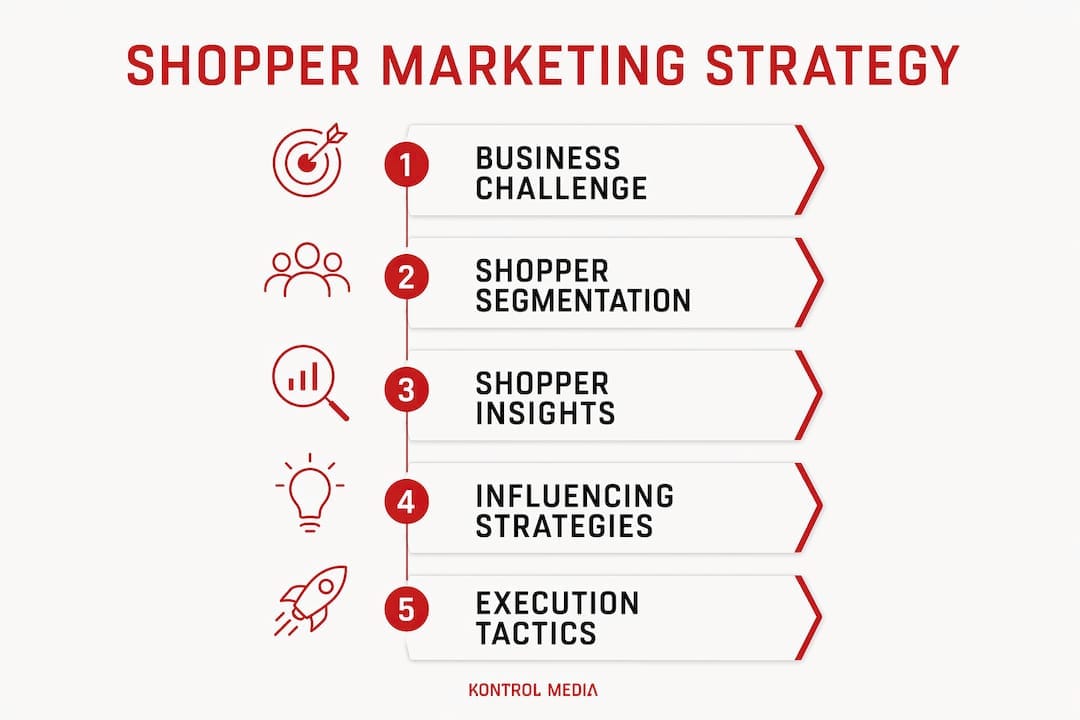
The structure of a shopper marketing strategy follows four standardized chapters: the business challenge, the target group, shopper insights, and influencing strategies. Each chapter builds on the last, and skipping any one of them tends to produce campaigns that feel creative but underperform commercially.
The business challenge is where you get honest about the numbers. How much does a buyer spend per transaction? What is the purchase frequency? How many buyers have purchased your brand in the past 30, 90, or 365 days? These metrics tell you whether you are trying to grow penetration, increase basket size, or win back lapsed buyers, and each answer points to a different strategic direction.
Target shopper segmentation narrows the field. Not every person who walks past your shelf is worth the same investment. Loyalists, brand switchers, and non-buyers each require different messages and different incentives. Assessing the lifetime customer value of each segment, alongside the cost to acquire them, keeps the strategy grounded in commercial reality rather than creative ambition.
Shopper insights are where the real differentiation lives. A shopper insight is a deep behavioral or psychological truth that the shopper themselves may not consciously recognize, but that directly influences their choices. These are typically uncovered through observational research, shopping trip accompaniments, and point-of-sale data rather than surveys, because people describe their behavior far more charitably than they actually exhibit it.
Influencing strategies flow naturally from the first three chapters. Mapping the full shopper journey from need recognition through preparation, in-store experience, and post-purchase evaluation reveals exactly where to intervene and with what kind of message.

Pro Tip: Integrate shopper insights into the creative brief before any concept development begins. Campaigns built around a genuine human truth consistently outperform those where the insight is retrofitted to justify a pre-existing creative idea.
Common tactics span both physical and digital environments: endcap displays, in-store demos, shelf signage, geo-fenced mobile ads, QR codes linking to loyalty rewards, product bundling, and personalized offers through retailer apps. The right mix depends entirely on where your target shopper makes their final decision.
How do you develop and execute campaigns with measurable outcomes?
Execution is where most shopper marketing strategies either prove their value or quietly disappear into a line item. The planning work matters, but retailer buy-in is what determines whether your campaign actually reaches the shelf, the app, or the retail media placement you designed it for.
Joint business planning with retail partners is the operational foundation. Sharing sales data, aligning on promotional calendars, and co-developing shopper content gives both parties a stake in the outcome. Fragmented tactics that treat retail media as separate from base brand strategy consistently underperform compared to integrated approaches that carry unified messaging from the brand campaign through to the point of purchase.
Retail media networks have become a critical activation layer in this process, enabling targeted advertising and sales activation across both digital and physical store environments. For brands operating across multiple retail formats, these networks offer the ability to reach shoppers with relevant messages at the exact moment they are in a buying mindset.
Measuring what works requires a mix of metrics:
- Sales lift by store and region, tracked against a control group
- Redemption rates on coupons, digital offers, and loyalty promotions
- Shopper dwell time near displays, which signals engagement before conversion
- New buyer acquisition versus repeat purchase rates
- Product reviews and social mentions during the campaign window
Tracking these metrics at the store and regional level gives you the granularity to optimize mid-campaign rather than waiting for a post-mortem. The brands that treat measurement as an ongoing discipline rather than a final report tend to compound their learning across campaigns.
The most persistent challenge is siloed execution. When in-store display teams, digital media buyers, and retail partnership managers operate independently, the shopper experiences a fragmented journey that dilutes the impact of each individual tactic. A unified strategy brief, shared across all activation teams and aligned to a single set of objectives, is the structural fix.
How Kontrol Media builds shopper marketing programs that actually move numbers
Kontrol Media’s work sits at the intersection of retail media, real estate channel partnerships, and full-funnel marketing execution, which gives the consultancy a perspective on shopper marketing that most generalist agencies simply do not have. The team has built and operated retail media networks for clients, which means the understanding of how these platforms function commercially informs every campaign recommendation.
The planning model Kontrol Media uses with clients starts with a rigorous business challenge analysis, pulling actual sales data before any creative or tactical work begins. From there, the team develops shopper personas grounded in behavioral research, maps the path to purchase across both physical and digital touchpoints, and identifies the specific moments where intervention will have the highest commercial impact.
Clients including Experian, RE/MAX, and West Monroe have worked with Kontrol Media across sales, marketing, and business development functions, which reflects the consultancy’s view that shopper marketing cannot be optimized in isolation from the broader commercial strategy. The marketing strategy execution work connects brand objectives to retail partner objectives, so the campaign serves both sides of the relationship.
Pro Tip: When building retailer partnerships for shopper marketing programs, lead with the retailer’s category objectives rather than your brand’s growth targets. Retailers respond to proposals that solve their problems first, and that framing consistently accelerates buy-in.
Key practices Kontrol Media applies across client engagements include aligning omnichannel messaging before any single-channel activation launches, building incrementality testing into campaign structures from the start, and using first-party data from retail partners to refine shopper segmentation over time.
Strategic recommendations that hold up across retail formats
The core of a successful shopper marketing program comes down to a few principles that do not change regardless of the retail format or channel mix.
- Start with the business challenge, not the tactic. Knowing whether you need penetration growth or frequency improvement determines everything downstream.
- Build shopper personas from behavioral data, not demographic assumptions. How shoppers actually behave in front of a shelf differs substantially from how they describe their behavior in a survey.
- Secure retailer alignment early. A campaign without retailer buy-in is a campaign that will underperform its potential, regardless of how strong the creative is.
- Integrate retail media into the base strategy, not as an add-on. Unified messaging across in-store and digital touchpoints consistently outperforms siloed channel activation.
- Measure continuously and iterate. Shopper behavior shifts, and the brands that build learning loops into their campaign structures compound their advantage over time.
Challenges and best practices across multiple retail formats
Running shopper marketing across multiple retail formats simultaneously is genuinely complex. A tactic that drives strong results in a large-format grocery environment may be completely irrelevant in a convenience channel or an e-commerce setting. The shopper’s mindset, time available, and decision criteria differ meaningfully across formats, and a single campaign brief rarely serves all of them equally well.
The best practice is format-specific activation within a unified strategic framework. The brand positioning, the core shopper insight, and the campaign objective stay consistent. The tactics, messaging hierarchy, and media mix adapt to the specific retail environment and the shopper behavior that characterizes it. This approach requires more planning upfront but produces far better results than either a one-size-fits-all execution or a completely siloed format-by-format approach.
Measurement complexity increases with format diversity. Assessing ROI across different retail environments requires establishing format-specific baselines before the campaign launches, then comparing performance against those baselines rather than against each other. A convenience channel campaign and a grocery channel campaign are solving different problems for different shoppers, and treating them as directly comparable obscures what is actually working.
Kontrol Media can build your retail media and shopper marketing program
Most marketing teams know what a strong shopper marketing program should look like. The gap is usually in execution: the retailer relationships that take years to build, the retail media infrastructure that requires technical and commercial expertise to operate, and the integrated planning process that keeps brand, sales, and retail objectives aligned simultaneously. That is exactly where Kontrol Media operates.
Kontrol Media builds, operates, and drives revenue for retail media and commerce media networks, while also developing the channel partnerships and marketing strategy that make those networks perform. For brands looking to grow through retail partnerships, the consultancy brings both the strategic framework and the hands-on execution capability to make it happen. Visit Kontrol Media’s services to see how the team can build a shopper marketing program tailored to your retail channels and growth objectives.
Key Takeaways
A shopper marketing strategy drives measurable growth by integrating behavioral insights, retailer collaboration, and unified omnichannel activation across both physical and digital retail environments.
| Point | Details |
|---|---|
| Definition and scope | Shopper marketing uses insights-driven initiatives to satisfy shopper needs and improve results for both retailers and manufacturers. |
| Four-chapter framework | Effective strategies address business challenge, target group, shopper insights, and influencing strategies in sequence. |
| Retailer buy-in is foundational | Joint business planning with retail partners aligns objectives and unlocks the placements and data that make campaigns perform. |
| Retail media integration | Treating retail media networks as part of the base strategy, not an add-on, consistently outperforms siloed channel activation. |
| Kontrol Media’s role | Kontrol Media builds and operates retail media networks and develops channel partnerships that connect shopper marketing strategy to measurable commercial outcomes. |
Recommended
- Retail Media Ad Sales: Strategic Guide for Marketing Pros in 2026 | Kontrol Media Consultancy
- Retail Media Strategy for Non-Retailers: 2026 Guide | Kontrol Media Consultancy
- Commerce Media: The 2026 Guide for Marketers | Kontrol Media Consultancy
- Crafting an Effective Marketing Strategy: From Research to Execution | Kontrol Media Consultancy