


CPC advertising models are still earning their place in the funnel
Cost per click advertising, more formally known as CPC or pay per click advertising, charges advertisers only when a user clicks an ad. Not for impressions. Not for eyeballs. For clicks. That single distinction shapes everything about how you plan, budget, and measure a campaign.
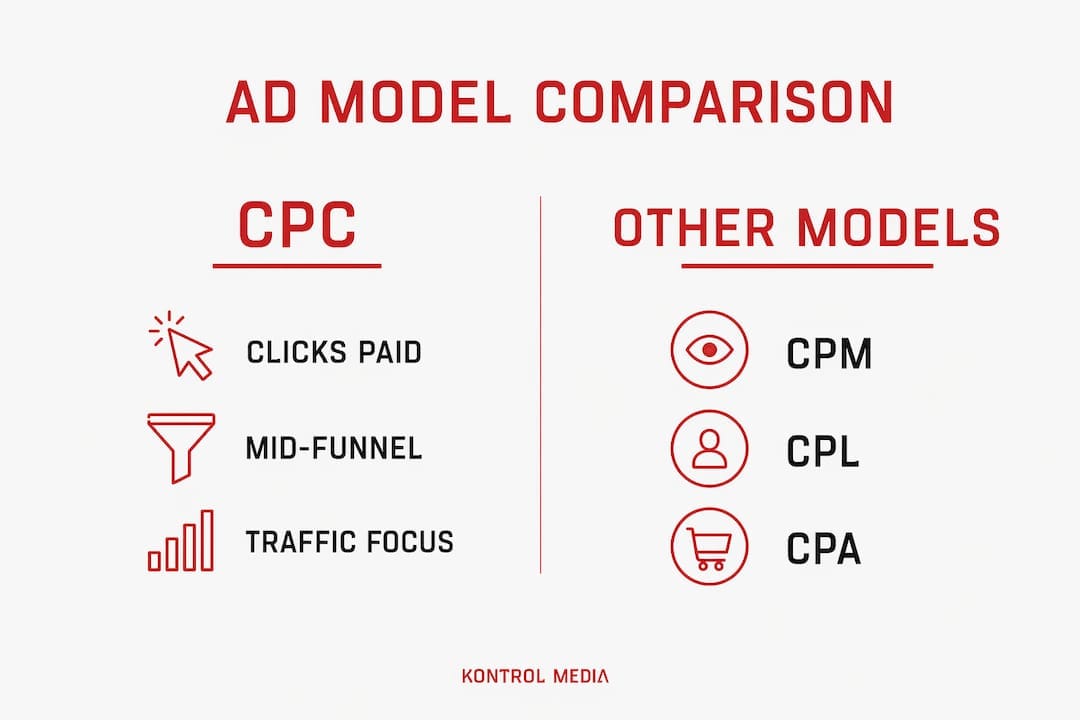
CPC sits squarely in the mid-funnel. It’s the model you reach for when brand awareness is already building and you need to drive qualified traffic before you have enough conversion data to optimize toward a sale. It’s not the cheapest model, and it’s not the most accountable. But it fills a gap that CPM and CPA simply can’t cover on their own.
Here’s what defines CPC in practice:
- Billing trigger: advertiser pays per click, not per impression or conversion
- Primary funnel stage: mid-funnel, traffic and intent capture
- Risk profile: lower than CPM (you don’t pay for unclicked impressions), higher than CPA (you pay without a guaranteed conversion)
- Best use cases: new product launches, traffic testing, audience discovery, landing page validation
- Common platforms: Google Ads, Meta Ads Manager, Microsoft Advertising
Kontrol Media has worked with brands like Experian, BuzzFeed, RE/MAX, and Enthusiast Gaming on multi-channel campaign strategies where CPC played a deliberate, stage-specific role rather than a default setting.
Table of Contents
- How CPC compares to CPM, CPL, and CPA models
- What experts say about CPC viability for brands and publishers in 2026
- Strategic recommendations for CPC campaigns in 2026
- Alternative pricing models and when they outperform CPC
- How CPC pricing is calculated and what drives cost fluctuations
- CPC vs. other models: what the performance data shows
- Kontrol Media helps brands get more from every ad dollar
- Key Takeaways
How CPC compares to CPM, CPL, and CPA models
Understanding where CPC fits means understanding what the other models are actually optimizing for.
- CPM (Cost Per Mille): you pay per 1,000 impressions regardless of clicks or conversions. Best for reach and brand recall at the top of the funnel. The risk is yours if targeting is weak.
- CPC: you pay per click. The network shares some risk because unclicked impressions don’t bill, but post-click economics are entirely your responsibility.
- CPL (Cost Per Lead): payment triggers only when a user submits their information. Ideal for relationship-driven industries like real estate, education, and financial services.
- CPA (Cost Per Action): the most performance-driven model. You pay only after a confirmed conversion. Lowest direct payment risk, but platforms typically require 30–50 conversion events before the algorithm can optimize effectively.
Most campaigns don’t live in a single model. A typical funnel uses CPM to build awareness, CPC to generate traffic and test creative messaging, and CPA to close once conversion signal is stable. The sequencing matters as much as the model selection. Forcing CPA bidding before you have sufficient data is one of the most common and costly mistakes in paid media strategy.
What experts say about CPC viability for brands and publishers in 2026
CPC remains viable, but the conditions around it have shifted considerably. Here’s where practitioners and analysts land:
- **BidsCube notes that high click-through rates can inflate CPC costs without producing conversions. Low-intent clicks drain budget fast, and bounce rate monitoring is non-negotiable.
- AI search impact is real for publishers, as explored in the analysis of the growing risks facing CPC advertising models. Programmatic ad request volume fell year over year in US and UK markets in Q2 2026, as AI-generated search results reduce referral traffic to publisher sites. eCPMs rose, but total spend declined.
- Geographic and niche factors drive CPC performance more than network selection alone. North American Tier 1 traffic in specialized niches commands meaningfully higher revenue per session than broad, undifferentiated traffic.
- Pure CPC/CPM reliance is fragile for publishers. Ad-blockers and zero-click AI search results are compressing the addressable inventory. Publishers finding stability are layering in newsletters, native advertising, and direct subscriber revenue.
- Kontrol Media’s position: hybrid models combining CPC with complementary revenue streams are more durable than single-model dependence. The evolution of digital ad models requires brands and publishers alike to treat pricing strategy as a living decision, not a one-time setup.
Strategic recommendations for CPC campaigns in 2026
The brands getting the most from click-based ad pricing in 2026 are the ones treating CPC as a phase, not a permanent state.
- Start with CPM or broad CPC to build audience data before shifting budget toward CPL or CPA once conversion signal matures.
- Keyword bidding discipline: in Google Ads and Microsoft Advertising, match types and negative keyword lists directly control cost efficiency in PPC. Broad match without negatives bleeds budget.
- Ad quality affects your CPC rate. Google’s Quality Score, which factors in expected CTR, ad relevance, and landing page experience, directly influences what you pay per click. A higher score lowers your cost.
- Click fraud and invalid traffic require active management. Work with platforms that offer invalid traffic protection, and use tools like ClickCease or TrafficGuard to monitor anomalies.
- Recommended platforms for CPC management: Google Ads, Meta Ads Manager, Microsoft Advertising, and for publishers, Setupad or Ezoic at mid-tier traffic levels.
- In-article and native ad placements tend to yield higher-quality clicks than standard banners, improving both CPC revenue and user experience simultaneously.
- Blend CPC with CPA for closing: use CPC for prospecting and audience discovery, then shift to CPA bidding once you have the conversion volume to support it.
Pro Tip: Run CPM and CPC campaigns in parallel on the same creative for at least two weeks before committing budget. Convert your CPM rate into an effective CPC by dividing CPM by (CTR × 1,000), then compare it against your actual CPC rate. The model closer to your allowable CPA gets the scale budget.
Alternative pricing models and when they outperform CPC
Each model maps to a distinct job in the funnel. Knowing when to hand off from CPC to something else is where real campaign ROI is made or lost.
- CPM: pays per 1,000 impressions. Best for awareness and retargeting pool building. Newsletter CPM rates vary widely depending on audience specificity and niche.
- CPL: pays per lead submission. Preferred in real estate, SaaS, and education where lead nurturing drives revenue. Gives advertisers full control over brand messaging throughout the process.
- CPA: pays per confirmed action (purchase, signup, install). Strongest model for mature funnels with stable conversion data. Dominant in e-commerce and finance.
- CPV (Cost Per View): pays per video view. Used for video awareness campaigns where completion rate matters more than clicks.
- CPI (Cost Per Install): pays per confirmed app install. A specific form of CPA suited to mobile app marketers who want to pay only for real users.
The right model by niche tends to follow a clear pattern: news and blogging favor CPC, real estate favors CPL, e-commerce and finance favor CPA. Most sophisticated advertisers layer these across funnel stages rather than committing to one.
How CPC pricing is calculated and what drives cost fluctuations

CPC is calculated through an auction. On Google Ads, your actual CPC is determined by the ad rank of the competitor below you divided by your Quality Score, plus one cent. You rarely pay your maximum bid. What you pay depends on competitive pressure, Quality Score, and the relevance of your ad to the query.
Several factors push CPC rates up or down: industry vertical (legal and financial keywords carry some of the highest CPCs in North America), geographic market, device type, time of day, and audience targeting precision. Broad audiences in low-competition niches cost less per click but often convert at lower rates. Tight audiences in competitive verticals cost more but tend to deliver higher intent.
CPC vs. other models: what the performance data shows
The performance gap between CPC and alternative models depends almost entirely on funnel stage alignment. When CPC is used for mid-funnel traffic testing, it consistently outperforms CPM on cost-per-engaged-session because you’re only paying for users who expressed intent. When it’s used as a substitute for CPA in mature funnels, it underperforms because you’re paying for clicks that a conversion-optimized campaign would filter out.
Publishers who shifted from pure CPC/CPM banner setups to hybrid monetization approaches combining native ads, newsletters, and affiliate partnerships have reported more stable revenue through the AI search disruption of 2025–2026. The data from that period is clear: single-model dependence, whether CPC or CPM, leaves publishers exposed to market shifts they can’t control.
Kontrol Media helps brands get more from every ad dollar
Kontrol Media works with brands at the point where ad model confusion costs real money. Whether you’re a middle-market company trying to figure out why your CPC campaigns aren’t converting, or a media network deciding how to structure advertiser pricing, the answer is rarely “pick a different model.” It’s usually about sequencing, funnel alignment, and knowing when to shift.
Kontrol Media’s client work spans brands like Experian, RE/MAX, and West Monroe, where the challenge wasn’t awareness but converting mid-funnel traffic into measurable outcomes. The team builds and executes across real estate marketing channels, retail media networks, and full-funnel strategy, with pricing model selection built into the execution rather than bolted on afterward.
If your current CPC spend isn’t producing the returns your model predicts, that’s a solvable problem. Talk to Kontrol Media about where your funnel is leaking and what a better-structured campaign looks like for your specific market.
Key Takeaways
CPC advertising remains a viable mid-funnel tool in 2026, but its value depends on proper funnel sequencing, quality monitoring, and integration with CPM and CPA models.
| Point | Details |
|---|---|
| CPC fills the mid-funnel gap | CPC drives traffic and captures intent between broad CPM awareness and conversion-focused CPA campaigns. |
| Platforms typically require 30–50 conversion events before the algorithm can optimize effectively for CPA bidding; CPC is used to gather initial conversion data before transitioning. | |
| Publisher revenue is under pressure | Programmatic ad request volume fell year over year in US and UK markets in Q2 2026 due to AI search. |
| Hybrid models outperform single-model setups | Layering CPC with native ads, newsletters, and CPA produces more stable revenue than relying on one pricing model. |
| Kontrol Media structures the full funnel | Kontrol Media advises brands and media networks on sequencing CPM, CPC, and CPA to maximize measurable growth. |
Recommended
- Advertiser Acquisition Strategies for Media Networks in 2026 | Kontrol Media Consultancy
- Commerce Media vs. Traditional Programmatic Advertising | Kontrol Media Consultancy
- Ad Sales Strategies That Drive Real Revenue in 2026 | Kontrol Media Consultancy
- Ad Operations: A Revenue Leader’s 2026 Guide | Kontrol Media Consultancy