


Private equity due diligence is the structured investigation PE investors run to confirm an investment thesis, uncover hidden risks, and establish the foundation for post-acquisition value creation. It is not a compliance exercise. Done well, it is the analytical spine of every deal, connecting what a target company claims about itself to what is actually true, and translating that gap into pricing, structure, and a 100-day plan.
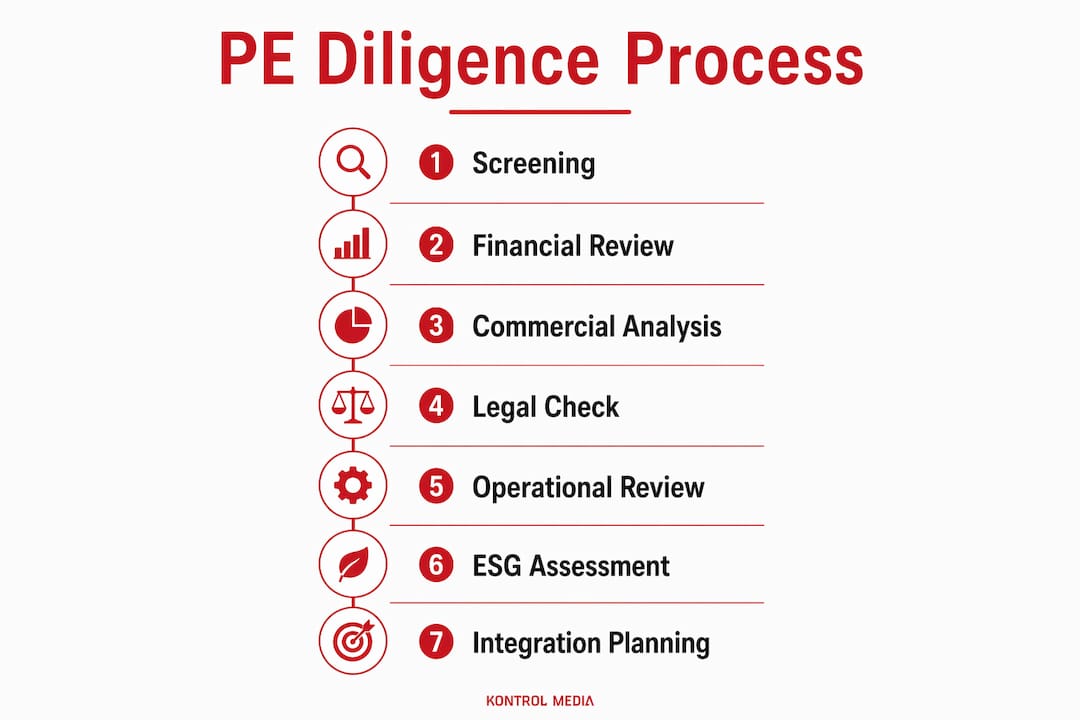
The core workstreams in any institutional PE deal span financial, commercial, legal, operational, technology, and ESG diligence. Each answers a different question. Financial diligence tells you where the business has been. Commercial diligence tells you where it is going. Legal, operational, and technology workstreams tell you what it will cost to get there. ESG diligence, increasingly weighted at the mega-fund level, tells you what the exit buyer will scrutinize in four to seven years.
The process splits into two phases: exploratory diligence, which acts as a high-level screen for deal-breakers before a letter of intent, and confirmatory diligence, which is the deep investigation that runs post-LOI. Key deliverables include the Quality of Earnings report, risk assessment memos, and the operational findings that feed directly into the value creation plan.
What are the core due diligence workstreams in PE?
Every institutional deal runs the same eight workstreams, but the weight each carries depends on the hold strategy. A buy-and-build platform over-weights operational system standardization and integration capacity. A take-private over-weights public-company wind-down and shareholder litigation exposure. Understanding that distinction before you allocate diligence resources is what separates disciplined deal teams from ones that inherit problems.

| Workstream | Typical Owner | Key Output | Timeline |
|---|---|---|---|
| Financial / Quality of Earnings | Third-party accounting firm | Adjusted EBITDA, add-back schedule | several weeks |
| Commercial | Strategy consultancy or in-house | Market sizing, win/loss analysis, customer references | 4 weeks |
| Legal | Buy-side counsel | Reps and warranties memo, corporate clean-up list | 4 weeks |
| Operational / IT | Internal team plus specialists | Systems map, integration risk, capex priorities | 3 weeks |
| ESG / Climate Risk | ESG advisor | Regulatory exposure, LP reporting inputs | 2–4 weeks |
| Tax | Tax counsel | Structure analysis, historic liability review | 3–6 weeks |
Timeline by fund size follows a clear pattern: smaller funds complete confirmatory diligence in a few weeks, mid-market funds take a longer period, and the largest funds extend the timeline further. The longer windows at the top end reflect ESG and climate-risk weighting, antitrust review under the HSR threshold, and the added complexity of representations-and-warranties insurance syndication.
Financial diligence centers on the Quality of Earnings report, which adjusts reported EBITDA for owner compensation normalization, non-recurring legal costs, and related-party expenses. Those EBITDA add-backs routinely move the final purchase price by 10–25%, because the acquisition multiple is applied to adjusted EBITDA, not reported EBITDA. Commercial diligence, by contrast, tests whether the revenue growth assumptions in the investment thesis hold up against market reality, using customer validation calls, competitor interviews, and channel checks that no financial model can replicate.
Pro Tip: Build your due diligence checklist around the hold strategy first, then assign workstream weights. A carve-out and a growth-equity minority deal on the same target require fundamentally different resource allocations.
Expert insights shaping PE due diligence in 2026
The most consistent finding from practitioners in 2026 is that deal teams over-index on financial and legal diligence while under-investing in commercial diligence, the one workstream that actually tells you whether the business is worth buying at the proposed price. Financial diligence validates the past. Commercial diligence validates the future. Both are necessary; neither is sufficient alone.
The “top-10 questions by day 3” framework has gained real traction among mid-market deal teams. The discipline is simple: within 72 hours of data room access, the team identifies the ten variables that would most likely kill the deal or materially reprice it. Everything else becomes supporting evidence. This prevents analysis paralysis and keeps senior attention on the factors that actually move the needle.
AI-powered platforms have meaningfully compressed commercial diligence cycles, refocusing consultants on strategic interpretation rather than data gathering. Contract review, CIM parsing, cohort analysis, and competitive landscape synthesis that once consumed days of associate time now surface in hours. The output still requires senior judgment, but the time-to-first-insight has dropped sharply.
Sellers who arrive with a sell-side Quality of Earnings report already prepared consistently close faster and at higher final multiples. Pre-diligence QoE reports address EBITDA add-back negotiations before buyers raise them, reducing mid-process friction and the kind of late-stage surprises that collapse deals or trigger price reductions. Close to 90% of PE firms formulate a 100-day plan at acquisition close, and the quality of that plan depends directly on what diligence surfaces. Firms that treat diligence outputs as inputs to the value creation plan, not just as deal-gating documents, consistently execute faster post-close.
How consulting firms strengthen your diligence process
Top consulting firms bring three things that most in-house deal teams cannot replicate at speed: proprietary analytic tools, sector-specific primary research networks, and the institutional memory of having run similar diligence dozens of times in the same industry. Firms like Bain & Company and KKR’s internal consulting arm have built structured commercial diligence frameworks that triangulate across customer interviews, competitor calls, and channel checks to produce conviction, not just data.

The collaboration model between PE deal teams and external consultants has evolved. The most effective arrangements assign the consultant a defined workstream with clear hypotheses and kill criteria, rather than an open-ended mandate to “assess the market.” Consultants who know what would cause the deal team to walk away produce sharper, faster outputs.
Consulting impact shows up most clearly in two places: purchase price adjustments driven by QoE findings, and integration planning informed by operational diligence. When a consulting firm’s operational assessment identifies a $3M annual cost reduction opportunity in supply chain consolidation, that finding feeds directly into the 100-day plan with an owner, a timeline, and a KPI. The diligence-to-value-creation handoff is where consulting engagement pays for itself.
For commercial due diligence specifically, the best firms structure primary research around testable hypotheses rather than comprehensive data collection. Five precisely targeted customer conversations beat twenty generic ones. Triangulation across multiple independent source types, customers, competitors, former employees, and industry operators, is what builds conviction rather than just volume.
How do PE firms monitor investments after the deal closes?
Post-investment monitoring is where diligence findings either pay off or expose their gaps. The 100-day plan, built directly from diligence outputs, assigns each identified risk and growth opportunity to a named owner with specific KPIs and defined timelines. This is not a soft planning document. It is the operating contract between the PE firm and the management team for the first quarter post-close.
Beyond the first 100 days, ongoing diligence takes the form of structured portfolio monitoring. Monthly financial reporting against the diligence model, quarterly commercial health checks using customer pulse surveys, and annual ESG assessments keep the investment thesis current. When a portfolio company’s customer concentration increases or a key executive departs, the monitoring framework surfaces that signal before it becomes a crisis.
The firms that execute this well treat post-close monitoring as a continuation of the diligence mindset, not a separate function. They revisit the original risk register quarterly, tracking which risks have been mitigated, which have materialized, and which new ones have emerged. Data analytics tools that were used to analyze the target during diligence often become the same tools used to monitor it during the hold period.
Data room management and documentation best practices
A well-organized data room is one of the clearest signals a seller can send about operational maturity. Buyers notice when documents are missing, mislabeled, or inconsistent with the CIM. Those gaps slow diligence, invite skepticism, and often trigger price adjustments that a cleaner data room would have prevented.
The most effective data rooms are organized by workstream, mirroring the buyer’s diligence structure: financial statements and QoE support materials in one folder, customer contracts and concentration analysis in another, legal documents and IP assignments in a third. Each folder should be complete before the data room opens, not populated reactively as buyers submit requests.
Version control matters more than most sellers expect. When a buyer’s financial model is built on a revenue figure that changes in a later document upload, the discrepancy creates a credibility problem that is hard to recover from. Designating a single data room administrator who controls uploads, tracks buyer activity, and manages the Q&A log keeps the process clean. Buyers who see a disciplined, well-maintained data room tend to move faster and negotiate less aggressively on price.
Risk assessment and mitigation strategies for PE deals
PE deal risk falls into four categories that every investment due diligence process must address: financial risk, commercial risk, operational risk, and legal or regulatory risk. The mistake most deal teams make is treating these as parallel workstreams with equal weight, when the actual risk profile of any given deal concentrates heavily in one or two areas.
Customer concentration is the most common financial risk that diligence surfaces and the one that most directly affects valuation. A single customer representing more than 20% of revenue is a structural vulnerability that must be priced into the deal, either through a purchase price reduction, an earnout tied to customer retention, or representations and warranties coverage. Ignoring it at LOI and hoping it resolves during confirmatory diligence is a pattern that ends badly.
Operational risk mitigation starts with the 100-day plan and extends through the hold period. When diligence identifies a technology infrastructure that cannot scale, the mitigation strategy is a specific capital expenditure commitment with a timeline, not a vague acknowledgment in the investment memo. Legal risk mitigation typically involves representations and warranties insurance, which at the $1B-plus enterprise value level can add 2–4 weeks to the diligence timeline for syndicated coverage but provides meaningful protection against post-close surprises. The hold-strategy-conditional framework weights these risk categories differently by deal type, which is why a carve-out diligence process looks so different from a growth-equity minority investment even when the target company is similar in size.
Kontrol Media brings strategy and execution to PE portfolio growth
PE due diligence surfaces the risks and opportunities. What happens next, turning those findings into measurable growth, is where most portfolio companies need a different kind of partner.
Kontrol Media works directly with private equity portfolio companies to build and execute the business and marketing strategies that diligence identifies but deal teams rarely have the bandwidth to operationalize. Where a QoE report flags revenue concentration or a commercial assessment reveals untapped market segments, Kontrol Media translates those findings into go-to-market plans, customer acquisition programs, and channel strategies with defined metrics. Clients including Experian, REMAX, Enthusiast Gaming, and West Monroe have worked with Kontrol Media at exactly this stage, moving from diligence insight to execution without the lag that typically costs portfolio companies their first-year growth targets. For PE firms looking to connect business strategy consulting with post-close execution, Kontrol Media is built for that handoff.
Key Takeaways
Effective PE due diligence requires balancing all workstreams, not just financial and legal, and connecting every finding directly to the post-close value creation plan.
| Point | Details |
|---|---|
| Workstream weighting matters | Weight diligence workstreams by hold strategy: buy-and-build over-weights operational and IT; take-private over-weights legal and governance. |
| QoE drives purchase price | EBITDA add-backs from the Quality of Earnings report routinely shift final purchase price by 10–25%. |
| Commercial diligence is underinvested | Most deal teams over-index on financial and legal work, missing the workstream that validates future revenue assumptions. |
| 100-day plan starts in diligence | Close to 90% of PE firms formulate a 100-day plan at close, built directly from diligence findings and risk assignments. |
| Kontrol Media bridges diligence to growth | Kontrol Media helps PE portfolio companies execute the business and marketing strategies that diligence identifies but deal teams rarely operationalize. |
Recommended
- Private Equity Commercial Due Diligence: 2026 Guide | Kontrol Media Consultancy
- Private Equity Marketing Due Diligence: 2026 Guide | Kontrol Media Consultancy
- Top 6 Agencies for Private Equity Due Diligence 2026 | Kontrol Media Consultancy
- Top 5 Commercial Due Diligence Agencies 2026 | Kontrol Media Consultancy