


Commerce media is defined as a transaction-driven advertising model that uses first-party purchase data to deliver targeted ads tied directly to measurable buying outcomes. Unlike traditional display advertising, it connects every impression to a real purchase signal. Platforms like YouTube, LiveRamp, and Ampd are already activating this model at scale. Financial networks including PayPal, Klarna, and Chase have built their own commerce media networks on top of cross-merchant transaction data. For marketing professionals and business leaders, this is the most direct path from ad spend to verified revenue.
What is commerce media and how does it differ from retail media?
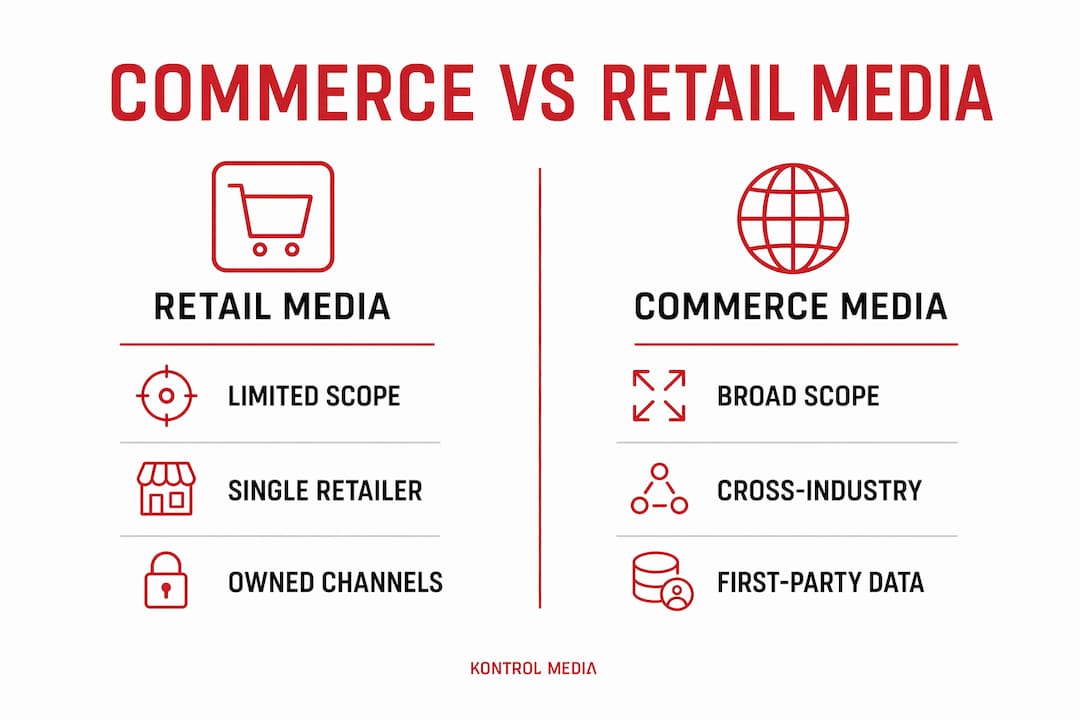
Commerce media is a horizontal advertising layer that extends transaction-driven advertising beyond retail to high-frequency transactional sectors like fintech, travel, and ticketing. Retail media, by contrast, is a subset confined to retailer-owned channels such as Amazon Sponsored Products or Walmart Connect. The distinction matters because it changes both the data available and the audiences you can reach.
Retail media lives inside a single retailer’s ecosystem. Commerce media aggregates first-party signals across entire industries. A fintech platform like Klarna sees purchase behavior across hundreds of thousands of merchants. That cross-merchant view produces richer audience segments than any single retailer can offer.

| Dimension | Retail media | Commerce media |
|---|---|---|
| Scope | Retailer-owned channels only | Any transactional platform or industry |
| Data source | Single retailer’s purchase history | Cross-merchant, cross-industry transaction data |
| Key players | Amazon, Walmart, Target | PayPal, Klarna, Chase, airlines, rideshare apps |
| Measurement | On-site conversion | Closed-loop, SKU-level, cross-platform |
| Audience depth | Shoppers of one retailer | Buyers across multiple categories |
The practical implication is reach. A travel brand advertising on an airline’s commerce media network accesses trip-timing signals that no retailer can provide. A CPG brand on a fintech network sees cross-category spending patterns that reveal true purchase intent. This is why commerce media networks are attracting serious budget attention from media planners who previously focused only on Amazon and Walmart.
What technologies power commerce media effectiveness?
Three technologies define how well a commerce media campaign actually performs: agentic deep linking, Model Context Protocol ad serving, and closed-loop SKU-level reporting.
Agentic deep linking solves one of the oldest problems in shoppable media. Traditional campaigns lose up to 95% of shoppers to drop-off caused by poor mobile routing and interstitial fatigue. Ampd’s agentic deep linking technology routes each shopper directly to their preferred retailer app, eliminating the friction that kills conversion. The result is up to a 5x conversion lift compared to legacy shoppable media formats. That is not a marginal improvement. It changes the economics of the entire campaign.
Model Context Protocol (MCP) native ad serving is newer and arguably more significant for the long term. MCP-native ad serving allows AI shopping agents to query a retailer’s ad server directly for contextually relevant sponsored products in real time. When a consumer uses an LLM-powered shopping assistant, the ads they see are pulled dynamically from the ad server rather than pre-loaded. This makes monetization possible inside conversational commerce environments that traditional ad formats cannot reach.
Closed-loop SKU-level reporting ties the loop between impression and purchase at the product level. Google’s commerce media suite integrates retailer shopper audiences with YouTube inventory, supported by LiveRamp and MetaRouter for reporting. Consumers watch 90 million hours of shopping-related videos daily on YouTube. That volume, combined with SKU-level conversion tracking, gives brands a measurement framework that retail media’s walled gardens have historically blocked.
- Agentic deep linking: routes shoppers to preferred retailer apps, reducing drop-off by up to 95%
- MCP native ad serving: enables real-time sponsored product delivery inside AI shopping agents
- SKU-level closed-loop reporting: connects YouTube and off-site impressions to specific product purchases
- LiveRamp and MetaRouter integrations: provide identity resolution across fragmented platforms
Pro Tip: Before launching any shoppable media campaign, audit your mobile routing setup. If your links land on a generic product page rather than the shopper’s preferred retailer app, you are leaving the majority of your conversions on the table.
How are diverse industries adopting commerce media?
PayPal, Klarna, Chase, and Revolut have each launched commerce media networks built on cross-merchant transaction data. Klarna reached 100 million users and 724,000 merchants as of Q1 2025. That scale gives advertisers access to purchase intent signals that span grocery, fashion, electronics, and travel within a single platform.
Financial services networks carry a data advantage that is easy to underestimate. A bank or payments platform sees not just what a consumer bought, but when, how often, and across which categories. Trip-timing data from an airline network tells a hotel brand exactly when to serve an ad. Cross-merchant spending patterns from a fintech platform reveal which consumers are actively in a purchase cycle for a specific product category.
Here is how commerce media adoption breaks down by industry:
- Financial services: PayPal, Klarna, Chase, and Revolut monetize cross-merchant transaction data for CPG, travel, and retail advertisers
- Travel and hospitality: Airlines and hotel chains use trip-timing signals to target travelers with relevant offers pre-trip and post-booking
- Rideshare and delivery: Platforms like Uber and DoorDash activate location and frequency data for restaurant, retail, and CPG brands
- Ticketing and entertainment: Event platforms use purchase timing and genre preferences to serve relevant brand advertising
- CPG and grocery: Loyalty program data from grocery networks provides category-level purchase signals for brand advertisers
The strategic implication for media buyers is straightforward. The right commerce media network depends on where your customer’s purchase journey actually begins. For a travel brand, that journey starts with a flight search, not a product page. For a financial services advertiser, it starts with a spending pattern. Matching your network to that moment of intent is the core discipline of digital commerce strategy.
How should marketers launch commerce media campaigns?
Test on networks aligned with your target audience before shifting significant budget from established retail media investments. Travel brands should start with airline and hotel networks. Financial services advertisers should evaluate PayPal and Chase first. This is not a universal playbook. It is a discipline of matching data signals to audience behavior before scaling spend.
Budget allocation requires a split mindset. Performance marketing and brand building serve different functions in a commerce media plan, and conflating them produces weak results in both directions. Ringfence a portion of your budget for upper-funnel activity, including video and display, even when the immediate return on ad spend is less clear. Commerce media balance for long-term growth requires investing in brand equity alongside conversion, not instead of it.
Data collaboration is the second discipline most brands skip. Retail media often feels like a cost burden because advertisers accept the network’s data and measurement on its own terms. Push for data collaboration agreements that let you bring your own first-party data into the network’s environment. Pair that with creative automation tools that can serve personalized ad variations at scale without manual production overhead.
- Identify the commerce media networks where your audience’s purchase journey begins
- Start with a contained test budget before reallocating from existing retail media spend
- Negotiate data collaboration terms so your first-party data informs targeting and measurement
- Ringfence upper-funnel budget for brand video and display alongside performance formats
- Demand SKU-level, closed-loop reporting as a baseline requirement from any network partner
Pro Tip: When evaluating a new commerce media network, ask for incrementality testing methodology upfront. If the network cannot demonstrate lift above your baseline conversion rate, the spend is not additive. It is just shifting credit.
What commerce media trends will define 2026 and beyond?
Agentic commerce is the most significant structural shift on the horizon. LLM-powered shopping agents are already querying product catalogs and making purchase recommendations on behalf of consumers. When a shopper asks an AI assistant to find the best running shoes under $150, that agent needs a mechanism to serve sponsored products alongside organic results. MCP-native ad serving is that mechanism, and it is moving from pilot to production across major retail platforms.
The interoperability problem is also getting real attention. Fragmented platforms with unique standards create optimization friction for performance marketers managing multiple commerce media networks simultaneously. The industry is moving toward shared identity frameworks and standardized reporting taxonomies, though progress is uneven. Brands that build clean first-party data infrastructure now will have a structural advantage when interoperability standards mature.
- Agentic commerce: AI shopping agents will become primary discovery surfaces, requiring MCP-native ad formats
- Cross-industry data sharing: Fintech, travel, and retail networks will develop shared identity resolution frameworks
- Conversational commerce monetization: Chat-based shopping interfaces will require entirely new ad unit designs
- Standardized measurement: Industry bodies will push for common incrementality and attribution standards across networks
- Creative automation at scale: Dynamic creative optimization will become table stakes for multi-network commerce media campaigns
Commerce media as a strategic priority means treating it as an enterprise initiative, not a media channel. The brands winning in 2026 are integrating commerce media signals into product development, supply chain planning, and customer experience design. The advertising layer is the visible part. The data infrastructure underneath it is the actual competitive asset.
Key Takeaways
Commerce media delivers measurable advertising outcomes by connecting first-party transaction data to purchase intent signals across fintech, travel, retail, and entertainment industries.
| Point | Details |
|---|---|
| Commerce media vs. retail media | Commerce media spans all transactional industries; retail media is limited to retailer-owned channels. |
| Agentic deep linking impact | Eliminating mobile routing friction can reduce shopper drop-off by up to 95% and deliver up to 5x conversion lift. |
| Cross-industry data advantage | Fintech and travel networks provide cross-merchant and trip-timing signals no single retailer can match. |
| Strategic budget split | Ringfence upper-funnel brand spend alongside performance formats to avoid short-term ROAS myopia. |
| Future readiness | MCP-native ad serving and agentic commerce will require new ad formats and clean first-party data infrastructure. |
Commerce media is not a channel. It’s an enterprise decision.
I have spent enough time inside media networks and brand marketing organizations to know the pattern. A brand hears about commerce media, assigns it to the performance team, and treats it like a new version of paid search. The team runs a few campaigns, measures last-click ROAS, declares it underwhelming, and moves on. That is the wrong frame entirely.
The brands getting real results from commerce media are treating it the way they treat CRM. They are asking which data they own, which networks can activate that data, and how the signals they collect today will compound into a targeting advantage over the next two years. That is a fundamentally different conversation than “what is the CPM on Klarna’s network.”
What I find most underappreciated is the creative side. Marketers spend enormous energy on audience targeting and almost none on whether the ad unit itself is built for a transactional environment. A commerce media placement sits next to a purchase decision. The creative needs to reflect that proximity. Generic brand awareness copy does not convert in a checkout-adjacent context.
The technology is genuinely exciting right now. MCP-native ad serving, agentic deep linking, closed-loop SKU reporting at scale. These are not incremental improvements. They change what is measurable and what is possible. But technology only creates opportunity. The brands that capture it will be the ones that treat commerce media as a strategic enterprise initiative with executive sponsorship, not a line item in the performance budget.
My honest advice: start with your data. Audit what first-party signals you actually own, find the network where those signals have the most activation value, and test with real budget and real measurement rigor. The results will tell you more than any industry report.
— Mark Kapczynski
How Kontrol Media helps you build and grow commerce media networks
Kontrol Media works directly with brands, media networks, and their agency partners to build, operate, and drive revenue from commerce media programs. The work spans everything from network architecture and advertiser acquisition to first-party data integration and platform partnerships across finance, travel, and retail sectors.
If you are evaluating how to attract brand advertisers to your network or how to allocate spend across emerging commerce media platforms, the advertiser acquisition strategies for 2026 guide is a direct starting point. For brands building a network from the ground up, Kontrol Media’s retail and commerce media network consulting practice covers the full build-out. The team has done this work with companies including Experian, BuzzFeed, and Enthusiast Gaming, and the methodology is built for measurable outcomes, not theory.
FAQ
What is commerce media in simple terms?
Commerce media is advertising that uses first-party transaction data from platforms like PayPal, airlines, or retailers to serve targeted ads tied directly to purchase intent. It connects ad impressions to measurable buying outcomes across multiple industries.
How does commerce media differ from retail media?
Retail media is limited to a single retailer’s owned channels, such as Amazon or Walmart. Commerce media extends that model to any transactional platform, including fintech, travel, rideshare, and ticketing networks.
What is agentic deep linking and why does it matter?
Agentic deep linking routes shoppers directly to their preferred retailer app from a shoppable ad, eliminating the friction that causes up to 95% drop-off in traditional campaigns. Ampd’s implementation delivers up to 5x conversion lift over legacy shoppable media formats.
Which industries are leading commerce media adoption?
Financial services platforms including Klarna, PayPal, and Chase are among the most active, alongside travel, rideshare, and grocery networks. Klarna reached 100 million users and 724,000 merchants as of Q1 2025, making it one of the largest commerce media networks outside traditional retail.
What should marketers prioritize when starting with commerce media?
Start by testing on networks that match your audience’s actual purchase journey before shifting budget from established retail media investments. Pair that with a data collaboration agreement and a clear incrementality testing framework to measure true lift.
Recommended
- Retail Media Ad Sales: Strategic Guide for Marketing Pros in 2026 | Kontrol Media Consultancy
- Commerce Media Networks: The Next Evolution in eCommerce Advertising | Kontrol Media Consultancy
- Retail Media Strategy for Non-Retailers: 2026 Guide | Kontrol Media Consultancy
- Consumer Brand Media Network Best Practices in 2026 | Kontrol Media Consultancy