


A media network business model is the framework by which media companies convert content and audiences into diversified revenue streams, simultaneously selling content access to consumers and audience attention to advertisers. As of 2025, 77% of publishers focus on subscriptions, 69% on display advertising, and 59% on native advertising, reflecting a clear shift toward hybrid monetization. The model operates as a dual-sided market: consumers receive content, advertisers receive reach, and the network captures value from both sides. Companies like BuzzFeed, Condé Nast, and Spotify have built entire business architectures around this principle, layering subscription fees, programmatic advertising, licensing deals, and affiliate commissions into a single integrated system.
What is a media network business model and how does it work?
A media network business model is defined as a structured system that aggregates audiences across content properties and monetizes that aggregation through multiple, interdependent revenue channels. The industry term for this architecture is a “dual-product market,” where the network produces two distinct products: content for consumers and audience access for advertisers. Understanding both sides of this equation is the starting point for any business leader or marketer building or scaling a media property.
The model works because audience attention is a finite, tradeable commodity. When a media network builds a loyal readership, listenership, or viewership, it creates an asset that advertisers will pay to access. The larger and more defined that audience, the higher the premium the network can command. This is why legacy media ad revenue collapsed so dramatically when digital fragmented attention across thousands of platforms, forcing traditional publishers to rebuild their monetization logic from scratch.
What separates a media network from a single publication or content creator is scale and structure. A network aggregates multiple content sources, shows, or publications under one commercial umbrella, creating a buyable audience package that no single property could offer alone. Podcast networks like Wondery, vertical content networks like The Athletic, and retail media networks like Amazon Advertising all operate on this aggregation principle, even though their surface formats look entirely different.

Which revenue streams define successful media network business models today?
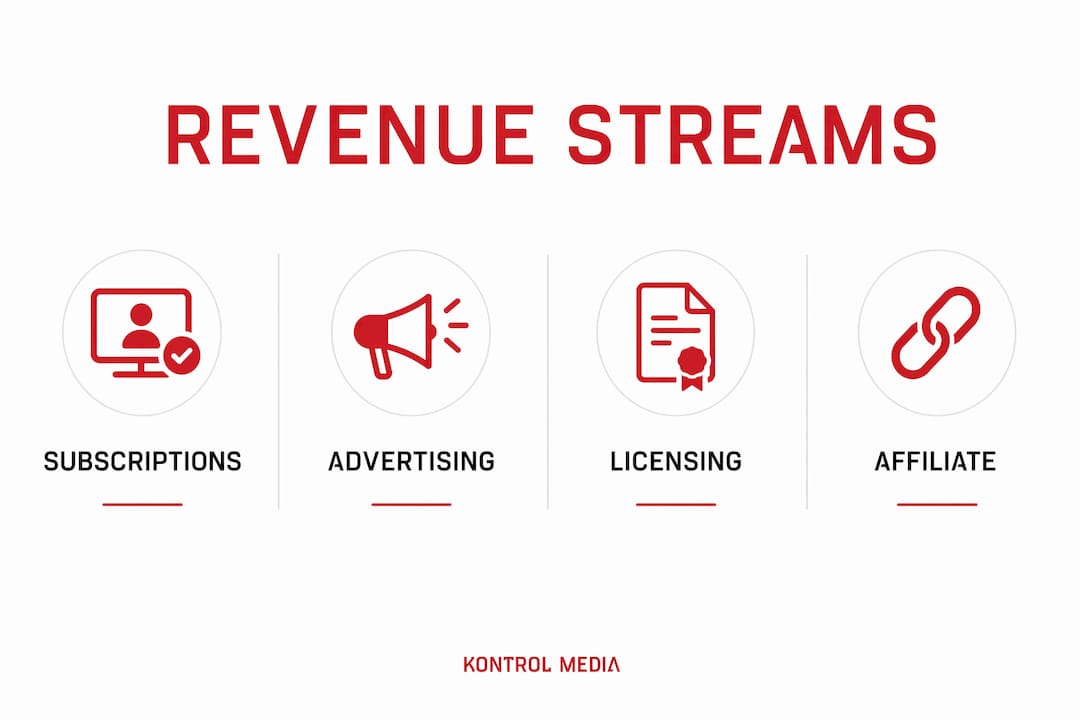
Successful media networks build revenue across five primary pillars: subscriptions and memberships, programmatic and direct advertising, licensing and syndication, transactional sales, and affiliate commissions. No single pillar is sufficient on its own. The networks that survive long-term are the ones that treat each stream as a load-bearing column rather than a bonus.
Subscriptions and memberships have become the anchor revenue stream for most modern networks. Subscriptions generate 10 to 20% of total network revenue while providing the recurring, predictable income that stabilizes cash flow during advertising downturns. Listeners and readers typically pay $5 to $15 per month for ad-free access and exclusive content. The New York Times crossed 10 million digital subscribers by leaning into this model aggressively, and Substack has demonstrated that even individual writers can build subscription businesses at scale.
Programmatic and direct advertising remain the largest revenue contributors for most networks, but they come with real operational requirements. Programmatic ad revenue requires a minimum of 50,000 monthly sessions to be viable, with payouts on a net-30 to net-60 basis. Direct sales, by contrast, allow networks to sell category packages and upfront commitments to advertisers, which commands longer commitments and higher premiums than individual inventory sales. Sponsored placements in niche networks generate between $800 and $3,500 per slot once critical traffic mass is reached.
Licensing, syndication, and affiliate commissions round out the revenue picture. Licensing intellectual property to other platforms, syndicating content to third-party publishers, and embedding affiliate links within editorial content each add incremental revenue without proportional cost increases. Events and commerce represent the next tier of ancillary revenue once the core model is stable.
Pro Tip: Build your advertising sales capability before you think you need it. Networks that wait until they have “enough” audience to start selling almost always leave 12 to 18 months of revenue on the table.
How do media networks balance consumer and advertiser demands?
The central tension in any media network business model is that consumers want low-cost or free content while advertisers want large, high-value audiences. These two goals pull in opposite directions. Raise subscription prices and you lose audience scale. Lower them and you undercut advertiser CPMs. Solving this pricing dilemma requires finding a consumer price that maintains engagement while maximizing advertiser revenue simultaneously.
The most effective networks resolve this tension through tiered pricing architectures rather than a single price point. The table below summarizes the four most common approaches and their trade-offs.
| Pricing model | Consumer experience | Advertiser impact |
|---|---|---|
| Metered paywall | Free access up to a limit, then paid | Maintains ad inventory while building subscriber base |
| Freemium | Core content free, premium content paid | Maximizes audience scale for advertisers on free tier |
| Full subscription | All content behind paywall | Reduces ad inventory but commands premium subscriber data |
| Bundle pricing | Multiple properties or formats packaged | Increases consumer value perception and reduces churn |
The metered paywall, used by The Wall Street Journal and The Atlantic, is particularly effective because it preserves a large free audience for advertisers while converting high-intent readers into subscribers. Freemium models, common in podcast networks and streaming platforms, work similarly by keeping the top of the funnel wide open for ad revenue while monetizing the most engaged segment through subscriptions.
Dynamic pricing adds another layer of sophistication. Networks that sell advertising inventory through both programmatic auctions and direct sales can adjust floor prices in real time based on demand signals, protecting revenue during soft advertising markets. The challenge is that large advertisers hold significant market power, and networks without differentiated audience data often find themselves accepting lower CPMs than their content quality warrants.
Pro Tip: First-party data is your pricing leverage. Networks that collect and activate audience behavioral data can justify premium CPMs to direct advertisers because they can prove audience quality, not just audience size.
What operational layers make a media network business model work?
A functioning media network business model depends on three operational layers working in concert. Strip out any one of them and the model either stalls or collapses. These three layers are audience aggregation, the monetization and sales engine, and production and growth services.
Audience aggregation is the foundation. This layer combines multiple content sources, shows, or publications into a characterized, buyable audience that advertisers can target with precision. The aggregation layer is what transforms a collection of individual properties into a network. Without it, you have a portfolio of assets. With it, you have a media business.
The monetization and sales engine converts that aggregated audience into diversified revenue. This includes the ad operations infrastructure, the direct sales team, the subscription platform, and the affiliate and licensing agreements. The most common failure mode of media networks is ignoring this layer until the audience is “ready,” when in reality the sales infrastructure needs to be built in parallel with audience growth. A network’s worth is a function of audience size multiplied by monetization capability multiplied by creator retention. Neglect any variable and the whole equation shrinks.
Production and growth services support the creators and content teams that feed the aggregation layer. This includes cross-promotion between properties, ad operations support, contract negotiation, and analytics reporting. When creators inside a network feel supported and see their audiences growing faster than they would independently, they stay. When they leave, they take their audiences with them.
The flywheel effect emerges when all three layers operate together. A growing audience attracts better creators. Better creators attract more audience. A stronger audience attracts higher-paying advertisers. Higher advertiser revenue funds better creator support. This is why effective integration of these layers is the defining characteristic of networks that scale sustainably versus those that plateau.
What types of media networks exist and how do their models differ?
Media business models vary significantly by network type, and each category carries distinct audience behaviors, monetization strategies, and operational priorities. Choosing the wrong network type for your business objectives is one of the most expensive strategic mistakes a media leader can make.
Retail media networks like Amazon Advertising, Walmart Connect, and Kroger Precision Marketing link advertising spend directly to purchase behavior. Advertisers pay for access to first-party shopper data and closed-loop attribution, meaning they can measure exactly how many sales a campaign generated. This model commands premium CPMs because the audience intent signal is the strongest available in digital advertising.
Content syndication networks aggregate third-party and original content around a vertical topic, monetizing through programmatic ads, affiliate commissions, and sponsored placements. Syndication operators can reach $2,000 in monthly revenue after four to six months of consistent publishing and partner building, though the ramp requires patience and volume. The business logic is topical authority: the more content a network publishes on a defined subject, the more search traffic it attracts, and the more valuable its advertising inventory becomes.
Commerce media networks sit between retail media and content networks, using content to drive product discovery and purchase. Platforms like Pinterest and YouTube operate partially on this model, where editorial content and shoppable inventory coexist in the same user experience.
Podcast networks like iHeartMedia and Wondery aggregate shows under a shared commercial umbrella, selling host-read sponsorships, programmatic mid-rolls, and subscription tiers. The network model allows them to offer advertisers cross-show packages and category exclusivities that individual podcasters cannot.
The table below compares the four primary network types across key operational dimensions.
| Network type | Primary revenue source | Audience signal | Monetization timeline |
|---|---|---|---|
| Retail media | Closed-loop ad sales | Purchase intent | Immediate with existing retail base |
| Content syndication | Programmatic ads, affiliates | Topical interest | 4 to 6 months to meaningful revenue |
| Commerce media | Shoppable content, ads | Discovery intent | Medium-term with content investment |
| Podcast network | Sponsorships, subscriptions | Loyalty and trust | 6 to 12 months for direct sales |
Selecting the right type requires aligning network choice to user behavior and campaign goals rather than defaulting to whatever format is currently generating the most industry buzz.
Key takeaways
A media network business model succeeds when audience aggregation, a functioning sales engine, and creator support operate as a single integrated system rather than separate functions.
| Point | Details |
|---|---|
| Dual-sided market structure | Media networks sell content to consumers and audience access to advertisers, requiring both sides to be managed simultaneously. |
| Revenue diversification is non-negotiable | Subscriptions, programmatic ads, direct sales, licensing, and affiliates each serve a distinct role in network stability. |
| Three operational layers drive scale | Audience aggregation, monetization infrastructure, and creator support must be built in parallel, not sequentially. |
| Network type determines monetization timeline | Retail media networks monetize fastest; content syndication networks require 4 to 6 months of consistent investment before meaningful returns. |
| Sales capability is a core asset | The most common failure mode is treating sales as a later-stage priority when it should be built alongside audience growth. |
Why most media networks leave money on the table
I have worked with enough media businesses to recognize a pattern that repeats itself with uncomfortable regularity. The team builds a genuinely good content product. The audience grows. The metrics look promising. And then the monetization conversation gets deferred because someone in the room says, “Let’s wait until we have more scale.”
That instinct is understandable and almost always wrong. The networks I have seen succeed, from vertical content properties to commerce media builds, started selling before they felt ready. They built the sales infrastructure, the rate cards, the advertiser pitch, and the category packages while the audience was still developing. By the time the traffic crossed the thresholds that programmatic platforms require, they already had direct relationships in place that paid three to five times the programmatic rate.
The other pattern I see is over-indexing on one revenue stream. A network that runs entirely on programmatic advertising is one algorithm update away from a revenue crisis. The ones that build subscriptions, direct sales, and affiliate revenue alongside their ad business have a buffer that lets them make long-term content decisions instead of chasing traffic spikes.
My honest recommendation is to pick a network type that aligns with your existing audience behavior, not the format that seems most exciting right now. If your audience is transactional, build toward retail or commerce media. If your audience is loyal and niche, subscriptions and direct sponsorships will outperform programmatic every time. The model you choose should feel like a natural extension of how your audience already engages with you, not a structure you are forcing them into.
— Mark Kapczynski
How Kontrol Media can help you build and monetize your media network
Kontrol Media works directly with business leaders and marketing teams to design, launch, and scale media network business models that generate real revenue. Whether you are evaluating network type, building your first advertiser pitch, or trying to understand why your current model is not converting audience into income, the work starts with a clear business strategy that connects your audience assets to the right monetization architecture.

Kontrol Media’s team has built and operated retail media and commerce media networks for clients including Experian, BuzzFeed, and Enthusiast Gaming. The firm handles platform selection, audience targeting, advertiser acquisition, and monetization blueprinting as an integrated engagement, not a menu of disconnected services. If you are ready to stand up a retail or commerce media network or need a strategic partner to accelerate an existing property, reach out to Kontrol Media directly.
FAQ
What is a media network business model in simple terms?
A media network business model is a system that aggregates audiences across content properties and monetizes that aggregation through subscriptions, advertising, licensing, and affiliate revenue. It operates as a dual-sided market, selling content to consumers and audience access to advertisers simultaneously.
How do media networks make money?
Media networks generate revenue through subscriptions, programmatic advertising, direct ad sales, content licensing, syndication, affiliate commissions, and events. As of 2025, 77% of publishers prioritize subscriptions and 69% rely on display advertising as primary revenue channels.
What is the difference between a retail media network and a content syndication network?
Retail media networks like Amazon Advertising link ad spend directly to purchase data, enabling closed-loop attribution and commanding premium CPMs. Content syndication networks aggregate topical content to build search authority and monetize through programmatic ads and sponsored placements, typically reaching meaningful revenue after four to six months of consistent publishing.
Why do media networks fail?
The most common failure mode is neglecting sales and monetization infrastructure until the audience reaches an arbitrary scale threshold. Networks that defer revenue operations too long lose the compounding advantage of early advertiser relationships and direct sales premiums.
How long does it take to monetize a media network?
Timeline depends on network type. Retail media networks with an existing customer base can monetize immediately. Content syndication and podcast networks typically require four to twelve months of consistent content investment and audience building before generating sustainable revenue.
Recommended
- What Is a Commerce Media Network? | Kontrol Media Consultancy
- Stand Up a Retail or Commerce Media Network | Kontrol Media Consultancy
- Commerce Media Networks: The Next Evolution in eCommerce Advertising | Kontrol Media Consultancy
- The Shift in Advertising Spend – How Retail Media Networks Are Changing the Game | Kontrol Media Consultancy