


Aligning marketing to business goals is the process of ensuring every marketing activity directly supports defined commercial outcomes, from revenue growth to customer retention. When that connection breaks down, the cost is real. Misalignment wastes 20–40% of annual marketing budgets, with losses ranging from $26,800 to over $536,000 depending on organization size. The upside is equally clear: aligned marketing can fuel 24% revenue growth and a 27% profit increase. This guide gives marketing professionals and executives a practical framework to close that gap, covering goal identification, objective translation, KPI selection, and the pitfalls that derail even well-funded teams.
How to align marketing to business goals: start with the right objectives
The most common mistake in marketing strategy alignment is starting with tactics instead of commercial outcomes. Before you write a single brief or allocate a dollar of budget, you need to know exactly what the business is trying to achieve in the next 6–12 months.
Common business goals fall into four categories: revenue growth, market share expansion, customer retention, and new product launches. Each one demands a different marketing response. A retention goal calls for loyalty programs, re-engagement campaigns, and customer success content. A market share goal calls for conquest advertising, competitive positioning, and category-level awareness. Conflating the two produces a strategy that does neither well.

The most effective approach is to identify one primary goal for the planning period, with no more than one or two secondary goals. This is not a limitation. It is a discipline that forces prioritization and prevents the “wish list” problem, where marketing plans try to accomplish everything and end up moving nothing.
A SWOT analysis is a practical starting point for surfacing the commercial problem marketing must solve. If the analysis reveals that customer churn is rising while acquisition costs are stable, the primary business objective is retention, not growth. Marketing must follow that signal. The CEO and CFO own the business objectives. The CMO owns the marketing objectives that serve them. That distinction matters because it clarifies accountability and prevents marketing from drifting into activity that feels productive but does not move the commercial needle.
Pro Tip: Before your next planning cycle, ask your CEO or CFO to name the single most important commercial outcome for the next 12 months. Build your entire marketing strategy from that answer.
How do you translate business objectives into marketing goals?
Once the business objective is clear, the next step is operationalization. This is where most marketing teams lose the thread. They translate “grow revenue” into “increase brand awareness,” which is not wrong, but it is incomplete. A marketing objective must describe a specific, measurable change in customer behavior or perception that directly moves a commercial metric.
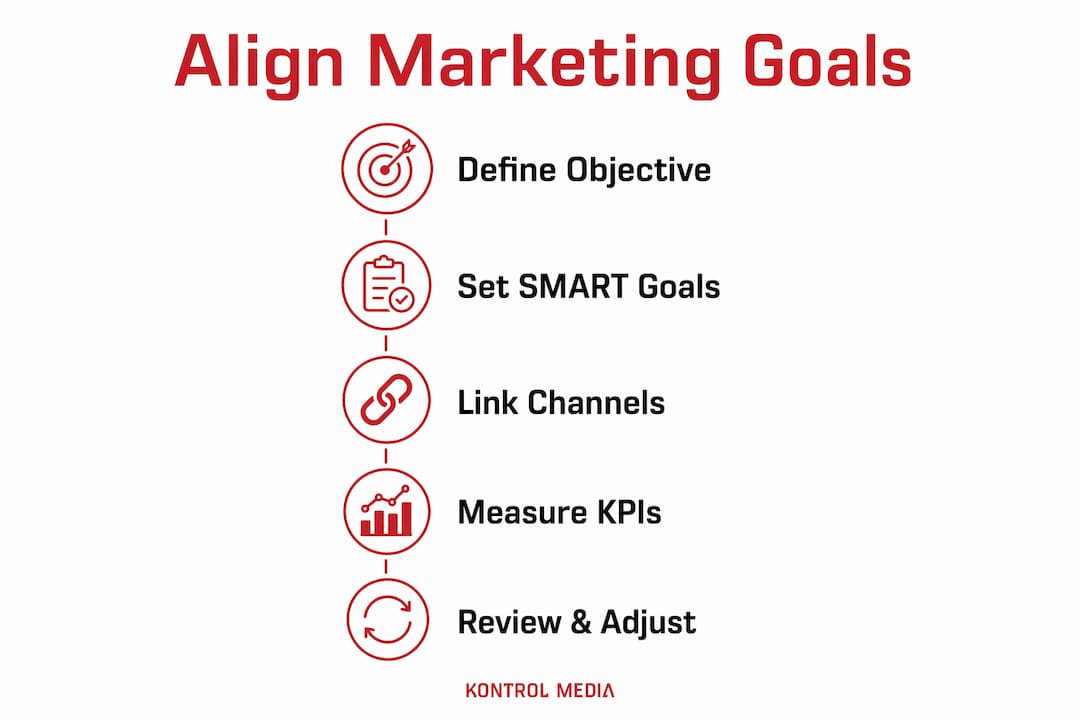
Marketing objectives belong to the CMO and must explicitly drive movement in commercial metrics, or marketing risks being viewed as a support function rather than a strategic driver. That framing should inform how you write every objective.
Here is how that translation works in practice:
- Business goal: Grow annual recurring revenue by 20%. Marketing objective: Increase qualified pipeline from mid-market accounts by 35% within two quarters, measured by sales-accepted leads.
- Business goal: Improve customer retention by 15%. Marketing objective: Increase 90-day re-engagement rate among lapsed customers by 25% through targeted email and content programs.
- Business goal: Launch a new product in Q3. Marketing objective: Generate 10,000 waitlist sign-ups and achieve 40% aided awareness among the target segment within 60 days of launch.
Each of these follows the SMART framework: specific, measurable, achievable, relevant, and time-bound. The SMART structure is not new, but most teams apply it inconsistently. The critical test is whether a CFO reading the objective would immediately understand how it connects to the P&L. If the answer is no, rewrite it.
Limit each marketing brief to one business objective, one marketing objective, and one communications objective. Focused marketing briefs produce better creative, clearer channel selection, and more accountable measurement. When a brief tries to serve five objectives, it serves none of them well.
Pro Tip: Run a “CFO test” on every marketing objective you write. If a CFO cannot see the direct line to revenue, profit, or retention within 10 seconds, the objective needs to be rewritten.
Integrating marketing with business strategy also means linking your objectives to specific channels and communication plans. A retention objective routes to CRM, email, and customer success content. An acquisition objective routes to paid search, content marketing, and sales development. The objective determines the channel, not the other way around.
What kpis actually measure marketing effectiveness?
Selecting the right KPIs is where marketing strategy alignment either holds or falls apart. Most marketing teams default to metrics that are easy to collect: impressions, clicks, follower counts, and open rates. These are not business metrics. They are activity metrics. Leadership does not manage the business by impressions, and marketing should not report by them either.
Marketing measurement must shift to focus on retention, expansion, and business KPIs rather than vanity metrics. That shift is what earns marketing a seat at the executive table. The table below shows the difference between vanity metrics and business-aligned KPIs across three common marketing objectives.
| Marketing Objective | Vanity Metric | Business-Aligned KPI |
|---|---|---|
| Drive new customer acquisition | Website sessions, ad impressions | Cost per acquired customer, sales-accepted leads |
| Improve customer retention | Email open rate, social engagement | 90-day retention rate, customer lifetime value |
| Support product launch | Press mentions, social shares | Waitlist conversions, aided awareness lift |
| Grow market share | Share of voice | New logo wins, competitive displacement rate |
The right KPIs connect marketing spend directly to outcomes the CFO already tracks. Customer lifetime value, pipeline influence, net revenue retention, and gross margin contribution are the metrics that make marketing legible to the rest of the business.
Quarterly business-aligned reporting is the mechanism that keeps this connection visible. Marketing should build its reporting cadence from the business planning calendar, not alongside it. A quarterly review that shows pipeline contribution, retention impact, and cost per acquisition tells a fundamentally different story than a monthly report full of engagement metrics. That story is what secures budget and organizational credibility.
For teams building out their measurement infrastructure, shifting to business-focused campaign ROI reporting is the fastest way to demonstrate strategic value. Tools like Salesforce, HubSpot, and Google Analytics 4 all support revenue attribution when configured correctly. The configuration is the work. Most teams skip it.
What causes marketing misalignment and how do you fix it?
Marketing misalignment is rarely caused by bad strategy documents. It is caused by the gap between what gets written and what gets executed. Three patterns show up repeatedly across organizations of every size.
Multiple conflicting goals. When marketing is asked to support revenue growth, brand awareness, product launches, and retention simultaneously, the result is a diluted plan that moves no single metric meaningfully. The fix is the prioritization discipline described earlier: one primary goal, one primary marketing objective, one focused brief.
Vanity metrics as the default reporting language. Leadership focuses on P&L drivers like profit margins and market share. When marketing reports impressions and engagement, the two groups are speaking different languages. The fix is to rebuild reporting around the metrics the CFO already uses.
Poor stakeholder involvement early in the planning cycle. Marketing strategies that are built in isolation and then presented to leadership for approval almost always face pushback or quiet deprioritization. The fix is to involve the CEO, CFO, and sales leadership in the goal-setting phase, not the approval phase. Marketing and sales alignment is particularly critical when pipeline influence is a primary KPI, because sales owns the data that validates marketing’s contribution.
Documented marketing strategy is a non-negotiable foundation. Marketers who document their strategy are 313% more likely to succeed, and 82% say their strategy is only effective when documented and followed. Documentation is not bureaucracy. It is the mechanism that keeps alignment intact when priorities shift, team members change, or budgets get cut.
Pro Tip: Schedule a 30-minute alignment check-in with your CEO or CFO at the start of each quarter. Bring your marketing objectives, your KPI scorecard, and one clear ask. That habit alone will change how marketing is perceived at the executive level.
A final note on 74% of small and medium businesses that report lacking confidence in their marketing strategies. The root cause is almost always the same: no clear, documented link between marketing activity and business outcomes. Confidence comes from clarity, and clarity comes from the alignment process described here.
Key takeaways
Effective marketing strategy alignment requires documented objectives, business-linked KPIs, and consistent executive communication to transform marketing from a cost center into a revenue driver.
| Point | Details |
|---|---|
| Start with one primary goal | Identify the single most important commercial outcome before writing any marketing brief. |
| Translate goals into SMART objectives | Write marketing objectives that describe measurable behavior or perception changes tied to commercial metrics. |
| Replace vanity metrics with business KPIs | Report on customer lifetime value, pipeline influence, and retention rate instead of impressions or clicks. |
| Document the strategy | Documented marketing plans produce 313% better success rates and keep alignment intact through organizational change. |
| Involve executives early | Bring the CEO, CFO, and sales leadership into goal-setting, not just approval, to secure buy-in and budget. |
The alignment problem is a leadership problem
I have worked with enough marketing teams to say this plainly: most alignment failures are not strategy failures. They are communication failures between marketing leadership and the rest of the executive team.
The CMO who builds a marketing plan from the business plan, rather than alongside it, operates in a fundamentally different position. That person is not defending a budget. They are presenting a contribution. The difference in how that lands in a board meeting is significant.
What I have seen work consistently is the discipline of one primary objective. Not three. Not five. One. When a team commits to moving a single commercial metric and builds every campaign, every channel decision, and every piece of content around that metric, the results are measurable and the story is easy to tell. When a team tries to serve every stakeholder’s priority at once, the results are diffuse and the story is impossible to tell.
The other thing I keep coming back to is the importance of a comprehensive business strategy as the foundation for any marketing plan. Marketing cannot align to goals that have not been clearly articulated. If the business strategy is vague, the marketing strategy will be vague. The work of alignment starts at the top, and it requires executives who are willing to be specific about what winning looks like.
— Mark Kapczynski
How kontrol media helps you build alignment that sticks
Getting the framework right on paper is one thing. Executing it across sales, marketing, and business development functions is another challenge entirely.
Kontrol Media works directly with marketing executives and leadership teams to build marketing strategies that start from the business plan, not alongside it. From goal identification and objective translation to KPI design and quarterly reporting structures, the work is hands-on and built around your specific commercial priorities. Clients like Experian, BuzzFeed, REMAX, and West Monroe have used this approach to move from activity-based marketing to measurable business growth. If your marketing plan is not clearly connected to your P&L, that is the starting point. Reach out to Kontrol Media to build the alignment your business needs.
FAQ
What does it mean to align marketing to business goals?
Aligning marketing to business goals means ensuring every marketing objective, tactic, and KPI directly supports a defined commercial outcome such as revenue growth, customer retention, or market share. Misalignment wastes 20–40% of annual marketing budgets and prevents marketing from functioning as a strategic driver.
Who owns business objectives versus marketing objectives?
Business objectives such as revenue growth and profit targets are owned by the CEO and CFO. Marketing objectives, which describe measurable changes in customer behavior or perception, are owned by the CMO and must explicitly connect to those commercial outcomes.
How do you set marketing goals that support business strategy?
Use the SMART framework to write marketing objectives that specify a measurable behavior or perception change, a target metric, and a time frame. Limit each planning brief to one primary marketing objective to maintain focus and accountability.
Why do most marketing strategies fail to align with business goals?
The most common causes are multiple conflicting priorities, vanity metric reporting, and marketing plans built in isolation from executive leadership. Documented strategies and quarterly business-aligned reporting are the two most effective corrective measures.
What kpis should marketing use to demonstrate business impact?
Replace impressions and engagement metrics with business-aligned KPIs such as cost per acquired customer, sales-accepted leads, 90-day customer retention rate, and pipeline influence. These metrics speak directly to the P&L and build executive credibility for the marketing function.
Recommended
- Align Marketing and Sales to Hit Revenue Goals | Kontrol Media Consultancy
- Why Marketing Strategies Misalign with Sales Teams | Kontrol Media Consultancy
- 5 Things Brands Should Prioritize in 2025 | Kontrol Media Consultancy
- Brand Marketing Versus Performance Marketing: 2026 Guide | Kontrol Media Consultancy