


Sponsored Brand advertising is a brand-level ad format that places your logo, a custom headline, and curated product creative in high-visibility positions across retail platforms, with Amazon Sponsored Brands being the dominant North American example. Its primary purpose is discovery and consideration, not just conversion. Three things it does well: it increases your share of voice at the top of search, it drives new-to-brand acquisition by introducing your catalog to shoppers who have never purchased from you, and it routes qualified traffic directly to a Brand Store or curated landing page where you control the full experience. Enrollment in Amazon Brand Registry is required to run these ads, which means only verified brand owners can access the format.
- Brand discovery: Appear at the top of search results before a competitor does.
- New-to-brand acquisition: Reach shoppers in the consideration phase who are category-aware but brand-undecided.
- Traffic routing: Send clicks to a Brand Store, a product collection, or a specific product detail page depending on your objective.
Table of Contents
- What is sponsored brand advertising and how does it actually work?
- How Sponsored Brands differs from Sponsored Products and Sponsored Display
- How to structure and target a Sponsored Brands campaign
- Who benefits most from Sponsored Brands?
- Measurement and KPIs that actually matter for Sponsored Brands
- Setup prerequisites, creative specs, and realistic timelines
- Best practices and an optimization checklist for Sponsored Brands
- Common mistakes that reduce Sponsored Brands effectiveness
- How Kontrol Media helps brands implement Sponsored Brands strategies
- Key Takeaways
- Sponsored Brands deserves a stronger opinion than most marketers give it
- Kontrol Media’s Sponsored Brands consulting and execution services
- Useful sources and further reading
What is sponsored brand advertising and how does it actually work?
Sponsored Brands are customizable, premium ad units that appear in three high-visibility placements: top-of-search (the most prominent position on the results page), within shopping results, and on product detail pages. Each placement carries a brand logo, a custom headline, and rich creative that distinguishes it visually from standard product listings.
The format comes in three distinct creative types, each with a different objective and landing behavior.
| Format | Primary Objective | Landing Destination |
|---|---|---|
| Product Collection | Showcase multiple SKUs simultaneously | Product detail page or Brand Store |
| Store Spotlight | Drive exploration of Brand Store sub-pages | Brand Store category pages |
| Sponsored Brands Video | Drive direct engagement via autoplay in search | Single product page or Brand Store |
Video creatives run between 6 and 45 seconds and autoplay in search results, giving them a distinct auction and placement set from static formats. Billing runs on a CPC model for most placements, with vCPM available for impression-based objectives and reserved top-of-search placements available for brands that want guaranteed visibility on branded keywords at a fixed upfront price.
How Sponsored Brands differs from Sponsored Products and Sponsored Display
Understanding where each format fits is what separates a coordinated retail media program from a fragmented spend. Sponsored Brands and Sponsored Products serve fundamentally different roles, even though they share the same platform.

| Dimension | Sponsored Brands | Sponsored Products | Sponsored Display |
|---|---|---|---|
| Primary goal | Awareness and consideration | Conversion and demand capture | Retargeting and audience reach |
| Creative flexibility | High (logo, headline, video, collection) | Low (product image and title) | Moderate (lifestyle image, audience-based) |
| Typical placement | Top-of-search, within results, PDPs | Within results, PDPs | PDPs, off-Amazon placements |
| Operational oversight | Higher (creative review required) | Lower (auto-generated from listing) | Moderate |
| Buying model | CPC, vCPM, reserved | CPC | CPC, vCPM |
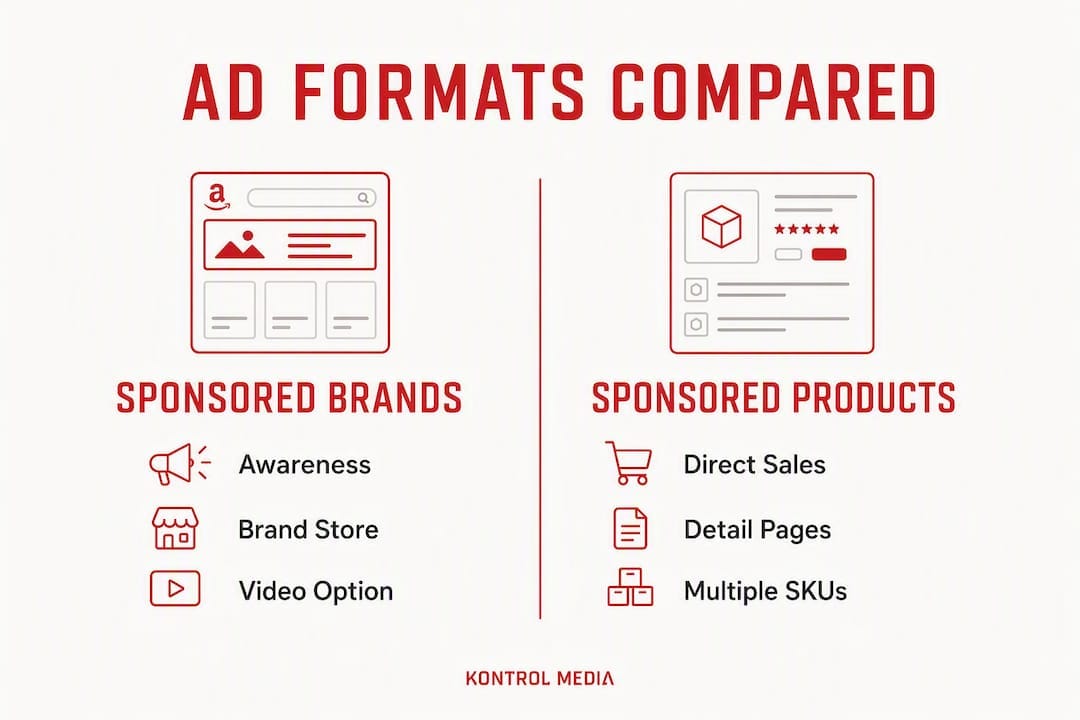
The most effective programs run Sponsored Brands and Sponsored Products together: Sponsored Brands builds the consideration that Sponsored Products later converts. Sponsored Display then re-engages shoppers who viewed but did not purchase. Running all three in coordination increases category impression share and closes the gaps where a competitor could intercept your branded traffic. Treating Sponsored Brands as an isolated format, rather than as part of a retail media growth system, is one of the most common strategic errors we see.
How to structure and target a Sponsored Brands campaign
Campaign structure for Sponsored Brands maps directly to your objective. Each campaign contains ad groups organized by creative theme or product set, and each ad group links to a specific landing destination.
Targeting types available:
- Keyword targeting (manual): The most common approach. Bid on category terms, competitor terms, and branded terms separately so you can control bids and messaging by intent level.
- Product/ASIN targeting: Target specific competitor or complementary product pages to intercept consideration at the detail page level.
- Category targeting: Broad reach across a product category, useful for new launches where keyword data is thin.
- Audience targeting (where supported): Layer in behavioral or purchase-history signals for more precise reach.
Initial setup priorities:
- Separate branded and non-branded keywords into distinct campaigns so you can set different bids and measure performance independently.
- Build a negative keyword list from day one to prevent wasted spend on irrelevant queries.
- Allocate budget by placement type: top-of-search typically warrants a higher bid than within-results placements because the intent signal is stronger.
- Link high-intent ad groups to product detail pages and exploratory ad groups to your Brand Store for a deeper brand experience.
- Set a minimum 4–6 week learning window before drawing conclusions on keyword performance.
Pro Tip: Start with three to five tightly themed ad groups rather than one broad campaign. Tighter groupings give you cleaner data on which creative and keyword combinations actually drive new-to-brand purchases.
Who benefits most from Sponsored Brands?
Sponsored Brands delivers clearest value when you have a catalog worth exploring and a brand story worth telling. A single-product seller with no Brand Store gets less from the format than a brand with a curated product line and a polished Store experience.
- Brand launches: Get immediate top-of-search presence before organic ranking builds.
- Seasonal campaigns: Reserve top-of-search visibility for branded keywords during peak periods using the reserve share-of-voice option.
- Product-line promotion: Surface new SKUs alongside established ones in a Product Collection ad.
- New-to-brand acquisition programs: Target category and competitor keywords to reach shoppers who know the category but not your brand.
- Traffic routing to Brand Stores: Use Store Spotlight ads to guide shoppers into curated brand experiences that increase basket size.
The prerequisite for all of this is Amazon Brand Registry enrollment. Without it, you cannot run Sponsored Brands campaigns. A well-built Brand Store is not technically required, but it meaningfully improves the return on your Sponsored Brands investment by giving clicks somewhere worth going.
Measurement and KPIs that actually matter for Sponsored Brands
Sponsored Brands operates across the upper and mid funnel, so measuring it purely on conversion metrics will make it look worse than it is. Expect a higher ACOS for Sponsored Brands than for Sponsored Products. That is not a failure signal; it reflects the awareness and longer-funnel effects the format is designed to produce.
Upper-funnel KPIs: Impressions, impression share, CTR, and Brand Store visits tell you whether your creative is earning attention at scale.
Mid-funnel KPIs: Add-to-cart rate (ATC), detail page views, and new-to-brand purchase rate tell you whether that attention is converting to consideration and first purchase.
Conversion KPIs: ROAS, CVR, and total attributed sales close the loop, but weight them against a longer attribution window than you would use for Sponsored Products.
New-to-brand metrics deserve special attention. They are the clearest signal that Sponsored Brands is doing its job: bringing in customers who have never bought from you before. For retail media measurement to be credible, you need a test window of at least four weeks and, ideally, a holdout group to isolate incrementality.
Key measurement principle: A Sponsored Brands campaign with a high ACOS but strong new-to-brand purchase rates is performing exactly as designed. Optimize for the metric that matches your objective, not the one that looks best in a default dashboard.
Setup prerequisites, creative specs, and realistic timelines
Before you build a single campaign, confirm these are in place:
- Amazon Brand Registry enrollment (required; verification can take 2–4 weeks if you are starting from scratch).
- An active Brand Store with at least one published page (required for Store Spotlight ads; strongly recommended for all formats).
- Approved product listings with complete titles, images, and A+ content.
- Creative assets: brand logo (at minimum), lifestyle images, and video if you plan to run Sponsored Brands Video.
For video, creatives run 6–45 seconds and must meet Amazon’s resolution and file-size requirements. Static creative requires review for imagery, copy, and layout before going live, which adds 1–3 business days to your launch timeline. Plan for a total of 4–8 weeks from Brand Registry initiation to first live campaign if you are starting from zero.
Best practices and an optimization checklist for Sponsored Brands
A well-run Sponsored Brands program is not set-and-forget. It requires deliberate iteration on creative, targeting, and landing experience.
- Define your objective before you build. Awareness campaigns need different KPI targets and budget levels than conversion campaigns.
- Test creative variants systematically. Run two headline variations per ad group with a minimum two-week test window before declaring a winner.
- Align landing pages to ad creative. If your ad features a seasonal collection, the Brand Store page it links to should reflect that same theme.
- Bid by placement. Increase bids for top-of-search on your highest-intent keywords; pull back on within-results placements that show high spend and low ATC.
- Build negative keyword lists proactively. Review search term reports weekly in the first month and add irrelevant terms to negatives.
- Coordinate with Sponsored Products. Run both formats on the same keyword sets so you own more of the search results page.
- Phase your budget. Allocate more budget to new-to-brand keyword sets in the first 60 days, then shift toward branded defense once you have established presence.
Pro Tip: Treat your Brand Store as a living asset, not a one-time build. Update it to reflect current promotions and seasonal creative so that Sponsored Brands traffic lands on a page that matches what the ad promised.
Common mistakes that reduce Sponsored Brands effectiveness
The format is forgiving in some ways and unforgiving in others. These are the errors worth avoiding.
- Treating it as a direct-response channel. Sponsored Brands is upper- and mid-funnel. Judging it on immediate ROAS alone leads to premature budget cuts.
- Poor creative quality. Generic headlines and low-resolution images waste premium placements. The creative is the brand impression.
- Routing all traffic to a single product page. A Product Collection ad that sends every click to one ASIN defeats the format’s purpose.
- Ignoring negative keywords. Without active negative management, Sponsored Brands campaigns bleed spend on irrelevant queries fast.
- Underfunding the learning window. Cutting budget before the algorithm has enough data to optimize produces misleading performance signals and bad decisions.
The fix for most of these is coordination: align your creative to your landing experience, coordinate Sponsored Brands with Sponsored Products and any active promotions, and set KPI expectations that match the funnel stage you are targeting.
How Kontrol Media helps brands implement Sponsored Brands strategies
Kontrol Media works with brands at the strategy-to-execution level, which means we do not hand you a playbook and walk away. We build and run the program. Our client roster includes Experian, BuzzFeed, HuffPost, REMAX, Enthusiast Gaming, and West Monroe, and our retail and commerce media network experience gives us a grounded perspective on what actually moves the needle in brand-level advertising.
Our engagement model for Sponsored Brands typically follows this sequence:
- Discovery: Audit your current catalog, Brand Registry status, and existing campaign structure.
- Strategy: Define objectives, KPI targets, and budget allocation across Sponsored Brands, Sponsored Products, and Amazon DSP where applicable.
- Creative production: Develop headlines, product collections, lifestyle imagery, and video briefs aligned to your brand standards.
- Campaign build and launch: Structure campaigns by objective, set targeting and bids, and configure Brand Store landing pages.
- Ongoing optimization: Weekly bid and budget reviews, monthly creative refreshes, and quarterly incrementality analysis.
Sponsored Brands is not just an ad format. It is the spine of your brand’s presence on the retail shelf that never closes. When it is built right and integrated with the rest of your retail media program, it does something no single-product ad can: it tells shoppers who you are before they have to ask.
Key Takeaways
Sponsored Brand advertising works best when it is treated as an upper- and mid-funnel growth lever integrated with Sponsored Products and Amazon DSP, not as a standalone conversion tool.
| Point | Details |
|---|---|
| Core purpose | Sponsored Brands drives brand discovery, share of voice, and new-to-brand acquisition at the top of search. |
| Format options | Product Collection, Store Spotlight, and Sponsored Brands Video each serve different objectives and landing destinations. |
| KPIs to watch | Prioritize new-to-brand purchase rate, ATC, and impression share alongside ROAS; expect higher ACOS than Sponsored Products. |
| Integration matters | Running Sponsored Brands alongside Sponsored Products increases category impression share and prevents competitor traffic interception. |
| Kontrol Media | Kontrol Media provides strategy, creative production, campaign execution, and ongoing optimization for Sponsored Brands programs. |
Sponsored Brands deserves a stronger opinion than most marketers give it
Here is what I see consistently: brands invest in Sponsored Products because the ROAS is clean and immediate, and they treat Sponsored Brands as an afterthought, a budget line that gets cut first when quarterly numbers tighten. That is a strategic mistake, and it compounds over time.
The brands that win category share on Amazon are not the ones with the lowest CPC. They are the ones that own the top of the search results page visually, before a shopper even reads a product title. Sponsored Brands is how you do that. It is how you make your brand the obvious choice before the comparison even starts.
The new-to-brand metric is the one I keep coming back to. It is the clearest signal that your advertising is actually growing your customer base rather than just recycling existing buyers. Most brands underweight it because it does not show up in the default ROAS calculation. That gap between what the dashboard shows and what the business actually needs is exactly where strategy has to live.
For the first 90 days, the priority order is straightforward: get Brand Registry and your Brand Store right first, then run Sponsored Products and Sponsored Brands in tandem from the start. Do not wait until Sponsored Products is “optimized” to add brand-level creative. The two formats build on each other, and the compounding effect of running both is real. Integrate PPC and social ad management alongside your Amazon programs when budget allows, because cross-channel reinforcement shortens the consideration cycle for new-to-brand shoppers.
The brands that treat Sponsored Brands as a system, not a line item, are the ones still growing when the category gets crowded.
Kontrol Media’s Sponsored Brands consulting and execution services
Kontrol Media is the alternative to building a retail media program in-house without the infrastructure to support it. We bring the strategy, the creative production, the campaign architecture, and the measurement framework, so your team is not learning on live budget. For brands that are serious about building a retail media presence that compounds over time, that is a meaningful difference.
Our engagements cover the full scope: Brand Registry setup and Brand Store development, Sponsored Brands and Sponsored Products campaign management, creative production, KPI framework design, and ongoing optimization. We work with mid-market and enterprise brands, PE portfolio companies, and growth-stage businesses that need execution, not just advice. If you are ready to build a Sponsored Brands program that actually grows your customer base, start the conversation with Kontrol Media today.
Useful sources and further reading
The following sources informed this guide and are worth bookmarking for ongoing reference.
- Amazon Ads: Your complete guide to Sponsored Brands — The primary reference for format specs, creative requirements, placements, and billing models.
- Amazon Ads: Sponsored Brands product page — Overview of strategic objectives, buying models, and Brand Store integration.
- Amazon Ads: Reserve share of voice — Detailed guide to securing guaranteed top-of-search visibility for branded keywords at fixed pricing.
- Feedvisor: Sponsored Brands on Amazon — Strategic context on treating Sponsored Brands as a coordinated growth system rather than an isolated format.
- Voyado: Sponsored product ads vs. sponsored brand ads — Side-by-side comparison of format differences, creative oversight, and recommended combinations.
- BigCommerce: What are Amazon Sponsored Brands? — Accessible overview of format mechanics, ACOS expectations, and integration with Sponsored Products.
Recommended
- Brand Marketing Versus Performance Marketing: 2026 Guide | Kontrol Media Consultancy
- Games and Advertising: A Smarter Strategy for Brands | Kontrol Media Consultancy
- Branding and Messaging Strategies for Marketers | Kontrol Media Consultancy
- Do Brands Still Advertise on News Sites? A CMO’s Guide | Kontrol Media Consultancy