


The best retail media org structure gives the network its own accountable leader with P&L responsibility, places that leader on the executive team rather than inside a marketing function, and builds a small core team of strategy, sales, campaign operations and measurement. How much sits in-house and how much you borrow at launch depends on your size and speed. This guide walks through ownership, the three common operating models, the first roles to fill, and how to divide decisions so that sales, shopper, technology and finance pull in the same direction. If you are a CMO, a retailer, a consumer business or a PE-backed company weighing a network, this is the structural groundwork that comes before the platform decision.
TL;DR
- Put one leader in charge of retail media with real P&L accountability, and seat that person alongside your chief commercial and marketing officers rather than beneath them.
- Pick an operating model on purpose: embedded in-house, standalone unit, or cross-functional hybrid. Each solves a different problem and creates a different one.
- Start with four functions: strategy and P&L, ad sales or brand partnerships, campaign operations, and data and measurement. Fill two or three with existing staff and hire as the network proves itself.
- Write down who decides what across sales, shopper, tech, operations and finance before the first advertiser signs.
- Track revenue, yield, advertiser adoption and measurement quality, not impressions alone.
Table of Contents
- Why structure decides whether a retail media network grows
- Who should own retail media
- Three operating models and when each fits
- The core team: roles to fill first
- Reporting lines and who decides what
- If you are the brand side of the table
- Coordinating agencies, partners and internal teams
- Measuring the organization, not just the campaigns
- Where we can take work off your hands
- Our perspective
- FAQ
- Sources
Why structure decides whether a retail media network grows
Most retail media networks do not fail on technology. They stall because nobody can say who is accountable for revenue, who owns the advertiser relationship, or who signs off when merchandising and media want the same placement. A retail media network sells advertising on a retailer’s own channels to third parties, so it touches merchandising, marketing, ecommerce, data, finance and vendor relationships at once. That is a structural problem before it is a technical one.
A Digiday piece on who controls retail media spend shows the same tension on the brand side: 36% of US retail media spend in one Forrester survey came from trade-marketing budgets and 26% from shopper-marketing budgets, with the remainder typically coming from marketing. Money arrives from several departments, so the network you build has to be legible to several departments.
Who should own retail media
The short answer: a dedicated executive with commercial and P&L experience, not a marketing role that adds retail media as a side responsibility.
A report on leadership in retail media argues that the strongest networks give their leaders a seat on the executive team alongside the chief commercial and marketing officers, rather than a reporting line into them. It also cautions against attaching retail media to a non-P&L role such as the CMO as a way to strengthen the marketing function. The leader needs commercial expertise, P&L management experience and marketing capability in one person.
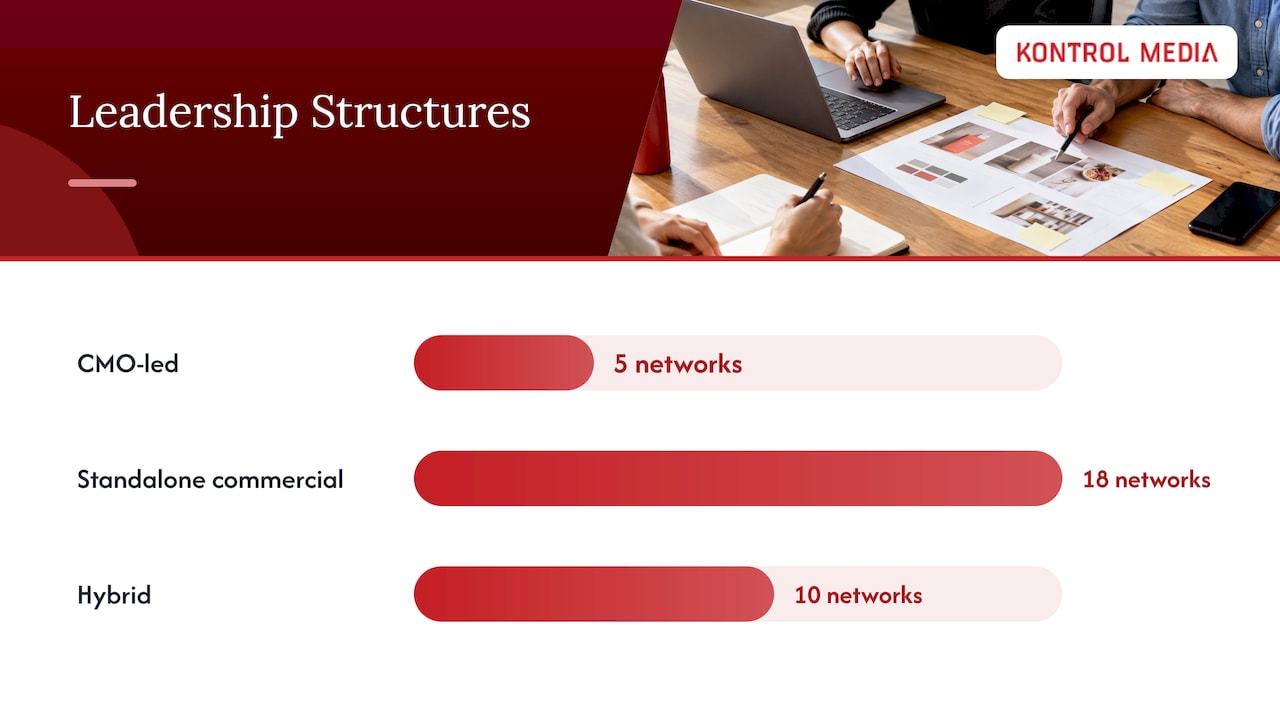
In practice, the market is split. A mapping of 33 networks published in August 2026 by Marketers & Money found five clearly under CMOs, 18 operating as standalone commercial units and 10 hybrids. The same mapping places Walmart Connect under a chief growth officer, Target Roundel under a chief digital and revenue officer and United Kinective Media under a chief commercial officer. The pattern is that the largest networks sit on the commercial side of the house.
Albertsons is a clear example. The Drum reported in October 2025 that Albertsons aligned retail media under a chief commercial officer who also oversees enterprise marketing, loyalty and personalized services, treating media as part of the retail growth engine rather than an isolated profit center.
Marketing home or commercial unit: the tradeoff
Housing the network in marketing keeps it close to brand, loyalty and customer data, and it is the quickest way to start. The cost is that marketing is usually measured on cost and reach, while a network has to be measured on revenue and margin. A commercial or standalone home lets the leader run sales targets, hire ad-tech talent and negotiate with brands as a seller, but it needs clear rules for sharing inventory and customer data with the rest of the business.
The funding side matters here too. Brands buying from you often pay out of co-op and trade budgets, so teams that already administer co-op and MDF fund management for their channel partners will recognize the approval and reconciliation workflows a commercial unit has to support. If your advertisers fund retail media that way, finance and sales operations belong in the structure from day one.
Three operating models and when each fits
IAB Europe’s guide to change management in retail media describes three common structures: embedded in-house, standalone entity, and cross-functional or hybrid. The tradeoffs are consistent across markets.
| Model | Where it fits best | What it does well | What to watch |
|---|---|---|---|
| Embedded in-house | Retailers with strong trade and category teams and modest ad ambitions | Aligns with merchandising and category planning | Can lack digital, ad-tech and analytics depth |
| Standalone unit | Retailers with enough scale to justify its own sales, ad ops, product and tech | Attracts specialist talent and incremental brand budgets | Needs clear channel ownership so it does not compete with trade teams |
| Cross-functional hybrid | Early-stage networks borrowing from several departments | Fast to launch, uses existing people | Decisions slow down without clear governance |
The hybrid is the most common starting point and the most common place networks get stuck. If you begin there, name a single accountable owner and a decision calendar immediately, so “cross-functional” does not become “nobody in charge.”
A second axis is how you deliver the service. A retailer guide from June 2026 separates managed service, self-service and hybrid delivery: managed service gives the retailer control during launch, self-service supports scale, and hybrid reserves bespoke support for major advertisers while the long tail uses self-service. Your org chart should reflect that choice. A managed-service launch needs more campaign managers and account people; a self-service model needs more product, support and tooling talent.
Klarna’s retail media leader describes the choice as a standalone unit with its own sales, ad ops, product and tech teams versus an integrated model that keeps the commercial relationship in one place, and Klarna chose the integrated route. Retail media cannot succeed as a siloed revenue initiative, the playbook says, and org design should follow commercial reality rather than the urge to move fast.
The core team: roles to fill first
There is broad agreement on the minimum viable team. A staffing guide for in-house networks lists a head or VP who owns strategy and P&L, ad sales or brand partnerships, campaign operations, and data and measurement. A 2026 launch guide for retailers recommends five launch roles: an executive sponsor or strategy lead, a retail media manager, sales and vendor partnerships, an ad operations and campaign manager, and technical support. It adds that retailers can fill two or three of those with existing employees at first and hire as the network matures.
Here is what each function actually does.
Head of retail media. Owns the strategy, the revenue target, the P&L and the relationship with the executive team. When Dollar General named a vice president and general manager of DG Media Network in July 2025, the role covered go-to-market strategy, media operations, insights, media sales and performance measurement. That span is the point: one leader, every moving part.
Ad sales and brand partnerships. The frontline communicators of the offering to advertisers. They need to sell outcomes to brand teams that buy across trade, shopper and marketing budgets, so they have to be fluent in all three.
Campaign operations. Trafficking, QA, pacing, optimization and reporting. This is where advertiser trust is won or lost, because a late or misreported campaign undoes the sales effort that preceded it.
Data and measurement. Closed-loop reporting, incrementality and the audience layer. Measurement may report to the network leader or to the analytics organization, but advertisers need a single set of numbers either way.
Finance. Often missing from early diagrams. Skai describes finance teams as the group that oversees the financial health of the network and manages the complex data behind decisions. Revenue recognition, vendor funding reconciliation and margin reporting all need an owner.
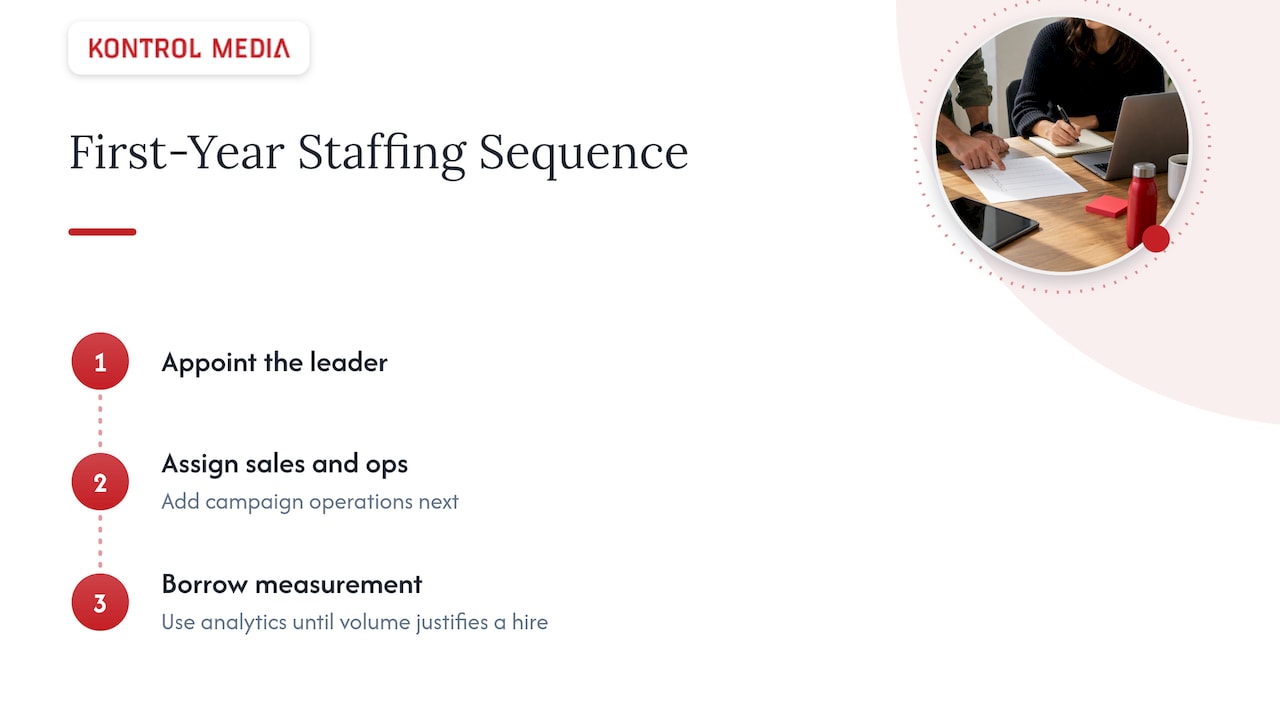
A sensible first-year sequence: appoint the leader, assign sales and campaign operations next, and borrow measurement from analytics until volume justifies a dedicated hire.
Reporting lines and who decides what
Reporting is where theory meets politics. The same staffing guide notes that the head of retail media typically reports to a CMO, CRO or CEO, with sales and campaign operations reporting to that head and measurement reporting either there or into analytics. Given the executive-team guidance above, reporting to the CEO or a chief commercial or growth officer gives the leader the most room to run the P&L.
A decision map prevents the recurring conflicts. Write it down in a one-page working agreement:
- Sales: owns advertiser relationships, pricing and packaging, and the revenue forecast.
- Merchandising and category: owns vendor terms and trade funds, and agrees with the network which placements are for sale and which are protected.
- Marketing: owns brand and customer experience standards, and approves how ads appear in owned channels.
- Technology and product: owns the ad stack roadmap, data access and privacy controls.
- Operations: owns campaign delivery standards and service levels for advertisers.
- Finance: owns billing, revenue recognition and the reporting that goes to the board or sponsors.
Walmart’s early-2026 reorganization shows the principle at scale. It aligned three advertising businesses, Walmart Connect U.S., Walmart Connect International and Sam’s Club Connect, under its chief growth officer, keeping them operating separately while standardizing the shared data and measurement layer underneath. Separate selling units, one shared foundation. Middle-market and PE-backed companies can borrow the idea at smaller scale: one measurement standard, even if sales is split by customer segment.
If you are the brand side of the table
Brands face the mirror-image problem. Econsultancy reports that brand-side ownership is dispersed across shopper marketing, media, digital, ecommerce, store, retail operations and in-house media teams, and practitioners it quotes call for joined-up structures instead of parallel retail media and shopper teams. If you are planning retail media spend, the same discipline applies: name one owner, agree which budgets feed which retailer programs, and set one view of results. If you want to know how a network sees you as a buyer, our guide to key metrics for retail media shows what the other side of the table will report back.
Coordinating agencies, partners and internal teams
Whatever the model, advertisers should meet one network, not five departments. Ahold Delhaize USA’s 2022 plan to move AD Retail Media in-house aimed to more than triple the team to 70-plus people and launch a unified on-site and offsite platform with a single campaign-measurement dashboard, bringing multiple channels under one business plan. The lesson for any org design is that the advertiser-facing interface should be unified even when the work behind it is spread across teams.
Albertsons took a related path. AdExchanger reported that it centralized planning, execution, measurement and product development in-house while keeping DSP partnerships for programmatic reach and closed-loop incremental measurement. Centralization buys methodological consistency, and it asks for real technical, privacy and operational capacity. For many mid-sized retailers, the practical hybrid is to keep strategy, sales leadership and measurement standards in-house and bring in operating capacity where the team is still thin.
On the sequence of onsite and offsite, our view is to prove one before scaling the other, and we lay out that reasoning in our piece on onsite versus offsite retail media. It also decides how many ad-operations and measurement people you need on day one.
Measuring the organization, not just the campaigns
A good structure shows up in a scorecard. Kohl’s, in a job posting for its retail media technology strategy, describes performance visibility in terms of media revenue, campaign delivery, yield, utilization, operational efficiency, advertiser adoption, measurement quality and incremental business impact. Each metric implies an owner. Yield and revenue belong to sales and the head of the network. Delivery and utilization belong to campaign operations. Adoption belongs to sales and product together. Measurement quality belongs to the data team. If a metric has no owner in your org chart, it will not move.
Review that scorecard monthly with the executive sponsor, and revisit the structure at each stage gate. The model that fits a pilot rarely fits a network that has reached scale.
Where we can take work off your hands
If you are standing up a network, we do that work with you: our stand up a retail or commerce media network service covers setup, and our retail media network operations service covers running it day to day. For a view of the build-or-buy question that sits behind most org designs, see our retail media network setup page.
Talk to us about the structure that fits your size, your budgets and your timeline through our consulting services.
Our perspective
We have spent years building, operating and selling for retail and commerce media networks, and the pattern we see in org design is consistent: structure is a growth decision, not an administrative one.
The most useful question is not whether retail media belongs under marketing or under commerce. It is who wakes up responsible for the revenue number. When that person exists, has the authority to hire, and has a line of sight into sales, operations and measurement, the network gets momentum. When ownership is spread across a committee, advertisers feel it before the leadership team does.
We also believe in starting smaller than the diagrams suggest. A lean core team with a clear owner, a decision map and a shared measurement standard will outperform a large, unsettled organization. Execution matters as much as the plan, which is why we pair strategy with hands-on operation across sales, marketing and business development. The structure should earn each new hire by showing advertiser adoption and revenue first.
The networks that do this well treat media as part of the retail growth engine, and they give it the same seriousness as any other line of business.
Mark Kapczynski
FAQ
Should retail media report to the CMO?
It can, and five of the 33 networks in the Marketers & Money mapping do. The stronger guidance is to give the retail media leader P&L accountability and an executive-team seat, whichever function they report through. Make revenue the leader’s measure, not marketing cost efficiency.
How many people do you need to launch a retail media network?
Start with four functions: strategy and P&L, sales, campaign operations, and measurement. Launch guidance suggests two or three roles can come from existing employees at first. Add dedicated hires as advertiser demand and revenue prove the network.
What is the difference between a standalone and an embedded retail media team?
An embedded team sits inside trade or category functions and aligns well with merchandising, while a standalone unit has its own sales, operations, product and technology and can attract specialist talent. The IAB Europe guide notes that embedded teams may lack ad-tech depth and standalone units need clear channel ownership.
Who decides pricing and placements?
The network’s sales leader should own pricing and packaging, and merchandising should agree which placements are protected. Settle this in a written working agreement before the first advertiser signs, and let finance own billing and reporting.
Sources
- Finding the Right Leaders for the $300 Billion Retail Media Revolution
- CMOs are selling retail media but rarely own it (Marketers & Money)
- Albertsons media collective (The Drum)
- Who controls retail media spend? (Digiday)
- IAB Europe’s Bitesize Guide to Change Management in Retail Media
- How to launch a retail media network: 2026’s guide
- How to Build a Retail Media Network: Klarna’s Playbook
- Building an In-House Retail Media Network Team
- Dollar General Hires Retail Media Veteran Austin Leonard (Path to Purchase Institute)
- How Retail Media Networks Can Conquer Complexity (Skai)
- Walmart Aligned Three Ad Businesses (Winning With Walmart)
- CPGs must build cross-functional teams (Econsultancy)
- AD Retail Media’s Transition In-House (Path to Purchase Institute)
- Why Albertsons In-Housed Its Retail Media Network (AdExchanger)
- Kohl’s Manager, MarTech Strategy, Capabilities & Innovation posting