


The single priority after close is protecting revenue and customers while you run short, visible revenue-up plays. Assign owners on Day 1 for customer communication, digital asset security, and account sponsorships, and freeze any risky external messaging until leadership agrees on one voice. Everything else, brand architecture, CRM cleanup, cross-sell pilots, follows once those three things are locked down across Day 1, Day 30, and Day 100.
TL;DR:
- Prioritize clear internal ownership and communication from Day 1 by securing critical accounts, announcing the deal, and locking down access to key assets.
- Make brand architecture and messaging decisions within the first 30 days using inputs like brand equity, customer overlap, and channel separation to avoid confusion.
- Focus 90-day efforts on establishing unified dashboards, running pilot cross-sell campaigns, and creating quick-win proof points to demonstrate early value.
- Reinforce internal alignment with decision logs and short, weekly cross-functional meetings, giving key teams ownership of visible workstreams to build buy-in.
- Allocate most of the marketing budget to retention efforts and technical consolidation in the first 100 days, reserving resources for quick pilots and contingency planning.
Table of Contents
- Building a Post-Acquisition Marketing Plan: Playbook and Ownership
- Should You Merge, Keep, or Blend the Brands?
- What Should You Tell Customers on Day 1?
- Integrating Sales and Marketing: CRM, Enablement, and Cross-Sell
- Securing Your Marketing Technology on Day 1
- Which Quick Wins Prove Marketing’s Value in 90 Days?
- Getting Internal Stakeholders Aligned Without Stalling
- Reassessing the Competitive Landscape After the Deal
- How Should You Allocate Marketing Budget After a Deal?
- What Timeline Should Your Marketing Plan Follow?
- What Legal and Compliance Issues Should Marketing Watch For?
- When Does It Make Sense to Bring In Outside Help?
- How Kontrol Media Supports Your Integration
- Sources
- FAQ
Building a Post-Acquisition Marketing Plan: Playbook and Ownership
A post-acquisition marketing plan lives or dies on sequencing. Marketing alignment in the first 100 days often determines whether the deal becomes a growth catalyst or a costly failure, and the damage usually starts internally. Confused messaging between sales and marketing spreads faster than any external announcement.
The workstreams need named leads before anything else happens: marketing owns brand and messaging, sales owns account continuity, customer success owns retention signals, and IT/legal owns access and compliance. A practical framework treats brand architecture, retention, team integration, tech consolidation, go-to-market alignment, quick wins, and metrics as seven distinct plays, each with its own owner and deadline.
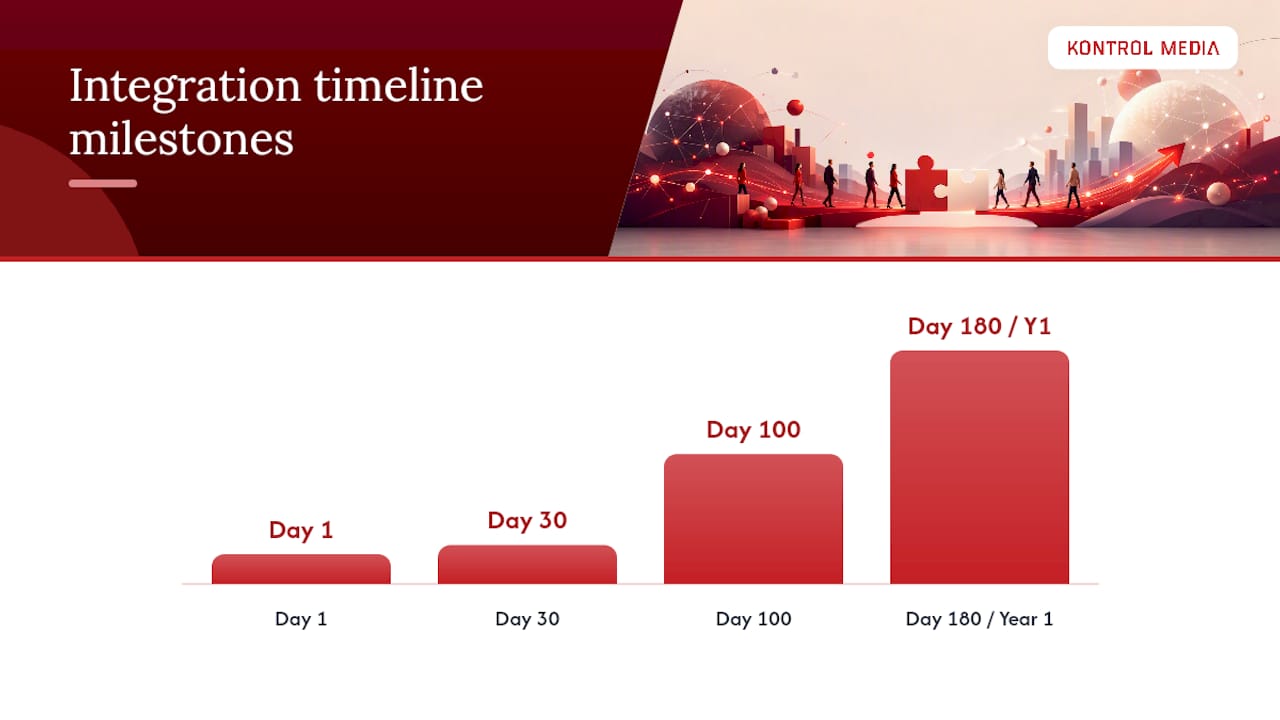
Here is how the timeline should actually break down:
- Day 1. Announce the deal internally and externally, confirm service continuity to customers, and lock down access to critical marketing accounts before anyone changes a password out of confusion.
- Day 30. Unify leadership reporting lines, re-segment the combined customer base by value and risk, and publish a short list of quick wins the board can see progress on.
- Day 100. Launch pilot campaigns with real budgets, finish sales enablement training, and consolidate reporting into a single dashboard that both teams trust.
- Day 180 and Year 1. Fold remaining brand and CRM cleanup into standard operations, and start measuring net revenue retention as the primary signal of integration success.
Cross-functional workshops early in the process help close the “us versus them” divide that forms almost automatically after a deal, giving product, sales, and marketing a shared vocabulary before customers ever notice friction.
Should You Merge, Keep, or Blend the Brands?
Brand architecture decisions need to happen fast, ideally within the first 30 days, because every week of ambiguity shows up in inconsistent sales decks and confused customer inquiries. The decision usually comes down to four inputs working together rather than any single factor.
- Relative brand equity. Which name carries more recognition, trust, or search volume in the markets that matter most?
- Customer overlap. If the two customer bases barely intersect, a hybrid approach often protects revenue better than a forced merge.
- Channel separation. Distinct sales motions or distribution channels argue for keeping some brand distinction, at least temporarily.
- Deal thesis. If the acquisition was bought for its brand, merging it away undermines the entire rationale for the purchase.
Once you have a direction, draft a one-page “One Voice” document defining what the combined company says about pricing, product continuity, and support, and route it to sales and support teams before it goes anywhere external. Test the messaging on a handful of at-risk accounts before a full rollout; their reactions will tell you more than any focus group.
Pro Tip: Run your draft messaging past your five most vocal customer accounts before publishing anything company-wide. Their pushback, or their silence, is the cheapest research you’ll ever get.
What Should You Tell Customers on Day 1?
Customer communication after an acquisition either buys you goodwill or triggers an exodus, and the difference is almost entirely about specificity. Vague reassurance reads as evasive; a Day 1 announcement should name what changes, what doesn’t, and who the customer’s point of contact is going forward.
- Send the Day 1 announcement immediately, covering service continuity, support contacts, and a plain statement of what stays the same in the next 90 days.
- Assign executive sponsors to top accounts and get them on one-on-one calls within the first week, not a mass email blast.
- Offer short-term commitments on pricing or contract terms to your highest-value customers to remove any incentive to shop competitors while you integrate.
- Segment retention campaigns by account value and set a cadence, weekly touches for your top tier, monthly for the rest.
- Stand up a churn task force that monitors login drops, support ticket spikes, and renewal delays, and staff it with people who can act same-day, not escalate for a week.
Starting internal alignment before external communications is the detail most teams skip, and it’s the one that causes the most damage when skipped. A slow external rollout rarely kills deals. Inconsistent internal messages almost always do.
Integrating Sales and Marketing: CRM, Enablement, and Cross-Sell
A sales and marketing integration roadmap starts with due diligence, not tooling. That means customer analysis, CRM design, and revenue retention planning come before anyone touches a new sales script, and the roadmap should carry explicit Day 1, Day 30, and Day 100 milestones.
Your CRM priorities in the first two weeks:
- Confirm account ownership so no customer falls into a gap between two sales teams.
- Map renewal dates across both systems before any contract slips through unnoticed.
- Build canonical contact records so support, sales, and marketing see the same customer history.
- Flag data mapping conflicts early, especially around lead scoring and lifecycle stage definitions.
Treat CRM quality as a revenue-protection issue, not a data-hygiene chore. A reliable, unified customer view is what makes targeted campaigns and cross-sell pilots possible at all.
Once the CRM is stable, build a sales enablement kit: battlecards that address the combined value proposition, updated pricing rules, call scripts for the transition period, and short-term incentives that reward reps for keeping accounts intact rather than chasing new logos. Roll it out in phases, starting with your highest-risk accounts, not all at once.
Pick early cross-sell targets based on product fit and existing trust, not just account size. Track net revenue retention, pipeline velocity, and churn signals weekly during the first 100 days, then shift to monthly reporting once the numbers stabilize.
Securing Your Marketing Technology on Day 1
Technical marketing infrastructure gets overlooked constantly during integrations, and it’s the fastest way to lose weeks of momentum. Domains, CMS access, ad accounts, and analytics need to be audited and secured before anyone touches a campaign.
- Confirm domain registrar and DNS control, and document who holds admin credentials.
- Get CMS admin access for both platforms and export a full backup before making any changes.
- Audit every ad account for active spend, billing ownership, and pending creative approvals to avoid a sudden pause in paid campaigns.
- Export analytics history, Google Search Console data, and tracking codes before any account gets merged or deprecated.
- Record every software license and its billing owner, then plan staged migrations instead of a single cutover date.
A step-by-step marketing automation audit is worth running in parallel, since automation platforms tend to hide the most technical debt of any system in the stack.
Which Quick Wins Prove Marketing’s Value in 90 Days?
Quick wins in the first 90 days, unified dashboards, cross-sell pilots, joint webinars, combined case studies, demonstrate early revenue synergy and keep board confidence intact while the deeper integration work continues underneath.
| Initiative | Timeline | Expected outcome |
|---|---|---|
| Unified analytics dashboard | Weeks 1 to 4 | Single source of truth for both teams |
| Cross-sell pilot with selected key accounts | Week 4 | Early pipeline evidence for the board |
| Joint webinar or launch event | Week 6 | Combined audience exposure, lead capture |
| Combined case study or proof point | Week 8 | Sales asset for both legacy customer bases |
Set conservative targets when presenting these to the board. Report weekly during the pilot phase on activity metrics, then shift to monthly reporting on revenue once a pilot proves out. Quick pilots with measurable KPIs build credibility and buy the time needed to finish the harder work: brand consolidation, tech migration, and team restructuring. Scale what clears its target by Day 90. Sunset what doesn’t, quickly and without ceremony.
Getting Internal Stakeholders Aligned Without Stalling
Every post-acquisition marketing strategy eventually runs into the same obstacle: people, not process. Legacy teams protect their own turf, executives disagree on priorities, and a marketing plan that looks clean on paper can stall for weeks over who approves the messaging.
Start change management with a shared decision log, one document listing every open question (brand name, pricing structure, org chart) with an owner and a deadline attached. Ambiguity is what kills momentum, not disagreement itself. People can work with a decision they dislike. They cannot work with no decision at all.
Weekly integration standups across marketing, sales, and customer success keep small conflicts from becoming political ones. Keep these short and focused on blockers, not status updates that could live in a shared document instead.
Give legacy team members from the acquired company real ownership over at least one visible workstream. Nothing accelerates buy-in faster than seeing your own name on a plan that leadership is actually funding. Nothing kills morale faster than watching your old processes get quietly replaced without anyone asking your opinion first.
Finally, set a cadence for executive updates that’s honest about what’s working and what isn’t. Boards and investors tolerate slow integrations far better than they tolerate integrations that get reported as smooth right up until they aren’t.
Reassessing the Competitive Landscape After the Deal
An acquisition changes your competitive position whether you plan for it or not, and most teams wait too long to reassess it. Competitors watch M&A announcements closely, and the smart ones move fast to poach unsettled accounts during the transition window.
Run a rapid competitive scan in the first 30 days: who is targeting your combined customer list with switch campaigns, what pricing moves are competitors making in response, and where does the combined company now have genuine category advantages it didn’t have solo. An acquisition that adds a new product line or geographic footprint often opens up competitive space that neither company could reach alone.
Look specifically for gaps competitors will try to exploit: customer confusion about pricing, delayed feature roadmaps, or sales reps who left during the transition and are now selling for a rival. Each of these is a churn risk and a marketing opportunity at the same time, depending on how fast you respond.
Equally important is spotting new opportunities the deal creates. Combined data sets, cross-industry credibility, or a broader partner network can open doors that neither brand had access to independently. Build this competitive reassessment into your Day 30 review rather than treating it as a separate, later exercise. Waiting until Day 100 to understand your new competitive position means you’re reacting to moves competitors made weeks earlier.
How Should You Allocate Marketing Budget After a Deal?
Budget decisions in the first 100 days need to favor retention over acquisition, almost without exception. Losing an existing customer costs far more than the marketing spend required to keep one, and a shaky integration period is exactly when existing customers are most likely to look elsewhere.
A workable early allocation looks something like this: the largest share toward retention campaigns and account-sponsor programs for top customers, a meaningful slice toward the technical work of consolidating martech and CRM systems, and a smaller, clearly bounded amount toward the quick-win pilots that prove momentum to the board. Net-new demand generation can wait until the retention and technical foundations are stable, usually somewhere past Day 60.
Resource planning matters as much as dollar allocation. Pulling your best people onto integration work often means pausing lower-priority campaigns that were running before the deal closed. Be explicit about that trade-off with leadership rather than trying to do everything on the existing headcount, which usually produces mediocre results across every workstream instead of strong results on the ones that matter.
Build in a contingency reserve, typically for unplanned technical migration costs or an unexpected competitor response. Integrations rarely go exactly as planned, and a budget with zero flexibility forces bad choices later when problems surface, as they usually do somewhere around Day 45.
What Timeline Should Your Marketing Plan Follow?
The phases of a post-acquisition marketing strategy after acquisition should map directly to the ownership milestones already set for Day 1, Day 30, and Day 100, rather than running on a separate marketing-only calendar that nobody else in the company is tracking.
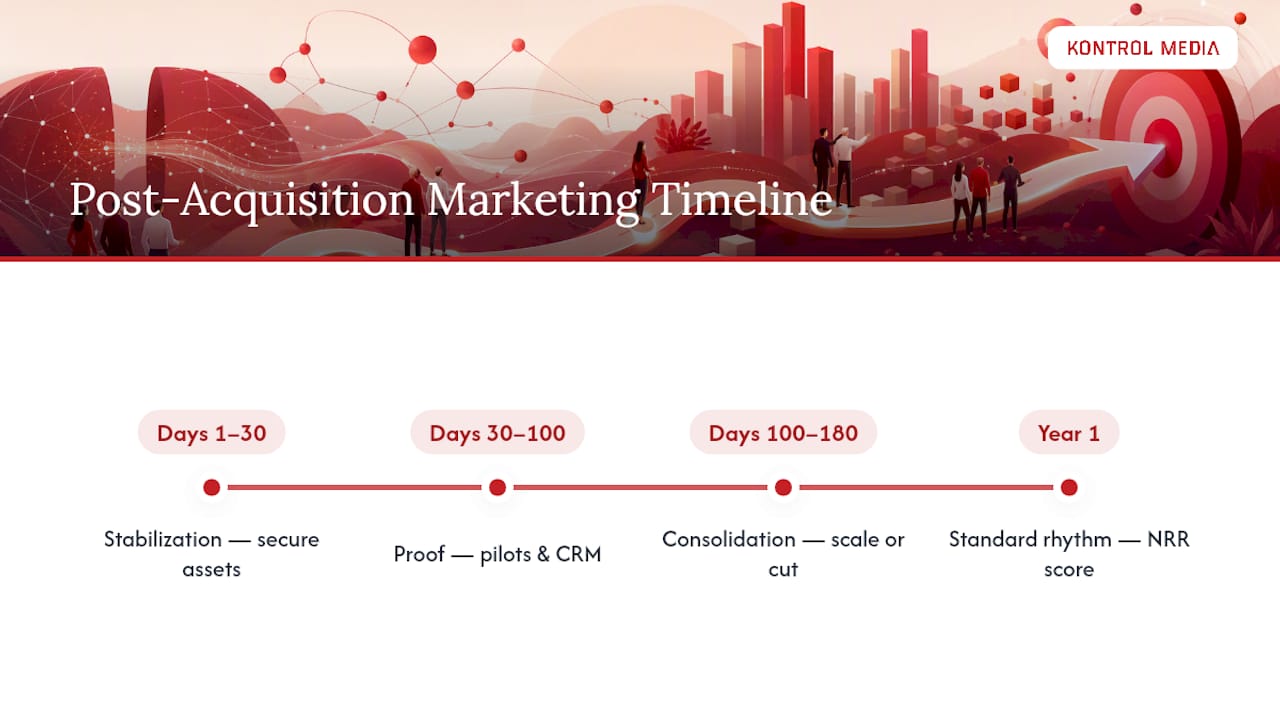
Phase one (Days 1 to 30) is about stabilization: securing digital assets, sending Day 1 customer communications, and making the brand architecture call. Nothing external launches broadly during this phase without an executive sign-off, because operational sequencing matters more than speed here.
Phase two (Days 30 to 100) shifts toward proof: quick-win pilots launch, CRM consolidation continues, and sales enablement rolls out to the full team. This is where the board starts asking for evidence that the deal is paying off, so reporting cadence tightens.
Phase three (Days 100 to 180) is consolidation: successful pilots scale, unsuccessful ones get cut, and reporting moves from weekly to monthly as the new normal sets in.
Phase four (Year 1) folds everything into standard operating rhythm, with net revenue retention as the scorecard metric that tells you whether the whole plan actually worked.
What Legal and Compliance Issues Should Marketing Watch For?
Marketing teams routinely underestimate how much legal exposure sits inside a post-acquisition rollout, particularly around contracts, data, and advertising claims that assumed a company structure that no longer exists.
Customer contracts often contain assignment clauses that require notice, or even consent, before they transfer to the new owning entity. Marketing and legal need to align on which customers require formal notification before any renewal or upsell conversation happens, not after.
Data privacy obligations follow the data, not the deal structure. If either company collected customer data under different privacy policies or in different jurisdictions, combining that data for marketing purposes without updated consent language can create real regulatory exposure, especially for companies handling health, financial, or personal data across state lines.
Advertising claims made by the acquired brand, especially anything involving performance guarantees, certifications, or comparative claims against competitors, need a legal review before the combined company keeps using them. What was defensible under the old corporate structure isn’t automatically defensible under the new one.
Trademark and licensing agreements deserve a specific check too. Co-branded partnerships, licensed content, or influencer agreements signed by the acquired company may include change-of-control clauses that trigger renegotiation or termination the moment the deal closes. Loop legal into every Day 1 communication draft, not just the final version.
When Does It Make Sense to Bring In Outside Help?
Internal teams rarely have slack capacity during an acquisition, and that’s precisely when timelines get aggressive and mistakes compound. External specialists earn their fee running rapid diagnostics and short integration sprints when internal bandwidth is thin or when the deal involves complex retail or commerce media network needs that most in-house teams have never built from scratch. That combination of strategy and hands-on execution is where a firm like Kontrol Media tends to add the most value, fast.
— Mark Kapczynski
How Kontrol Media Supports Your Integration
Kontrol Media is built for exactly this moment: the stretch after close when internal teams are stretched thin and every week of delay costs revenue. Unlike a traditional agency that hands you a deck and disappears, Kontrol Media pairs business strategy with hands-on execution across marketing, sales, and go-to-market, the same combination this playbook has walked through section by section.
If your deal involves retail or commerce media opportunities, Kontrol Media can stand up and operate the network rather than just advising on it from the sidelines. If the gap is channel partnerships or outsourced sales capacity during the integration crunch, that’s a core part of what the team runs day to day. Request a rapid diagnostic if you need a fast read on where your Day 1 priorities stand, or a fixed-scope integration sprint if you already know which workstream needs outside hands. Reach out through Kontrol Media’s contact page to scope what your first 90 days should look like.
Sources
- Sales and marketing integration in M&A: a 6-phase roadmap – M&A Institute
- Post-Acquisition marketing checklist to avoid integration chaos – Michael Mackenzie Communications
- Post acquisition marketing strategy: How to drive growth after the deal – MarketerHire
FAQ
What Is the 3-3-3 Rule for Marketing?
The 3-3-3 rule generally refers to setting three goals across three time horizons, often three months, three quarters, and three years, to keep short-term wins tied to long-term strategy. In a post-acquisition context, teams often adapt this to Day 30, Day 100, and Year 1 milestones instead.
What Does Post-Acquisition Mean in Marketing?
Post-acquisition refers to the period after a company purchase closes, when the acquiring company must integrate marketing systems, messaging, and customer relationships from both organizations. The work typically spans the first 100 days through Year 1, covering brand decisions, CRM consolidation, and retention campaigns.
What Are the Five Stages of an M&A Transaction?
M&A transactions typically move through strategy and target identification, due diligence, deal structuring and negotiation, closing, and post-close integration. The integration stage is where a post-acquisition marketing plan becomes operational, and it’s the stage most deals underinvest in relative to the negotiation itself.
What Are the Six Steps of a Marketing Plan?
A marketing plan generally covers situation analysis, objective setting, target audience definition, strategy and messaging, budget and channel allocation, and measurement. After an acquisition, this same structure applies, but compressed into the Day 1 to Day 100 window with combined customer data and a unified brand voice as prerequisites.
When Should You Bring in Outside Marketing Support After a Deal?
Outside support makes sense when internal teams lack the bandwidth for an aggressive integration timeline or when the deal involves specialized needs like retail media network setup. Firms offering both strategy and hands-on execution, such as Kontrol Media, can run a rapid diagnostic or a fixed-scope sprint to accelerate the first 100 days without pulling internal teams off customer-facing work.