


A market entry playbook is an execution manual that converts a single hypothesis about a new market into a staged, instrumented rollout, complete with go/no-go gates at each phase. The first move isn’t a 40-slide deck. It’s choosing one testable entrance thesis and designing a small pilot to prove or kill it. Everything else in this guide gives you the structure, phases, and metrics to govern that pilot from first conversation to first-year scale.
TL;DR:
- A market entry playbook must be an adaptive, ownership-driven process with clear decision gates and success criteria, not a static plan.
- The six core sections—thesis, qualification, go-to-market, operational readiness, finance, and governance—ensure a comprehensive, staged approach to validation and scaling.
- Sequencing phases from screening through early scale to year one emphasizes validated repeatability before expanding channels or increasing investment.
- Constant learning, with weekly reviews and clear pivot rules, is crucial for rapidly falsifying or confirming hypotheses and avoiding costly mistakes.
- External partners should be aligned on incentives and roles, and hidden costs like contracting, compliance, and support often derail budgets if not proactively planned.
Table of Contents
- What Is a Market Entry Playbook, and Why Does It Have to Live?
- What Core Sections Belong in Every Market Entry Playbook?
- What Are the Market Entry Steps From Validation to Scale?
- How Do You Run the Playbook as a Learning Engine?
- What Mistakes Sink Most Market Entry Strategies?
- What Does a Realistic First-Year Market Entry Plan Look Like?
- How Kontrol Media Applies This Playbook in Practice
- How Do You Build a Risk Assessment Framework for Market Entry?
- How Do You Map and Align Stakeholders Before You Launch?
- What Hidden Costs Blow Up Market Entry Budgets?
- What Regulatory and Compliance Steps Does a New Market Require?
- How Do You Analyze the Competitive Landscape Before You Commit?
- What Comes After Year One?
- Which Entry Mode Fits Your Situation?
- A Leadership Note on Staged Learning
- Build and Run Your Playbook With Kontrol Media
- Sources
- FAQ
What Is a Market Entry Playbook, and Why Does It Have to Live?
A static market entry plan is a forecast. A market entry playbook is a working document with owners, feedback loops, and decision gates built in. The difference matters because markets don’t behave the way slide decks predict, and a plan that can’t absorb new evidence just gets ignored the first time reality disagrees with it.
A playbook that’s actually alive does a few specific things a plan doesn’t:
- Assigns a named owner to each phase, not a department
- Builds in review cadences (weekly, monthly) instead of a single annual check-in
- Ties every section back to explicit success criteria, so “how’s it going” has a measurable answer
- Treats each gate as a real decision point, not a status update
This is the core shift behind an adaptive, intelligence-driven playbook: it converts uncertainty into governed execution rather than pretending the uncertainty isn’t there.
What Core Sections Belong in Every Market Entry Playbook?
Every credible market entry plan example follows a similar skeleton, even when the market, product, or entry mode is completely different. Six sections do the real work.
- Entry thesis. A one-page statement of who you’re serving, what job you solve, and the explicit success criteria that would prove or kill the bet.
- Market qualification. The addressable segment, the customer’s actual job-to-be-done, and any regulatory constraints that shape what’s even possible.
- Go-to-market design. Channel selection, value proposition by segment, and the pricing experiments you’ll run before locking a price.
- Operational readiness. Contracting templates, billing systems, support coverage, and compliance steps that need to exist before customer one.
- Finance. Investment profile by phase, CAC payback targets, and milestone-based budgets rather than one lump sum.
- Governance. Who signs off on each go/no-go decision, and what evidence they require before signing.
Frameworks built around these four pillars, market attractiveness, competitive landscape, company capability, and financial feasibility, treat an early failed gate as a hard stop rather than something to explain away.
Pro Tip: Write the governance section before you write the go-to-market section. Knowing who has to approve the pilot, and what they’ll demand as evidence, changes what you design the pilot to measure.
What Are the Market Entry Steps From Validation to Scale?
Sequencing is the single most underrated skill in market entry. The market entry steps below run in order, and skipping one to save time almost always costs more time later.
- Phase 0, screening. Score the market on attractiveness and fit against your entry thesis before spending a dollar on discovery.
- Phase 1, discovery. Run a series of structured interviews, scan potential partners, and survey pricing expectations. This is cheap, and it’s where most flawed theses die.
- Phase 2, pilot. Prove repeatability with a defined cohort, a small group of customers, against fixed KPIs before touching headcount.
- Phase 3, early scale. Tighten unit-economics guardrails and add channels only after the pilot clears its gate.
Discovery-stage research at this depth is what separates a real market entry plan example from a wish list, and it’s also where founders discover the thesis needs to change before it’s expensive to change it.
Each phase needs an explicit acceptance template. A pilot doesn’t graduate because it “feels like it’s working.” It graduates because it hit the retention number, the CAC payback window, or the conversion rate the gate specified in advance.
How Do You Run the Playbook as a Learning Engine?
The best operators treat a market entry playbook the way engineers treat a monitoring dashboard, checked constantly, adjusted immediately. That means:
- Weekly learning reviews focused on what got falsified, not what got shipped
- Monthly unit-economics checks against CAC payback, funnel conversion by step, and early retention proxies
- Experiment templates with minimum sample sizes attached, so nobody scales a “win” built on four data points
- Clear pivot-versus-persist rules decided before the data comes in, not after
Governance built around pre-defined decision authority shortens internal debate because leadership’s expectations were already converted into measurable gates before anyone got emotionally attached to a result. The most valuable number in this whole system isn’t revenue. It’s learning velocity, how fast you can falsify or confirm a hypothesis, because everything downstream depends on how quickly bad theses get caught.
Pro Tip: If a metric can’t move a go/no-go decision, stop tracking it during the pilot. Vanity metrics dilute attention exactly when focus matters most.
What Mistakes Sink Most Market Entry Strategies?
Failure patterns repeat across industries because they’re structural, not situational.
- Scaling fixed costs too early. Hiring a full local team before the pilot proves repeatable unit economics is a documented, repeatable failure pattern, not bad luck.
- Copying the home-market model. Assuming mechanics that worked domestically will transfer directly is one of the most expensive and common mistakes in expansion.
- Choosing partners for access, not enablement. A partner who can make an introduction but can’t help you close and support the account isn’t a distribution strategy.
- Funding the wrong amount at the wrong time. Stage capital to milestones. Underfunding starves a working pilot; overfunding removes the pressure that keeps a team honest about what’s actually working.
What Does a Realistic First-Year Market Entry Plan Look Like?
A market entry plan example needs real months attached to real deliverables, or it stays theoretical.
- Months 0 to 3: Lock the entry thesis, complete discovery interviews, validate at least one partner relationship, and launch the earliest pilots.
- Months 4 to 8: Adjust the pilot based on what discovery got wrong, land your first 3 to 5 paying customers, and instrument every core metric before you need it — a critical step in how to develop a marketing strategy for organic growth anchor.
- Months 9 to 12: Tighten unit economics, hire only once repeatability is proven rather than hoped for, and finalize the operational stack.
Before you scale past that first cohort, close the operational readiness checklist: contracting templates that don’t need a lawyer every time, invoicing that works in the new market’s currency and terms, support coverage with real SLAs, and a compliance review specific to the new jurisdiction. Treating expansion as paid learning, where the goal of months 0 to 8 is proof, not volume, is what keeps year one from turning into an expensive guess.
How Kontrol Media Applies This Playbook in Practice
Some agencies pair strategy work with hands-on execution so pilots don’t stall between the slide deck and the first real customer. That means operationalizing a pilot into an instrumented program, then converting proven repeatability into a scale plan, not a second round of planning. If you’re staring at a thesis you can’t validate alone, that’s the point to bring in execution help rather than delay action.
How Do You Build a Risk Assessment Framework for Market Entry?
Risk in a new market breaks into four categories, and treating them separately keeps you from drowning one risk in a conversation about another: market risk (does demand actually exist at the price you need), operational risk (can you deliver reliably at the volume you’re targeting), regulatory risk (what could block or delay you legally), and partner risk (does the entity you’re depending on have the incentive to perform).
Score each category before the pilot starts, not after something breaks. A simple three-tier scale, low, moderate, severe, with a named mitigation for anything above low, forces the conversation leadership needs to have before capital moves. Severe regulatory risk with no mitigation plan should stop a launch regardless of how attractive the market otherwise looks.
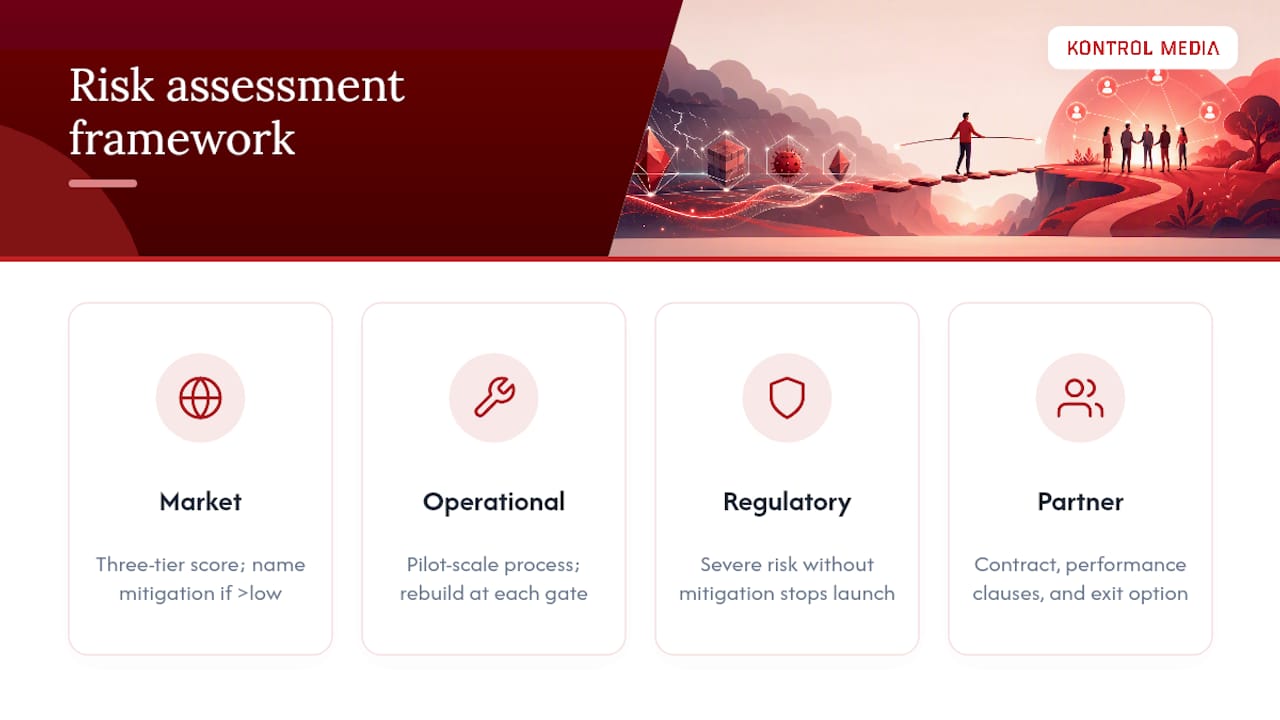
Mitigation works best when it’s staged rather than absolute. You don’t need to eliminate partner risk before you start. You need a contract structure, performance clauses, and an exit option, so the downside is contained rather than removed. The same logic applies to operational risk: a pilot with 5 customers can tolerate a support process that wouldn’t survive 500. Build the process for the volume you actually have, and rebuild it at each gate rather than over-engineering for a scale you haven’t earned yet.
The governance section of your playbook should specify who owns each risk category and what evidence clears it. Without that assignment, risk review turns into a group discussion with no decision attached, which is functionally the same as skipping it.
How Do You Map and Align Stakeholders Before You Launch?
Market entry fails almost as often from internal misalignment as from external market rejection. A stakeholder map for entry work usually spans four groups: executive sponsors who control budget and can kill or extend the pilot, operational owners who have to actually deliver the product or service, external partners whose cooperation the plan depends on, and the frontline team running discovery and the pilot itself.
Map each stakeholder against two axes: how much influence they have over the outcome, and how aligned they currently are with the entry thesis. A highly influential executive who’s skeptical of the thesis is a bigger risk to the pilot than a market that hasn’t warmed up yet, and the playbook should treat that alignment gap as seriously as any market risk.
Alignment techniques that actually work tend to be structural rather than persuasive. Give sponsors a seat at the go/no-go gate itself, not just a status update after the fact, so their skepticism gets addressed with evidence instead of debated in a hallway. Give operational owners input on the readiness checklist before the pilot launches, since they’re the ones who’ll inherit any shortcuts taken to hit a launch date. External partners need incentive alignment written into the agreement, referral fees, co-marketing commitments, exclusivity terms, because goodwill fades faster than a contract does.
Run a short alignment check at every gate: does each stakeholder group still agree on what success looks like? Misalignment caught at month 3 costs a conversation. Misalignment caught at month 9 costs the whole pilot.
What Hidden Costs Blow Up Market Entry Budgets?
The visible costs of entering a new market, salaries, marketing spend, initial inventory, are the easy part to budget. The costs that blow up a first-year plan are almost always the ones nobody put a line item against.
Contracting and invoicing friction is one of the most common. New markets often require different payment terms, different currencies, or different legal formats for the same basic contract you already use elsewhere. That operational drag, sometimes called a drag tax, accumulates quietly from mismatched invoicing systems, contract templates that need local legal review, and support workflows that weren’t built for a new time zone. None of it shows up in a pre-launch budget, and all of it shows up in month four.
Compliance timelines are the second trap. Licensing, registration, or certification requirements frequently take longer than teams assume, and a delayed regulatory clearance can stall a pilot that’s otherwise ready to launch. Build a buffer into your timeline specifically for this, not into your budget alone.
Partner enablement costs money too, training materials, co-selling support, incentive payments, and teams that budget only for the referral fee routinely underfund the relationship that was supposed to drive volume.
That third layer matters more than its size suggests. Teams that need budget committee approval to fix a support gap lose weeks they didn’t need to lose.
What Regulatory and Compliance Steps Does a New Market Require?
Regulatory risk varies enormously by industry and geography, but the checklist structure stays consistent regardless of what you’re entering. Confirm entity structure and registration requirements first, since almost everything else depends on whether you’re operating as a registered local entity, a foreign entity, or through a partner of record.
Licensing and certification come next. Some markets require product-specific approval before you can legally sell; others require none. Assume you don’t know until you’ve confirmed it with a primary source or qualified local counsel, never a competitor’s marketing page or a forum post.
Data handling and privacy rules deserve their own line item, particularly if the new market has different consumer protection standards than your home market. Tax registration and reporting obligations typically trigger the moment you have a local entity, a local employee, or in some jurisdictions, simply local revenue above a threshold, and the threshold itself varies by market and entity type.
Build the compliance checklist into the operational readiness gate, not as a separate afterthought. A pilot that’s commercially ready but legally unregistered isn’t ready. It’s exposed.
How Do You Analyze the Competitive Landscape Before You Commit?
Competitive analysis for market entry differs from the competitive analysis you run in a mature market, because you’re often assessing companies you don’t fully understand yet, in a market where you don’t have native intuition.
Start with direct competitors serving the same customer job you’re targeting, and separate them by how they win: price, distribution, brand trust, or regulatory relationships. Each of those is a different kind of moat, and each requires a different counter-strategy. A price-based competitor is vulnerable to a better value proposition. A distribution-based competitor is vulnerable to a channel they haven’t secured yet.
Indirect competitors matter just as much and get ignored more often. These are the substitutes customers currently use to solve the same job without buying anything resembling your product, sometimes that’s a manual process, sometimes it’s simply doing without. If your entry thesis doesn’t account for why customers will switch from their current workaround, the pilot will struggle regardless of how good the product is.
Local incumbents deserve a specific note: they often have relationship-based advantages, regulatory familiarity, and brand trust that no amount of product superiority overcomes quickly. Map how long they’ve operated, how concentrated their customer base is, and whether they’ve faced a serious challenger before. A market with no real incumbent competition sometimes means opportunity, and sometimes means nobody’s found a way to make the economics work.
What Comes After Year One?
Scaling past the first year means shifting the questions you ask. Year one asks whether the thesis is true. Years two and beyond ask how far it stretches before it breaks.
Expand channels one at a time, using the same gated evaluation discipline you used for the original pilot. A channel that worked for your first cohort doesn’t automatically work for the next segment you’re targeting, and treating channel expansion as a series of small pilots, rather than one big rollout, keeps the same guardrails in place.
Revisit your unit-economics thresholds regularly. CAC payback windows, margin targets, and retention benchmarks that made sense at pilot scale often shift once volume changes your cost structure, sometimes for the better as fixed costs spread, sometimes for the worse as easy customers get exhausted and the next segment costs more to acquire.
Localization deepens over time rather than finishing at launch. The version of your product or service that cleared the pilot gate is rarely the final version a mature market needs, and teams that stop adapting because “we already localized” tend to plateau earlier than teams that treat localization as ongoing.
Which Entry Mode Fits Your Situation?
The entry mode you choose shapes every other decision in the playbook, so it deserves its own evaluation rather than a default choice.
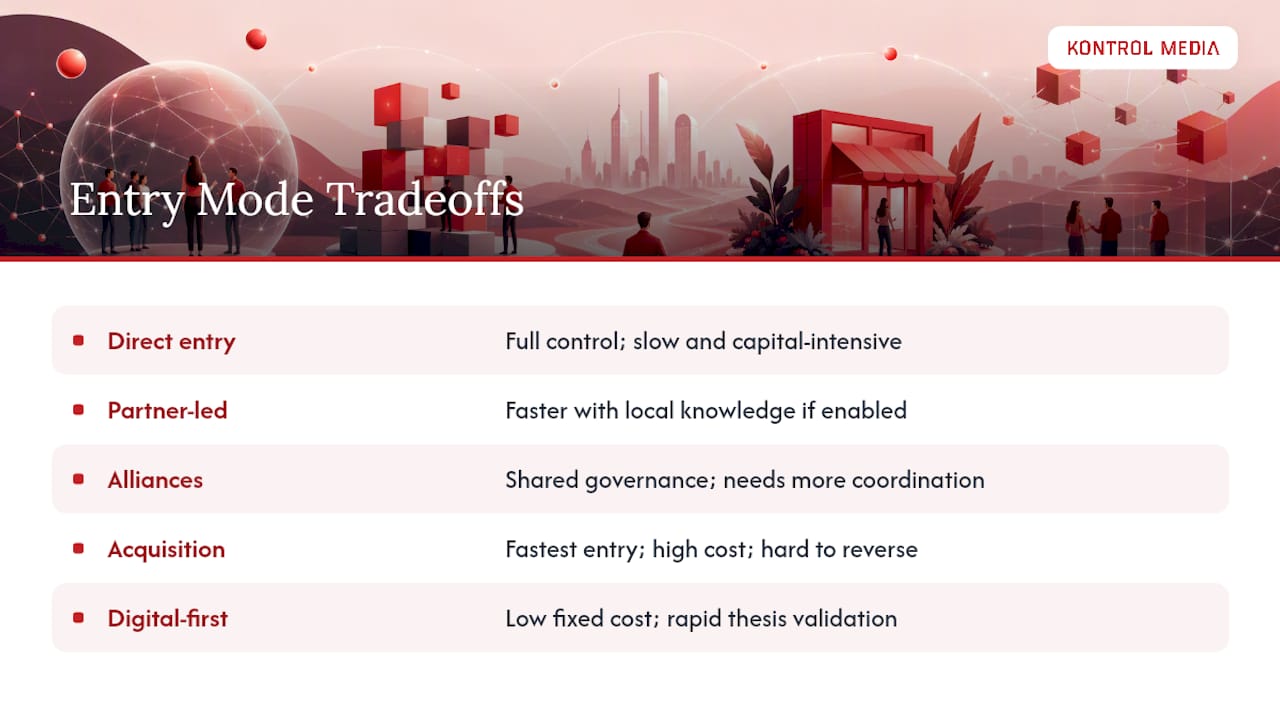
Direct entry gives you full control over brand, pricing, and execution, but it’s the slowest and most capital-intensive path, and it puts all the regulatory and localization risk on you alone.
Partner-led entry trades some control for speed and local knowledge. A well-chosen partner can compress your discovery phase dramatically, but only if the partnership includes real enablement, training, incentive structures, and shared accountability, rather than a simple referral arrangement.
Alliances work when two companies each bring something the other lacks, distribution for you, a missing product line for them, and neither side wants to fully absorb the other’s risk. Alliances demand more governance than partnerships because the decision rights are shared rather than owned.
Acquisition is the fastest way to get local market share, existing customers, and regulatory standing in one move, but it’s also the hardest to reverse if the thesis turns out wrong, and it front-loads capital risk that a pilot-based approach would have caught earlier and cheaper.
Digital-first entry lets you test demand with minimal fixed investment, ideal for validating a thesis before committing to any of the heavier modes above. Many teams use digital-first as literally Phase 1 of a plan that eventually becomes direct or partner-led once the thesis proves out.
None of these is universally right. The correct choice depends on how much capital you can risk, how fast the market is moving, and how much local knowledge your team already has walking in.
A Leadership Note on Staged Learning
Treat market entry as staged learning under leadership’s direct control, not a project handed to a team and checked on quarterly. The playbook’s real value is reducing your own bias: a written gate forces you to admit when a pilot missed its number, instead of narrating around it in a meeting.
Before your next go/no-go review, ask three questions: did the pilot hit its predefined metric, what would change our mind if it didn’t, and who’s accountable for the next decision.
— Mark Kapczynski
Build and Run Your Playbook With Kontrol Media
Most market entry plans die in the gap between the strategy deck and the first real pilot, not from a bad thesis. Kontrol Media closes that gap by pairing the strategy work with execution: building the go-to-market, running the pilot, and enabling the partners your entry mode depends on, all inside one engagement instead of handing you a plan and walking away.
If your team has the bandwidth and market fluency to run discovery and a pilot internally, do it. But if you’re choosing a partner-led or retail media entry mode and need someone who’s already built and operated these programs, that’s exactly where Kontrol Media’s execution-first playbook applies. Some firms with experience working with prominent clients reflect the kind of hands-on execution that turns a validated pilot into a scaled program rather than another slide deck. Start with a conversation about your entry thesis and see how a strategy and execution engagement could shorten your path to a real pilot.
Sources
For deeper detail on any single phase, these sources back the framework used throughout this guide: a practical market entry plan template for B2B discovery and milestone mapping, a breakdown of why expansions fail and how staged validation prevents it, a look at governance-based entry frameworks, and a review of costly entry mistakes worth studying before you finalize a thesis.
- Market Expansion: Why Startups Fail and How to Avoid It
- Market Entry Intelligence Playbooks: Control Market Risk
- The market entry mistakes that cost you millions – Arxis Partners
FAQ
How long should a market entry pilot run?
Most pilots need sufficient time to achieve repeat or retained customers with reliable data on CAC payback and conversion, typically spanning several months depending on sales cycle length. Cutting a pilot short to hit an arbitrary launch date usually just moves the failure downstream to a more expensive phase.
What evidence justifies scaling past a pilot?
Scaling requires the pilot to have cleared its predefined go/no-go gate, meaning it hit the specific retention, conversion, or CAC payback target set before the pilot began, not simply that momentum “felt right.” Repeatability across a small number of customers is the practical minimum most credible frameworks require.
How do I choose between a partner-led and direct entry mode?
Choose partner-led when local regulatory or relationship knowledge is scarce and speed matters more than full control; choose direct entry when capital allows it and the brand experience needs to stay entirely in your hands. Many teams start with a partner or digital-first mode specifically to validate the thesis before committing to direct entry.
When should I bring in outside execution help instead of running entry internally?
Bring in outside help when your team has a validated thesis but lacks the bandwidth or channel relationships to run the pilot and partner enablement simultaneously. Kontrol Media works specifically in that gap, pairing strategy with hands-on execution for pilots and partner programs rather than handing over a plan alone.
What’s the biggest first-year budgeting mistake teams make?
Teams consistently underfund the contingency layer meant to absorb compliance delays and contracting friction, treating direct costs as the whole budget instead of one piece of it. A contingency band of a significant percentage of direct costs is a more realistic starting point for a first-time entry into an unfamiliar regulatory environment.