


Most business leaders treat acquisition as a financial transaction with a marketing afterthought. They close the deal, announce the news, and assume the customer base comes along for the ride. It rarely works that way. What is growth through acquisition marketing, really? It is the discipline of using strategic acquisitions, what the industry formally calls inorganic growth, to expand your customer base, enter new markets, and scale revenue faster than organic efforts allow. But the marketing dimension is where most of the value gets created or destroyed. This article unpacks both sides with the specificity you need to actually act on it.
Table of Contents
- Key Takeaways
- What growth through acquisition marketing actually means
- When acquisitions make more strategic sense than partnerships
- Marketing integration: where most acquisitions break
- Programmatic M&A as a repeatable growth engine
- How to implement acquisition marketing in practice
- My honest take on where this goes wrong
- How Kontrol Media helps you grow through acquisition
- FAQ
Key Takeaways
| Point | Details |
|---|---|
| Acquisition marketing targets new customers | It measures success through customer acquisition cost and lifetime value ratios, not just deal size. |
| Marketing assets favor acquisitions over partnerships | Governance complexity makes brand and customer assets harder to manage in a partnership structure. |
| Integration timing is non-negotiable | Aligning brand, pricing, and communications within 90 days post-merger directly prevents customer attrition. |
| CMO involvement starts before close | Marketing leaders who enter due diligence early shape better brand architecture and go-to-market plans. |
| Programmatic M&A demands repeatable playbooks | Multiple smaller acquisitions require a systematic marketing framework, not a case-by-case approach. |
What growth through acquisition marketing actually means
Growth through acquisition, in the formal sense, means buying companies to grow faster than organic efforts would allow. You are purchasing customers, distribution channels, brand equity, or market position rather than building them from scratch. The tradeoff is clear: more upfront capital, but dramatically compressed timelines.
Acquisition marketing, the second half of this concept, operates at a different level. It refers to the discipline of converting new customers through targeted tactics and measuring how efficiently you do it. Think paid media, SEO, referral programs, and channel partnerships, all calibrated to bring strangers into the funnel and track cost per acquisition. When you layer acquisition marketing onto inorganic growth strategy, you get something more powerful than either approach alone.
The distinction from retention marketing matters here. Acquisition marketing focuses exclusively on net-new customers, while retention marketing focuses on the ones you already have. Both are necessary, but they require different budgets, metrics, and mindsets. Conflating them is one of the most common strategic errors I see in post-acquisition planning.
Types of acquisitions vary considerably. You might acquire a competitor to consolidate market share, a complementary product company to expand your portfolio, or a distribution network to access a geography. Each type changes what acquisition marketing looks like in practice. A consolidation play means harmonizing two customer bases with overlapping messaging. A portfolio expansion means introducing a new value proposition to an existing audience. The marketing work is completely different.
- Horizontal acquisitions target competitors or similar businesses to increase market share within the same industry
- Vertical acquisitions bring suppliers or distributors in-house to control more of the value chain
- Conglomerate acquisitions expand into entirely new industries or customer segments
Pro Tip: Before evaluating any acquisition target, map its customer acquisition channels and associated costs against your own. If their CAC is structurally higher than yours, that cost profile follows the deal.
Synergy benefits are real but often overstated. Consolidating operations can reduce redundant overhead and improve profitability. The risk is assuming synergies will materialize without disciplined integration. They do not appear on their own.
When acquisitions make more strategic sense than partnerships
The decision to acquire versus partner is more nuanced than most board decks acknowledge. Research from the Kelley School of Business found that marketing assets favor acquisitions over partnerships because of governance complexity. Brand equity, customer data, and go-to-market relationships are difficult to share cleanly. A partnership introduces ambiguity around ownership, messaging authority, and customer experience. An acquisition eliminates that ambiguity.
Technology-oriented firms often find that partnerships work because technical assets can be defined contractually with relative precision. Marketing-driven firms do not have that luxury. When your competitive advantage lives in brand perception, customer trust, or distribution relationships, you want full control over how those assets are managed and evolved.
There are four situations where acquisition marketing is the cleaner path:
- Your growth is capped by addressable market size and you need adjacencies fast
- A competitor or complementary brand has customer relationships you cannot replicate quickly through organic channels
- A potential partner’s marketing governance would create conflicting brand narratives in the market
- You need a market entry that would take years to build from a standing start
“The most overlooked strategic consideration is not whether to acquire, but whether you can actually govern the marketing assets post-close. If the answer is uncertain, the deal economics are uncertain.” — Kelley School of Business research on market-driven firms
The organic growth comparison is worth being direct about. Organic growth preserves capital and builds compounding brand equity. But it is slow, and in category-defining windows, slow can mean permanent irrelevance. Speed and control sit in tension here. Acquisitions expand your market faster at the cost of integration complexity. The right answer depends entirely on your timeline and your ability to execute integration well.
Marketing integration: where most acquisitions break
Marketing integration is where acquisition value goes to die. Post-acquisition marketing fractures when organizations treat it as a communications project rather than a commercial one. The symptoms show up as duplicated go-to-market motions, mixed brand messaging, and a confused customer base that starts quietly migrating to competitors.

The sequence of failures is predictable. First, two sales teams pursue the same accounts with different pitches. Then, customers receive inconsistent communications from what are now technically the same company. Finally, the brand architecture question that nobody resolved in due diligence becomes a public-facing mess.
Here is what effective marketing integration actually requires, in order:
- Appoint a commercial integration lead within the first two weeks. This person owns brand, customer communications, and go-to-market alignment, and has executive authority to make decisions.
- Audit customer overlap across both organizations to identify at-risk segments before they receive any messaging.
- Decide brand architecture within 30 days: will you consolidate under one brand, maintain separate brands, or use an endorsed architecture?
- Align pricing and packaging across both customer bases before any cross-sell motion begins.
- Establish a unified attribution model so marketing spend across both entities is measured consistently.
Pro Tip: Set a 90-day integration sprint with explicit milestones for brand, customer communications, and go-to-market alignment. Research shows that aligning brand architecture within 90 days directly reduces post-merger customer attrition.
The performance marketing challenge deserves specific attention. You now have two ad accounts, two SEO footprints, two CRM systems, and two sets of campaign attribution logic. Consolidating these without losing visibility into what is actually driving acquisition is genuinely hard. A comparison of the two states makes the stakes clear:
| Integration element | Pre-integration risk | Post-integration goal |
|---|---|---|
| Brand messaging | Contradictory market narratives | Unified positioning across all channels |
| Customer communications | Duplicate or conflicting outreach | Consolidated CRM with segmented messaging |
| Performance marketing | Split budgets, unattributed conversions | Unified attribution and consolidated spend |
| Go-to-market teams | Competing for same accounts | Coordinated coverage model |
Customer retention through post-merger periods requires proactive communication, not reactive damage control. The customers you acquired in the deal are watching to see if the acquisition was good for them. Show them it was, early and specifically.
Programmatic M&A as a repeatable growth engine
Programmatic M&A is the practice of executing multiple smaller acquisitions systematically rather than pursuing one transformative deal. Companies like Constellation Software and Roper Technologies have built extraordinary market positions this way. The premise is that smaller, faster deals with repeatable integration playbooks compound into sustained competitive advantage.
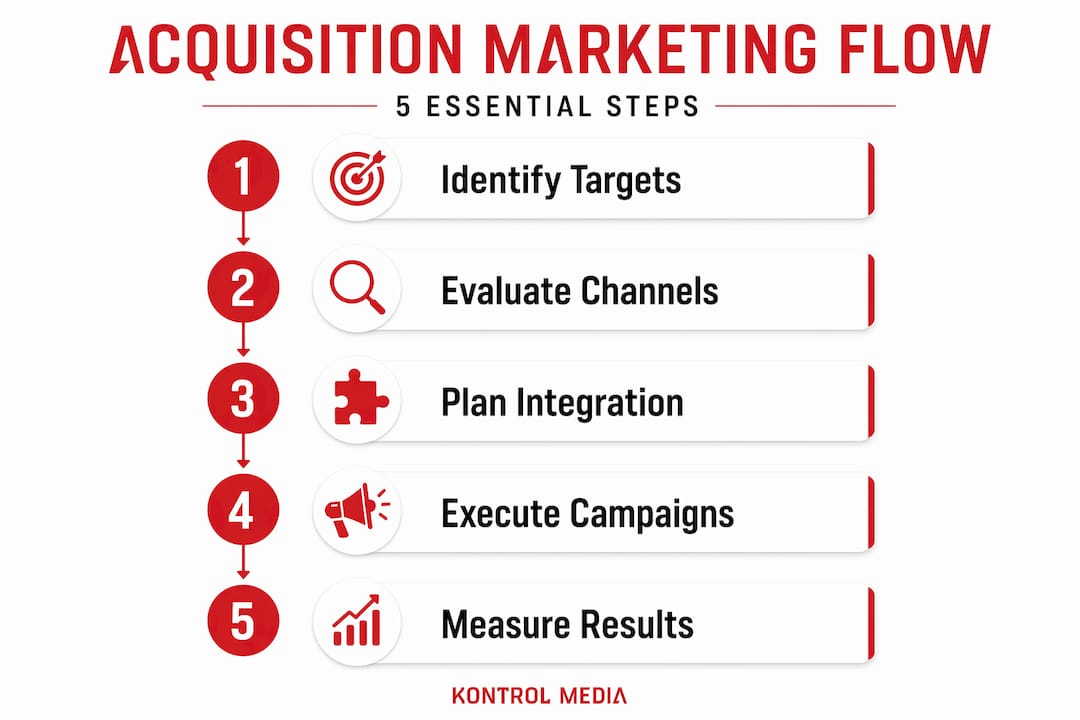
From a marketing perspective, this approach changes everything about how the function operates. Marketing is no longer a post-close communicator. It becomes a strategic partner in acquisition evaluation, assessing brand fit, customer overlap, channel complementarity, and go-to-market synergies before the deal closes.
Consider what this looks like in a hypothetical media company executing four acquisitions per year. Without a programmatic framework:
| Acquisition | Marketing involvement | Integration timeline | Outcome |
|---|---|---|---|
| Deal 1 | Post-close only | 18 months | Brand confusion, customer churn |
| Deal 2 | Post-close only | 14 months | Overlapping campaigns, wasted spend |
| Deal 3 | Mid-process | 10 months | Better alignment, moderate churn |
| Deal 4 | Pre-close involvement | 6 months | Clean integration, retention maintained |
The pattern is consistent across industries. Earlier CMO involvement correlates with faster integration and better customer retention outcomes. The marketing narrative also matters for deal sequencing. When you build a coherent acquisition story around a category you are consolidating or expanding, each deal reinforces the prior one. Target companies become easier to identify. The market starts to understand your intent. That clarity has real value in negotiations and in customer communication.
How to implement acquisition marketing in practice
Practical implementation starts long before a deal closes. The preparation phase is where most organizations underinvest.
- Define your acquisition marketing thesis before engaging targets. Are you buying to consolidate, to enter new markets, or to acquire specific capabilities?
- Build a target profile that includes marketing-specific criteria: brand reputation, customer base quality, acquisition channels, CAC structure, and brand architecture compatibility.
- Conduct marketing due diligence alongside financial due diligence. Review the target’s top-of-funnel performance, customer cohort data, NPS or satisfaction scores, and any brand equity research.
- Develop an integration roadmap with marketing milestones mapped to the 30, 60, and 90-day marks.
- Track the right metrics from day one post-close to catch deterioration early.
The LTV to CAC ratio is the foundational metric for acquisition marketing health. A ratio near 3:1 is generally considered sustainable. Below 1:1 means you are losing money on every customer you acquire. Above 5:1 often signals under-investment in growth. Use both organizations’ historical data to benchmark and set targets for the combined entity.
Pro Tip: Map the acquired company’s customer acquisition channels against your own during due diligence. Expanding into new markets through acquisition only creates value if those channels can be maintained or improved under new ownership.
Common pitfalls include assuming the acquired team will naturally align with your go-to-market motion, ignoring the cultural dimension of merging marketing teams, and delaying brand decisions while customers wait for clarity. Each of these is avoidable with deliberate planning.
My honest take on where this goes wrong
I have watched deals close at impressive multiples and then quietly unravel over 18 months because nobody treated marketing integration as a commercial priority. The financial model said one thing. The customer behavior said another.
What I have come to believe is that acquisition valuation multiples are built on customer retention assumptions. When commercial integration plans are weak, those assumptions evaporate. You are not just losing revenue. You are losing the core thesis of why you paid what you paid.
The non-obvious risk is internal. Post-acquisition, two marketing teams are each trying to prove their approach was right. That competition produces noise in the market and confusion for customers. Strong commercial leadership has to step in and make decisions quickly, even when the data is imperfect.
My experience at Kontrol Media has reinforced one thing above everything else: when marketing gets a seat at the table before the deal closes, outcomes are measurably better. Not because marketers have the right answer on deal structure, but because they are the ones who understand how customers will interpret and respond to what you just did. That perspective is not optional. It is what protects the value you paid for.
Growth through acquisitions is not a shortcut. It is a different kind of work, one that demands as much commercial discipline as financial rigor. The companies that treat it that way are the ones still enjoying the results three years later.
— Mark Kapczynski
How Kontrol Media helps you grow through acquisition
At Kontrol Media, we work directly with business leaders who are navigating growth through acquisitions and need more than a strategy deck. Our approach spans the full execution cycle: defining your acquisition marketing thesis, building target evaluation frameworks, guiding marketing due diligence, and leading post-close integration planning. Whether you are a private equity-backed portfolio company or a mid-market enterprise looking to craft a comprehensive business strategy that includes inorganic growth, we bring the commercial rigor and marketing depth that deals require. If you want to maximize business growth through acquisition marketing done right, let’s talk.
FAQ
What is growth through acquisition marketing?
Growth through acquisition marketing, also called inorganic growth with acquisition marketing, is the strategy of buying companies to expand your customer base and market position, while using targeted marketing tactics to convert and retain those new customers efficiently.
How is acquisition marketing different from retention marketing?
Acquisition marketing focuses entirely on attracting new customers and measures success through CAC and new customer volume. Retention marketing focuses on keeping existing customers through loyalty programs and satisfaction, and measures lifetime value.
What metrics matter most in acquisition marketing?
The LTV:CAC ratio is the most critical metric, with a benchmark near 3:1 indicating sustainable acquisition spend. Ratios below 1:1 signal you are spending more to acquire customers than they return.
When should a company acquire instead of partnering?
When the growth assets in question are marketing-driven, such as brand equity, customer data, or distribution relationships, acquisitions offer more control than partnerships, which introduce governance complexity and messaging conflicts.
How quickly should marketing integration happen after an acquisition?
Brand architecture, pricing alignment, and customer communications should be resolved within 90 days post-close. Delays beyond that window increase customer confusion and attrition, directly eroding the value of the deal.
Recommended
- What Is Marketing-Led Growth? A Strategic Guide | Kontrol Media Consultancy
- Growth Marketing Frameworks CMOs Use to Drive Revenue | Kontrol Media Consultancy
- Unlocking Business Potential: Strategic Marketing and Consulting for Growth | Kontrol Media Consultancy
- Advertiser Acquisition Strategies for Media Networks in 2026 | Kontrol Media Consultancy