


A marketplace retail media strategy comes down to one question: how do you turn seller competition for visibility into an ad business without damaging the shopper experience that created the traffic? The answer has four parts. Build a self-serve ad foundation, sell a mix of endemic and non-endemic demand, measure incrementality to a standard buyers trust, and staff the commercial side as seriously as the technology.
We work on this every week, from both sides of the table: with retailers and marketplaces standing up networks, and with brands trying to decide where their dollars deserve to go. What follows is the version we would give a CMO or head of growth over coffee, including the parts that rarely make it into vendor decks.
TL;DR
- The US market is large and lopsided: Amazon and Walmart are projected to take about 89% of new retail media spend in 2026, so a marketplace has to win on specificity, not scale.
- Marketplaces have a head start, because sellers already compete for placement. The work is building self-serve tooling, billing and listing logic before you chase budgets.
- Non-endemic advertisers and incrementality-based reporting are the two levers that separate networks that renew budgets from networks that stall.
- Sales execution is the most underestimated line item. Technology without a team selling it produces a very elegant, very empty ad server.
Table of Contents
- Why a marketplace is not a retailer with a banner
- Solve the cold start before you sell a single ad
- Know the market you are walking into
- Build the ad product in layers
- Measurement: the part that decides renewals
- From performance engine to full-funnel network
- Data collaboration without the chaos
- Perspective: where we think most marketplaces go wrong
- A 90-day plan to get moving
- How Kontrol Media can help
- FAQ
- Sources
Why a marketplace is not a retailer with a banner
A classic retailer owns inventory, sets prices and sells ad space around its own shelf. A marketplace hosts other people’s inventory, which changes the economics in a way that helps you and the way it complicates things.
The help: your sellers already pay to be found. Sponsored listings, search placement and category takeovers are natural extensions of a behavior that exists today. Retail media units such as sponsored search are reported to deliver margins of 70% or more, set against the thin margins typical of retail. Osmos puts network gross margins above 60 to 80%, which is why every board eventually asks about it.
The complication: you do not control the product, the price or the content quality. When ads promote a listing that is out of stock, mispriced or poorly described, shoppers blame the marketplace. So the strategy has to protect relevance first and revenue second, at least until the system is trusted.
This is also where a marketplace differs on who the advertiser is. A large share of your early buyers are your own sellers, whose budgets come out of the same margin they use to pay your commission. If ads feel like a tax, sellers leave. If ads feel like a growth tool with clear returns, they spend more every quarter. That framing should shape every product decision.
Solve the cold start before you sell a single ad
Marketplace builders know the cold start problem: supply without demand is a ghost town, and demand without supply is a waiting room. Retail media has its own version. You cannot sell ad inventory that does not attract attention, and you cannot attract advertisers without proof of attention.
The pattern that marketplace operators describe is to hit a density threshold in one narrow slice before expanding. We would translate that to ads: pick the category or region where your traffic is deepest, make that the first sellable surface, and prove returns there. A single category with convincing numbers will do more for your sales conversations than a platform-wide launch with vague promises.
The technical foundation is unglamorous. Osmos describes the self-serve ad infrastructure a marketplace needs: automated billing, wallet systems and live listing logic. Without them, every campaign becomes a manual project, and a manual project does not scale past the first dozen sellers. The same source also notes that partnering with an established network can be a smarter route than building a standalone stack that never reaches scale.
That build-or-partner decision deserves its own analysis, and we wrote one: our build vs. buy verdict on network setup walks through the criteria. The short version is that most marketplaces should buy the commodity pieces and invest their own effort where they are unique: seller relationships, shopper data and the commercial team.
Know the market you are walking into
The numbers are worth stating plainly, because they set your expectations. EMARKETER forecasts US retail media spend of $69.33 billion in 2026, up from $58.79 billion in 2025. Of the new money, roughly 89% is headed to two companies. Everyone else is competing for what remains.
That should not discourage a marketplace. It should change the pitch. You will not win by claiming to be a smaller version of the giants. You win by offering something they structurally cannot: a defined audience, a category where your shoppers are unusually committed, and a more direct relationship with the advertiser.
A specialty marketplace for outdoor gear, home improvement or collectibles reaches a buyer with a clear purchase mission. A brand in that category may already be spending on the largest platforms for broad reach and still want a place to speak to enthusiasts without paying for everyone else’s traffic. That is a real, sellable proposition.
For brands reading this from the buy side, the implication is the mirror image. Do not treat the giants as the whole plan, and do not treat every smaller network as equally worth testing. Pick a few where the audience genuinely overlaps with your customer, and hold them to a measurement standard before you scale.
Build the ad product in layers
Marketplaces tend to launch with sponsored listings, and that is the right first step. It is familiar to sellers, easy to explain and tied directly to a sale. But a network that stops there tops out quickly, because search inventory is finite and the best slots go to the same advertisers.
We suggest thinking in three layers.
Layer one: on-site performance
Sponsored products and search placements. Keep the auction simple, show sellers transparent reporting and protect relevance with rules about stock, rating and price competitiveness. This is where you earn credibility.
Layer two: on-site brand formats
Category banners, homepage placements, curated collections and sponsored content for brands that want presence rather than just clicks. These formats need creative guidelines and a sales team that can talk about brand goals, not only return on ad spend.
Layer three: off-site and non-endemic
This is where the strategy gets interesting. Many networks are discovering that advertisers who do not sell on the platform are a major growth path. EMARKETER notes that non-endemic advertising is a significant opportunity as endemic brand spend nears saturation, because it lets retailers monetize first-party data by selling to advertisers outside their own assortment. Think financial services, travel and telecom reaching a shopper audience they cannot find as cleanly elsewhere.
Marketplaces are well placed here, since they often hold rich behavioral data across many categories. The condition is trust: the data must be handled with consent, privacy rules and clear governance. We cover the planning side in our guide to retail media strategy for non-retailers, and the revenue case in turning first-party data into revenue.
Measurement: the part that decides renewals
If you remember one thing from this article, make it this: advertisers will fund networks they can verify. Not networks with the most inventory, and not networks with the prettiest dashboard.
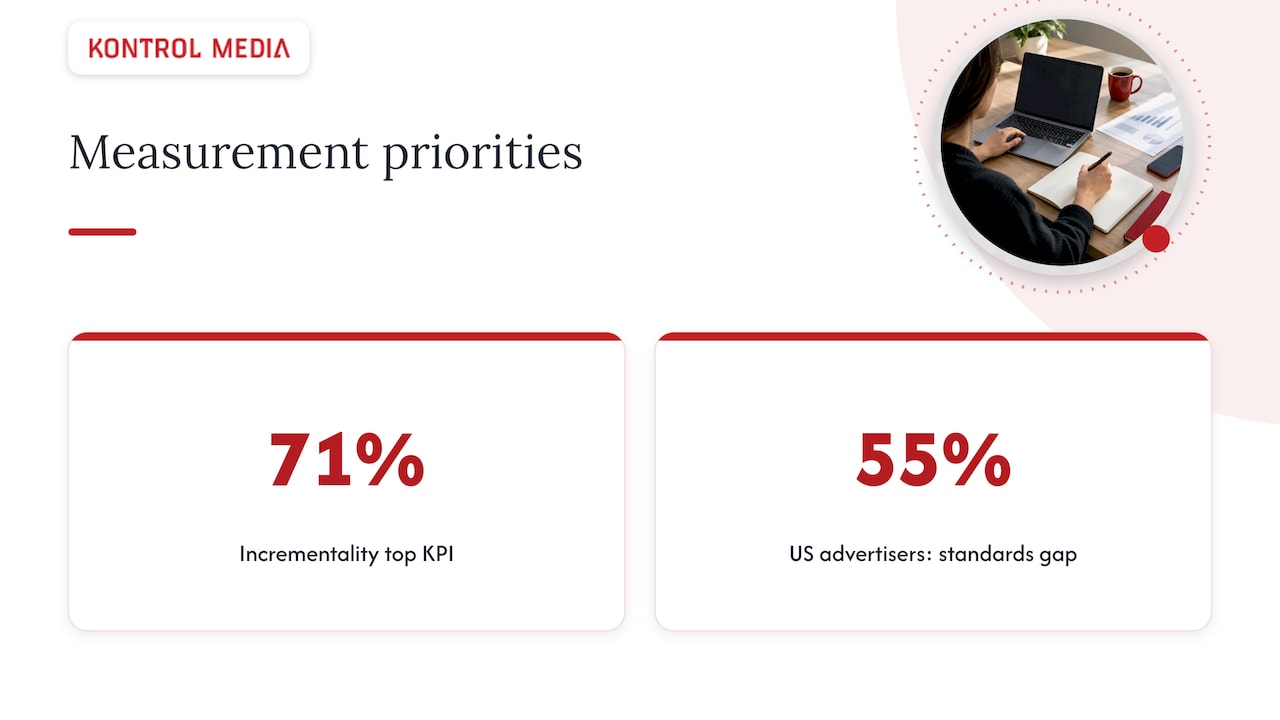
The data is consistent. In EMARKETER’s reporting, 71% of advertisers rank incrementality as the top KPI for retail media investment, and 55% of US advertisers say the lack of standardization across more than 200 networks is their biggest challenge. Brands are, in the words of that coverage, increasingly willing to hold back spend from platforms that are not transparent.
Incrementality asks a simple question: how many sales would not have happened without this ad? Answering it requires test-and-control design, where a group of shoppers is deliberately held out and compared. It is harder than reporting a ratio of ad revenue to spend, which is why it is so valuable when you offer it. We explain the mechanics in incrementality in retail media and the related ratio in iROAS measurement for retail media.
For a concrete example of a mid-sized network taking this seriously, look at what Dollar General’s media network has done: it built its incrementality measurement around IAB specifications for test-and-control methodologies, a standard many retailers avoid. That is a sign of where buyer expectations are heading, regardless of network size.
A marketplace has an extra measurement burden: sellers need to see that ad-attributed sales are not just cannibalizing organic sales they would have made anyway. Build that view early. A seller who understands the lift keeps spending, and a seller who suspects the lift is an illusion eventually stops.
On the standards front, we also recommend reading our marketer’s guide to key retail media metrics, which lays out which numbers to put in front of which stakeholder.
From performance engine to full-funnel network
The early era of retail media was easy money: capture shoppers who were already about to buy, report a high return on ad spend and move on. That model is hitting its limits. Instacart’s advertising leadership has argued that networks must move past being simple performance engines, and instead support the whole shopper journey, from discovery to conversion, with causal modeling rather than a single flawed metric.
For a marketplace, this means designing formats and reporting for awareness and consideration, not just the last click. It also means being honest that upper-funnel value takes longer to show. Set expectations with advertisers about the testing windows, and agree on the measurement design before the campaign starts, not after the results arrive.
Data collaboration without the chaos
Once you have more than a handful of advertisers, the data question becomes unavoidable. Brands want to compare performance across networks. You want to protect your shopper data. Clean rooms sit in the middle of that tension. Industry voices argue they are more than a compliance tool: they are the mechanism for standardizing insight, audience segmentation and activation across networks.
We would not buy one on day one. Start with what questions advertisers actually ask, then check whether a clean room answers them. Our note on retail media clean rooms and what to check before buying covers the evaluation points.
When the data estate grows across ad tools, seller dashboards and commerce systems, unifying it becomes an engineering and governance project in its own right. Teams exploring AI strategy and advisory for retail often begin with exactly this question of how to bring scattered performance signals into one reliable view.
Perspective: where we think most marketplaces go wrong
We have sat in rooms where a marketplace leadership team was convinced that the technology was the hard part. It almost never is. The platform can be licensed, configured and live within a quarter. What takes longer, and what separates a network that earns real revenue from one that produces a nice slide, is the commercial engine: who is calling advertisers, what they are promising, how they report results and how they handle the first campaign that underperforms.
So our view is simple. Treat the network as a business with a sales function, not a feature with a dashboard. Hire or borrow people who have sold media before. Give them a clear price list and a few packages that make sense to a brand marketing lead. Insist on a measurement approach that you would be comfortable defending to a skeptical finance team.
We also believe marketplaces should be more candid about what they are. You are not the largest network, and you do not need to pretend otherwise. You are a place where a certain kind of shopper shows up with a certain kind of intent, and the best pitch is a specific one. That candor tends to earn trust faster than a claim of scale.
And finally, protect the shopper. The networks that will still be here in five years are the ones that kept the experience good while the ad load grew. Revenue that quietly erodes the reason people visit is borrowed from the future.
— Mark Kapczynski
A 90-day plan to get moving
Here is how we would sequence the first quarter for a marketplace that wants to turn a retail media idea into something real.
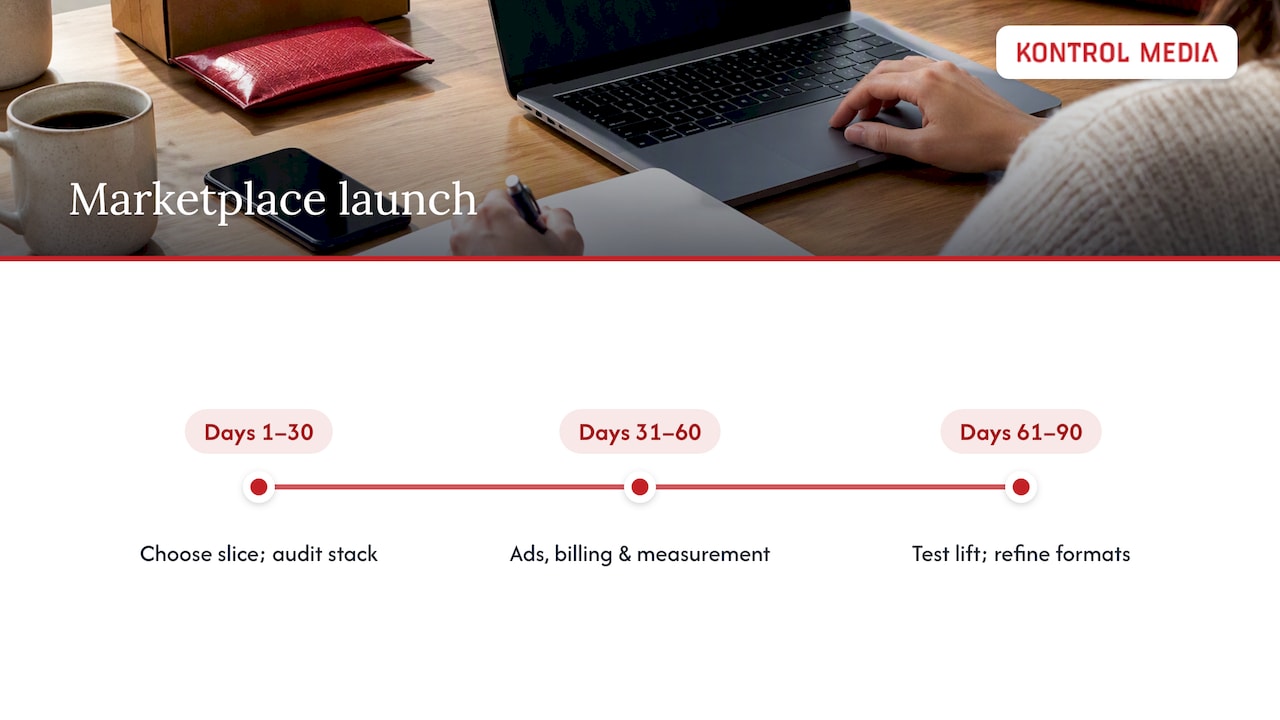
Days 1 to 30: choose the battlefield
Pick one category or region with your deepest traffic. Audit listing quality, stock accuracy and search relevance there, since ads amplify whatever is already present. Decide whether you will build, buy or blend the ad stack. Define the single measurement standard you will use, and write it down.
Days 31 to 60: launch the foundation
Stand up self-serve sponsored listings with automated billing and wallets for a small group of sellers who will give honest feedback. Create a simple rate card and two or three packages. Draft the incrementality test design so that the first campaigns are measured properly from day one.
Days 61 to 90: sell and learn
Bring in a handful of brand advertisers and, if your data governance is ready, one or two non-endemic prospects. Run test-and-control reads, share the findings plainly, including the weak spots, and use them to refine pricing and formats. At the end of the quarter you should know three things: which surface sells, which advertisers renew and what the measurement says about real lift.
If you want a deeper look at the commercial side, our retail media ad sales guide and the execution-first operations playbook go further on how the team should work day to day.
How Kontrol Media can help
We build, operate and drive revenue for retail and commerce media networks, and we handle the sales, partnerships and strategy work that makes a network pay for itself. If you are planning a launch, our network setup service covers the foundation. If your network is live and needs revenue, our retail media network operations team works alongside yours. For broader questions about go-to-market and growth, see our consulting services or start from kontrolmedia.com.
FAQ
Can a small marketplace run a retail media network?
Yes, but start narrow. Focus on one category where your traffic is strongest and launch self-serve sponsored listings before anything else. Partnering for technology can be more practical than building, as long as you keep control of seller relationships and shopper data.
Should marketplaces sell to non-endemic advertisers?
Often, yes, once the on-site foundation is working. Non-endemic demand lets you monetize first-party data by selling to brands outside your assortment. You need clear consent practices and governance first, because trust in your data is the product.
What metric should I lead with when pitching advertisers?
Lead with incrementality. Advertisers increasingly rank it first, and a clean test-and-control design answers the question finance teams ask. Report return on ad spend as supporting detail, not as proof.
How is a marketplace strategy different from a retailer’s?
A marketplace does not own the products it advertises, so relevance, stock accuracy and seller trust matter more. Many of your first advertisers are your own sellers, which means the ads must feel like a growth tool rather than an added fee.
Sources
- Retail Media Ad Spending Forecast and Trends H2 2025, EMARKETER
- Measuring what matters in retail media’s boom with incrementality, EMARKETER
- FAQ on non-endemic retail media, EMARKETER
- Retail media’s next act: Instacart goes full funnel, EMARKETER
- Future of Retail Media 2026-2028, Osmos
- The Path to Smarter Retail Media Is Here, Adweek
- Dollar General’s new media chief targets rural America’s last mile, The Drum
- The Marketplace Cold Start, Open Scout
- Retail media and marketplaces: the flywheel for revenue and growth, InternetRetailing