


You can stop renting attention one click at a time by building partnerships where you pay for outcomes, such as qualified opportunities, closed deals or incremental sales, and where a partner’s audience becomes your distribution. It is not a switch you flip. It is a gradual reallocation: you keep the search and social spend that clearly earns its keep, and you build a second engine that compounds instead of resetting to zero every month.
We have spent years on both sides of this shift, operating media partnerships, retail media networks and real estate channel programs. This guide lays out how we think about it, what to build first, and how to prove it worked.
TL;DR
- Paid clicks stop when the budget stops. Partnerships, when structured well, keep producing because the audience and trust belong to the partner, not the auction.
- Pay partners for defined actions (qualified opportunities, closed deals, incremental sales) and match the deal structure to the goal.
- Real estate agents and retail or commerce media networks are two of the most underused partner channels for reaching buyers at the moment of intent.
- Measure partner revenue with a clear rule for sourced versus influenced revenue, fully loaded costs, and a baseline for incrementality.
- Put disclosure and quality control in writing before any partner sends a single visitor.
Table of Contents
- Why click-based growth stalls
- What “revenue from partners” actually means
- Channel one: reaching home buyers and owners through real estate agents
- Channel two: retail and commerce media networks
- A first 90 days that does not waste a quarter
- How to measure partner-driven revenue
- Guardrails: disclosure and quality control
- Our perspective
- Where we can help
- FAQ
- Sources
Why click-based growth stalls
Pay-per-click is a wonderful tool and a poor foundation. Every dollar buys access to an audience you do not own, in an auction where your competitors can bid up the same intent. When costs rise, you have two choices: pay more or get less. Neither builds an asset.
The symptoms are familiar to most CMOs and heads of growth we talk with: blended acquisition costs creeping up, a channel mix that looks diversified but all draws on the same auction logic, and a board asking why revenue is not growing in proportion to spend. The problem is rarely that the ads are bad. It is that the model rewards volume of traffic, not the quality of the relationship behind it.
There is also a useful data point on how much room this leaves. A 2019 KPI report from Wolfgang Digital, summarized in an industry white paper on partnerships versus paid search, found the average business gets 18% of its revenue from paid search, while high-maturity partnership programs contribute 28% of overall company revenue. That is an older, single-year figure, so treat it as directional rather than a benchmark to promise your board. The direction, though, matches what we see: mature partner programs punch above their budget.
What “revenue from partners” actually means
The phrase gets used loosely, so let us pin it down. A partner-driven revenue program is any arrangement where another company puts your offer in front of its audience, and you compensate it based on what happens next rather than what is displayed. That can look very different depending on the partner.
Pay for outcomes, not volume
Performance and affiliate-style partnerships let you pay for defined, measurable actions like qualified opportunities or closed deals, which ties spend to outcomes instead of raw lead counts, as MarketingProfs describes in its 2026 piece on partner-sourced pipeline. The discipline is in defining “qualified.” If you pay on a form fill, you will get form fills. If you pay on a sales-accepted opportunity, partners learn quickly who your buyer is.
Match the structure to the job
The same source makes a point we would underline: choose the financial model for the objective. Co-marketing suits an audience trade, where two brands swap reach. Revenue share suits long-term customer value, where the partner keeps earning as the customer keeps buying. Using revenue share to chase a one-off launch spike, or flat sponsorship fees to build recurring revenue, is how good partnerships turn sour in the second quarter.
We lay out a staged approach in our 90-day partnership development strategy, and the principles behind a deal both sides want to renew are in our guide to forming win-win strategic partnerships.
Choose partners by audience fit, not by size
The biggest partner is rarely the best one. A smaller publisher, retailer or professional network whose audience already has your buyer’s problem will convert at a different level than a large one with a vague overlap. Start with three questions: who already has the trust of the customer I want, what do they need that I can supply, and how will we both see the result?
Channel one: reaching home buyers and owners through real estate agents
If your customers are buying or owning a home, they are also buying furniture, insurance, mortgages, appliances, renovations, utilities, security systems and a long list of other things. The real estate agent sits at the center of that moment, and most brands still reach those households only through broad digital advertising.
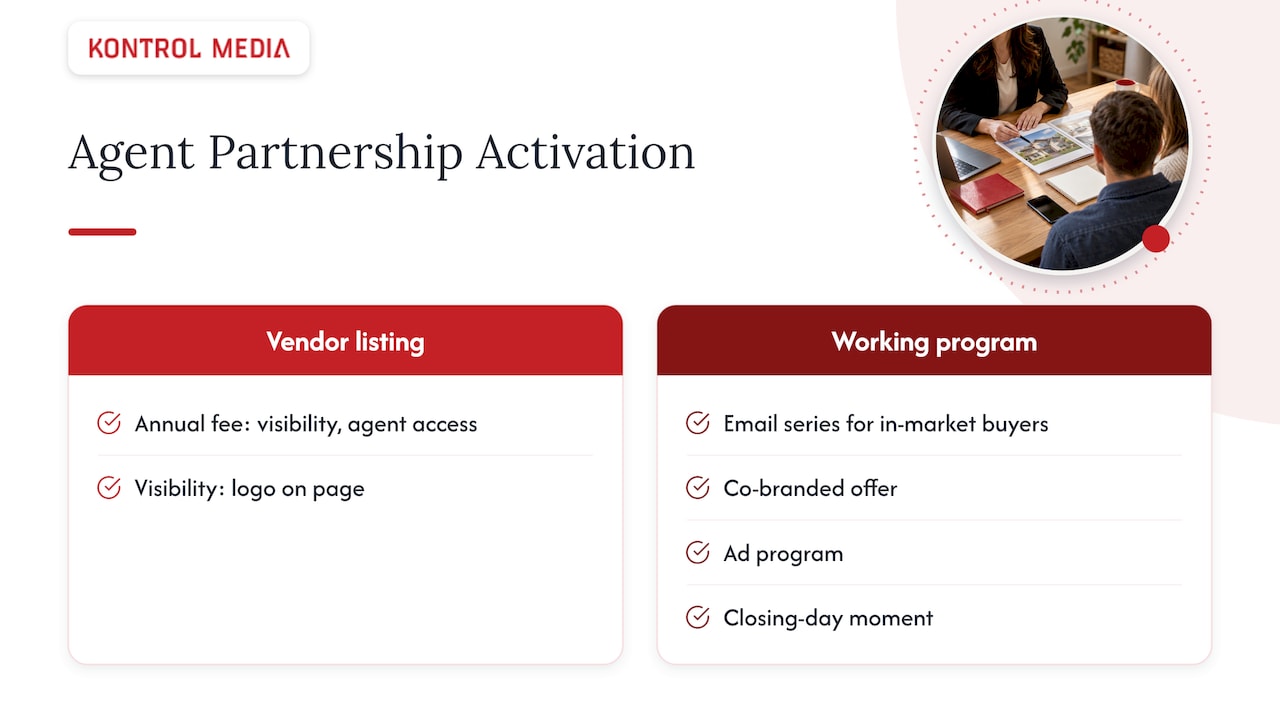
Brokerages are already building businesses around this. According to the National Association of Realtors, some brokerages, such as The Signature Real Estate Companies in Florida, create preferred vendor subscription programs where businesses pay annual fees for visibility and access to agents. The same NAR piece describes brokerages expanding into branded content studios, real estate technology platforms and industry events. Each of those is a surface where a brand can show up in a trusted context instead of bidding for a click.
The practical difference between a preferred vendor listing and a real program is activation. Visibility alone gives you a logo on a page. A working program gives agents something worth sharing with their clients: an email series for in-market buyers, a co-branded offer, an ad program, a closing-day moment. That is the territory of our real estate agent partnership playbook, and it is how brands and their agencies can turn the agent relationship into a revenue channel without carrying the cost of a click on every household.
Channel two: retail and commerce media networks
The second partner channel runs in the opposite direction. Instead of renting someone else’s audience, you turn your own into a revenue line, or you buy into a retailer’s audience at the point of purchase.
Nielsen explains that retail media networks are either retailer-owned advertising assets or third-party publishers whose ads use retailers’ first-party shopper data, and that they can tie impressions to sales on a platform. Retailers can monetize through sponsored search ads, promotional banners and branded video on their own sites, and by using shopper data to tailor ads on social media, connected TV and digital radio.
Physical stores are in the game as well. A 2025 industry report on in-store screens describes retailers selling shelf-edge and end-cap screen inventory through direct sales, private-marketplace deals, open auctions and vendor sponsorships, with targeting that can draw on point-of-sale logs and loyalty programs, and reporting that includes proof of play and transaction-log correlation.
The part retailers underestimate
A retail media network is not an extension of merchandising. An IDC paper published in 2026 describes it as a primarily B2B advertising business that needs advertising and adtech expertise, plus new operations for ad sales, attribution, targeting metrics and data delivery. It adds that retailers can build in-house or lean on partners, consultants and systems integrators.
That matches our experience. The technology is the easier half. The harder half is selling to advertisers, packaging inventory, and reporting in a way a brand’s finance team will believe. If you are weighing the path, our write-ups on build versus buy for retail media network setup and what a commerce media network is are good places to start, and retail media sponsorships that must prove impact before renewal covers the buy side.
A first 90 days that does not waste a quarter
Partnership programs fail slowly, which is why they are expensive. A tight first quarter protects you.
Weeks 1 to 3: define the economics. Decide what a qualified outcome is, what a customer is worth over time, and what you can pay per outcome while staying profitable. Write down the sourced-versus-influenced rule now, before a partner’s numbers force the argument.
Weeks 3 to 6: pick two or three partners, not twenty. Choose by audience fit, and give each a distinct structure. One co-marketing arrangement, one performance deal and, if relevant, one channel program like agents or a retail network placement will teach you more than a dozen identical affiliates.
Weeks 6 to 12: launch with a test design. Hold out a comparable audience or region so you can estimate what the partner added beyond what would have happened anyway. Our walkthrough on proving media partnership impact in 90 days goes through this in more detail.
At the end, you should be able to say which partners to double, which to fix and which to end, using numbers your CFO has already agreed to read.
How to measure partner-driven revenue
This is where most programs lose credibility, so be strict early.
Start with simple ROI and honest costs
Partner ROI is the partner-generated return minus program cost, divided by program cost. The arithmetic is easy; the discipline is in the denominator. Include everything the program really costs: partner-team salaries and overhead, tooling, market development funds, incentives, enablement, events and partner discounts. Count partner-sourced revenue as its own line, report influenced revenue separately or discount it, and state your margin assumptions and time window. A program that looks like 8x on commissions alone can look very different once the team and tools are loaded in.
Go beyond attribution to incrementality
Attributed sales tell you a partner was present. Incrementality tells you whether the partner changed the outcome. The January 2024 IAB and Media Rating Council guidelines for U.S. retail media define incrementality as causal value above a baseline, and recommend accurate, verifiable data, transparent methodology and, where feasible, randomized test and control groups. They also call for disclosing test design, assumptions, duration and limitations. That is a good standard to hold any partner report to, whether or not retail media is involved.
For the metrics worth tracking once the test is running, see our 2026 guide to key retail media metrics and our broader piece on measuring the ROI of marketing and advertising campaigns. If you are taking this to your board, five to seven revenue metrics will persuade better than a dashboard of impressions.
Guardrails: disclosure and quality control
Partners speak in your name, and that carries legal weight in the United States. The Federal Trade Commission has said that advertisers can be liable for affiliates’ deceptive claims, and that brands should provide detailed advertising guidelines, run quality control and investigate consumer concerns. The agency cautions that programs where affiliates drive traffic without direction or oversight can lead to deceptive practices.
On disclosure, the FTC’s endorsement guidance says affiliates must clearly and conspicuously disclose their relationship to the retailer on their site, with plain language such as saying they earn commissions on purchases made through links. Build that into your partner agreement, supply approved language, and audit a sample of partner content every month. If your program touches legal terms you are unsure about, your counsel should review the agreement before you launch.
Our perspective
We have a bias, and we will be candid about it: we think most companies do not have a traffic problem, they have a relationship problem. Paid clicks let you skip the harder work of earning a place in someone else’s world, and for a while that works. Then the auction gets crowded and the bill grows.
What we see in the real estate channel, in retail and commerce media, and in media partnerships is that the brands who win treat partners as an extension of their go-to-market team. They define the outcome together, they share the data, and they keep the structure simple enough that both finance teams can follow it. The brands who struggle usually did the opposite: they signed a sponsorship, waited for magic and then cut it when the report was fuzzy.
We would also say this plainly: you do not need to abandon paid media. You need a second engine that does not stall when you stop spending, and you need a way to prove it is working. Strategy without execution is a slide deck, and execution without strategy is expensive motion. The work is doing both, with a bit of enjoyment along the way, because partners can tell when the relationship is only transactional.
— Mark Kapczynski
Where we can help
If you want an operating partner rather than another slide deck, we build and run these programs. That includes partnership development and go-to-market strategy, real estate channel programs for brands and their agencies, and retail or commerce media network setup and day-to-day network operations. Tell us your growth target and we will tell you which partner channel we would test first.
FAQ
Can I stop paying for clicks entirely?
Most companies should not, and we would be wary of anyone who says otherwise. Paid search and social remain useful for capturing existing demand. The goal is to lower your dependence on them by building partner channels that produce revenue you do not have to repurchase each month.
How long does it take for partner revenue to show up?
It depends on the partner type and your sales cycle. Performance deals can show qualified opportunities within weeks, while revenue-share and channel programs usually take a few quarters to compound. That is why we suggest a 90-day test with an agreed baseline, so you can judge early signals without waiting for the full payoff.
What should I pay partners for?
Pay for the action closest to revenue that you can verify, such as a sales-accepted opportunity or a closed deal. Paying for raw leads rewards volume, which brings you back to the click problem. Match the model to the goal: co-marketing for audience swaps, revenue share for long-term customer value.
How do I know a partner actually added revenue?
Compare against a baseline. Use a holdout group or region where feasible, document the test design, and report sourced revenue separately from influenced revenue. If a partner only reports attributed sales, ask what would have happened without them.
Do I have legal exposure for what partners say about my product?
Potentially, yes. In the United States the FTC has said advertisers may be liable for affiliates’ deceptive claims and expects clear disclosure of financial relationships. Put guidelines and disclosure language in the contract, monitor partner content, and ask your counsel to review the agreement.
Sources
- MarketingProfs: Partner-Sourced Pipeline: Structure, Pay, and Measure It
- Partnerships versus paid search white paper (Wolfgang Digital KPI data, 2019)
- NAR: How Smart Brokerages Are Making Money Beyond Transactions
- Nielsen: What are retail media networks
- Invidis: Spectrio launches RMN Gateway for in-store screens
- IDC: The Race to Build an Advertiser-Centric Retail Media Network
- IAB/MRC Retail Media Measurement Guidelines
- FTC: Advertising and marketing enforcement challenges
- FTC: Endorsement Guides, what people are asking