


The sponsorship sales process is a sequence you run every sales cycle: inventory & valuation, targeted prospecting, discovery meetings, outcome-led proposals, activation, and renewal. Most teams skip straight to prospecting, which is why deals stall on price. The highest-leverage move is building your inventory and valuation first, because it sharpens who you pitch and what you charge before you ever send an email, as detailed in Social Media for Event Venues — Fill Your Date Calendar | Presly.
TL;DR:
- Building a comprehensive inventory and valuation worksheet before outreach ensures accurate pricing and targeted prospecting, preventing deals from stalling on price.
- Prospect ranking should include audience fit, budget history, timing, category conflicts, and prior sponsorship behavior to identify high-potential sponsors efficiently.
- Discovery meetings should focus on understanding a sponsor’s true success criteria and building a specific follow-up plan rather than pushing for immediate closure.
- Sponsorship proposals must align with the sponsor’s objectives, include clear KPIs and activation timelines, and incorporate transparent assumptions to avoid future renewal disagreements.
- Focus on consistent activation, accurate proof of performance, and detailed reporting to foster renewal conversations and capitalize on upsell opportunities.
Table of Contents
- What Is the Sponsorship Sales Process, and Where Does It Start?
- How Do You Build and Value Your Sponsorship Inventory?
- How Should You Prioritize Sponsorship Prospects?
- What Should You Ask in a Sponsorship Discovery Meeting?
- How Do You Write a Sponsorship Proposal That Doesn’t Feel Generic?
- How Do You Deliver, Report, and Renew a Sponsorship?
- Which KPIs Actually Matter to Sponsors?
- How Kontrol Media Approaches Sponsorship Sales Challenges
- Where Teams Waste the Most Time in Sponsorship Sales
- Kontrol Media: A Direct Way to Run Your Sponsorship Sales Process
- Sources
- FAQ
What Is the Sponsorship Sales Process, and Where Does It Start?
The sponsorship sales process runs in five connected stages: inventory and asset valuation, prospecting, discovery meetings, proposal and pricing, then activation, fulfillment, and renewal. Skip a stage, and the next one gets harder. Sellers who jump straight into cold outreach without a valued inventory sheet end up negotiating from weakness, because they cannot defend a price they never calculated.
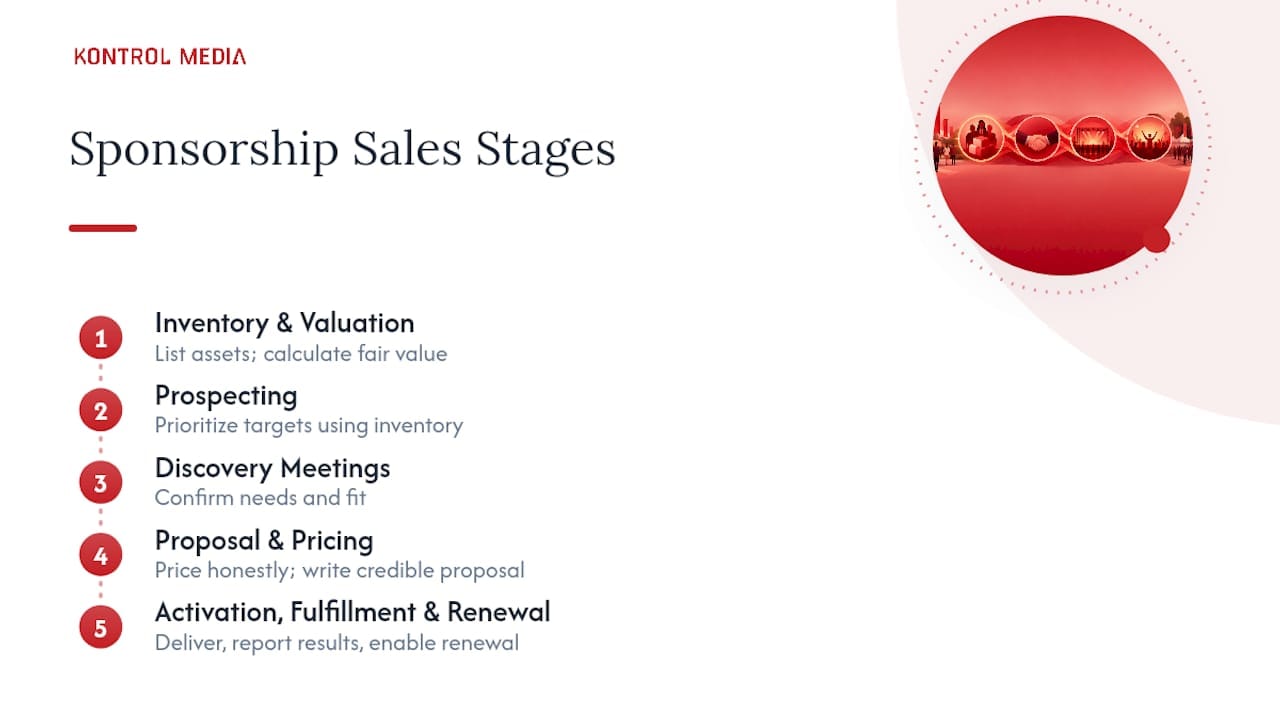
Inventory and valuation come first for a reason. You cannot prioritize prospects intelligently, price honestly, or write a credible proposal until you know exactly what you are selling and what it is worth. This is the step most teams treat as an afterthought, and it is the one that determines whether every later stage goes smoothly or turns into guesswork.
The rest of this guide walks through each stage in the order you should actually run it, with the practical mechanics for building sponsorship relationships, structuring proposals, and reporting results that make renewal an easy conversation instead of a re-pitch.
How Do You Build and Value Your Sponsorship Inventory?
Start with a full inventory-and-valuation worksheet before you contact a single prospect. List every sellable touchpoint you have, not just the obvious ones. The Sponsorship Collective recommends documenting audience data, reach, exclusivity, timing, and delivery cost for each asset, then pricing against real market comparables rather than round numbers pulled from last year’s rate card.
Common sellable touchpoints include:
- Naming rights on stages, sessions, or program tracks
- Speaking slots or co-branded content sessions
- Booth space, sampling zones, or product demo areas
- Email placements to your registered audience
- Digital placements on your website, app, or event platform
- Lead-generation integrations (scan-to-win, matchmaking, badge data)
- Product integrations built into the attendee experience
For each asset, capture the same data fields so you can compare apples to apples later:
| Data Field | Why It Matters |
|---|---|
| Audience segment | Determines sponsor fit and relevance |
| Estimated reach | Sets the ceiling on perceived value |
| Exclusivity | Category exclusivity commands a premium |
| Timing | Peak slots price higher than filler slots |
| Activation cost | Feeds directly into your profitability math |
| Delivery owner | Assigns accountability before you sell it |
| Proof of performance | What you’ll show in the wrap report |
Price each asset with a simple three-part method: benchmark against comparable sponsorships in your category, apply a cost-plus floor so activation expenses never eat your margin, and write down every assumption behind the number. Revisit the whole worksheet annually, whenever your audience shifts materially, and always before a new sales cycle opens.
How Should You Prioritize Sponsorship Prospects?
Once your inventory is valued, prospecting becomes a matching exercise rather than a guessing game. Each asset has an audience profile and a business objective it can serve, so map those attributes against the sponsor categories most likely to care.
Score every prospect on five factors before you spend outreach time on them:
- Audience fit. Does the sponsor’s target customer overlap with your attendee or reader base?
- Budget likelihood. Have they spent on sponsorships or comparable marketing before?
- Timing. Is their fiscal or campaign calendar open to a new commitment right now?
- Category conflict. Would signing them block or compete with an existing sponsor?
- Prior sponsorship behavior. Have they renewed sponsorships elsewhere, or churned quickly?
Rank prospects by combined score, then run a multi-channel cadence: an email that leads with a specific audience insight, a LinkedIn touch that references something real about their recent campaigns, and a warm-intro request through any mutual connection you can find. Space touches over two to three weeks rather than firing them all in one week.
Before you reach out, research how the sponsor’s internal buying unit actually evaluates success. A sponsorship manager’s preference rarely closes the deal alone. The real decision often runs through demand generation, sales, finance, and sometimes legal, and each of those stakeholders needs different evidence to build their own internal business case.
Pro Tip: Build one outreach sequence per audience segment instead of one generic template for everyone. A sponsor selling to homeowners cares about completely different proof points than one selling to enterprise buyers, even if both fit your event.
What Should You Ask in a Sponsorship Discovery Meeting?
The first meeting has exactly one job: gather information and book the next meeting. Trying to close in meeting one is the single most common reason sponsorship sales stall, because you end up pitching assets before you understand what the sponsor is actually trying to achieve.
Ask questions that reveal the sponsor’s real success criteria, not just their budget range:
- Who is your target audience, and how does it compare with ours?
- What KPIs will your team report internally after this campaign?
- Who else needs to sign off before this budget gets approved?
- What worked or fell flat in past sponsorships you’ve run?
- What would make this a clear win when you report back to your boss?
Listen for the difference between what they say they want and what their internal buying unit will actually measure. A marketing lead might talk about “brand visibility,” but if finance is in the room, the real currency is pipeline value and cost per lead.
After the meeting, send a short recap within 24 hours that restates their objectives in your own words and proposes a specific follow-up date. This qualification step, not the pitch itself, is what separates sellers who build lasting sponsorship relationships from those who chase every lead at the same intensity. The most common discovery mistake is talking more than you listen. The second most common is failing to book a specific next meeting before you hang up.
How Do You Write a Sponsorship Proposal That Doesn’t Feel Generic?
A strong proposal mirrors the objectives the sponsor stated in discovery, not a menu of tiers copied from last year’s deck. Structure it around five elements: their stated objectives, the specific assets you recommend (not all of them), the KPIs you’ll track, an activation timeline, and total costs with clear service-level commitments.
Fixed tiers (bronze, silver, gold) work fine for smaller, low-touch sponsors who want a quick yes or no. For anything above your mid-tier price point, tiers usually cost you money, because sponsors with unique objectives either overpay for assets they don’t need or walk away when nothing quite fits. Present a base package, then list negotiable add-ons priced individually.
Your pricing needs to include full activation and production costs, not just the asset’s face value. Set a simple profitability gate, a minimum net margin, before you approve any custom activation request, so a sponsor’s flattering “can you also build us a photo wall” doesn’t quietly erase your margin.
- Include a one-paragraph measurement commitment describing what you can directly observe versus what will require the sponsor’s own reporting.
- Flag attribution limits honestly, especially for awareness-style assets where a clean cause-and-effect line rarely exists.
- Attach a delivery timeline with named owners for each asset.
Pro Tip: Write “assumptions” as a visible line in the proposal, not a footnote. Stating “reach estimates based on 2025 registration data” up front prevents a renewal argument eight months later.
How Do You Deliver, Report, and Renew a Sponsorship?
Activation is where sponsorship sales either earn a renewal or lose one quietly. Build an ownership matrix before the event or program launches, assigning a named owner to every asset, whether that’s a booth build, an email send date, or a digital placement going live.
Run activation and fulfillment in this order:
- Confirm every asset against the signed contract two weeks before delivery.
- Assign a single point of contact for on-site or on-platform execution.
- Capture proof of performance in real time: photos, screenshots, download counts, attendance logs.
- Compile a fulfillment report within 10 business days of the event closing.
- Schedule a sponsor debrief call to walk through the report together.
Your fulfillment report should go asset-by-asset, pairing each deliverable with the metric that proves it happened and the KPI it was meant to serve. A vague summary undermines trust; a specific one, complete with screenshots and a sponsor quote where you have one, builds it.
- Capture a baseline at contract signing, before any activation begins.
- Schedule one mid-campaign check-in so surprises surface early, not in the wrap report.
- Turn the wrap report into a renewal proposal draft, not a separate document written from scratch later.
This is also the moment to introduce expansion. If the fulfillment evidence shows a sponsor over-performed on leads relative to what they paid, that data point is your opening line for an upsell conversation, not a footnote buried in appendix three.
Which KPIs Actually Matter to Sponsors?
Sponsors rarely care about raw attendance anymore. What matters is whether the sponsorship moved a number their own boss tracks, and that number changes depending on their objective.
Freeman’s guidance on outcome-led measurement recommends tracking meetings, session engagement, downloads, and viewing time rather than leaning on a single attendance figure, because quality and objective attainment matter more than volume alone.
| Sponsor Objective | Primary KPI | Supporting Signal |
|---|---|---|
| Lead generation | Qualified leads / pipeline value | Cost per lead, meeting requests |
| Brand awareness | Impressions with engagement context | View time, session attendance |
| Engagement | Session or booth attendance | Content downloads, dwell time |
| Product trial | Sampling or demo conversions | Follow-up survey response rate |
Channel matters as much as objective. In-person assets are best measured through meetings, scans, and booth traffic. Virtual assets need landing-page time and content download counts. Hybrid programs require you to define a roll-up method in advance, because combining in-person headcount with digital session views without a clear formula produces a number nobody trusts.
Be precise about what you can prove directly versus what requires the sponsor’s own data or a modeled estimate. You can directly observe booth scans, email opens, and session attendance. You cannot directly observe whether a sponsor’s sales team closed a deal that started at your event unless they share their CRM data with you, which means that number is sponsor-reported, not organizer-verified. Say so in writing.
A simple example: if a sponsor invests a certain sum and your fulfillment report indicates qualified leads that translate to a significant expected pipeline value with a reasonable cost per lead, you can calculate the return on investment accordingly. The AMA’s Marketing ROI Calculator walks through exactly this chain: cost to leads, leads to closed deals, deals to revenue, and it’s worth running every sponsorship through the same math you’d apply to a paid media campaign, as detailed in our guide to measuring marketing ROI.
Bake measurement into the contract stage, not the wrap report. EventMarketer’s ROI-driven RFP framework argues that measurement should be a scored criterion during proposal review, with reporting cadence and baseline capture specified before anyone signs.
How Kontrol Media Approaches Sponsorship Sales Challenges
Kontrol Media works directly inside the stages above, running inventory and valuation sprints, standing up outsourced sales support when internal teams lack bandwidth, and building measurement frameworks that hold up when a sponsor’s finance team asks hard questions.
Consider bringing in outside help when any of these show up:
- Your team can value inventory but can’t staff consistent activation and reporting.
- Measurement requests from sponsors have outpaced your internal data tools.
- You want to productize recurring sponsorship packages instead of custom-building every deal.
For teams weighing whether to build this in-house or bring in support, our breakdown on running a sales function without adding headcount covers the trade-offs.
Where Teams Waste the Most Time in Sponsorship Sales
Most teams over-invest in prospecting volume and under-invest in inventory clarity, then wonder why every deal turns into a price negotiation. If your organization has limited capacity this quarter, run a 30-day sprint instead of a full overhaul: value your full inventory, rank your top 10 prospects using the fit scoring above, and build one outreach sequence tailored to that group. Treat measurement as a living system you adjust every cycle, not a report you write once the event ends.
— Mark Kapczynski
Kontrol Media: A Direct Way to Run Your Sponsorship Sales Process
There are hands-on alternatives to hiring a traditional agency for sponsorship strategy work that never touches execution. Instead of a slide deck telling you what your inventory could theoretically be worth, Some firms run the valuation sprint, staff the outreach and discovery cadence, and build measurement frameworks that sponsors trust when renewal time comes.
That combination matters because sponsorship sales rarely fail from bad ideas. They fail from under-resourced execution: nobody owns the fulfillment report, nobody revisits pricing, nobody builds the renewal sequence until the sponsor has already gone quiet. Kontrol Media’s sales execution services exist specifically to fill that gap, whether you need a full outsourced sales function or support standing up the inventory and reporting systems behind it.
If your sponsorship program is already tied into a retail or commerce media strategy, Kontrol Media also helps organizations structure and operate those networks so sponsorship-style partnerships scale beyond one-off deals. Visit Kontrol Media’s services page to see where your team’s gaps line up with what we run day to day, and get in touch to talk through your next sponsorship cycle.
Sources
Run your next valuation with the Sponsorship Collective’s inventory framework, calculate returns with the AMA ROI Calculator, review Freeman’s measurement guidance, and study IAEE’s sponsorship strategy research for customization tactics that lift participation.
- Sponsorship Collective — About / blog content
- Freeman measurement materials / Exhibitor Online summary
- AMA Marketing ROI Calculator
FAQ
What Are the Steps in the Sponsorship Sales Process?
The core steps are inventory and asset valuation, prospecting, discovery meetings, proposal and pricing, and activation followed by renewal. Each stage feeds the next, which is why skipping valuation to jump straight into outreach usually produces weaker pricing power later.
What Exactly Are Sponsorship Sales?
Sponsorship sales is the process of packaging an event or program’s sellable assets, naming rights, content sessions, digital placements, and pitching them to brands whose objectives match your audience. The goal is a paid partnership tied to specific, measurable outcomes rather than a flat donation or ad buy.
What Are the Typical Sponsorship Levels?
Common sponsorship levels follow a tiered naming pattern such as title, presenting, gold, silver, and bronze, each bundling a different mix of assets and visibility. Tiers work well for lower-budget sponsors seeking a quick decision, but larger or more specific sponsors often need custom packages built around their stated objectives instead.
How Much Do Sponsorships Typically Pay?
Sponsorship pricing varies widely by audience size, exclusivity, and asset mix, so there’s no single industry-wide number to quote. A defensible price comes from benchmarking against comparable market opportunities and factoring in your actual activation costs, as outlined in the inventory and valuation approach above.
Should I Hire Help or Run Sponsorship Sales In-House?
Keep it in-house if your team can staff consistent prospecting, activation, and reporting without gaps. Bring in outside support, such as Kontrol Media’s outsourced sales services, when measurement demands or activation volume have outgrown your current capacity.