


AI serves humans when someone has designed it to. When no one has, people drift into serving the tool: accepting its answers, adjusting their work to its output, and losing the skills they once used. For a marketing or growth leader, the practical question is not philosophical. It is whether your team’s judgment sits in front of the AI or behind it. The research is fairly consistent that the first arrangement produces better work, and that it takes deliberate management to get there.
We work with CMOs, retailers and PE-backed companies on strategy and hands-on execution, and the pattern is the same each time a new tool arrives: the teams that win decide what the tool is for before they decide which tool to buy.
TL;DR
- AI is a different, narrower kind of intelligence than human intelligence. It finds patterns in data and does not understand the world or the people in it, according to MIT neuroscientists.
- It helps most with codified, repeatable work such as drafting, summarizing and first-pass analysis, which frees people for judgment and client-facing work.
- Dependence is the real risk: users accept wrong suggestions, feel lazier, and can lose skills when they outsource their core thinking.
- Control is a design choice: meaningful oversight, safeguards matched to the stakes, and training in judgment.
- Put AI under a clear owner and a clear business goal, and it serves you. Leave that out, and you serve it.
Table of Contents
- Why the question has two honest answers
- What AI actually is, and is not
- Where AI does serve people at work
- Where people start serving the machine
- How to keep AI in service: five working rules
- What this means for retail media, commerce media and channel marketing
- Who is in control, really?
- Where we can help
- Our perspective
- FAQ
- Sources
Why the question has two honest answers
Both directions are real, and they happen in the same company at the same time.
In one direction, AI does work people would rather not do. A 2026 Goldwater Institute report describes it drafting routine responses, summarizing documents, classifying invoices and producing first-pass code, so workers can move toward client interaction, judgment and quality control.
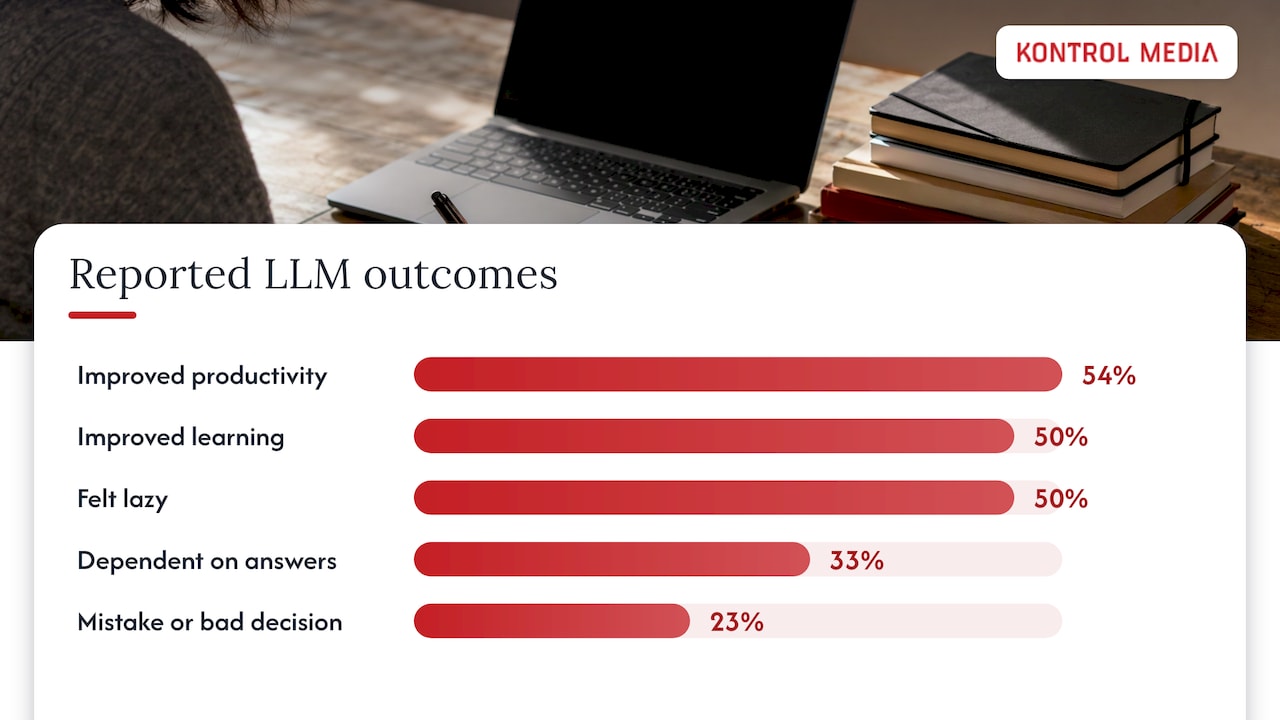
In the other direction, people reshape their habits around the tool. A 2025 survey of 500 U.S. large-language-model users found 54% said the tools improved their productivity and 50% said they improved learning. Yet 50% also felt lazy, 33% felt too dependent on them for answers, and 23% had made a significant mistake or bad decision by relying on LLM-generated information. Same users, same tools, both outcomes.
So the useful question becomes: which of those outcomes is your organization building toward, and who decided?
What AI actually is, and is not
A plain definition helps here, because most bad AI decisions start with a mistaken picture of what the system is doing.
A language model learns statistical patterns in text. MIT’s McGovern Institute researchers put it bluntly: these models don’t know about the world or about other people’s mental states, and Tomaso Poggio describes them as very far from human intelligence. A peer-reviewed conversation among AI and psychology researchers reaches a similar view: computers have mechanical intelligence. They are fast and accurate at what they are told to do, but they lack the creation, abstraction and drive to obtain knowledge that mark human intelligence.
For a growth leader, that translates into a division of labor. AI is strong at speed, scale and pattern recognition. It is weak at knowing why a retailer’s shopper behaves differently in March, why an agent’s client list responds to one message and ignores another, or what a brand promise should mean. Those questions belong to people.
Where AI does serve people at work
The clearest wins come from tasks that can be written down as steps. Drafting a first version, summarizing a long document, sorting records, and producing a rough analysis are all codified work. Pew found the public is comfortable with this kind of help: in a June 2025 survey of 5,023 U.S. adults, 73% would let AI assist at least a little with day-to-day activities, but only 13% would let it assist a lot. Among the 25% who rate AI’s benefits as high or very high, the most common reason, at 41%, was efficiency that frees people to spend their time in better ways.
That last phrase is the test. Efficiency only counts as service if the saved time goes somewhere better. In marketing and sales, “somewhere better” usually means:
- more time with buyers, partners and agents, where relationships are won
- sharper positioning and offer design
- measurement, including whether a campaign or partnership actually produced incremental revenue
If the hours AI saves are simply absorbed by more output volume, you have bought speed, not growth.
Where people start serving the machine
The research on dependence is sobering, and worth reading as a manager rather than as a skeptic.
Overreliance is the default. A 2021 experiment by Buçinca, Malaya and Gajos with 199 participants found that people using AI decision support frequently accept wrong suggestions, and that adding explanations did not fix it. What did help were “cognitive forcing” designs that make a person think through the problem before seeing the AI’s answer.
Skills can fade. MIT Sloan’s Eric So describes an “AI gravity”, a pull toward dependence that can weaken memory, judgment, learning and attention. His advice is practical: let AI amplify each worker’s signature thinking skills, the uniquely human abilities of the job, rather than perform them. A year-long study of AI-assisted radiation oncology found that early efficiency gains masked “intuition rust” and skill atrophy.
Accountability can blur. A 2026 peer-reviewed paper on AI agents in research warns that heavy reliance can create a “responsibility gap”, where nobody bears full accountability for errors. In a marketing organization, that looks like a wrong audience definition or a misleading claim that everyone assumed someone else had checked.
Human connection can thin out. In a month-long study of 1,000 people with OpenAI, MIT Media Lab’s Pattie Maes reports that heavier daily chatbot users became lonelier, socialized less and were more dependent on the AI. Our work depends on relationships, so this is the finding we would weigh most in sales and partnership roles.
The public senses this. Pew found that 57% of Americans rate AI’s risks to society as high or very high, and among those, 27% most often named the erosion of human abilities and connections.
How to keep AI in service: five working rules
The evidence points to management practice, not to the tool itself. A 2026 MIT paper, Humans in the Loop, notes that roughly half of American workers said they used AI in January 2026, and that in more than 20 companies workers are increasingly asked to oversee and analyze AI processes instead of executing them by hand. Its recommendations, together with the American Psychological Association’s workplace guidance, translate into rules a leadership team can apply this quarter.
1. Name a human owner for every AI-assisted outcome
Every audience segment, outbound sequence, pricing recommendation or report that AI touches needs a named person who answers for the result. This closes the responsibility gap before it opens.
2. Match the safeguard to the stakes
The APA says safeguards should scale with what is at risk, and that oversight must be meaningful rather than a formality. A draft social caption can be skimmed. A claim about a product, a data-sharing arrangement or a customer list needs a real review, because the APA also flags rare high-consequence events and correlated failures, where many outputs go wrong at once.
3. Make people think first
Borrow the cognitive-forcing idea. Ask the strategist to write the hypothesis or the shortlist before the model produces its own, then compare. This keeps the human judgment sharp and gives you a real second opinion instead of a rubber stamp.
4. Protect the signature skills
Identify what makes each role valuable, such as negotiating a partnership, reading a retail buyer, or deciding which message belongs to which agent audience. Use AI around those skills, not in place of them. For sales teams that means automating the research and the logistics while keeping real conversations human, a theme we cover in how to automate sales outreach without losing the human touch.
5. Measure human outcomes, not just output
Maes argues the AI field focuses almost entirely on technical benchmarks and treats the human impact as an afterthought. A marketing team can do better by tracking whether decisions improved, whether errors were caught, and whether people are still building skill. Retaining human control over AI-assisted decisions also means keeping logs and review gates, the same way technical teams use automated gates to audit AI search visibility.
What this means for retail media, commerce media and channel marketing
These are data-rich businesses, so AI will be pulled into them quickly: audience modeling, creative variants, bid and placement optimization, and reporting. Done well, it helps a network scale. Done carelessly, it optimizes for whatever it can count, which is rarely the same as incrementality, the revenue that would not have happened without the advertising.
A few places where the human layer matters most:
- Advertiser trust. Brands buying a network’s inventory want to know results are real. A person who understands measurement has to stand behind the numbers. Our guides on retail media network cost and building data partnerships show where those decisions sit.
- Search and discovery. AI answers are changing how brands get found. Leaders still decide what the brand stands for, and we write about it in our enterprise brand visibility strategy and the role of generative AI in enterprise SEO and SEM.
- Relationships with agents and partners. Reaching home buyers and owners through real estate agents works because agents are trusted people. Automation can support the program, but the trust is human, as in our piece on advertising to home buyers through real estate agents.
- Technology choices. New tools belong inside a strategy, not ahead of one. See integrating new technologies into your business strategy.
Who is in control, really?
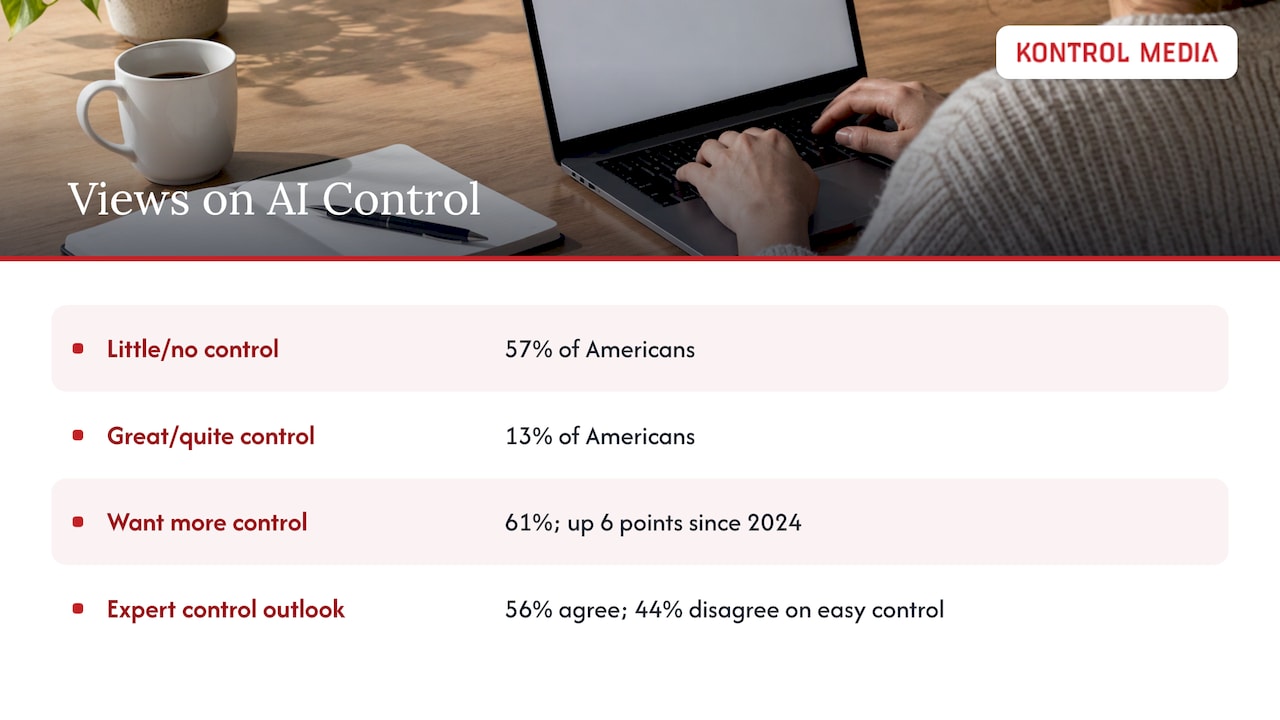
Public confidence is thin. In the same Pew survey, 57% of Americans said they have little or no control over whether AI is used in their lives, only 13% said they have a great deal or quite a bit, and 61% want more control over how it is used, up 6 points since 2024. In a separate Pew canvassing of experts, 56% agreed that by 2035 most smart systems will not be designed to let humans easily stay in control of tech-aided decisions, while 44% disagreed.
That split is the opening for any company willing to act. A RAND working paper argues that AI systems may remain reliant on humans for physical maintenance, ethical guidance and social legitimacy, and that managing those interdependencies is a central governance challenge. Governance is not someone else’s job. Inside your company, it is a management practice, and the MIT authors note that organizations have deployed generative AI with significant variation, which means the levers are yours to pull.
Ownership questions around AI outputs also deserve legal attention. For questions such as who owns AI-generated creations, speak with an attorney before you build a content program on them.
Where we can help
If your team is working out how AI fits into growth, the useful work is rarely the tool selection. It is the strategy, the sales and partnership motion, and the measurement around it. Kontrol Media provides business strategy, marketing and sales support with hands-on execution, and we build and operate retail and commerce media networks for retailers and consumer businesses. We also help brands and agencies reach home buyers and owners through real estate agents.

If you want a partner who plans the work and then does it with you, start with our strategy, marketing and sales services. If the question is a media network, look at how we stand up a retail or commerce media network and run it through retail media network operations.
Our perspective
We have a simple view after years of building media networks, partnerships and sales programs: AI is a very good assistant and a poor owner. It can draft, sort, summarize and suggest. It cannot sit across the table from a retail buyer, earn the trust of an agent, or decide what a brand is willing to be known for.
That is why we pair strategy with execution. A plan that never meets the market is a document, and an automated program that never met a strategy is noise. The most useful role for AI in either case is to take the repetitive weight off good people, so they can spend their days on the judgment calls that move revenue.
Our advice to leaders is optimistic and specific. Decide the goal first. Name the person accountable. Let the tool earn its place against a measure you trust. The companies that do this will find AI serves them well, and they will have kept the skills that make them worth serving in the first place.
Mark Kapczynski
FAQ
Is artificial intelligence human?
No. MIT researchers describe today’s language models as systems that learn patterns in text without knowing about the world or other people’s mental states. They are a restricted, different form of intelligence, useful for speed and scale, and they still need people for judgment.
What does AI do to help humans?
It takes over codified tasks such as drafting routine responses, summarizing documents, classifying records and producing first-pass code. The Goldwater Institute’s 2026 report says this lets workers move toward client interaction, judgment and quality control.
Can people become too dependent on AI?
Yes, and the research shows it. In a 2025 survey of LLM users, 33% felt too dependent on the tools for answers and 50% felt lazy. MIT Sloan’s Eric So advises using AI to amplify a worker’s signature thinking skills rather than perform them.
How do I keep humans in control of AI at work?
Name a human owner for each AI-assisted outcome, match review to the stakes, and have people form their own view before seeing the AI’s. The APA and MIT both stress oversight that is meaningful rather than a formality, plus training in judgment.
Sources
- MIT McGovern Institute: what language models like ChatGPT tell us about intelligence
- National Science Review conversation on AI and human intelligence (PMC)
- Goldwater Institute: Harnessing the Value of AI at Home and in the Workplace
- 2025 national survey of users of large language models
- To Trust or to Think: Cognitive Forcing Functions Can Reduce Overreliance on AI
- MIT Sloan: The Collision: What AI Does to Us
- From Future of Work to Future of Workers (arXiv)
- Benefits and Risks of Using AI Agents in Research (PMC)
- Masters of Scale: What humans get (and don’t get) from AI
- MIT: Humans in the Loop
- APA: Deploying AI into workplaces
- Pew Research Center: The Future of Human Agency
- RAND: Mutual Dependence and Vulnerability in Human and AI Futures