


A retail media data partnership is an agreement in which a retailer and a brand combine their data, usually through a controlled environment, so both can target better, measure honestly and learn which products and audiences actually move. The retailer brings first-party transaction data. The brand brings category and shopper insight. The value comes from what neither side can see alone, and the risk comes from how carelessly the data is handled. This guide covers what to share, how matching works, how to measure results and what to settle in writing before anyone sends a file.
TL;DR
- A data partnership pairs a retailer’s purchase data with a brand’s category or shopper insight to improve targeting, segmentation and closed-loop measurement.
- Data is usually matched in a clean room, but a clean room is only as private as the constraints configured inside it.
- Plan onsite, offsite, in-store and CTV activation together, and agree on measurement definitions, including how incrementality is tested, before launch.
- In the US, the contract matters as much as the technology: limited purposes, symmetrical consent choices and clear service-provider terms.
- Start with a readiness check on your own data, then write the use cases and permissions down before you pick a partner.
Table of Contents
- What a retail media data partnership actually is
- What each side brings to the table
- How the data gets matched without being handed over
- Activating the data across channels
- Measuring what the partnership delivers
- The US privacy and governance layer
- A practical way to launch
- Our perspective: partnerships are an operating discipline
- Getting hands-on help
- FAQ
- Sources
What a retail media data partnership actually is
We like to start with the plainest definition, because the term gets stretched. A retail data partnership lets retailers and brands combine insights securely to improve targeting, segmentation and campaign measurement. Transaction data on the retailer side and category or shopper insight on the brand side can surface cross-sell opportunities and support closed-loop attribution, which is the ability to tie an ad exposure to a sale.
That sounds technical, but the commercial logic is simple. A retailer knows what people bought, when and how often. A brand knows how its category behaves across channels, which segments it wants to grow and what its own creative and promotions are doing. Put the two together and a retailer can sell media that is better targeted and provably effective, while a brand can spend with more confidence.
The IAB frames the broader system the same way. Its buyer’s guide describes retail media as objective-led and omnichannel, with retailer first-party data connecting audience targeting to closed-loop retail outcomes. The data partnership is the plumbing underneath that system. If you want the foundation first, our piece on first-party data as the fuel behind commerce media networks goes deeper on where that data comes from.
What each side brings to the table
The most common mistake we see is a partnership that starts with “let’s share data” and no view of which data does which job. Be specific.
The retailer’s contribution
Retailers contribute first-party transaction data: who bought what, in which channel, at what frequency. Loyalty IDs, app and site behavior and in-store purchase records all belong in the conversation, but each has a different match rate and a different consent history. A retailer that cannot identify most of its in-store buyers has a narrower asset than its sales volume suggests, and an honest partner will say so early.
The brand’s contribution
Brands usually offer category- or shopper-level insights rather than raw customer lists. That can include segment definitions, promotional calendars, creative variants and the brand’s own sales and CRM signals. Some platforms have moved away from accepting hashed CRM data directly. Yahoo’s data exchange documentation, for example, describes relying on partner-assigned IDs to facilitate matching instead, which is a reminder that the match mechanism you assume may not be the one your partner supports.
Linked accounts and what they expose
When accounts are linked in an ad platform, the visibility runs both ways. Google’s documentation on commerce media notes that advertising partners can see commerce partner account details plus conversion and product performance data, while commerce partners can see advertiser account details and campaign performance and spend data. Read what each side sees before you click the link, not after.
How the data gets matched without being handed over
The usual answer is a data clean room. In a clean room, encrypted datasets can be matched and analyzed without either party directly exchanging raw customer information. Retailers use them to run audience overlap, build segments and, importantly, to measure. The IAB notes that clean rooms support attribution modeling by securely sharing aggregated transaction data, which lets retailers and brands link marketing touchpoints to conversions and calculate return on ad spend.
Here is the caveat that should shape your contract. The Federal Trade Commission has written that clean rooms are not inherently privacy-preserving; their protection depends on the specific constraints that limit what can be analyzed and exported. FTC staff also point out that because these tools often combine data from multiple entities, organizations must carefully implement, monitor and enforce those constraints. In practice, “we use a clean room” is the start of a privacy conversation, not the end of it. Ask who can run which queries, what output thresholds exist, whether row-level exports are blocked and who audits the settings.
We cover the evaluation side in more detail in our guide to retail media clean rooms, their three main uses and what to check before buying.
Activating the data across channels
Once data is matched, the question is where it works. The IAB defines onsite media as advertising on a retailer’s website or app, and offsite media as any digital property the retailer does not own and operate, including web, app, display, social, CTV, audio, digital video, DOOH and in-game channels. Retailer first-party data can steer offsite campaigns across search, social, display and CTV, alongside onsite ads and in-store digital media. The IAB’s recommendation is to plan these channels together against shared objectives rather than buying each as a separate line.
That matters because shoppers do not respect channel boundaries. An ad seen on a connected TV screen might close at the shelf, and a sponsored product listing might drive a store visit. A partnership scoped to onsite only will undercount that, and a partnership scoped to offsite only will miss the highest-intent moment.
Discovery is shifting too. As shoppers increasingly ask AI assistants what to buy, brands need to think about how they show up outside traditional search results, a theme explored in this piece on AI-driven discovery for brands. Data partnerships that keep product, price and availability signals clean will adapt to that shift more easily than those built on one-off file swaps.
Measuring what the partnership delivers
Measurement is where partnerships succeed or quietly sour. Agree on definitions first. The IAB’s operational guidance says retailers should prioritize clear measurement standards and definitions when working with brands, so both sides approach retail media from the same full-funnel view. A brand reading “ROAS” one way and a retailer reporting it another is the quickest route to a bad renewal conversation.
Incrementality is the real question
Attributed sales tell you who bought after seeing an ad. Incrementality tells you who bought because of it. Measuring that takes real experimental design: randomized controlled trials or matched-market tests to separate causal impact from baseline sales. The same Australian measurement principles also list synthetic controls among methods that compare exposed and control groups or similar markets. Different methods carry different cost and rigor, so decide up front which one applies to which campaign. Our primer on what incrementality in retail media really means walks through the trade-offs, and our 2026 guide to key retail media metrics covers the metrics that should sit beside it.
Questions to ask before you sign
eMarketer’s guidance for brands suggests several practical questions. Can the network marry in-store and onsite data, given that online ads may contribute to in-store sales and the reverse? Is the sales-lift methodology incremental, household-based or something else? And can it provide campaign data while campaigns are still running, so teams can lean into what works and adjust what does not? If a retailer cannot answer these cleanly, you have learned something valuable before spending a dollar.
The US privacy and governance layer
This is where we would slow down and involve counsel. We are marketers and operators, not lawyers, and your privacy counsel should review any agreement that touches personal information. Still, a few points from primary and professional sources shape how partnerships get drafted.
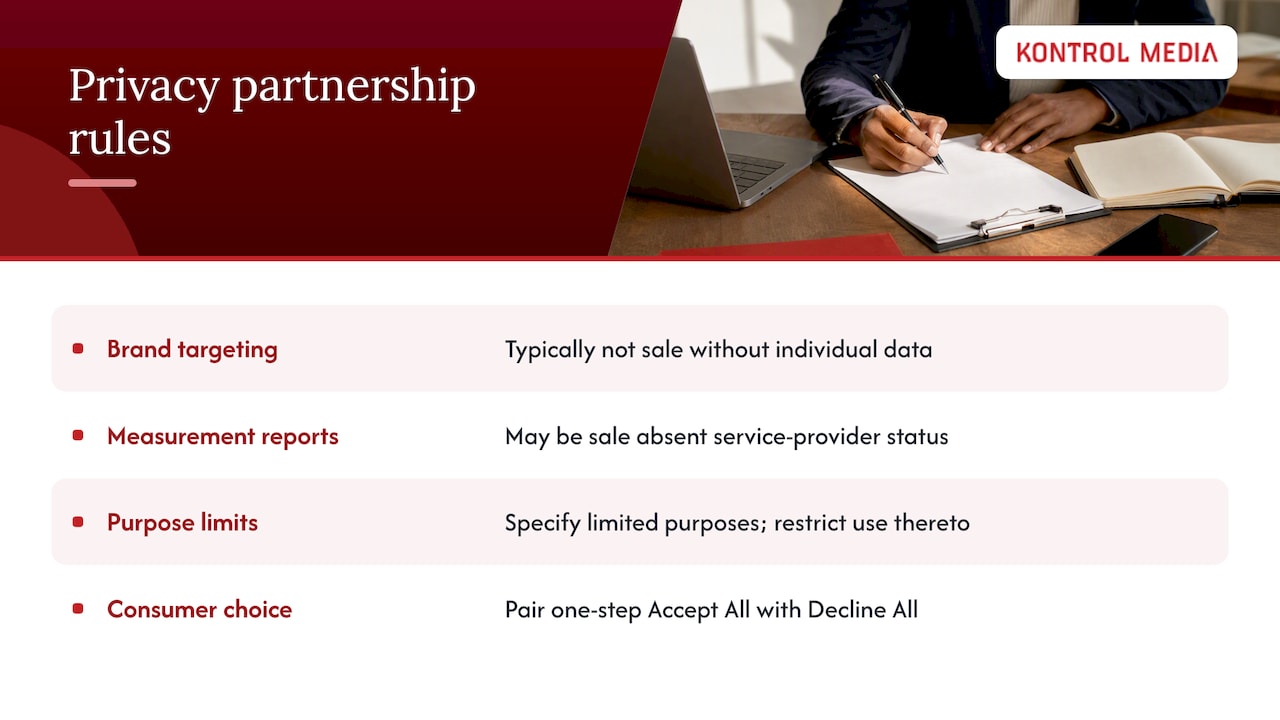
First, the sale question. The IAB’s analysis of commerce media networks says CMNs typically do not “sell” personal information when they let brands target characteristics without disclosing individual consumer data. But delivering measurement reports that contain personal information may constitute a sale unless a formal service provider relationship exists. That distinction should drive what your reports contain and how your contract classifies each party.
Second, purpose limits. The California Privacy Protection Agency’s 2025 order against Honda states that CCPA agreements with third parties, service providers or contractors must specify limited purposes for using personal information and restrict use to those purposes. Vague “business purposes” language in a data agreement is a liability.
Third, consumer choice. The same order makes clear that in California, methods for submitting requests need symmetrical choice: a one-step “Accept All” can be paired with a one-step “Decline All.” If your partnership depends on consent captured at the retailer’s front door, check that the experience there is symmetrical, because your campaign inherits the weakness.
For a marketer-focused version of this, see our 90-day privacy-first approach to retailer data partnerships.
A practical way to launch
We recommend a sequence that keeps ambition in check and gives both sides early proof.
Start by auditing your own data. Look at the scale of your first-party data, how much of it is identified, how accessible it is, its quality and hygiene, and the technical resources you have to work with it. A retailer with strong data and no engineering capacity needs a different setup than one with a mature data team.
Next, map use cases and permissions. Write down which questions the partnership should answer (overlap, segmentation, cross-sell, lift) and what each party is permitted to do with the results. Then, if you are choosing a clean-room technology, issue an RFI or RFP that tests your user requirements and the commercial models on offer. Snowflake’s guidance lists subscription, revenue-sharing, compute and pay-as-you-go structures as typical options to compare, which is a useful reminder that the cost model can matter as much as the features.
Finally, pilot narrowly. Choose one category, one or two channels and one incrementality test. Define success before launch. Review at a fixed point, then widen. Retailers thinking about turning this into a revenue line can look at our view on turning first-party data into 2 to 5 percent of revenue.
What to put in the agreement
Whatever the technology, the agreement should settle the following, in plain language:
- The permitted purposes and the data fields involved.
- Who owns outputs, insights and derived audiences.
- Measurement definitions and the test method for lift.
- Reporting cadence, including in-flight visibility.
- Security responsibilities and audit rights for the clean-room configuration.
- Commercial terms: fees, revenue share and what happens at renewal.
Our perspective: partnerships are an operating discipline
We have spent years on both sides of the table, helping brands and agencies reach buyers through partnerships and helping retailers and consumer businesses build and run media networks. What we see again and again is that data partnerships rarely fail because the technology is wrong. They fail because nobody owns the operation after the kickoff call.
The pattern is familiar. A retailer signs with a clean-room provider, a brand agrees to a pilot, and three months later the first report lands with definitions nobody agreed on. The retailer thinks the brand is impatient. The brand thinks the retailer is hiding something. Neither is true: no one wrote down how lift would be tested, who would answer questions mid-flight or what a good result looked like.
So we push clients to treat the partnership as an operating discipline, closer to a sales process than a data project. Agree on the questions, assign a human owner on each side, test incrementality honestly even when the answer is unflattering, and keep the privacy terms boring and precise. The optimistic part is that the rest is very doable. Retail media is maturing, standards are getting clearer, and the partners who build trust early are the ones who get larger budgets later.
— Mark Kapczynski
Getting hands-on help
If you are a retailer or consumer business planning a media network, or a brand trying to get more from retailer data, we can help structure the partnership and run it. Our work spans standing up a retail or commerce media network and day-to-day retail media network operations, including the commercial and measurement design that makes data partnerships stick. To discuss a specific situation, start at Kontrol Media.
FAQ
What is the difference between a retail media network and a retail media data partnership?
A retail media network is the advertising business a retailer runs on its own and partner properties, using its first-party data. A data partnership is the arrangement under which a retailer and a brand combine data for targeting and measurement. Most networks rely on several such partnerships, but the partnership can also exist for insight and measurement alone.
Do I need a data clean room?
Not always, but it is the common way to match datasets without exchanging raw customer records. Remember the FTC’s point that a clean room protects privacy only when its constraints are properly implemented and enforced. If your use case is simple, such as aggregated reporting, a lighter setup may do.
How do we prove a partnership is working?
Define the success metric before launch and test incrementality with a controlled design, such as a randomized trial or matched-market test. Attributed sales alone will overstate impact. Ask for in-flight reporting so you can adjust while the campaign is still running.
Can a brand that is not a retailer take part?
Yes. Brands contribute category and shopper insight, and some non-retailers build their own media networks around owned audiences. Our retail media strategy guide for non-retailers covers how.
Sources
- IAB Retail Media Buyer’s Guide, July 2023
- IAB: Untangling the Issues in Commerce Media Networks, June 2025
- IAB Retail Media 2023: Operational Strategies for Growth
- IAB: How Retailers Are Using Data Clean Rooms
- FTC: Data Clean Rooms, Separating Fact from Fiction
- California Privacy Protection Agency: American Honda Motor Co. order
- Google Ads Help: data sharing and policies for commerce media
- Yahoo DataX: Partner Match API
- eMarketer: 3 questions brands should ask before working with retail media networks
- Australian retail media measurement principles
- How retailers and brands win with data partnerships