

For most retailers and marketplace operators, the right ad server comes down to three profiles: Top Sort for API-first, auction-native infrastructure; Kevel for developer-led composable builds; and Zitcha or Koddi for commerce-aware full-stack deployments. If your team lacks the engineering bandwidth or advertiser sales capacity to operate a network independently, Kontrol Media is the managed-service path that covers selection, integration, and monetization as a single engagement.
The platforms below differ on dimensions that matter more than feature checklists: auction architecture, catalog-awareness, first-party data ownership, and realistic time-to-revenue. A retail media ad server must evaluate campaigns, apply targeting and auction logic, select the winning creative, and deliver it within a sub-100-millisecond response window. Generic publisher ad servers were not built for that.
Quick shortlist by use case:
- Retailer-owned network, full control: Kevel or Koddi
- Fast API-first launch, auction-native: Top Sort
- Commerce-native full stack with catalog targeting: Zitcha
- Marketplace with seller self-serve: Moloco or Rithum
- Managed launch with advertiser sales included: Kontrol Media
Key Takeaways
The most important decision in retail media ad server selection is not which platform has the most features but whether your team can operate what you choose.
| Point | Details |
|---|---|
| Commerce decisioning is non-negotiable | Your ad server must support catalog-aware targeting, sponsored-product auctions, and real-time inventory checks. |
| Implementation time varies widely | API-first platforms can go live quickly; enterprise full-stack deployments typically take several weeks or longer. |
| Own your data and attribution | Require server-side conversion postback reconciled against POS, not client-side pixels alone. |
| Pilot before committing | A 30–90 day proof-of-value test with pre-agreed KPIs protects against costly long-term lock-in. |
| Kontrol Media as managed path | Retailers without internal ad ops or advertiser sales capacity can launch faster through Kontrol Media’s managed network service. |
Table of Contents
- How do the major retail media ad servers compare?
- How we evaluated these platforms
- What should you do next after shortlisting?
- What does a retail media ad server actually do?
- What do case studies and third-party reviews reveal?
- How do these platforms perform under real traffic conditions?
- How do vendors handle support and customer success?
- Can these platforms scale through peak traffic events?
- What security features matter beyond privacy compliance?
- How steep is the learning curve for marketing teams?
- What Kontrol Media has learned about choosing the right ad server
- Kontrol Media builds and operates retail media networks for you
- Sources
How do the major retail media ad servers compare?
The table below covers ten platforms across the dimensions buyers use most during shortlisting. Kontrol Media leads as the managed-service option; the remaining platforms are self-serve or SaaS infrastructure.
Three tradeoffs stand out when you read across that table:
- Built-in demand vs. open APIs. Moloco and Rithum bring demand-side relationships; Kevel and Top Sort hand you the infrastructure and expect you to source advertisers yourself.
- Managed networks vs. point solutions. Koddi and Flipkart Commerce Cloud offer more complete operating systems but carry longer onboarding and deeper vendor dependency. Kevel and Top Sort are composable, which means faster starts and more long-term control.
- Time-to-revenue vs. engineering lift. API-first platforms shorten integration time but leave campaign workflows and advertiser onboarding to the retailer. Full-stack OS providers reduce that lift while increasing lock-in.
How we evaluated these platforms
This comparison draws on vendor documentation, published product pages, industry analyses, and publicly available case studies. No platform paid for placement. The evaluation criteria reflect what retail marketplaces actually prioritize: auction support, product relevance scoring, pacing and budgeting controls, and closed-loop attribution.
Criteria weighted in this comparison:
- Auction architecture and sponsored-product mechanics
- Catalog-awareness and real-time inventory integration
- First-party data ownership and privacy controls
- Measurement depth: closed-loop, incrementality, server-side attribution
- API quality and integration flexibility
- Published implementation timelines and time-to-revenue signals
- SLA transparency and support model
Sources used: vendor product pages, Kevel’s retail media ad serving guide, Top Sort’s commerce-native ad serving documentation, Osmos’s retail media infrastructure analysis, and Guideflow’s platform comparison.
Limitations to acknowledge:
- Pricing is not publicly listed for most enterprise platforms; figures in the table reflect model type, not quoted rates.
- Demand network strength (closed buyer relationships, CPM floors) requires direct sales conversations and was not independently verified.
- UX and support responsiveness assessments rely on published case studies and vendor-stated SLAs, not first-hand testing.
- Flipkart Commerce Cloud’s primary market is outside North America; North American availability should be confirmed directly with the vendor.
What should you do next after shortlisting?
For a retailer-owned network prioritizing long-term control, Kevel or Koddi belong on the shortlist. Kevel’s developer-friendly APIs give engineering teams full flexibility; Koddi adds a more complete operating layer for teams that want less custom build. For a fast API-first launch with auction-native sponsored products, Top Sort is the clearest fit, with documented go-live timelines measured in days rather than weeks. Marketplaces with seller self-serve requirements should evaluate Moloco and Rithum, both of which carry demand-side relationships that reduce cold-start risk. Retailers testing commerce media without a dedicated internal team should consider Kontrol Media’s managed path before committing to infrastructure.
Procurement next steps:
- Request a product demo that includes a live auction simulation against a sample catalog feed.
- Ask for a sample SLA document covering uptime guarantees, response-time commitments, and escalation paths.
- Request a published or reference implementation timeline with engineering-hour estimates.
- Obtain data governance documentation covering first-party data access, anonymization practices, and CCPA/CPRA compliance posture.
- Negotiate a 30–90 day proof-of-value pilot with pre-agreed KPIs before full contract commitment.
KPIs to bake into contracts:
- Incrementality lift measured against a holdout group
- Closed-loop attribution reconciled against POS or order-of-record (not client-side pixels alone)
- Sponsored-product click-through and conversion rates by category
- Advertiser ROAS and billing reconciliation accuracy
- Platform uptime and ad decision latency against the sub-100ms standard
What does a retail media ad server actually do?
The ad server is the decision engine at the center of a retail media stack. When a shopper loads a product listing page, the ad server receives a bid request, evaluates active campaigns against targeting rules and auction logic, selects the winning creative, and returns it, all within a sub-100-millisecond window. That speed requirement alone disqualifies most general-purpose publisher ad servers.
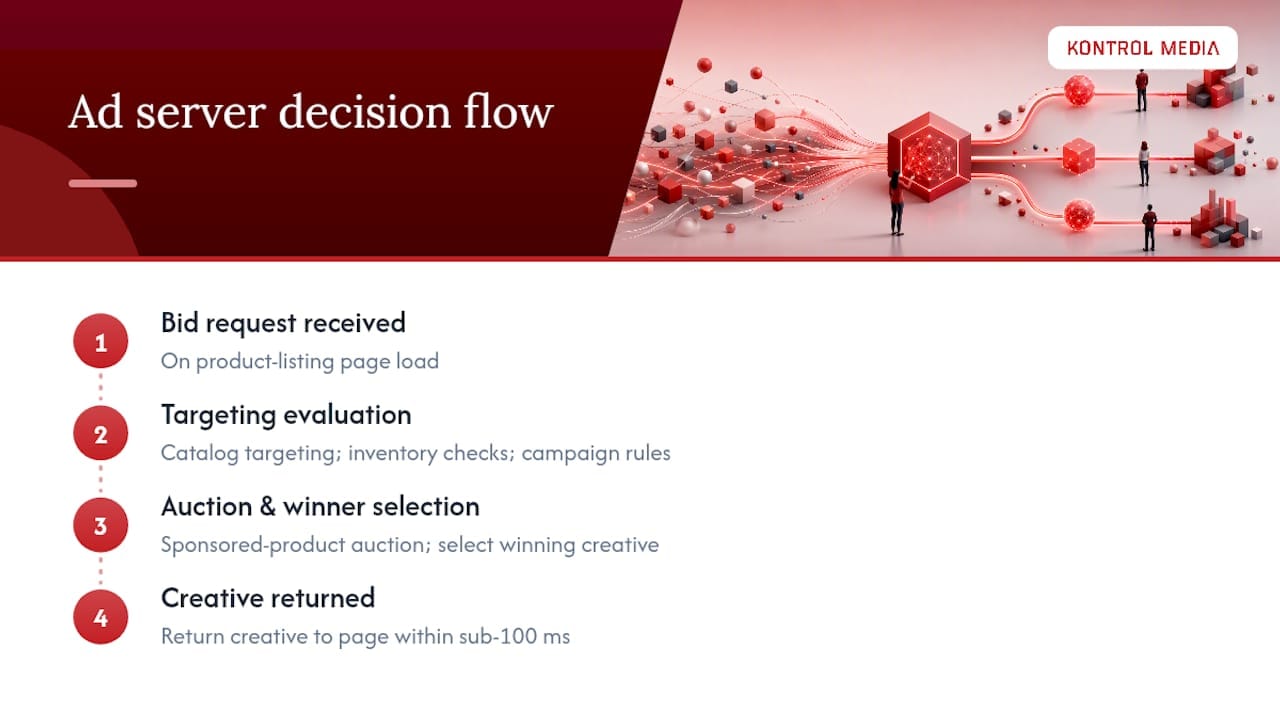
What makes retail media decisioning genuinely different is the data layer underneath. Commerce-specific decisioning requires catalog-based targeting, sponsored-product auction mechanics, real-time inventory checks, and closed-loop purchase attribution. A platform that cannot ingest a live product catalog and reconcile ad impressions against actual purchases is not a retail media ad server in any meaningful sense. It is a display server wearing a retail costume.
What do case studies and third-party reviews reveal?
Published evidence across these platforms points to a consistent pattern: closed-loop measurement and publisher-style analytics reduce friction for advertisers trying to prove ROAS, which directly accelerates commercial adoption. Retailers that can show an advertiser a clean, reconciled attribution report close more repeat campaigns.
Moloco has published results from marketplace clients showing meaningful lift in advertiser return on ad spend through its ML optimization layer. Koddi’s case studies highlight enterprise travel and retail networks that scaled sponsored-product revenue after consolidating on its OS. Kevel’s documentation references retailers that built fully custom ad experiences on its API layer, including unique ad formats that off-the-shelf platforms could not support. Top Sort has cited rapid go-live timelines for commerce clients, consistent with its API-first positioning. Particular Audience’s published work emphasizes recommendation-driven monetization, where product affinity signals drive both relevance and revenue per session.
How do these platforms perform under real traffic conditions?
Reliability at scale separates platforms that work in demos from those that hold up during peak commerce events. The sub-100ms ad decision window is the industry benchmark, and it tightens further during Black Friday or Prime Day-equivalent traffic spikes when catalog sizes, concurrent bid requests, and auction complexity all increase simultaneously.
Enterprise platforms like Koddi and Flipkart Commerce Cloud are architected for high-volume environments, with multi-region infrastructure and enterprise SLAs. API-first platforms like Kevel and Top Sort push performance responsibility partly to the retailer’s infrastructure layer, which means your cloud architecture and CDN choices affect latency as much as the vendor’s own stack. Moloco’s ML optimization layer is designed for high-throughput app and marketplace environments. For any platform, the right question during evaluation is not “what is your uptime SLA?” but “what is your p99 ad decision latency under peak load, and can you share a reference customer who has validated that?”
How do vendors handle support and customer success?
Support quality varies more than feature lists do. Enterprise platforms like Koddi and Flipkart Commerce Cloud typically include dedicated customer success managers and structured onboarding programs. Kevel and Top Sort, as API-first vendors, lean on developer documentation and tiered support plans; the quality of that documentation is a meaningful differentiator. Zitcha and Carter offer dedicated onboarding support suited to mid-market retailers. Moloco and Rithum, with their managed-service components, provide account management as part of the engagement model.
The practical question is whether the vendor’s support model matches your team’s profile. A retailer with a strong engineering team can extract full value from Kevel’s developer-first support. A marketing-led team without dedicated ad ops will struggle with the same model and will get more traction from Koddi, Zitcha, or a managed operator like Kontrol Media.
Can these platforms scale through peak traffic events?
Scaling through peak events is where architecture decisions made at contract time become very expensive to change. Platforms built on cloud-native, horizontally scalable infrastructure handle traffic spikes by adding compute capacity automatically. The risk is not usually the ad server itself but the integrations around it: catalog sync, inventory checks, and conversion postback pipelines all need to hold up under the same load. Retailers that start with sponsored listings and plan to add display and CTV later should confirm that their chosen platform scales across formats, not just search-based placements.
What security features matter beyond privacy compliance?
Privacy compliance (CCPA/CPRA for North American networks) is the floor, not the ceiling. Beyond it, the security dimensions that matter most in retail media are data encryption in transit and at rest, role-based access controls for advertiser campaign data, fraud detection on impression and click events, and audit logging for billing reconciliation. Ad fraud in sponsored-product environments tends to manifest as invalid click traffic inflating advertiser costs, which damages trust and churn rates faster than almost any other operational failure.
Enterprise platforms like Koddi and Flipkart Commerce Cloud publish security certifications (SOC 2 Type II is the standard to request). API-first platforms like Kevel allow retailers to layer their own security controls on top of the base infrastructure. For any platform, request the vendor’s most recent security documentation and ask specifically about invalid traffic detection methodology.
How steep is the learning curve for marketing teams?
The honest answer is that most retail media ad servers were designed by engineers for engineers, and the UX reflects that. Kevel is the clearest example: its power is real, but campaign management requires custom-built advertiser interfaces that the retailer must design and maintain. Top Sort’s API-first model has a similar dynamic. Full-stack platforms like Koddi and Zitcha invest more in self-serve advertiser UIs, which shortens the learning curve for marketing teams and reduces the support burden on ad ops. Carter is positioned explicitly for mid-market retailers who need a usable self-serve experience without a large technical team behind it. Particular Audience’s recommendation-driven approach tends to feel more intuitive to merchandising and marketing teams because it maps to familiar product-affinity logic rather than abstract auction parameters.
What Kontrol Media has learned about choosing the right ad server
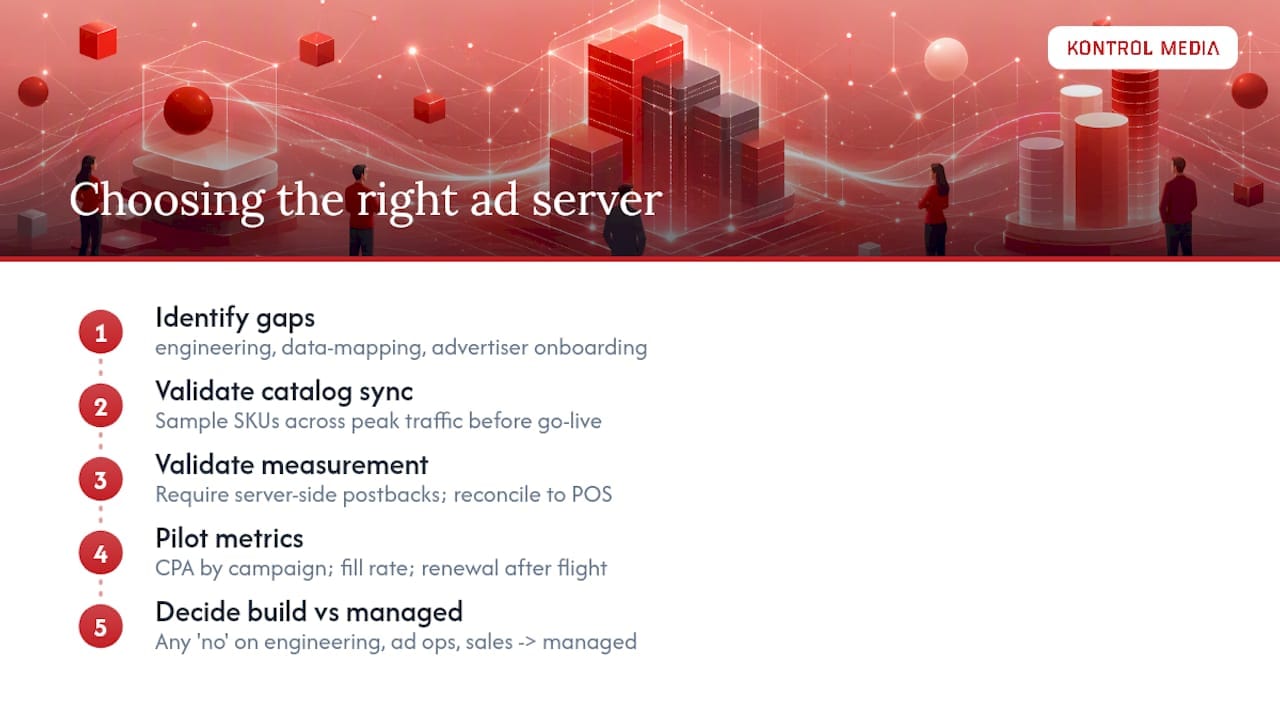
The selection process for a retail media ad server almost always surfaces the same three gaps: engineering bandwidth, data-mapping complexity, and advertiser onboarding capacity. Most retailers underestimate all three.
On the engineering side, API-first platforms like Kevel are genuinely powerful, but “fast integration” in vendor marketing often means fast for a team that has already built advertiser-facing campaign UIs, catalog sync pipelines, and conversion postback infrastructure. If those components do not exist yet, the real timeline is measured in months, not days.
Pro Tip: Validate catalog sync reconciliation by sampling SKUs across a peak traffic window before go-live. Mismatches between catalog price or availability and ad decisioning cause advertiser disputes and wasted impressions that are difficult to explain after the fact.
Pro Tip: Require a server-side conversion postback path and reconcile it against your POS or order-of-record system. Client-side pixels alone produce attribution gaps that undermine advertiser confidence in your measurement.
When Kontrol Media assesses a vendor during a pilot, the P&L metrics we ask for first are cost-per-acquisition by campaign type, impression fill rate by placement, and advertiser renewal rate after the first flight. Those three numbers tell you more about a platform’s real-world performance than any benchmark deck. The question of whether to build on infrastructure or partner with a managed operator comes down to one honest assessment: does your team have the engineering, ad ops, and advertiser sales capacity to operate a network independently? If the answer is no on any of those three, a managed path is faster and cheaper than discovering the gap six months into an integration.
Kontrol Media builds and operates retail media networks for you
The platforms compared here are strong infrastructure options. But infrastructure alone does not generate advertiser revenue. Kontrol Media’s managed retail media service covers the full stack: ad server selection and integration, advertiser acquisition and onboarding, yield management, and ongoing monetization operations. Clients working with Kontrol Media skip the 6–12 month internal build cycle and move directly to a revenue-generating network with active advertisers.
Kontrol Media has built and operated networks for clients including Experian, BuzzFeed, and Enthusiast Gaming, applying the same retail media strategy that turns ad server selection into a monetization outcome rather than a technology project. If your team is evaluating platforms but lacks the internal capacity to operate what you build, contact Kontrol Media to discuss a managed launch engagement.
Sources
- Retail Media Ad Tech Infrastructure: 5-Component Stack (2026)
- 8 best retail media platforms for 2026 – Guideflow Blog
- Retail Media Ad Serving Guide | Kevel
- Ad Server for Retail Media | Commerce-Native Ad Serving Infrastructure
Recommended
- Advertiser Acquisition Strategies for Media Networks in 2026 | Kontrol Media Consultancy
- Advertising Sales Strategies for Media Networks in 2026 | Kontrol Media Consultancy
- Commerce Media vs. Traditional Programmatic Advertising | Kontrol Media Consultancy
- The Shift in Advertising Spend – How Retail Media Networks Are Changing the Game | Kontrol Media Consultancy