


Outsourcing marketing consulting delivers faster access to senior expertise, predictable costs, and measurable growth outcomes — and for most mid-market and enterprise teams, it outperforms the build-in-house alternative on nearly every dimension that matters to a CFO or CMO. The benefits of outsourcing marketing consulting are not theoretical. They show up in pipeline velocity, cost-per-lead, and time-to-market in ways that internal hiring rarely matches at comparable speed.
The highest-impact advantages, in order of how quickly they tend to show up:
- Speed to expertise: Senior specialists can be operational in days, not quarters
- Cost predictability: Fixed retainers replace unpredictable fully loaded headcount costs
- Scalability: Ramp resources up or down without severance or restructuring
- Access to advanced tools: Enterprise-grade MarTech stacks shared across client engagements
- Fresh perspective: External consultants surface blind spots internal teams have normalized
- Measurable ROI: Outcome-based engagements tie spend directly to pipeline and revenue metrics
- Focus on core business: Leadership reclaims time spent managing marketing operations
- Specialist depth: Access to channel experts (SEO, paid media, partnerships, analytics) without full-time headcount
The companies that gain most from outsourcing are typically mid-market firms with $10M–$500M in revenue, PE-backed portfolio companies under growth mandates, and enterprise teams launching new products or entering new markets where internal capability is thin.
Key Takeaways
Outsourcing marketing consulting is the fastest path to senior expertise, cost-predictable execution, and measurable pipeline growth for mid-market and enterprise teams that cannot afford the 10–18 month ramp of building in-house.
| Point | Details |
|---|---|
| Speed to expertise | Outsourced specialists can be operational in days; building in-house takes 10–18 months. |
| Cost efficiency | Comparable capability typically costs 50–70% less than a fully loaded in-house team. |
| Hybrid model wins | Keep brand strategy in-house; outsource channel execution and specialist functions. |
| Pilot before committing | Run a paid 4–6 week discovery sprint with defined KPIs before signing a full retainer. |
| Kontrol Media | Offers fractional strategy plus outsourced execution, with pipeline-level ROI reporting from day one. |
Table of Contents
- What outsourcing marketing consulting actually means in practice
- Which marketing functions are most commonly outsourced?
- The core benefits of outsourcing marketing consulting, explained with impact
- Challenges to manage when outsourcing marketing consulting
- How to decide between in-house, outsourced, or hybrid models
- Real-world outcomes and how Kontrol Media structures engagements
- When to outsource and when to keep it in-house
- Kontrol Media’s approach to outsourced marketing consulting
- Sources
What outsourcing marketing consulting actually means in practice
Harvard Business Review frames outsourcing marketing as a strategic option to access specialist capabilities and operational flexibility when internal skills or scale are limited — not a cost-cutting measure of last resort. The distinction matters. Done well, it is a deliberate staffing and capability decision, not a concession.
In practice, outsourcing marketing consulting means contracting an external party to own or execute one or more marketing functions: strategy, channel execution, demand generation, analytics, or some combination. The external party may advise, execute, or both. What separates it from traditional agency work is the degree of accountability: the best outsourced partners own outcomes, not just deliverables.
Four delivery models dominate the market:
- Full-service agency: Handles strategy and multi-channel execution under one roof; highest cost, broadest scope
- Outsourced marketing partner: Acts as an embedded growth team, owning KPIs and reporting to leadership directly
- Fractional CMO or specialist: A senior expert engaged part-time for strategy, positioning, or a specific channel
- Embedded/dedicated team: A small team placed inside the client’s operations, working alongside internal staff
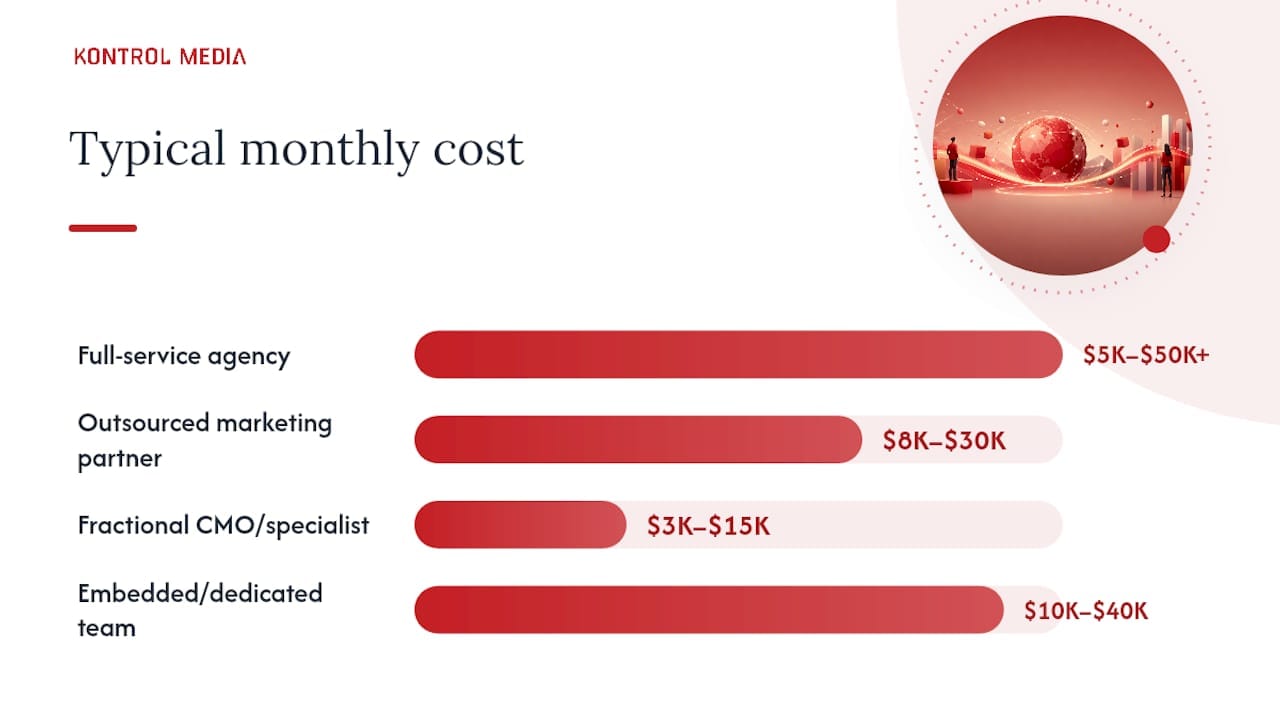
MarketerHire reports three dominant models in the current market: full-service agencies running $5K–$50K+ per month, fractional experts at $3K–$15K per month, and freelance marketplaces at $2K–$8K per month. Fractional experts can start in as little as 48 hours, which changes the calculus entirely for time-sensitive initiatives.
| Model | Typical monthly cost | Ideal use case | Ramp time |
|---|---|---|---|
| Full-service agency | $5K–$50K+ | Multi-channel campaigns, brand launches | 4–8 weeks |
| Outsourced marketing partner | $8K–$30K | Ongoing demand gen, full-funnel ownership | 2–4 weeks |
| Fractional CMO/specialist | $3K–$15K | Strategic projects, positioning, channel expertise | 48 hours–2 weeks |
| Embedded/dedicated team | $10K–$40K | Close integration, product-led growth, complex orgs | 2–6 weeks |
Which marketing functions are most commonly outsourced?
Most organizations do not outsource everything. They identify the functions where the skill gap is widest, the cost of internal hiring is highest, or the time-to-value is most critical, and they start there.
- Content marketing: Producing consistent, high-quality content requires writers, editors, strategists, and SEO expertise simultaneously. Outsourcing compresses the team-building timeline and delivers editorial calendars, long-form assets, and distribution plans within weeks.
- SEO: Technical audits, keyword architecture, and link acquisition require specialists whose skills depreciate quickly as search algorithms evolve. Deliverables typically include a technical audit, a prioritized backlog, and monthly organic traffic benchmarks.
- Paid media (SEM/social): Platform expertise across Google Ads, Meta, and LinkedIn is narrow and expensive to hire. Outsourced teams manage spend efficiency, creative testing, and attribution reporting against agreed ROAS or CPA targets.
- Analytics and marketing operations: Data infrastructure, attribution modeling, and dashboard build-out are high-skill, low-glamour functions that internal teams often deprioritize. Outsourced analytics partners align marketing metrics with sales and product outcomes — a practice MarTech recommends to ensure vendors are evaluated on revenue-related KPIs rather than vanity metrics.
- Demand generation: Building and running outbound and inbound programs — email sequences, webinar programs, ABM campaigns — requires both strategy and operational execution that most lean internal teams cannot sustain.
- Partnership and channel development: Identifying, negotiating, and activating revenue-generating partnerships is a specialized function that benefits from external networks and deal-making experience.
- Marketing automation: Configuring and optimizing platforms like HubSpot, Marketo, or Salesforce Marketing Cloud requires certified expertise that is expensive to maintain in-house.
Functions that show the fastest time-to-value when outsourced: paid media (results visible within 30 days), SEO technical fixes (impact within 60–90 days), and demand generation programs (pipeline contribution measurable within one quarter).
The core benefits of outsourcing marketing consulting, explained with impact
Speed to expertise
Building equivalent in-house capability typically takes 10–18 months — recruiting, onboarding, ramping, and then waiting for institutional knowledge to accumulate. An outsourced partner arrives with that knowledge already built. For a company entering a new market or launching a product, that gap is not a minor inconvenience; it is a competitive window that closes.
Cost efficiency and budget predictability
Acadia’s analysis indicates significant savings compared to building the same capability with full in-house headcount, once you account for salary, benefits, management overhead, recruiting fees, and tool licenses. Forbes Council analysis reinforces this: payroll and indirect costs for a full in-house marketing function routinely exceed base salary projections, and hybrid models — fractional strategy plus outsourced execution — are frequently the most cost-effective structure. Understanding how to reduce outsourcing costs through scope clarity and milestone-based pricing can push those savings further.
Stat to know: Outsourced partners can deliver comparable marketing capability at 50–70% lower cost than building the equivalent full in-house team, according to Acadia’s outsourced marketing guide.
Scalability without structural risk
A company running a product launch needs ten times the marketing output for six months, then a steady-state program afterward. Outsourcing handles that curve without a hiring surge followed by layoffs. You scale the retainer, not the org chart.

Access to tools and technology
Enterprise-grade platforms — Salesforce Marketing Cloud, Semrush Enterprise, Bombora intent data, Looker dashboards — carry license costs that are hard to justify for a single internal team. Outsourced partners spread those costs across multiple clients, giving you access to the full stack at a fraction of the standalone price. As Acadia notes, this consolidated technology access is one of the underappreciated financial advantages of outsourced models.
Objectivity and fresh perspective
Internal teams normalize their own blind spots. An outsourced consultant who has worked across ten companies in your vertical will immediately see the positioning gap, the underperforming channel, or the messaging inconsistency that your team has stopped noticing. That objectivity is not a soft benefit — it often produces the highest-ROI recommendations in the first 90 days.

Focus on core business activities
Every hour your leadership team spends managing marketing operations is an hour not spent on product, customers, or strategy. Outsourcing the execution layer returns that time. It is a leverage decision as much as a cost decision.
Measurable ROI and accountability
Outcome-based engagements — where the consultant owns MQL targets, pipeline contribution, or organic traffic benchmarks — create a level of accountability that internal teams rarely face. When KPIs are written into the contract, measurement becomes structural rather than optional.
Pro Tip: When negotiating a retainer, require a 90-day performance review clause tied to two or three agreed revenue-adjacent KPIs (MQLs, pipeline sourced, or cost-per-acquisition). This creates a natural checkpoint to adjust scope before either side is locked into a misaligned engagement.
Challenges to manage when outsourcing marketing consulting
Outsourcing is not without friction. The companies that struggle most are the ones that treat vendor selection as a procurement exercise rather than a strategic partnership decision.
Common challenges:
- Misalignment on brand voice and messaging standards
- Slow feedback loops that delay campaign execution
- Vendor churn leading to knowledge loss mid-engagement
- Over-reliance on the external partner without internal capability development
- Inadequate IP and confidentiality protections in contracts
Questions to ask prospective vendors before signing:
- What does your onboarding process look like, and what do you need from us in the first two weeks?
- Who specifically will work on our account, and what is their relevant experience?
- How do you handle underperformance against agreed KPIs?
- What reporting cadence do you use, and what does a standard dashboard include?
- How do you manage knowledge transfer if the engagement ends?
- What confidentiality and IP ownership language do you include in your standard contract?
Contract essentials to insist on:
- SLAs with defined response times and escalation paths for missed deliverables
- Ramp timeline commitments with milestone checkpoints at 30, 60, and 90 days
- Knowledge-transfer clauses requiring documentation of all strategies, passwords, and platform configurations before offboarding
- IP ownership language confirming that all creative assets, data, and campaign materials belong to your company
- Confidentiality and NDA provisions covering your customer data, pricing, and competitive strategy
- Termination and handover terms with a minimum 30-day wind-down period and a structured transition plan
Legal and confidentiality risk is real, particularly when outsourced teams handle first-party customer data or proprietary go-to-market strategy. Require data processing agreements (DPAs) that comply with applicable privacy regulations, and limit access to sensitive systems on a need-to-know basis from day one.
How to decide between in-house, outsourced, or hybrid models
The decision is not binary. Most mid-market and enterprise companies land on a hybrid model: core strategy and brand positioning retained in-house or with a fractional strategist, while channel execution and specialist functions are outsourced. Forbes Council analysis consistently points to this hybrid structure as the best balance of cost and control for growing firms.
| Business profile | Recommended model | Rationale |
|---|---|---|
| Early-stage, limited budget | Fractional CMO + freelance execution | Speed and cost efficiency; no long-term headcount commitment |
| Mid-market, growth mandate | Outsourced partner + fractional strategist | Full-funnel ownership with strategic oversight retained |
| Enterprise, new market entry | Embedded team + internal brand lead | Close integration with existing teams; faster market learning |
| PE portfolio company | Outsourced partner with board-level reporting | Accountability to investors; rapid ramp without hiring delays |
A simple cost-comparison formula:
Example: A three-person in-house marketing team at $90K average base salary costs approximately $351K in fully loaded compensation annually, plus $40K–$60K in tools and $30K–$50K in recruiting. Total first-year cost: $420K–$460K.
Operational checklist for vendor selection and onboarding:
- Define two or three primary KPIs before issuing an RFP — vendors who cannot speak to those metrics specifically are not ready for your engagement
- Run a paid discovery sprint (4–6 weeks) before committing to a full retainer
- Assign an internal point of contact with decision-making authority to avoid approval bottlenecks
- Establish a shared project management workspace (Asana, Monday.com, or Notion) from day one
- Schedule a formal 30-day review with the vendor’s senior lead, not just the account manager
- Document all brand guidelines, messaging frameworks, and ICP definitions before kickoff
Real-world outcomes and how Kontrol Media structures engagements
The evidence for outsourced marketing consulting’s impact is consistent across B2B sectors. Rushogen’s analysis of B2B marketing consultants finds that well-scoped engagements can pay for themselves within 90 days by improving close rates and pipeline velocity — particularly when the consultant focuses on positioning, messaging, and go-to-market architecture rather than tactical execution alone.
Kontrol Media’s engagement model reflects this principle. Working with clients including Experian, BuzzFeed, RE/MAX, and Enthusiast Gaming, the firm structures hybrid engagements that pair fractional strategy with outsourced execution: a senior strategist owns the go-to-market architecture while a dedicated execution layer runs channel programs, partnership development, and demand generation. This mirrors the Datamatics finding that embedded models typically run 30–50% below the fully loaded cost of equivalent internal headcount while maintaining closer alignment than traditional agency relationships.
For a OneMarket engagement, Kontrol Media applied this model to drive measurable pipeline contribution within a single quarter, combining go-to-market strategy with hands-on partnership and channel execution. The metrics that matter in these engagements: MQL volume, MQL-to-SQL conversion rate, pipeline sourced by channel, and cost-per-opportunity. Tracking marketing ROI at the pipeline level — not just the campaign level — is what separates accountable outsourced engagements from vendor relationships that produce reports but not revenue.
Kontrol Media is also recognized among top marketing services agencies for its outcome-driven methodology, which prioritizes measurable business growth over activity metrics.
What clients should expect from a well-structured outsourced engagement:
- A documented go-to-market strategy within the first 30 days
- Active channel programs running by day 45–60
- First pipeline attribution data available by end of quarter one
- A quarterly business review (QBR) format that ties marketing spend to revenue outcomes
| Engagement phase | Timeline | Key deliverable |
|---|---|---|
| Discovery and strategy | Weeks 1–4 | Go-to-market plan, ICP definition, KPI framework |
| Program launch | Weeks 5–10 | Active campaigns, partnership outreach, content calendar |
| Optimization and reporting | Weeks 11–12 | Performance dashboard, pipeline attribution, QBR |
| Retainer and scale | Month 5 onward | Ongoing execution, monthly reporting, quarterly strategy refresh |
When to outsource and when to keep it in-house
The conventional wisdom says outsource when you lack the skill. That is true, but incomplete. The more precise answer is: outsource when the cost of speed matters more than the cost of control.
Brand strategy and product positioning should almost always remain in-house or with a retained fractional strategist who has deep context. These are the functions where institutional knowledge, customer intimacy, and long-term narrative coherence are irreplaceable. Handing them entirely to an external party — especially one rotating account managers — is how brands lose their voice. A solid marketing strategy foundation built internally gives outsourced execution teams the rails they need to perform.
Channel execution, specialist functions, and demand generation programs are different. The pattern recognition that comes from working across dozens of clients in your vertical is genuinely hard to replicate internally, and the platform expertise required for paid media, SEO, and marketing automation evolves faster than most internal teams can track. Outsourced teams that work across many clients bring that cross-client pattern recognition — they have seen what works in your category before you have.
Three steps to validate outsourcing this quarter: run a paid 4–6 week discovery sprint with a shortlisted partner, define two revenue-adjacent KPIs before the sprint begins, and establish a governance cadence (weekly check-in, monthly reporting, 90-day review) before signing anything longer than a pilot agreement. If the sprint produces a credible go-to-market plan and early channel data, extend. If it does not, you have spent a fraction of what a bad full-time hire would cost.
One caveat worth stating plainly: outsourcing works best when your internal leadership can articulate what winning looks like. If your executive team cannot define the ICP, the primary value proposition, or the revenue target for the next 12 months, no external consultant will manufacture that clarity for you. The strategy has to be owned. The execution can be outsourced.
Kontrol Media’s approach to outsourced marketing consulting
Kontrol Media works with mid-market and enterprise companies that need senior marketing expertise and hands-on execution without the cost and timeline of building a full internal team. The engagement model is direct: a fractional strategist owns the go-to-market architecture while a dedicated execution layer runs channel programs, partnership development, and demand generation — the hybrid structure this article recommends as the strongest model for most growth-stage organizations.
A recommended starting point is a 6–12 week strategic sprint: a documented go-to-market plan, an active channel program, and a pipeline attribution framework, all delivered before a longer retainer is proposed. For PE portfolio companies, the model extends to board-level reporting and investor-ready growth metrics. For enterprise teams entering new markets, Kontrol Media brings the market entry strategy and the execution capacity to move fast without the organizational drag of internal hiring. Retailers and commerce-focused businesses can also explore Kontrol Media’s work standing up retail media networks as a revenue-generating channel.
Request a discovery call at Kontrolmedia to discuss your growth mandate and the right engagement structure for your stage.
Sources
- Harvard Business Review: Outsourcing marketing
- In-house vs. outsourced marketing: What’s best for your business? — Forbes
- How to Outsource Sales and Marketing (Without Losing Control) — MarketerHire
- Outsourced Marketing: The Complete Guide for B2B Companies in 2026 — Acadia
Recommended
- Unlocking Business Potential: Strategic Marketing and Consulting for Growth | Kontrol Media Consultancy
- Growth Equity Through Marketing: A Mid-Market Leader’s Guide | Kontrol Media Consultancy
- Top 3 Marketing Services Agencies 2026 | Kontrol Media Consultancy
- Kontrol Media | Your Business Consulting and Marketing Agency