


The fastest route to active homebuyers is not a programmatic campaign or a lead-list purchase. It is a structured, revenue-generating program that treats real estate agents as distributed media nodes and trusted local advisors simultaneously. Here is the short verdict: build agent-led partnerships that combine paid placements in high-intent agent-owned channels with co-marketing pilots, then measure incrementally and scale what converts.
The immediate action is simple:
- Pick one market and appoint a single cross-functional owner, ideally your marketing lead with a partnerships mandate.
- Select two channel types: one paid media placement (brokerage storefront DOOH or listing sponsorship) and one co-marketing activation (lender workshop or co-branded content series).
- Commit to a 90-day pilot with defined go/no-go thresholds before any budget expansion.
This is not a brand-awareness play dressed up as performance marketing. Done right, it is both.
Key Takeaways
Real estate agent partnerships work when brands treat agents as media and distribution partners, not referral sources, and build the operational infrastructure to measure incrementally from day one.
| Point | Details |
|---|---|
| Lead with paid placement plus co-marketing | Combine DOOH/storefront media with one co-marketing activation for the strongest pilot signal. |
| DOOH recall advantage | Brokerage storefront DOOH drives 86% ad recall and 2–3x higher engagement versus static signage. |
| RESPA is non-negotiable | All payments must reflect documented FMV for services rendered, never tied to referral volume. |
| Measure quality over volume | Track qualified lead rate, CPA, and incremental ROAS rather than raw lead counts. |
| Kontrol Media runs pilot to scale | Kontrol Media handles strategy, partner onboarding, media ops, and measurement end to end. |
Table of Contents
- Why real estate agent partnerships outperform standard digital lead buys
- What partnership models and channels should you actually test?
- What should you give agents so they actually promote your brand?
- How do you structure commercial terms and incentives?
- How do you measure success in agent-led channels?
- What does a 90-day pilot actually look like?
- What are the legal and compliance risks you cannot ignore?
- How Kontrol Media executes these programs end to end
- The real opportunity most brands are still missing
- Kontrol Media can run your agent partnership pilot
- Sources
Why real estate agent partnerships outperform standard digital lead buys
Agents reach consumers at the highest-intent moment in their financial lives: the active home search. That context is nearly impossible to replicate through a display ad or a paid social unit. An agent’s recommendation carries the weight of a trusted advisor relationship built over weeks or months, and that trust transfers to the brands the agent endorses or co-presents.
Local sponsorships and agent-led activations are most valuable when treated as relationship-building platforms rather than one-off lead-gen efforts. The brands that win in this channel are the ones that show up consistently, add value to the agent’s practice, and earn a place in the agent’s client conversation.
DOOH deployed inside brokerage storefronts drives 86% ad recall and 2–3x higher engagement versus static signage, according to brokerage marketing leaders cited in Inman’s Smartify coverage.
The commercial implication for your team: agent channels tend to produce leads with higher lifetime value and better conversion-to-close rates than cold digital inventory, because the consumer arrives pre-qualified by the agent relationship. That is the core case for reallocating a portion of your acquisition budget here.
What partnership models and channels should you actually test?
Six models are worth piloting, each suited to a different objective.
- Brokerage storefront DOOH. Physical screens inside RE/MAX and other major brokerage offices, powered by networks like Smartify, turn foot traffic into programmatically buyable media inventory. High recall, moderate lead speed, low compliance risk, harder to attribute without UTM or unique landing pages.
- Listing sponsorships on Realtor.com. Realtor.com’s builder and listing solutions let brands appear adjacent to active property listings. Builders already use agent partnerships to amplify reach through agents’ buyer networks, and the same logic applies to lenders, insurers, and home-services brands.
- Agent newsletters and co-branded content. Agents with engaged subscriber lists offer direct access to active buyers. Co-branded market guides or financing explainers sit naturally in that context.
- Open-house sponsorships. Brand presence at open houses creates a physical touchpoint at peak purchase intent. Local sponsorships that create experiences drive engagement and long-term relationship-building far better than passive signage.
- Lender and builder co-marketing workshops. A 90-minute joint seminar with a lender partner can produce pre-approved buyer leads at a fraction of digital CPA. One documented example produced 17 pre-approved leads and 6 closed transactions from a single event, per Jamil Academy’s co-marketing analysis.
- Agent-influencer programs. Agents who publish local social content, particularly nano and micro creators with geographically concentrated audiences, can outperform national influencers for market-level campaigns. Kontrol Media’s agent-influencer practice is built specifically around this model.
Pro Tip: Use AI-powered creative testing to pre-validate ad units before placing them in agent channels. Agents are protective of their client relationships; a creative that feels off-brand for their audience will get pulled fast.
“Top agents are community gatekeepers. Cold outreach rarely works. The brands that gain access do so through vetted introductions, exclusive partner programs, or trusted industry ecosystems.”
Real Producers B2B Playbook
What should you give agents so they actually promote your brand?
The answer is operational value, not a pitch deck. Agents will promote a brand willingly when that brand makes their job easier and their client conversations richer.
High-impact assets worth building into your partner library:
- Localized market guides (neighborhood-level data, school ratings, commute maps) agents can share with buyer clients
- Financing and payment calculators co-branded with your logo, hosted on a lightweight landing page
- Open-house kits: printed and digital materials agents can deploy without design resources
- Short-form social templates (Instagram Reels scripts, carousel copy) agents can post in under five minutes
- Client gift programs tied to closing milestones, keeping your brand visible post-transaction
- Workshop slide decks for joint educational events with lenders or builders
Banks and credit unions are an underused co-marketing partner in this asset mix. Educational content and fair cost-sharing are compliant, practical ways to build referral relationships that benefit all three parties: the brand, the agent, and the financial institution.
Pro Tip: Package all assets inside a single, password-protected agent portal. Friction is the enemy of adoption. If an agent needs more than two clicks to find and download a co-branded guide, most will not bother.
How do you structure commercial terms and incentives?
Prioritize transparent, services-for-fee or media-revenue-share models with documented fair-market-value (FMV). This protects you under RESPA and keeps the relationship clean.
A sample term sheet for an agent or brokerage partnership should include:
- Services provided: Specify exactly what the brand delivers (ad creative, co-branded assets, event sponsorship, DOOH placement fees).
- Payment structure: Flat monthly fee for signage or placement, CPM for DOOH inventory, or proportional cost-split for co-funded ad spend. Revenue share on ad inventory is appropriate for brokerage-level DOOH deals.
- Delivery SLAs: Creative submission deadlines, screen uptime guarantees, content approval timelines.
- Reporting cadence: Monthly performance reports with agreed KPIs; quarterly business reviews for larger programs.
- Compliance clause: Explicit language confirming payments reflect FMV for services rendered, not referral volume. Legal review is non-negotiable before execution.
| Model | Structure | Best For |
|---|---|---|
| Flat monthly fee | Fixed payment for screen placement or newsletter slot | Brand awareness, consistent presence |
| CPM (DOOH) | Cost per thousand impressions on brokerage screens | Reach and recall campaigns |
| Co-funded ad spend | Proportional cost split between brand and agent/brokerage | Shared lead generation |
| Revenue share | Percentage of ad inventory revenue to brokerage | Scaling DOOH networks |
How do you measure success in agent-led channels?
Prioritize lead quality and conversion metrics over raw volume. A hundred unqualified leads from a banner campaign costs more in sales time than twenty pre-approved buyers from an agent workshop.
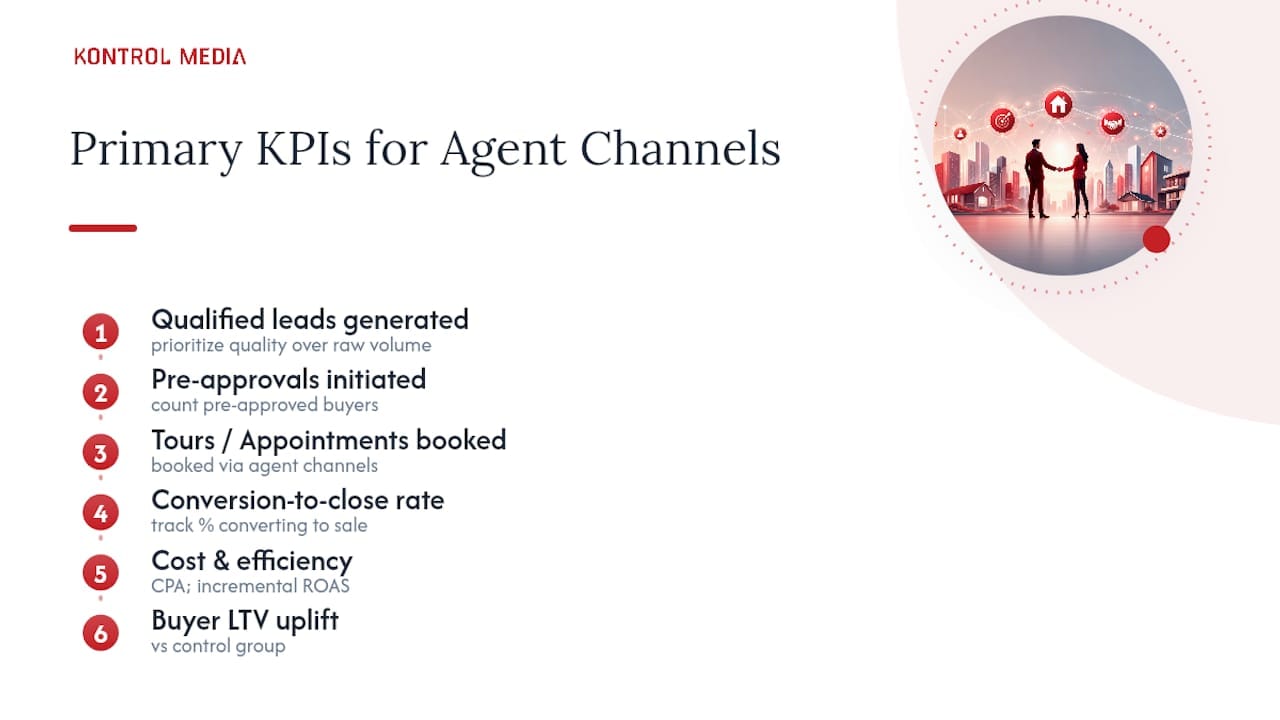
Primary KPIs to track from day one: qualified leads generated, pre-approvals initiated, tours or appointments booked, conversion-to-close rate, cost-per-acquisition (CPA), incremental ROAS, and buyer LTV uplift versus your control group.
Attribution in agent channels requires deliberate setup. Use unique landing pages with UTM parameters for each agent or brokerage partner, co-branded form flows that capture source at submission, and call-tracking numbers for phone-driven leads. For larger programs, run a small incrementality test by holding out a matched zip code and comparing conversion rates.
What does a 90-day pilot actually look like?
Run the pilot in one or two contiguous zip codes with a single marketing owner accountable for results. Scope matters: too broad and you cannot isolate signal; too narrow and you lack statistical confidence.
| Week | Milestone |
|---|---|
| — | Market selection, partner identification, legal review of term sheets |
| 3–4 | Partner onboarding, asset build, tracking setup (UTMs, landing pages, call tracking) |
| 5–6 | Soft launch: DOOH placement live, co-branded assets distributed to agent partners |
| — | First optimization pass: creative refresh, lead routing audit, agent feedback loop |
| — | Mid-pilot performance review against KPIs |
| — | Final data pull, incrementality analysis, go/no-go decision |
Go/no-go criteria for scaling:
- Qualified lead rate of at least 20% of total leads generated through agent channels.
- CPA at or below your current best-performing digital acquisition channel.
- At least one measurable incremental conversion uplift versus the holdout zip code.
- Agent retention rate above 70% (partners who remain active through week 12).
What are the legal and compliance risks you cannot ignore?
RESPA is the threshold issue for any North American program that involves lenders. The statute prohibits payments tied to referral volume; every payment must reflect FMV for actual, documented services. This is not a gray area.
Common red flags that attract regulatory scrutiny:
- Payment amounts that correlate with referral counts rather than services delivered
- Undocumented marketing service agreements (MSAs) or verbal-only arrangements
- Co-branded materials that obscure which party is paying for what
- Lead-routing arrangements where the lender receives preferential treatment in exchange for co-marketing funds
- Any payment from a lender to an agent that exceeds the documented FMV of the service
Co-marketing with lenders is legal under RESPA when payments reflect fair market value for actual services and are not tied to referral volume. Document everything: invoices, service descriptions, delivery confirmations.
Pro Tip: Before launching any lender co-marketing program, have outside counsel review your MSA template against current RESPA guidance. A one-time legal review costs far less than a HUD enforcement action.
Operational mitigations: maintain independent payment flows (brand pays brokerage directly, not through the agent), keep audit logs of all creative approvals and delivery confirmations, and require signed MSAs before any funds move.
How Kontrol Media executes these programs end to end
Kontrol Media operates at the intersection of retail and commerce media networks and agent-led channel marketing, which means we can run pilot-to-scale programs without handing off between vendors.
The Smartify network is a live example of the brokerage-storefront DOOH model: brokerage offices equipped with digital screens that advertisers can buy programmatically, turning physical locations into distributed media inventory. Realtor.com’s builder and listing solutions demonstrate the same logic at the listing level, where brands appear in the highest-intent digital context in residential real estate.

Kontrol Media’s client roster includes Experian, RE/MAX, BuzzFeed, HuffPost, Enthusiast Gaming, and West Monroe. That breadth reflects our ability to operate across the full stack: strategy, partner onboarding, media sales, creative ops, and measurement.
For a brand or agency evaluating this channel, Kontrol Media will run: market and partner selection, term sheet development and legal coordination, asset library build, media placement and DOOH network activation, lead routing and attribution setup, and ongoing optimization through the pilot and into scale.
The real opportunity most brands are still missing
What I keep seeing is this: brands spend months debating whether agent channels “work” while their competitors are already running pilots and learning. The question is not whether agents can reach homebuyers. They do it every day, at scale, with a level of trust no programmatic platform can replicate. The real question is whether your organization is willing to treat agents as genuine partners rather than a cheap distribution layer.
The brands that get this right are the ones that invest in the relationship before they ask for the lead. They build the market guide. They show up at the open house. They fund the workshop. And then, because they have earned a place in the agent’s ecosystem, the leads follow.
The playbook in this article is not theoretical. It is the approach Kontrol Media has developed working with brands across real estate, fintech, and media. If you want to scope a pilot or pressure-test your current channel mix, the conversation starts at Kontrolmedia.
Kontrol Media can run your agent partnership pilot
Kontrol Media builds and operates agent-led marketing programs for brands and ad agencies that need to reach active homebuyers in North America. Where a traditional agency hands you a media plan and walks away, Kontrol Media owns the execution: partner sourcing, term sheet negotiation, asset production, DOOH placement, lead routing, and measurement. You get a functioning pilot in 90 days, not a deck. For brands ready to move from strategy to market, the next step is a scoping call. Reach out at Kontrolmedia to discuss your market, your budget, and what a pilot looks like for your category.
Sources
The sources below are the primary references used in this article, organized by their most practical use case for your team.
- Active Advertising: How local sponsorships bring a brand to life | Inman Real Estate News
- Co-Marketing with Lenders 2026 | Free Real Estate Leads
- How Real Estate Agents Can Maximize Referrals through Bank Partnerships | PNC Insights
- Realtor
- How to Partner with Top Real Estate Agents: The B2B Playbook | Real Producers
This article is general information, not a substitute for advice from a qualified lawyer. Consult a qualified legal professional about your own circumstances before acting on anything here.
Recommended
- Advertising to Home Buyers Through Real Estate Agents | Kontrol Media Consultancy
- What Is the Marketing Ops Function? A CMO’s Guide | Kontrol Media Consultancy
- RE/MAX for Brands: Reach Active Home Buyers in 2026 | Kontrol Media Consultancy
- Align Marketing and Sales to Hit Revenue Goals | Kontrol Media Consultancy