


CMOs now have to drive growth and revenue: that’s not aspirational language anymore, it’s the job description. Own the metrics that finance already tracks, partner with the CFO on the definition of success, and run a small number of revenue plays with real payback windows. That’s the whole mandate compressed into one sentence.
Here’s what that looks like in the next 90 days. Align your dashboard with the CFO’s dashboard so you’re arguing about strategy, not definitions. Pick one or two revenue plays instead of ten. Set up a pilot with a KPI a controller would accept without translation. Then go get funding reallocated from whatever isn’t working.
The urgency is real: Gartner reports revenue growth now sits at the top of CMO priorities, even as many marketing budgets grew only modestly. Cross-functional integration between marketing and finance has improved but remains below half, representing an opportunity-focused lever for CMOs, which means the opportunity is bigger than most CMOs think. Kontrol Media works alongside marketing leaders as an execution partner precisely for this window, when the strategy is clear but the org isn’t built to run it yet.
- Align metrics with the CFO before month one closes
- Choose one or two revenue plays, not a portfolio
- Launch a pilot with a KPI the finance team recognizes
- Reallocate budget from underperforming channels immediately
Key Takeaways
CMOs now have to drive growth and revenue by aligning metrics with the CFO, running a small set of prioritized plays, and proving impact through a measurement framework the C-suite already trusts.
| Point | Details |
|---|---|
| Own the revenue number | Align marketing metrics with the CFO’s dashboard before launching any new play. |
| Prioritize ruthlessly | Choose one or two revenue plays this quarter instead of spreading budget across many. |
| Fix retention first | Retention and account expansion typically deliver the fastest, most credible revenue wins. |
| Close the AI gap | Assign a named run-owner and validate data before scaling any AI or martech pilot. |
| Partner for execution | Kontrol Media pairs strategy with hands-on execution across retail media, partnerships, and measurement programs to help CMOs deliver revenue results this quarter. |
Table of Contents
- Why CMOs Now Have to Drive Growth and Revenue
- Six Plays to Start Driving Revenue This Quarter
- Building a Real CMO-CFO Partnership
- What a Revenue-Focused Measurement Framework Looks Like
- Getting AI and Martech to Actually Pay Off
- Funding Growth Without Starving the Brand
- A 30/60/90 Day Plan for Traction
- Should You Prioritize Brand or Performance Right Now?
- What Revenue-Driven CMOs Are Actually Doing Differently
- How Digital Transformation Changed What CMOs Own
- Why Customer Experience Now Drives Revenue Directly
- Where New Channels Fit Into the Revenue Plan
- Forecasting Revenue Impact Before You Spend
- Frequently Asked Questions
- Sources
Why CMOs Now Have to Drive Growth and Revenue
The shift didn’t happen overnight, but it happened fast. A decade ago, a CMO’s scorecard was built on impressions, brand lift, and share of voice. Today, McKinsey’s research on the CMO’s comeback finds that companies with a single executive owning customer and growth outcomes consistently outgrow those that split the job across silos. Boards noticed. So did CEOs looking for someone accountable when growth stalls.
The barriers are structural, not personal. The CMO Survey out of Duke’s Fuqua School of Business points to three recurring drags on marketing’s ability to move revenue:
- Internal bureaucracy that slows decisions past the point where they matter
- Scorecards still built around reach and engagement instead of business outcomes
- Marketing budgets that have flattened to near-historic lows relative to revenue
A revenue-owning CMO looks different on paper. Success isn’t a brand tracker moving three points. It’s net new revenue attributable to a specific play, a shortened payback window on customer acquisition spend, and a seat at the table when the CFO builds next year’s plan. CMSWire frames this as a new mandate: the CMO as an architect of enterprise-wide influence, not a department head running awareness campaigns in isolation.
Six Plays to Start Driving Revenue This Quarter
You don’t need a twelve-point strategic plan. You need a short list of plays that move a number the CFO already watches, executed well enough that the results survive scrutiny.
- Map revenue-focused customer journeys. Identify your highest-value cohorts and rebuild the journey around what makes them buy again, not around channel logic. Goal: lift conversion in the top two cohorts by a measurable margin within one quarter.
- Run rapid, revenue-tied experiments. Structure tests as A/B holdouts with a defined payback window, not open-ended brand experiments. If a test can’t show revenue signal in 60 days, redesign it.
- Double down on retention and expansion. Cross-sell and upsell campaigns to existing accounts almost always carry a shorter path to revenue than new acquisition. McKinsey’s analysis points to retention and account expansion as the fastest credibility win available to a CMO trying to prove impact quickly.
- Partner with product and pricing on packaging. A pricing or bundling test run jointly with product often moves revenue faster than a new campaign. Bring your product counterpart in at the design stage, not after launch.
- Monetize the channels you already touch. Retail media, commerce media, and partner networks turn existing customer relationships into a direct revenue line instead of a cost center. Our growth marketing frameworks walk through how this gets built in practice.
- Stand up a small growth ops team. Two or three people who own measurement and orchestrate the experiments above will outperform a larger team with no clear owner of the numbers.
Pro Tip: Rank your six plays by payback window, not by size of opportunity. A smaller play that proves revenue in 45 days buys you the credibility to fund the bigger one.
Building a Real CMO-CFO Partnership
Nothing on the list above survives without governance. The minimum viable structure is a single named owner for customer and growth outcomes, paired with a shared scorecard that marketing and finance both check weekly, not quarterly.
Build a measurement case the way you’d build one for the board: state the expected lift, the investment required, and the downside if the play underperforms. Bring that case to finance before you need the money, not after you’ve already spent it. Inc. documented how Autodesk restructured so brand, demand, and commerce all report into marketing, closing the loop between storytelling and revenue under one accountable leader.
- Name one owner for growth outcomes, full stop
- Build a shared scorecard finance actually checks
- Bring a lift-and-cost case to the CFO before spending, not after
- Set a recurring meeting rhythm, not an annual review
Our guide on aligning marketing and sales covers the templates that make this governance stick past the first quarter.
What a Revenue-Focused Measurement Framework Looks Like
A CFO doesn’t care about impressions. Map every marketing KPI to something that shows up on a P&L: awareness feeds funnel conversion, funnel conversion feeds net new revenue. That chain has to be explicit, or the CFO will build their own version of it without you.
The metrics worth reporting: net new revenue by channel, revenue per cohort, the ratio of customer acquisition cost to lifetime value, and contribution margin on your top plays. Use marketing mix modeling for channel-level attribution over longer horizons, and holdout tests when you need a fast, clean read on a single campaign’s revenue effect. Our marketing mix modeling guide covers when each method actually applies.
- Report net new revenue, not just leads generated
- Use CAC-to-LTV as your efficiency check
- Reserve MMM for channel mix, holdouts for fast reads
- Frame results with a confidence range, not a single number
Gartner’s data shows marketing-finance integration still sits under 50% at most companies, which means the CMO who closes that gap first earns disproportionate trust at budget time.
Getting AI and Martech to Actually Pay Off
Most AI pilots fail for boring reasons: no clean data feeding the tool, no one assigned to act on what it produces, and no integration plan connecting it to systems that already run the business. Fortune’s reporting notes CMOs are investing heavily in AI upskilling, but the real gap is operational, not technical.
A short pilot checklist keeps this from repeating:
- Define the KPI the tool is supposed to move before you buy it
- Validate the underlying data is clean enough to trust
- Build the integration plan into existing systems first
- Assign a named run-owner responsible for acting on outputs
- Set scale criteria in advance so a good pilot doesn’t stall in limbo
Tools like apppricer that tie marketing activity directly to app or product revenue are a useful example of tech that earns its keep because the KPI is unambiguous from day one. On outsourcing: build internally when the capability is core to your model, outsource when speed matters more than ownership this quarter.
Funding Growth Without Starving the Brand
Every CFO conversation eventually becomes a trade-off conversation. The decision rule that holds up: protect what compounds, brand equity and retention, and pull funding from activity that shows flat or declining return.
Build the incremental investment request the way finance builds theirs: expected lift, payback period, and a sensitivity case showing what happens if the lift comes in low. That format gets funded far more often than a request built around campaign creativity alone.
- Protect brand and retention spend from first-round cuts
- Cut funding from channels with flat or falling return
- Build requests with lift, payback, and a downside case
- Upskill existing talent before making a permanent hire
On talent, resist the urge to hire a full team before you’ve proven a play works. Short-term partnerships close capability gaps faster than a hiring cycle, and they let you scale the team once the revenue case is proven rather than before.
A 30/60/90 Day Plan for Traction
Thirty days in, you should have metrics aligned with the CFO, one or two plays chosen, and a pilot team staffed. That’s the foundation everything else sits on.
- Days 1 to 30: Align on shared metrics, select priority plays, staff the pilot team
- Days 31 to 60: Run the first experiments and present early results to the CFO and CEO
- Days 61 to 90: Scale the plays that worked, reallocate budget accordingly, formalize the operating rhythm
Momentum built in the first 90 days sets the tone for whether marketing gets treated as a growth function or an expense line for the rest of the year.
Should You Prioritize Brand or Performance Right Now?
This is the trade-off every CMO eventually has to defend to a skeptical CFO: brand spend builds long-term pricing power and demand, performance spend shows revenue this quarter. Both are real. The mistake is treating them as competitors for the same dollar instead of different time horizons on the same growth curve.
The practical answer is a split, not a choice. Protect a floor of brand investment, roughly whatever keeps your unaided awareness and consideration metrics from eroding, and put the rest into performance plays with a defined payback window. Cutting brand spend to zero to fund a quarter’s performance numbers usually shows up as a problem twelve months later, when acquisition costs climb because fewer people recognize you at the top of the funnel.
The sequencing matters as much as the split. If you’re new in the role or the company hasn’t seen marketing prove revenue impact recently, lead with performance wins. A retention campaign that lifts renewal rate by a visible margin in 60 days buys you the credibility to defend brand spend later. If the company already trusts marketing’s numbers, you have more room to run brand and performance in parallel.
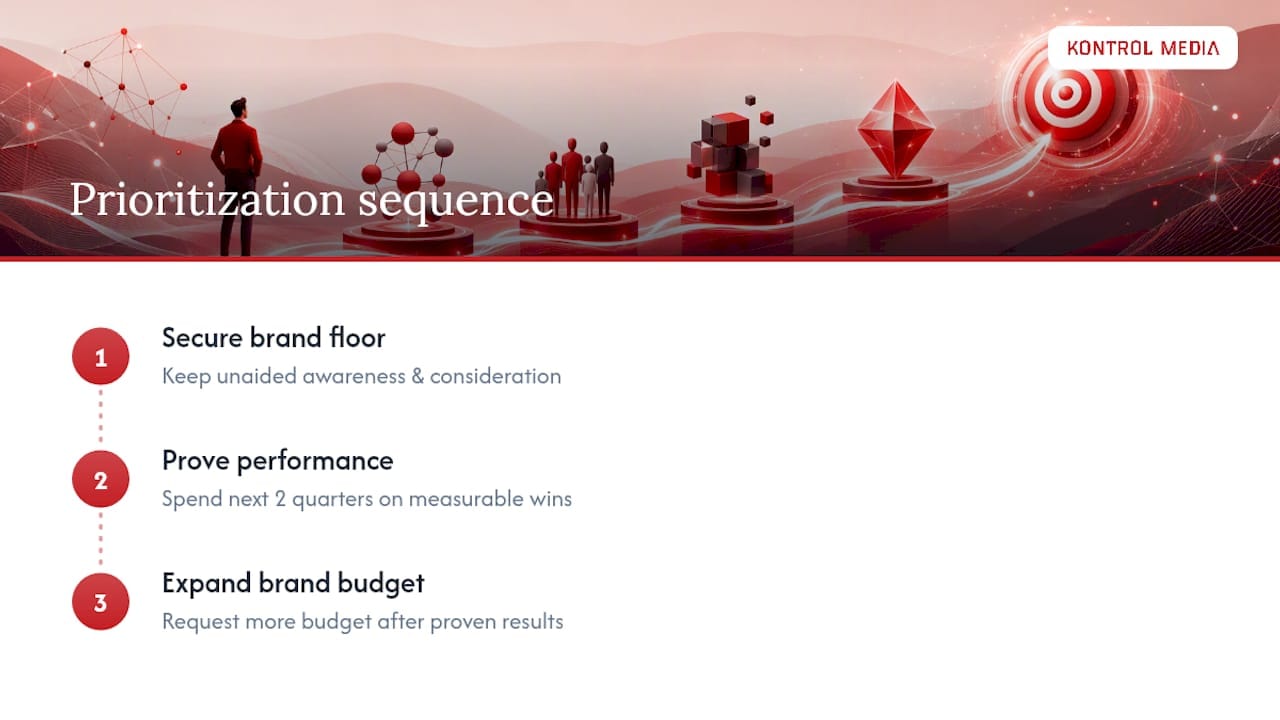
Recommended prioritization for most CMOs walking into this mandate: secure a floor for brand, then spend the next two quarters proving performance wins before asking for expanded brand budget. That sequence matches how CFOs actually think about risk. They fund what’s already worked before they fund what might work.
What Revenue-Driven CMOs Are Actually Doing Differently
The pattern across companies that have made this shift work isn’t a single tactic, it’s structural. Autodesk’s reorganization, documented by Inc., pulled brand, demand generation, and commerce under one marketing leader so the handoff between storytelling and revenue stopped leaking. Before that change, a customer could see a brand campaign, hit a demand gen funnel with different messaging, and land on a commerce experience built by a third team entirely. Consolidating ownership closed that gap.
The common thread in these examples is accountability for the full funnel, not just the top of it. A CMO who owns awareness but hands off conversion to sales and retention to customer success has no way to defend a revenue number, because three different teams control the outcome. The CMOs making real progress have pulled enough of that funnel under one roof, or one shared scorecard, to actually own the result they’re being asked to deliver.
None of this requires a massive reorg to start. A shared dashboard between marketing, sales, and customer success, reviewed on the same weekly cadence, gets you most of the accountability benefit without the disruption of moving reporting lines. The org chart change matters less than whether everyone touching the customer journey is looking at the same number.
How Digital Transformation Changed What CMOs Own
Digital transformation didn’t just add channels to the CMO’s job, it added infrastructure responsibility. A decade ago, the CMO’s technology footprint was an email platform and an analytics dashboard. Today it’s a customer data platform, a martech stack with a dozen integrated tools, and increasingly the systems that connect marketing activity to product usage and revenue recognition.
That infrastructure shift is why the CMO role now overlaps so heavily with operations and finance. You can’t credibly claim a revenue number without a data pipeline that connects a marketing touch to a closed deal or a renewed subscription. Building and maintaining that pipeline used to belong to IT. Now it belongs to whoever is answering for the revenue number, which increasingly means marketing.
The upside is real leverage once the infrastructure works. A CMO with a clean data connection between campaign activity and revenue outcomes can run experiments with actual statistical confidence instead of guessing based on last quarter’s directional trend. That’s the difference between a marketing function that reports what happened and one that predicts what will happen next quarter, which is the conversation CFOs actually want to have.
Why Customer Experience Now Drives Revenue Directly
Personalization used to be a nice-to-have layered on top of a campaign. It’s now one of the more direct levers a CMO has for moving revenue, because a better experience shortens the path from interest to purchase and extends the relationship after the sale.

The mechanism is straightforward: a personalized experience, whether that’s product recommendations, tailored pricing, or a support interaction that remembers the customer’s history, reduces the friction that causes people to abandon a purchase or churn after one. Reducing that friction shows up directly in conversion rate and retention, two numbers that sit right next to revenue on any CFO’s dashboard.
The CMOs getting the most out of this aren’t running the flashiest personalization tech. They’re running the simplest version well: segmenting customers by actual behavior, not demographic guesswork, and building journeys around what the highest-value cohort needs at each stage. That’s the same principle behind play one in the priority playbook above, and it’s worth revisiting here because customer experience work often gets treated as a separate initiative from revenue plays when it should be the foundation underneath them.
Where New Channels Fit Into the Revenue Plan
Not every emerging channel deserves budget, and chasing all of them dilutes the plays that already work. The channels worth serious evaluation right now share one trait: they connect directly to a purchase decision instead of sitting several steps upstream of it.
Retail media and commerce media networks are the clearest example. They put a brand’s message in front of a customer at the exact moment of purchase intent, inside a retailer’s own environment, which is why they’ve become one of the fastest-growing categories in marketing spend. For a CMO evaluating where to put incremental dollars, a channel that sits this close to the transaction usually outperforms a channel several steps removed from it, dollar for dollar.
Partner and affiliate channels deserve a similar look, particularly channel marketing built around trusted intermediaries like real estate agents for home-related brands, where the recommendation itself carries weight a paid ad can’t replicate. The revenue potential in any new channel comes down to one question: how close does this get a customer to a decision they were already leaning toward? Channels that answer that question well are worth testing. Channels that only add impressions rarely justify the budget shift.
Forecasting Revenue Impact Before You Spend
Every play on this list needs a forecast before it gets funded, and the forecasting method matters as much as the number itself. Marketing mix modeling works well for estimating the revenue contribution of channels over a longer horizon, particularly when you’re deciding how to split budget across five or six channels running simultaneously.
Holdout testing is the faster, more precise option when you need to know whether one specific campaign or play caused a revenue change. Run a controlled group that doesn’t see the campaign, compare it to the group that does, and you get a clean read without waiting for a full quarter of mixed signals. This is the same method behind play two in the priority playbook, and it’s worth using it for forecasting new plays, not just measuring ones already in flight.
Whatever method you use, present the forecast as a range with a stated confidence level, not a single precise number. A CFO trusts a forecast that says “we expect a lift between 8 and 14 percent, with a payback window of four to six months” far more than one that claims an exact figure with no stated uncertainty. Precision without acknowledged uncertainty reads as guesswork dressed up as data, and finance teams have seen enough of that to spot it immediately.
A Perspective on Executing Revenue-First Marketing
The gap between strategy and results is almost always execution, not ideas. Kontrol Media’s model works because it pairs the strategy with the hands-on build, whether that’s a retail media network or a partnership channel. Partner with specialists when speed matters more than building the capability from scratch.
A Direct Path When You Need Execution, Not Just a Plan
Every play in this article, from mapping revenue journeys to standing up a growth ops team, requires hands-on execution that most internal marketing teams don’t have bandwidth to build while running the day job. Kontrol Media exists for that gap: strategy and execution together, not a deck handed off for your team to implement alone.
Kontrol Media’s work spans the exact plays covered here: business strategy built for measurable growth, retail and commerce media network setup and operation, partnership development through channels like real estate agent networks, and measurement programs that translate marketing activity into numbers a CFO trusts. Clients including Experian, BuzzFeed, and West Monroe have used this model to move from strategy to revenue results without building an entire internal function first. If you’re evaluating a retail or commerce media network as one of your revenue plays, that’s a direct example of where Kontrol Media builds and operates the channel rather than just recommending it. Reach out through the contact page to talk through which play fits your quarter first.
Frequently Asked Questions
Why do CMOs now have to drive growth and revenue instead of just brand awareness?
Boards and CEOs increasingly hold marketing accountable for measurable business outcomes, not just engagement metrics. Gartner’s research confirms revenue growth now ranks as the top CMO priority industry-wide.
What’s the fastest way for a CMO to show revenue impact?
Retention and account expansion campaigns typically show revenue signal faster than new acquisition plays, since the relationship and trust already exist. Pair that with a holdout test structure so the result is defensible to finance.
How does a CMO build trust with the CFO?
Start with a shared scorecard both teams check on the same schedule, and bring investment requests to finance framed as lift, payback window, and downside risk, the same format the CFO already uses internally.
Should CMOs cut brand spend to fund performance marketing?
No. Cutting brand investment to zero to fund short-term performance numbers tends to raise acquisition costs later, once fewer prospects recognize the brand. Protect a floor for brand spend and fund performance plays with the remainder.
What role does AI play in helping CMOs drive revenue?
AI delivers results when it automates measurement or experimentation workflows that already have a clear owner and revenue objective. Without that ownership, Fortune’s reporting notes it tends to create noise instead of results.
Sources
- Gartner — CMOs top challenges and priorities for 2026
- The CMO Survey — Highlights and Insights Report 2026
- McKinsey — The CMO’s comeback
- CMSWire — The CMO’s new mandate
- Fortune — The CMO, AI, and expanded remit
Recommended
- Growth Marketing Frameworks CMOs Use to Drive Revenue | Kontrol Media Consultancy
- The Top Issues Facing CMOs for 2026, Solved One by One | Kontrol Media Consultancy
- Revenue Growth Strategies for Mid and Large Enterprises | Kontrol Media Consultancy
- What Is the Marketing Ops Function? A CMO’s Guide | Kontrol Media Consultancy