


Adopt an entity-first, AI-aware visibility program that treats brand visibility as a cross-functional discipline, not a marketing line item. That is the whole verdict. Everything else in this piece explains how to operationalize it.
Start this week with three moves. Run an AI visibility audit across the engines your buyers actually use. Fix critical entity grounding so your brand descriptors read the same way everywhere a machine might scrape them. Publish one to three answer-object pages built to be extracted and cited, not just ranked.
- Audit citation presence on 50 sampled queries this week to establish a baseline.
- Correct inconsistent brand descriptors across your top ten cited sources.
- Ship your first answer-object page before the next leadership review.
Quick metric to watch: citation mentions per sampled query, tracked before you touch anything else. That single number tells you whether your enterprise brand visibility strategy is starting from zero or from a real foothold.
Key Takeaways
An enterprise brand visibility strategy succeeds when entity grounding is accurate, citation share is tracked weekly, and one owner keeps marketing, sales, and service aligned around the same query set.
| Point | Details |
|---|---|
| Fix entity grounding first | Inconsistent brand descriptors across knowledge-graph surfaces are the most common cause of missed AI citations. |
| Audit all 12 surfaces | Sample 50 to 75 queries across intent types to find citation gaps before investing in new content. |
| Track citation share weekly | Hold a fixed query set for 90 days to keep trend lines valid before adjusting strategy. |
| Close the Engagement Divide | Assign one owner for the query set and one for the weekly pulse report to prevent silos from returning. |
| Bring in hands-on execution | Kontrol Media pairs strategy with direct execution for enterprise clients like Experian and REMAX, closing the gap between plan and rollout. |
Table of Contents
- Why Enterprise Brand Visibility Strategy Efforts Stall
- How Do You Audit Enterprise Brand Visibility Across AI Surfaces?
- What Are the Highest-Impact Brand Awareness Tactics for Enterprises?
- How Do You Measure Enterprise Brand Visibility With a GEO Scorecard?
- What Does a 90 to 180 Day Rollout Look Like?
- What Are the Risks in an AI-Driven Visibility Strategy?
- How Should Visibility Strategy Connect to Broader Marketing Goals?
- Does Your Team Have the Skills for AI-Era Visibility Work?
- The Kontrol Media Take on Enterprise Visibility
- Get Hands-On Help Executing Your Visibility Program
- Sources
Why Enterprise Brand Visibility Strategy Efforts Stall
Most enterprise visibility programs fail for one of two reasons, and they compound each other. The first is organizational: marketing, commerce, sales, and service each hold a partial view of the customer, and none of them talk to each other on a working cadence.
A large majority of brands believe they deliver seamless experiences across channels, despite running on fractured data between marketing, commerce, sales, and service. That gap between belief and reality is what SAP’s research calls the Engagement Divide, and it is the quiet reason so many visibility budgets underperform.
The second reason is newer: AI mediation. Large language models don’t rank your site, they cite it, or they don’t. Citation density across a defined set of surfaces now determines whether your brand appears in an AI-generated shortlist at all, a shift the AI GTM Visibility Framework documents in detail.
Put those two failures together and you get the real cost:
- Sales teams work leads that never saw your brand mentioned in an AI answer.
- Marketing reports strong impressions while pipeline quietly erodes.
- Executives discover the gap only after a competitor gets cited and they don’t.
How Do You Audit Enterprise Brand Visibility Across AI Surfaces?
A useful audit doesn’t start with tools. It starts with a fixed list of where visibility can actually happen and a disciplined way to sample it. The AI GTM Visibility Framework maps 12 distinct AI visibility surfaces. These include conversational AI answers, AI Overviews, knowledge panels, review aggregators, structured data feeds, developer documentation, social citation sources, and earned media indexed by crawlers. Each surface gets a simple presence check: does your brand show up, and if it does, how deep is the description.
Run the audit in three steps:
- Build a seed set of 50 to 75 queries split across informational, comparative, and transactional intent, mirroring how your actual buyers search.
- Query each surface with that same set and log whether your brand is cited, ignored, or misrepresented, then calculate citation share as a percentage of queries where you appear.
- Group the results into gap categories, for example a Surface 1 gap (no presence in conversational AI answers) versus a Surface 8 gap (thin or outdated review citations).
The output should read like a short punch list, not a research report: which surfaces show zero presence, which show shallow or stale mentions, and which show a competitor cited where you should be.
Pro Tip: Run the same 50 queries through ChatGPT, Perplexity, and Google’s AI Overviews in one sitting. The differences in who gets cited across the three will tell you more about your entity grounding than any single tool’s dashboard.
What Are the Highest-Impact Brand Awareness Tactics for Enterprises?
Once the audit tells you where the gaps sit, the work becomes sequencing. These seven moves consistently produce the fastest gains in citation density, and they double as sound brand awareness tactics for any enterprise marketing team building a corporate visibility plan.
Build answer-object content. Structure pages around a direct question and a direct answer, backed by schema markup, so a model can lift the answer cleanly. This is the core of AEO and GEO content design, and Semrush’s brand visibility guidance treats it as the baseline requirement, not an advanced tactic.
Ground your entity consistently. Your brand descriptor, category, and key facts need to match across your site, Wikipedia or Wikidata where applicable, LinkedIn, Crunchbase, and any knowledge-graph surface a model might pull from. Inconsistency here is often the single biggest reason a real brand gets ignored in favor of a smaller, cleaner one.
Engineer earned media for extraction. Write for citation, not just placement. A press mention with a clear, quotable fact gets lifted into AI answers far more often than a mention buried in narrative prose.
Run reputation programs that increase citation velocity. Reviews on platforms models actually crawl move faster than most PR cycles, and a steady flow of fresh reviews keeps your entity current.
Publish executive and technical voices. Bylined analysis from named leaders, plus developer-facing documentation where relevant, gives models more grounded material to cite than marketing copy alone.
Build machine-readable assets. Structured product feeds, APIs, and case studies formatted for retrieval outperform PDF brochures every time a model goes looking for facts.

Layer paid amplification onto citation candidates. Once a piece of content is getting cited organically, paid distribution accelerates its reach rather than starting from zero. This is how generative AI is reshaping enterprise SEO at the tactical level, and it applies just as directly to paid strategy.
How Do You Measure Enterprise Brand Visibility With a GEO Scorecard?
Citation share is the core metric: the percentage of sampled queries where your brand gets cited by name across the engines you track, typically ChatGPT, Perplexity, and Google’s AI Overviews. It replaces impressions and rankings as the primary signal of AI-era awareness.
Build the scorecard around a repeatable cadence:
- Start with a fixed set of 50 queries and hold that set steady for a full quarter before changing it.
- Sample weekly and log citation share, sentiment accuracy, and any misattributed facts.
- Set a 90-day baseline before drawing conclusions about trend direction, a discipline TrySight’s measurement guidance treats as non-negotiable for valid trend lines.
| Metric | What it tells you |
|---|---|
| Citation share | Percentage of sampled queries where your brand is cited by an AI engine |
| — | Traffic arriving from AI answer surfaces, tracked as a distinct channel |
| Entity accuracy rate | Percentage of citations that describe your brand correctly |
| Source opportunity count | Number of uncited but citable surfaces identified in the last audit |
Velocity AI’s LENS framework recommends exactly this structure: a fixed query set, citation-share tracking, weekly pulse reporting, and a quarterly strategic review layered on top.
What Does a 90 to 180 Day Rollout Look Like?
Sequencing matters more than ambition here. A program that tries to do everything in month one usually collapses under its own governance gaps by month three.
- Days 0 to 30: Complete the 12-surface audit, fix the entity grounding errors it surfaces, publish your first one to three answer-object pages, and push a targeted PR cycle around your strongest citable fact.
- Days 30 to 90: Scale content production, launch a structured reputation campaign, integrate review feeds into your content pipeline, and stand up the GEO scorecard dashboard for weekly reporting.
- Days 90 to 180: Automate the machine-readable assets, lock in a weekly measurement cadence, and fold citation share into your GTM playbooks and pipeline attribution models.
Governance is what keeps this from decaying back into the Engagement Divide. Assign one owner for the seed query set so it doesn’t drift, one person accountable for the weekly pulse report, and a monthly leadership readout that ties citation trends to pipeline. CoreMedia’s guidance on enterprise engagement architecture makes the same point from a data standpoint: without a unified customer profile behind the content, personalization and visibility efforts pull in different directions.
Pro Tip: Put the weekly pulse report on the same calendar invite as an existing meeting. A new standalone meeting is the fastest way to watch a governance model die within a quarter.
What Are the Risks in an AI-Driven Visibility Strategy?
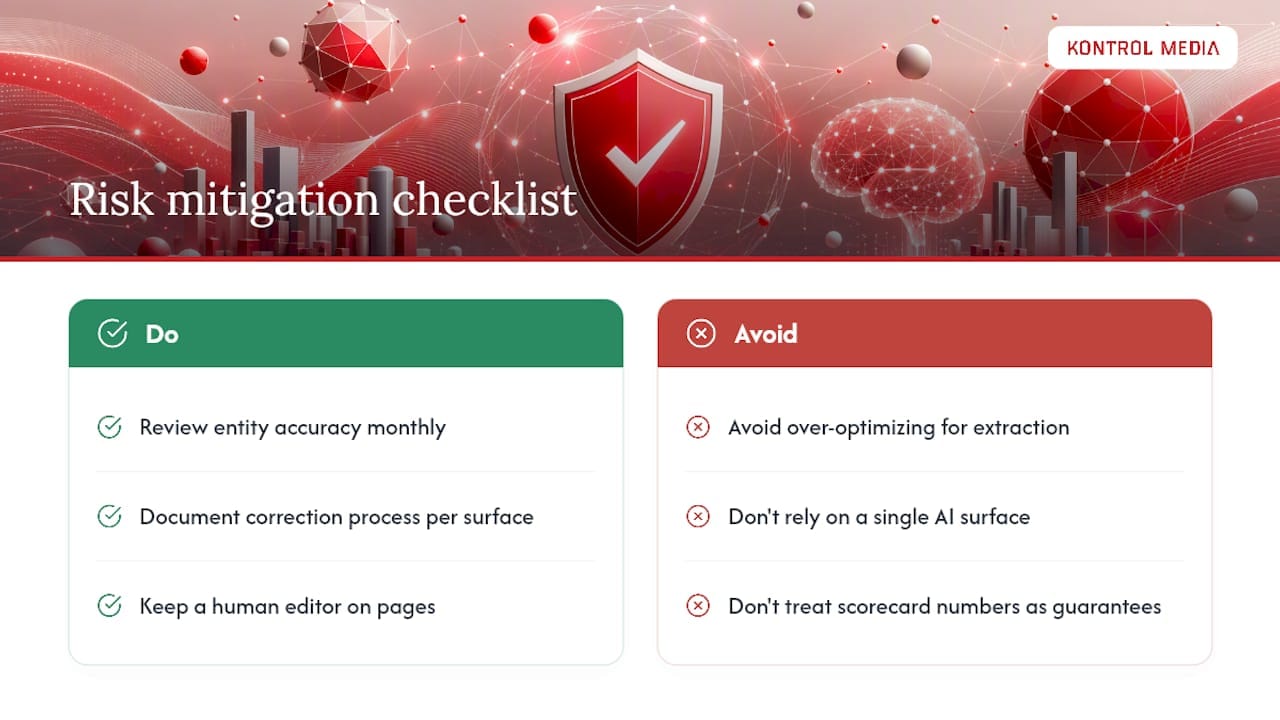
The biggest risk isn’t obscurity, it’s misattribution. A model that cites your brand with an outdated product description or a wrong category is often worse than a model that doesn’t cite you at all, because you don’t control the correction cycle the way you would with a website edit.
Volatility is the second risk. AI engines update their retrieval and ranking logic on their own schedule, and a citation share that looked strong last quarter can drop without any change on your end. Treat every scorecard number as a snapshot, not a guarantee, and build slack into your reporting so a single bad week doesn’t trigger a strategy overhaul.
Over-optimization creates a third risk. Content engineered purely for extraction can read as thin or manipulative to human visitors who land on it after the AI reference. Keep a human editor in the loop on every answer-object page, not just a schema checklist.
There’s also a concentration risk worth naming: leaning too hard on one AI surface (say, a single conversational engine) leaves you exposed if that engine changes its citation behavior overnight. Spread the audit and the content investment across the full 12-surface set rather than chasing whichever engine is trending this month.
Mitigate all three with the same habit: review entity accuracy monthly, not quarterly, and keep a documented correction process for every surface where you’ve identified a factual error in how you’re described.
How Should Visibility Strategy Connect to Broader Marketing Goals?
A visibility program that lives apart from your core marketing plan becomes a side project with its own budget line and its own excuses. It needs to report into the same goals your CMO already answers for: pipeline contribution, brand lift, and customer acquisition cost.
Tie citation share directly to funnel stages. A jump in AI-referred sessions in your top-of-funnel tracking should map to a corresponding lift in branded search or direct pipeline within the following quarter. If it doesn’t, the content strategy needs revisiting, not the measurement approach.
Brand experience and customer experience aren’t separate workstreams either. Forrester’s research on total experience ties joint management of the two to sustainable revenue growth, which means your visibility program should sit on the same roadmap as your CX and retention initiatives, reviewed by the same stakeholders. Aligning marketing and sales on shared revenue goals is the connective tissue that makes this work in practice rather than in a slide deck.
Does Your Team Have the Skills for AI-Era Visibility Work?
Most enterprise marketing teams are staffed for the search era that’s ending, not the one that’s here. Content teams know keyword research; fewer know how to structure an answer-object page or write for citation extraction.
Run a skills inventory before you build a training plan. Ask three questions of every content and comms hire: do they understand structured data and schema markup, can they read a citation-share report and act on it, and have they written anything designed to be lifted verbatim by a model rather than read start to finish by a person.
Gaps usually cluster in three places. Content teams need training in AEO and GEO structuring as a discipline distinct from traditional SEO copywriting. PR and comms teams need to learn citation engineering, writing press materials with quotable, extractable facts rather than narrative framing. Analytics teams need a working definition of Generative Engine Optimization so they stop reporting AI-referred traffic as generic “other” in dashboards.
Build the training plan in two tracks: a short workshop for the whole marketing org on what citation density means and why it matters, and a deeper certification path for the two or three people who will own the GEO scorecard long term. Skipping the second track is the most common reason these programs stall after a promising launch.
The Kontrol Media Take on Enterprise Visibility
Most of what breaks an enterprise visibility program isn’t the tactics, it’s the handoff between strategy and execution. Kontrol Media has spent years inside that gap, working with brands including Experian, BuzzFeed, Huffpost, REMAX, Enthusiast Gaming, and West Monroe on exactly the kind of cross-functional alignment this article describes.
The Engagement Divide doesn’t close with a slide deck. It closes when someone owns the audit, fixes the entity grounding, and stays accountable for the weekly citation numbers. That’s the hands-on execution layer Kontrol Media brings to a strategy engagement, explored further on our services page.
Get Hands-On Help Executing Your Visibility Program
Reading the playbook is one thing. Running it inside a real organization, with real handoffs between marketing, sales, and commerce teams, is where most programs stall. Kontrol Media exists for that exact gap: strategy work paired with hands-on execution, not a deck that sits in a shared drive after the kickoff call.
What separates this from hiring a traditional agency is the model itself. Kontrol Media builds the audit, fixes the entity grounding, and stays in the work through the 90 to 180 day rollout, rather than handing you a strategy document and disappearing. That’s the same approach behind our guidance on crafting a comprehensive business strategy, applied here to citation engineering and cross-functional visibility governance.
If your team is staring at a citation-share baseline of zero and needs an owner for the next 90 days, reach out through our services page and we’ll scope the audit first.
Sources
- SAP — 2026 Global Customer Engagement Index
- Forrester — Turn brand promise into customer reality with total experience
- Dark Horse Strategies — AI GTM Visibility Framework (README)
- Semrush — Brand visibility (2026)
Recommended
- Riding the AI Wave: Brand in the Age of Innovation | Kontrol Media Consultancy
- What’s the Role of Generative AI in Enterprise SEO and SEM? | Kontrol Media Consultancy
- Types of Market Visibility Strategies for Enterprise Leaders | Kontrol Media Consultancy
- 5 Things Brands Should Prioritize in 2025 | Kontrol Media Consultancy