


An outsourced sales model is an arrangement where an external partner runs some or all of your revenue generating activity, from prospecting through closing or account management, using its own reps, systems, and management layer instead of yours. The decision rule is simpler than most vendors make it sound: outsourcing wins when you need to validate a channel, market, or message fast and don’t yet have the internal management bandwidth to do it well. It tends to lose when your product is unproven, your ideal customer isn’t defined, or you’re trying to use a vendor to paper over a positioning problem.
Three quick filters help you sort your own situation:
- Outsourcing usually wins when you’re entering a new market, testing an unproven channel, or need pipeline in weeks rather than a full hiring cycle.
- Outsourcing usually loses when your ICP is fuzzy, your product requires deep technical discovery no outsider can learn in a month, or you’re chasing a vendor to fix a broken sales narrative.
- Hybrid usually wins long term once you’ve validated the motion and want to keep prospecting external while closing moves in-house.
Pro Tip: Before signing anything, run a 30 to 90 day pilot with one clearly defined segment. If the vendor can’t hit a modest, mutually agreed meeting or reply benchmark inside that window, you’ve learned something valuable for the price of a quarter, not a year.
Key Takeaways
An outsourced sales model works best as a fast, lower-cost way to validate a sales channel or market before committing to permanent headcount, provided the vendor operates against clear KPIs and shared data ownership.
| Point | Details |
|---|---|
| Decision rule | Outsource when you need speed and channel validation; keep sales in-house when your ICP or product knowledge is still unsettled. |
| Cost and speed advantage | Outsourced arrangements often run 35% to 45% of fully loaded in-house SDR cost and ramp in weeks instead of months. |
| Protect ownership | Contract for CRM access, sending domain ownership, and data portability before onboarding begins, not after. |
| Measure the right thing | Track qualified opportunities and pipeline velocity, not just meetings booked, to prevent qualification drift. |
| Strategy needs execution | Kontrol Media pairs due diligence and strategy with hands-on execution, including sales, account management, and billing, so a plan doesn’t stall at handoff. |
Table of Contents
- What Counts as an Outsourced Sales Model?
- Who Benefits From an Outsourced Sales Model?
- What Tangible Benefits Does Outsourcing Deliver?
- Which Outsourced Sales Model Fits Your Business?
- Which Parts of the Sales Funnel Should You Outsource?
- What Are the Risks of an Outsourced Sales Model?
- How Do You Evaluate and Choose a Sales Outsourcing Partner?
- What Does Onboarding an Outsourced Sales Team Look Like?
- What Does an Outsourced Sales Model Cost?
- What KPIs Should You Track to Measure Success?
- What Common Mistakes Sink Outsourced Sales Engagements?
- How Does a Hands-On Execution Partner Run Outsourced Sales?
- How Do You Run a 90-Day Outsourced Sales Pilot?
- When Does Outsourcing Actually Make Strategic Sense?
- Ready to Pilot an Outsourced Sales Model?
- Frequently Asked Questions
- Sources
What Counts as an Outsourced Sales Model?
Outsourced sales splits into two broad categories: partial and full. Partial outsourcing hands off a specific slice of the funnel, usually top-of-funnel prospecting, while your team keeps discovery calls, demos, and closing in-house. Full outsourcing extends the vendor’s ownership across the whole cycle, from the first cold email to a signed contract, sometimes including onboarding and renewal. Hybrid arrangements sit between the two and, according to Vparagon’s analysis of outsourced versus in-house sales, are the most common outcome because they offset the weaknesses of pure approaches on either side.
The functional scope you outsource typically falls into one or more of these buckets:
- SDR and prospecting: cold outreach, list building, initial qualification.
- Meeting booking: scheduling and confirming discovery calls with qualified prospects.
- Full-cycle closing: reps who carry a quota from first touch to signature.
- Account management: post-sale retention, upsell, and renewal conversations.
- Channel and partnership sales: managing resellers, agents, or co-marketing relationships.
- Advertising and media sales: selling inventory or sponsorships on your behalf, common in publishing and retail media.
Delivery models matter as much as scope. A dedicated embedded team works exclusively on your account and behaves closer to an extension of your own staff. A shared pool splits rep time across several clients, which usually lowers cost but also lowers your control over cadence and messaging. Performance-based delivery ties vendor compensation to results like booked meetings or closed revenue, which sounds appealing until you read the fine print on what counts as a “qualified” outcome. Each model carries different implications for who owns the CRM data, the sending domains, and the playbooks once the contract ends. Nail that ownership question before you sign, not after.
Who Benefits From an Outsourced Sales Model?
Certain company profiles get outsized value from this approach. Pre-scale startups that have proven their product but not their go-to-market motion often use outsourcing to test messaging without hiring a full sales floor. Mid-market companies expanding into a new vertical or geography use it to borrow local market knowledge and language fluency they don’t have internally. Larger organizations with a lean sales ops function sometimes outsource simply because they lack the management bandwidth to run a growing team well, not because they lack budget.
A few operational signals tend to point the same direction:
- Time-to-pipeline pressure: leadership needs qualified meetings in weeks, not the quarter it takes to recruit and ramp new hires.
- Recruiting bottlenecks: your talent team can’t source or vet sales hires fast enough to keep pace with growth targets.
- Unvalidated outbound: you haven’t proven a repeatable outbound motion and don’t want to build a permanent team around an unproven playbook.
- High cost of in-house hires: fully loaded SDR salaries make a first hire risky before you know the channel works.
Before committing, run this self-assessment:
- Do you have a documented ideal customer profile, or is “our customer” still a moving target internally?
- Can you commit a point person to manage the vendor relationship weekly, not just at kickoff?
- Is your CRM clean enough to hand a vendor without weeks of data cleanup first?
- Would a failed pilot cost you materially less than a failed internal hire?
If most of those answers point toward “yes, but,” outsourcing likely deserves a serious pilot. Vendisys’ outsourcing guide makes the point bluntly: vendors perform well when plugged into an already-aligned revenue engine, and poorly when used to mask a deeper positioning problem.
What Tangible Benefits Does Outsourcing Deliver?
The cost shape changes first. Instead of a large fixed salary, benefits, and ramp cost sitting on your books from day one, you convert most of that into a variable expense tied to a contract term. According to 2CT Sales Co.’s cost comparison, a fully loaded U.S. That gap is the early-stage arbitrage that makes outsourcing attractive before you’ve proven a channel works.
Speed compounds the cost advantage. RemoteReps’ research on B2B sales outsourcing puts outsourced SDR ramp typically takes a few weeks to start outreach and about one to two months to full productivity, compared to the multiple months a typical in-house hire needs before they’re carrying meaningful volume.
Beyond cost and speed, a few structural advantages matter:
- Specialized tooling: established vendors already run multi-channel sequencing, intent data, and AI-assisted personalization that would take your team months to configure from scratch.
- Market access: entering a new country or vertical often means borrowing a vendor’s existing language fluency and local buyer instincts rather than building that knowledge internally.
- Focus preservation: your internal team stays focused on closing and strategic accounts instead of splitting attention across prospecting and pipeline management.
That combination of lower fixed cost and faster time-to-meeting is why outsourcing works best as a validation tool, not necessarily a permanent structure. Learn more about why outsourcing marketing consulting drives real growth for a broader view of the same logic applied across functions.
Which Outsourced Sales Model Fits Your Business?
Not all outsourced arrangements look alike, and the differences show up in management load and pricing as much as in scope.
SDR-only outsourcing hands off prospecting and initial qualification while keeping everything downstream in-house. It’s the lowest management load, the fastest to start, and usually priced as a monthly retainer or per-meeting fee. It suits companies with a defined ICP but limited outbound capacity.
Full-cycle outsourcing puts an external rep on the whole funnel, from first touch to signed contract. It demands more oversight because you’re trusting someone outside your walls to represent your brand through negotiation, and pricing often blends a base retainer with commission on closed revenue.
Embedded pods dedicate a small team, often a manager, one or two SDRs, and sometimes an account executive, exclusively to your account. They behave closer to an internal team, cost more than a shared pool, but preserve more institutional continuity.
Shared pools split rep attention across multiple clients. They’re the cheapest option and the fastest to deploy, but you get less customization and slower response to strategy changes.
Performance-based fees tie vendor pay to outcomes like booked meetings or closed deals. This sounds like risk-free upside until you scrutinize the qualification definition, since a vendor paid per meeting has every incentive to book meetings, not necessarily good ones.
Most companies eventually land on a hybrid: outsourced SDRs feeding a pipeline that in-house account executives close. This structure keeps your closers focused on relationship-heavy conversations while the vendor absorbs the repetitive, volume-driven work of prospecting. Channel and partnership outsourcing is a separate variant worth mentioning, where a vendor manages a network of resellers, agents, or affiliates rather than direct prospects, and it comes with its own management rhythm built around enablement rather than daily coaching.
Which Parts of the Sales Funnel Should You Outsource?
Map the funnel before you decide anything: top-of-funnel prospecting, lead qualification, demo booking, handoff to a closer, and post-sale account development. Each stage carries different risk if it goes to an outsider.

Prospecting and initial qualification are the safest functions to outsource almost regardless of product complexity, because the skill required is volume, cadence discipline, and message testing rather than deep product knowledge. Demo booking is nearly as safe, since a good vendor is scheduling qualified time, not explaining your architecture.
Product complexity changes the calculation for everything downstream. If you sell a simple, well-understood product with a short sales cycle, outsourcing full-cycle closing is reasonable because there’s little proprietary technical knowledge a rep needs to internalize. If you sell something highly technical, an enterprise SaaS platform with a multi-stakeholder buying committee, keep discovery and closing in-house even while outsourcing the prospecting layer. The nuance a technical buyer expects rarely survives a handoff to someone who joined the account three weeks ago.
A workable default for most mid-market companies: outsource multi-channel prospecting (email, LinkedIn, phone) to build volume and test messaging, but keep discovery calls and closing with people who live inside your product every day, as detailed in Lead generation — Coleman Web Designs. That split captures most of the cost and speed benefit while protecting the parts of the cycle where deep expertise actually closes deals.
What Are the Risks of an Outsourced Sales Model?
The advantages are real, but so are the failure modes, and pretending otherwise does no one any favors. Speed, cost arbitrage, and scalability sit on one side of the ledger. Reduced control, institutional knowledge that walks out the door when the contract ends, and handover friction sit on the other.
Four operational risks deserve specific attention:
- Qualification drift: a vendor incentivized by meeting volume can quietly lower the bar for what counts as “qualified” unless your SLA ties pay to downstream conversion, not raw meeting count.
- Data siloing: if the vendor runs its own CRM instance instead of working inside yours, you lose visibility into what’s actually happening in your pipeline.
- Sending domain and mailbox ownership: if the vendor owns the email domains used for outreach, you lose your sender reputation and your prospect history the day the contract ends.
- Vendor churn: turnover on the vendor’s side means your account restarts its ramp with someone new, often without you knowing it happened.
Best practice from reporting on outsourced sales performance points to the same fix for most of these: align outsourced KPIs to pipeline quality and downstream conversion rather than raw activity, and make that alignment explicit in the contract, not a verbal understanding.
Pro Tip: Insist on owning the sending domains and CRM records from day one, even if it means a slightly slower vendor setup. The two or three days that costs you up front is nothing compared to losing a quarter’s worth of prospect history when the engagement ends.
How Do You Evaluate and Choose a Sales Outsourcing Partner?
Treat the proposal stage as due diligence, not a sales conversation. Require a written ramp plan with specific milestones for weeks one, four, and eight. Require named KPIs tied to pipeline quality, not just activity volume. Require reporting access into a shared dashboard rather than a monthly PDF summary. And require, in writing, that you retain ownership of sending domains, mailboxes, and any data the vendor generates on your behalf.
During selection, ask pointed questions rather than accepting a polished pitch deck:
- Can you speak with two or three current clients in a similar industry or company stage?
- What’s your average client retention length, and why do clients typically leave?
- What CRM and sequencing tools do you run, and how do they integrate with ours?
- What does the transition process look like if we end the engagement?
Vendor quality varies more than most buyers expect. G2’s reviews of outsourced sales providers show a wide spread in client outcomes across similarly positioned firms, which is exactly why references matter more than the pitch.
Contract terms deserve the same scrutiny as the sales pitch. Push for SLAs that define lead quality in measurable terms, a data portability clause guaranteeing export of contact records and activity history, and a termination clause that includes a transition assistance period rather than a hard cutoff.
A vendor that resists writing its promises into the contract was never going to keep them informally either. If a provider balks at data portability or SLA language, that reluctance is the most useful data point you’ll get in the entire sales process.
Watch for red flags during evaluation: reluctance to share client references, vague answers about reporting cadence, or evasiveness about how many accounts a single rep juggles at once. Each one predicts a specific failure mode you’ll live with for the length of the contract.
What Does Onboarding an Outsourced Sales Team Look Like?
A realistic onboarding timeline runs four phases: discovery, training, warm-up, and live outreach. Discovery, usually one to two weeks, covers ICP definition, messaging alignment, and CRM access setup. Training, another week or two, gets vendor reps fluent enough in your product to hold a credible first conversation. Warm-up, typically the following week, involves small-batch outreach to test messaging before scaling volume. Live outreach begins in earnest by week four to six, consistent with the productivity timelines RemoteReps documents for outsourced SDR functions.
The minimum tech stack you should insist on before day one:
- CRM access or scheduled exports, so activity and contact data land in a system you control, not a black box on the vendor’s side.
- A shared reporting dashboard updated at least weekly, not a monthly recap email.
- Sequence and outreach tooling visibility, so you can audit cadence, messaging, and volume.
- Analytics tied to downstream conversion, not just top-of-funnel activity counts.
Security and data ownership deserve a written checklist, not a handshake. Confirm who owns the sending domains and mailboxes used for outreach, since losing that reputation on contract end is one of the most common and avoidable outsourcing headaches. Confirm credential handling: shared logins should run through a password manager with revocable access, not a spreadsheet of passwords emailed at kickoff. Set a reporting cadence in writing: weekly operational syncs and monthly outcome reviews are the minimum most successful engagements run on, based on the shared-dashboard practices Salesforce recommends for sales outsourcing programs.
What Does an Outsourced Sales Model Cost?
Four pricing structures dominate the market, and each buys you a different risk profile. A fixed retainer gives you predictable monthly cost regardless of output, which suits companies that want budget certainty during a pilot phase. Per-lead pricing ties cost directly to volume of qualified leads delivered, shifting some risk to the vendor but often at a higher per-unit price. Commission-based pricing ties most of the cost to closed revenue, appealing in theory but rare in practice because few vendors will carry that much risk without a base fee. Hybrid pricing, a smaller retainer plus performance bonuses, is the most common structure because it balances predictability with shared incentive.
A simple ROI formula works for most first-pass evaluations:
ROI = (Pipeline Value Generated × Historical Close Rate) minus Total Vendor Cost, divided by Total Vendor Cost.
Consider a worked example. A company pays a vendor $8,000 per month, or $24,000 across a three-month pilot.
| Pricing Model | Typical Structure | Best Fit |
|---|---|---|
| Fixed retainer | Flat monthly fee | Budget-certain pilots and early validation |
| Per-lead | Fee per qualified lead delivered | Companies with a proven close rate wanting volume |
| Commission | Percentage of closed revenue | Rare; requires high vendor trust and long-term relationship |
| Hybrid | Base retainer plus performance bonus | Most common; balances risk between both parties |
Budget for vendor management time as a real cost, not an afterthought. Someone on your team needs to own the weekly sync, review the dashboard, and escalate quality issues, and that person’s time is part of the true cost of the engagement even though it never appears on the vendor’s invoice.
What KPIs Should You Track to Measure Success?
Five metrics matter more than the rest: meetings booked, qualified opportunities created, pipeline value generated, lead-to-opportunity conversion rate, and pipeline velocity, meaning how quickly a lead moves from first contact to a closed decision. Tracking meetings booked alone invites the qualification drift problem covered earlier, since a vendor optimizing purely for volume will hit that number while quality erodes underneath it.
| Metric | What It Tells You | Review Cadence |
|---|---|---|
| Meetings booked | Raw activity and outreach effectiveness | Weekly |
| Qualified opportunities | Whether meetings convert to real pipeline | Weekly |
| Pipeline value | Dollar impact of the engagement to date | Monthly |
| Conversion rate | Quality of leads versus volume | Monthly |
| Pipeline velocity | Speed of movement through your funnel | Monthly |
Set the reporting rhythm before the engagement starts: a weekly operational check-in covering activity and early signals, and a monthly outcome review covering pipeline value and conversion trends against the original targets. Build in an escalation trigger, a defined threshold like two consecutive weeks below the agreed meeting or reply benchmark, that automatically prompts a strategy conversation rather than letting underperformance drift unaddressed for a quarter.
Ownership of metric definitions matters as much as the numbers themselves. Agree upfront on what counts as a “qualified” meeting, ideally in writing, so the vendor and your internal team aren’t quietly measuring different things. For a deeper look at aligning these two functions, see aligning marketing and sales to hit revenue goals.
What Common Mistakes Sink Outsourced Sales Engagements?
The same handful of mistakes explain most disappointing outsourcing outcomes. Vague or undefined ICPs top the list, since a vendor asked to prospect “mid-market companies” with no further detail will burn budget on the wrong accounts. Under-investing in onboarding, treating the first two weeks as a formality instead of the foundation for everything that follows, is a close second. Missing SLAs and unclear data ownership round out the pattern, both of which turn into expensive disputes only after something has already gone wrong.
Vendor red flags to watch for during evaluation: no willingness to provide client references, reporting that’s vague about how leads are sourced and qualified, and outreach practices that risk your domain reputation, like aggressive send volumes from day one.
Concrete fixes you can put in place immediately: write your ICP down in a one-page document before the first vendor call, insist on a documented ramp plan with weekly milestones, and put lead quality definitions and data ownership terms in the contract rather than a follow-up email.
Pro Tip: Ask every vendor finalist for one reference client who left the engagement, not just satisfied current clients. How they talk about a lost account tells you more about how they’ll handle friction with you than any success story will.
How Does a Hands-On Execution Partner Run Outsourced Sales?
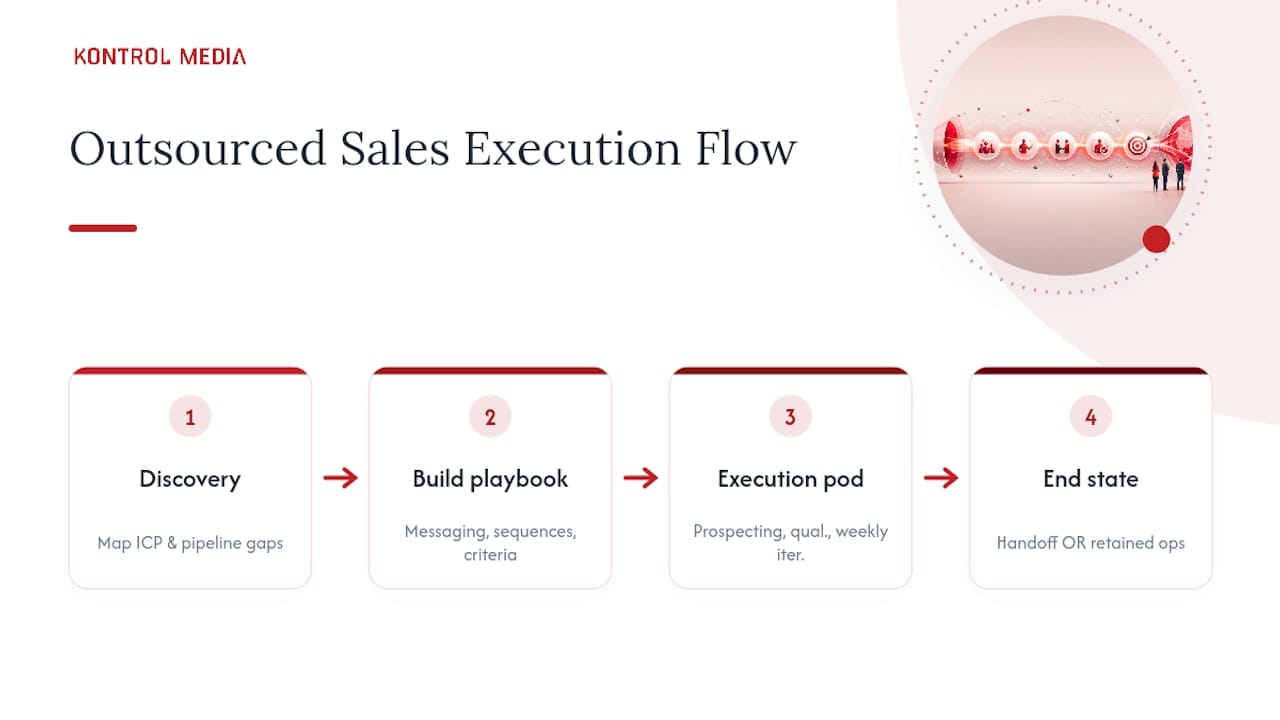
A practitioner-grade outsourcing engagement follows a recognizable sequence, and the difference between firms shows up most in what happens after the strategy deck is delivered. Discovery comes first: mapping the ICP, current pipeline gaps, and where the internal team’s bandwidth genuinely runs out. From there, a working playbook gets built, messaging, sequencing, target account lists, and qualification criteria documented in enough detail that a new rep could execute it without a month of hand-holding.
Execution follows through a dedicated pod, often a small team running prospecting and qualification against the documented playbook, with weekly iteration based on reply rates and meeting quality rather than gut feel. This is the phase where most vendors either prove their model or expose its gaps.
The strategy work only earns its value once it survives contact with actual prospects. A playbook that looks sharp in a slide deck and collapses in week three of real outreach was never a real strategy, just a well-formatted guess.
What separates a hands-on partner from a strategy-only firm is what happens at the end. Some engagements hand full ownership back to the client, complete with the playbook, CRM data, and sending infrastructure. Others continue as a retained operating function indefinitely, running the channel on an ongoing basis. Kontrol Media builds engagements to support either path deliberately, because designing the strategy and running the downstream execution under one roof means the client isn’t stuck translating a consultant’s recommendations into a second vendor’s execution plan. For a broader look at team design principles that inform this approach, see building a high-performing sales team.
How Do You Run a 90-Day Outsourced Sales Pilot?
Structure the pilot as a genuine experiment with a fixed scope, not an open-ended trial. A workable template:
- Days 1 to 14: onboarding, ICP alignment, CRM access setup, and playbook documentation.
- Days 15 to 30: warm-up outreach at reduced volume to test messaging and refine targeting.
- Days 31 to 75: full-volume outreach with weekly performance reviews against agreed benchmarks.
- Days 76 to 90: outcome review and go/no-go decision against the original success criteria.
Set success criteria before outreach begins, not after you see the results:
- A minimum reply rate benchmark appropriate to your industry and outreach channel.
- A target number of qualified meetings booked per month.
- Early signs of pipeline velocity improvement compared to your historical baseline.
Build a clear decision gate into the plan from the start. If the pilot clears its benchmarks, options include extending the engagement, scaling volume, or transitioning toward a hybrid model with in-house closers. If it falls short, diagnose whether the shortfall traces to vendor execution or a deeper messaging and ICP problem before writing off the channel entirely.
When Does Outsourcing Actually Make Strategic Sense?
The mistake I see leaders make most often isn’t outsourcing sales. It’s outsourcing sales while treating the vendor as a black box they never have to manage. Outsourcing works as a strategic lever precisely when it’s paired with real execution discipline on your side: a defined ICP, a shared dashboard, and someone internally accountable for the relationship every week, not just at renewal time.
Where this breaks down industry-wide is the gap between strategy and delivery. Plenty of firms will hand you a sharp go-to-market plan and a due diligence report, then leave you to find someone else to actually run it. That handoff is where momentum dies, because the team executing the plan wasn’t in the room when it was built and has to relearn everything the strategists already knew.
Kontrol Media was built to close that gap. We do the strategy and due diligence, and we’re equally capable of running the downstream execution ourselves, from campaign management to account management to billing, so the plan doesn’t lose fidelity crossing from strategist to operator. If you’re weighing whether to outsource sales, marketing execution, or both, our guide to business strategy consulting walks through how we structure that handoff, or the lack of one.
Ready to Pilot an Outsourced Sales Model?
If you’ve read this far, you already know the honest tradeoff: outsourcing buys you speed and a lower fixed cost while you validate a channel, but only if someone is actually accountable for turning strategy into daily execution. Kontrol Media runs both halves under one roof. We build the ICP, messaging, and playbook, then staff and operate the outreach, qualification, and reporting ourselves, so you’re not left holding a strategy deck with no one to run it.
That matters most for leaders who’ve been burned by firms that hand over a due diligence report and disappear the moment execution starts. We stay in the account through campaign management, account management, and even billing if that’s what the engagement calls for, and we hand over full ownership whenever a client wants to bring the function in-house. Explore our comprehensive business and marketing services to see the full range, or reach out to scope a 90-day pilot built around your specific ICP and revenue targets. Start with a conversation, not a contract.
Frequently Asked Questions
Is an outsourced sales model cheaper than hiring in-house?
Usually, at least in the early stages. Outsourced arrangements often cost roughly 35% to 45% of a fully loaded in-house SDR salary, though that gap narrows as volume grows and internal hiring becomes more cost-effective at scale.
How long does it take to see results from outsourced sales?
Most programs reach full productivity in four to six weeks, according to RemoteReps’ onboarding research, compared to two to three months for a typical in-house hire’s ramp.
Can I outsource sales without losing control of my brand?
Yes, provided you keep discovery and closing in-house for complex products, retain ownership of sending domains and CRM data, and require the vendor to work from a documented messaging playbook rather than improvising.
What’s the difference between full outsourcing and a hybrid model?
Full outsourcing hands the entire cycle, from first contact to close, to the vendor. A hybrid model keeps outsourced reps focused on prospecting while your internal team handles discovery and closing, which Vparagon identifies as the most common long-term structure.
What should be in an outsourced sales contract?
At minimum: SLAs defining lead quality, a data portability clause, clear ownership of sending domains and mailboxes, a defined reporting cadence, and a termination clause that includes transition assistance.
How do I know if my outsourced sales pilot succeeded?
Judge it against the benchmarks you set before outreach began, typically a minimum reply rate, a target number of qualified meetings, and early signs of pipeline velocity improvement, not just raw activity volume.
Sources
For readers who want to go deeper on specific pieces of this decision, these sources informed the guidance above:
- Salesforce — Sales outsourcing
- RemoteReps — B2B Sales Outsourcing: Pros, Cons & How to Get It Right
- 2CT Sales Co. — Outsource vs Hire Internal: The Math
- Vparagon — Outsourced vs In-House Sales: 7 Strategies for Success
Recommended
- Your Sales Function, Without the Headcount | Kontrol Media Consultancy
- Why Outsourcing Marketing Consulting Drives Real Growth | Kontrol Media Consultancy
- Building a High-Performing Sales Team: Strategies and Best Practices | Kontrol Media Consultancy
- Best Marketing Mix Modeling Tools for Marketing Teams | Kontrol Media Consultancy