


When you set out to create a marketing strategy from scratch, the goal is not to produce a lengthy document that collects dust. It is to translate your enterprise’s revenue targets into a focused, living plan that tells every team member exactly where to aim and why. For companies operating in real estate and retail media, that clarity is not optional. These are sectors where buying cycles are long, stakeholder counts are high, and the cost of misaligned spend compounds fast.
A well-built plan rests on seven foundations:
- Clear, measurable objectives tied directly to revenue, not just activity
- In-depth market research and competitor analysis that surfaces real opportunity gaps
- Detailed customer personas and buying committee maps, not generic segments
- A channel mix that blends brand-building with performance outcomes simultaneously
- A data-driven framework for ongoing budget allocation and reallocation
- Strategic priorities aligned with enterprise business goals and resource constraints
- Built-in agility for cross-departmental execution and mid-cycle adaptation
Strategic marketing plans with SMART objectives outperform general plans by 20% in achievement of revenue targets. That gap widens at enterprise scale, where the absence of measurable goals creates drift across dozens of teams and channels.
Table of Contents
- How do you build a strategic marketing plan from zero?
- How do data-driven growth loops change budget allocation?
- How Kontrol Media executes this for enterprise clients
- How do you keep an enterprise marketing strategy from going stale?
- Key Takeaways
- Kontrol Media brings strategy to life at enterprise scale
How do you build a strategic marketing plan from zero?
The process is sequential, but it is not linear. You will loop back. Here is the order that works at enterprise scale.

1. Run a situation analysis. Map your current market position using a SWOT framework, then layer in competitor intelligence. In real estate, that means understanding which agents, platforms, and media partners your competitors are activating. In retail media, it means auditing your sponsored placement share-of-shelf across networks like Amazon Ads, Walmart Connect, and Target’s Roundel.
2. Set SMART objectives. Every goal needs a number, an owner, and a deadline. “Increase brand awareness” is not a goal. “Grow marketing-sourced pipeline by 30% in Q3 among mid-market real estate developers in the Southeast” is.
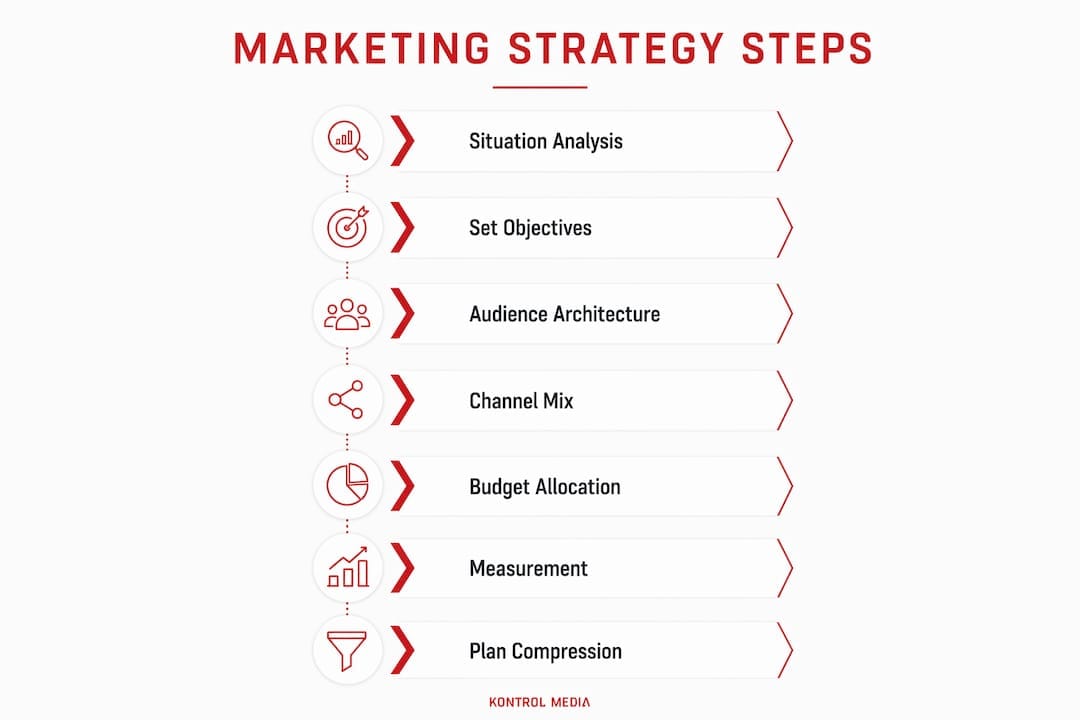
3. Build your audience architecture. At enterprise scale, buying committees include multiple stakeholders with varied priorities. Mapping content to each stakeholder type — economic buyer, technical evaluator, end user — improves pipeline velocity in B2B settings by 15%. Generic personas will not cut it here.
4. Design your channel mix and messaging. The distinction between brand and performance marketing has largely dissolved. Top CMOs now integrate channels that build identity while delivering measurable conversion, with intent-driven account-based marketing cited as the primary vehicle at enterprise scale. Your channel plan should reflect that same duality. For a deeper look at how these two disciplines intersect, the brand vs. performance marketing guide from Kontrol Media is worth your time.
5. Assign budget, owners, and timelines. Every tactic needs a dollar figure, a named owner, and a go-live date. Without this, strategy stays theoretical.
6. Define your measurement framework. Set both leading indicators (engagement rate, pipeline velocity, account activation) and lagging indicators (revenue influenced, customer lifetime value, retention rate). Vanity metrics like raw impressions tell you almost nothing about whether your plan is working.
7. Compress it. Enterprises using concise, one-page plans achieve faster decision-making cycles. A one-page strategic summary forces prioritization and keeps dispersed teams aligned on what actually matters.
Pro Tip: Treat your one-page plan as the “spine” of your strategy. Every campaign brief, budget request, and channel decision should trace back to it. If a tactic cannot be mapped to a line on that page, question whether it belongs in the plan at all.
| Plan Component | Purpose | Key Output |
|---|---|---|
| Situation Analysis | Understand current position | SWOT, competitor map |
| SMART Objectives | Define measurable targets | Revenue-tied KPIs |
| Audience Architecture | Map stakeholders and personas | Buying committee profiles |
| Channel Mix | Select and integrate channels | Integrated media plan |
| Budget & Ownership | Allocate resources | Tactical calendar with owners |
| Measurement Framework | Track and optimize | Leading + lagging KPI dashboard |
How do data-driven growth loops change budget allocation?
Static annual budgets are a liability in enterprise marketing. The better model is a growth loop: performance data flows back into budget decisions continuously, shifting spend away from underperforming channels with evidence rather than historical precedent. Companies applying growth loop frameworks report up to 25% improved marketing ROI within the first year of implementation.
In retail media specifically, this discipline is non-negotiable. Amazon’s 14-day attribution window versus Walmart Connect’s 30-day window means raw ROAS comparisons across networks are meaningless. The fix is TACOS (Total Advertising Cost of Sale), a unified metric that normalizes spend against total revenue, not just ad-attributed revenue, enabling genuine cross-network budget decisions.
Inventory-aware bidding is the other lever most enterprise retail media teams underuse. Stepping down bids automatically when inventory cover falls below 30 days reduces wasted spend by up to 12%. Tools like Pacvue, Skai, and Perpetua connect bidding automation directly to inventory feeds so campaigns do not burn budget on unavailable stock.
For a structured review cadence, a four-tier measurement approach works well at enterprise scale:
- Weekly: Campaign-level performance review. Pause underperformers, reallocate to what is working.
- Monthly: KPI review against SMART objectives. Identify leading indicators that are trending off-track.
- Quarterly: Channel mix and budget reallocation. Run incrementality tests on your top two spending networks.
- Annually: Full strategic refresh. Reassess assumptions, ICP, competitive position, and channel priorities.
Pro Tip: Reserve 10–15% of your marketing budget explicitly for experimentation. Label it as such in your plan. This protects test-and-learn cycles from being raided when a campaign underperforms mid-quarter.
How Kontrol Media executes this for enterprise clients
Kontrol Media works at the intersection of real estate, retail media, and enterprise marketing strategy, which means the frameworks above are not theoretical for us. They are operational.
In real estate, Kontrol Media builds revenue-generating marketing partnerships that connect brands with home buyers and homeowners through the real estate agent channel. Clients like RE/MAX have used this approach to reach active, high-intent audiences at the moment of purchase consideration, a channel most brands overlook entirely. The real estate marketing channel guide details how this channel compares to traditional digital spend for brands targeting home buyers.
In retail media, Kontrol Media builds, operates, and drives revenue for retail media and commerce media networks. That means standing up the infrastructure, defining the measurement architecture, and executing the go-to-market strategy for the network itself. The retail media network service page outlines what that engagement looks like in practice.
Across both sectors, the work begins with strategic alignment: mapping the client’s revenue goals to a marketing plan with clear owners, timelines, and KPIs. Clients including Experian, BuzzFeed, Enthusiast Gaming, and West Monroe have gone through this process, each with a different starting point and a different definition of growth.
“The most common gap we see in enterprise marketing plans is not a lack of ambition. It is a lack of specificity. Teams know they want to grow. They have not yet defined what growth looks like in a way that every department can act on.” — Kontrol Media
The strategic marketing and consulting overview on the Kontrol Media site captures the broader methodology, including how historical performance data informs the initial strategy build.
How do you keep an enterprise marketing strategy from going stale?
A plan built in January should not look identical in September. Markets shift, channels evolve, and the assumptions you made at the start of the year will be at least partially wrong by mid-year. The discipline is not in getting the plan right the first time. It is in building the governance to keep it honest.
A few practices that hold up at enterprise scale:
- Quarterly strategic reviews that reassess not just KPIs but the assumptions underneath them. If your ICP has shifted or a competitor has entered a channel you dominated, the plan needs to reflect that.
- Cross-functional alignment sessions that bring marketing, sales, and business development into the same room. Aligning marketing and sales on shared metrics is one of the highest-leverage moves an enterprise team can make.
- Formal risk assessment built into the annual planning cycle. Identify the three to five scenarios that could materially disrupt your plan, and define contingency responses in advance.
- Controlled experimentation with emerging channels. Privacy regulations and zero-party data strategies are reshaping how enterprises build customer profiles. Preference centers and interactive surveys integrated into email campaigns improve data quality and customer trust without sacrificing compliance.
- Budget flexibility. Treat your annual budget as a starting allocation, not a commitment. Build in a formal reallocation mechanism tied to your quarterly review cadence.
The executive learning dimension matters here too. Executive learning’s role in growth is often underestimated in marketing strategy discussions, but the teams that adapt fastest are the ones whose leaders are actively updating their own frameworks alongside the plan.
Pro Tip: Simplicity scales. A strategy with three clear priorities, each with a named owner and a measurable outcome, will outperform a 40-page document that no one reads after the kickoff meeting. Complexity is not sophistication.
Key Takeaways
A marketing strategy built from scratch succeeds when measurable objectives, data-driven budget loops, and cross-functional execution are aligned from day one, not retrofitted after the fact.
| Point | Details |
|---|---|
| SMART objectives drive results | Plans with SMART goals tied to revenue outperform general plans by 20% in target achievement. |
| Buying committee mapping matters | Enterprise deals involve 6–10+ stakeholders; tailored content by role improves pipeline velocity by 15%. |
| Growth loops beat static budgets | Companies using data-driven growth loop frameworks report up to 25% improved marketing ROI in year one. |
| TACOS unifies retail media measurement | Standardizing on TACOS resolves attribution window discrepancies across Amazon, Walmart, and other networks. |
| Kontrol Media executes end-to-end | Kontrol Media builds and runs marketing strategy across real estate and retail media for enterprise clients, from plan to execution. |
Kontrol Media brings strategy to life at enterprise scale
Most marketing teams can write a plan. Fewer can execute one across sales, marketing, and business development simultaneously, in sectors as specific as real estate and retail media. That is the gap Kontrol Media fills.
Kontrol Media is not a generalist agency. The work is sector-specific, execution-focused, and built around the revenue outcomes that matter to enterprise leaders. Whether you need to reach home buyers through the real estate agent channel, build and monetize a retail media network, or develop a comprehensive business strategy that your entire organization can execute against, Kontrol Media brings the frameworks and the hands-on capacity to make it real. The client list, from Experian to RE/MAX to West Monroe, reflects the range of enterprise contexts where this approach has worked. If you are ready to move from planning to execution, connect with Kontrol Media to start the conversation.
Recommended
- Crafting an Effective Marketing Strategy: From Research to Execution | Kontrol Media Consultancy
- What Is a Marketing Strategy? A Guide for Business Growth | Kontrol Media Consultancy
- Adapting Your Business Strategy in a Rapidly Changing Market | Kontrol Media Consultancy
- The Importance of Crafting a Comprehensive Business Strategy | Kontrol Media Consultancy