


The key standards in retail media are the IAB/MRC Retail Media Measurement Guidelines (January 2024), the in-store definitions the IAB finalized in December 2024, and the ANA’s Retail Media Measurement Standardization framework from August 2026. Together they tell you how to define an impression, when an ad counts as viewable, how long an attribution window should run and what a network must disclose. If you run a network, they are the spec your reporting gets judged against. If you buy retail media, they are the checklist for comparing one network to another. Either way, the standards only help when someone turns them into daily operating practice, and that is where most teams stall.
TL;DR
- The baseline is the IAB/MRC Retail Media Measurement Guidelines (January 2024): shared definitions for impressions, viewability, invalid traffic, outcomes and attribution.
- In-store media has its own standard (final December 3, 2024), built around ad play, gross impressions and opportunity to see, with footfall sources and formulas disclosed.
- The ANA’s August 2026 framework is the current brand-side guidance, recommending a 14-day lookback window, a 52-week “new to” definition and third-party validation.
- Networks still report differently, so the practical job is verifying definitions and attribution rules before you compare results.
Table of Contents
- Why standards became the top issue
- The baseline: IAB/MRC Retail Media Measurement Guidelines
- In-store media has its own standard
- The ANA framework: what brands now expect
- Where networks still differ
- A working checklist for any network’s reporting
- What this means if you are building a network
- Perspective
- Turning the standards into a network that earns
- FAQ
- Sources
Why standards became the top issue
Retail media grew up one retailer at a time. Each network built its own ad products, its own data and its own way of counting a sale, which was fine while budgets were small. Once retail media became a line item that CMOs defend in front of a CFO, the lack of a shared language turned into a real barrier. The Path to Purchase Institute reports that 55% of advertisers surveyed by the ANA named lack of standardization their number one barrier, pointing to differences in lookback windows, “new to” definitions, and audience and product category definitions.
For retailers the pressure runs the other way. A network that cannot explain its numbers in terms brands already recognize will have a harder time winning incremental budget. Standards are not a compliance exercise for a retailer launching a network, they are part of the product.
The baseline: IAB/MRC Retail Media Measurement Guidelines
The IAB/MRC guidelines are where every other document starts. They define retail media as marketing to consumers near their point of purchase or their choice between brands or products, online or in store, and they ask for transparency and consistency in definitions and methods so that metrics can be compared across platforms. The Media Rating Council (MRC) is the industry body that accredits measurement, and the guidelines build on its existing standards for viewable ad impressions, invalid traffic, outcomes and data quality, and cross-media measurement.
Three definitions do most of the work.
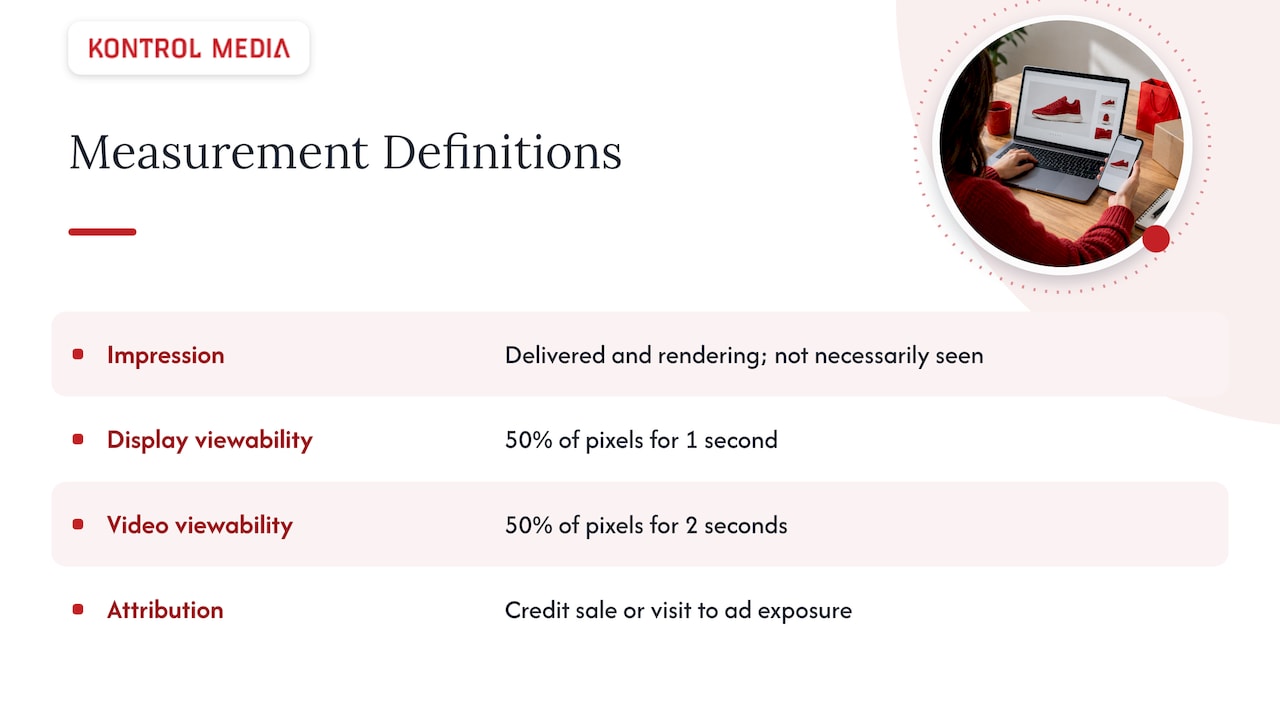
Impression. An impression is an ad successfully delivered to a user’s device that has begun to render on the page or app. It does not mean anyone saw it. That distinction matters because a network reporting “impressions” and a network reporting “viewable impressions” are not describing the same thing.
Viewability. For display, the guidelines follow the familiar MRC threshold: at least 50% of the ad’s pixels in view for one continuous second, or two continuous seconds for video. A network that uses a different threshold has to disclose it.
Attribution. Attribution assigns credit for a sale or visit to an ad exposure, at individual or household level, using lookback windows that are empirically supported and disclosed before the campaign runs and again with the results. The guidelines also call for filtering sophisticated invalid traffic out of outcome measurement, and for disclosing biases that come from omitted media or outside factors.
Notice what this adds up to. The guidelines rarely say “use this number”. They say define it, apply it consistently, and tell the buyer. That is a transparency standard more than a performance standard, and it is why two networks can both be compliant and still hand you reports you cannot line up side by side.
Data quality underneath the metrics
The MRC’s Outcomes and Data Quality Standards go a level deeper. They require attribution approaches to meet standardized data precision and resolution, and they require limitations and coverage gaps to be disclosed, with their effect on results quantified. For a retailer, that translates into a data question before it becomes a reporting question: can you tie an ad exposure to a transaction at the level of detail an auditor would expect? We cover the field-level rules in our piece on data requirements for audit-grade attribution.
In-store media has its own standard
Physical screens, shelf-edge displays and digital signage cannot be measured with a pixel count. The IAB and IAB Europe in-store definitions and measurement standards, finalized on December 3, 2024, define a small set of terms:
- Ad play: the ad actually ran on the screen.
- Gross impression: the audience in the display’s exposure zone multiplied by ad plays.
- Opportunity to see (OTS): the in-store proxy for viewability.
- Sensor-based impressions: counts that rely on sensors rather than modeled footfall.
Networks are expected to report ad play and gross impressions and to disclose the formulas behind them. In-store impressions should also follow the MRC’s digital place-based audience measurement standards. The standard allows footfall to come from transaction data, panels, sensors, door counters or beacons, as long as the source is disclosed. It also flags privacy implications for sensor-based attention measurement, which is worth raising with your legal team early.
In December 2025 the US IAB added an in-store maturity framework. It positions unique reach, frequency and dwell time as planning metrics, and deterministic sales linkage as the outcomes layer. For a retailer, that reads as a roadmap: start with disciplined ad play and impression reporting, then earn the right to claim outcomes.
The ANA framework: what brands now expect
On August 18, 2026, the ANA released its Retail Media Measurement Standardization report. It was built by the ANA’s Retail Media Working Group with more than 40 brand heads of media and with feedback from several retail networks, according to Digiday’s coverage. Its recommendations are the clearest statement yet of what advertisers will ask for in an RFP:
- A standardized 14-day lookback window for attribution.
- A common 52-week definition of “new to” customers, per the Path to Purchase Institute.
- Third-party measurement and validation, plus transparency into methods, logic and definitions.
- A common definition of “outcomes”, and fuller performance context beyond attributed sales, including access to product and category sales, inventory availability, pricing and basket size.
The validation point is the one to watch. CMO Mag reports that the framework leans on third-party validators, which will shape who marketers trust to verify network reporting.
It is guidance, not law. The ANA’s Jason Trubowitz describes it as a starting point, with later updates expected on outcomes and incrementality, data sharing, interoperability and on-platform experimentation. Retailers and brands should read it as the direction of travel: a network that already reports a 14-day window and a 52-week new-to-brand definition will meet fewer objections than one that has to explain its own conventions each time. If new customer acquisition is your goal, our guide to reaching new-to-brand customers in retail media shows how that definition changes the way campaigns are planned.
Where networks still differ
Standards narrow the gap, they do not close it. Three differences keep showing up.
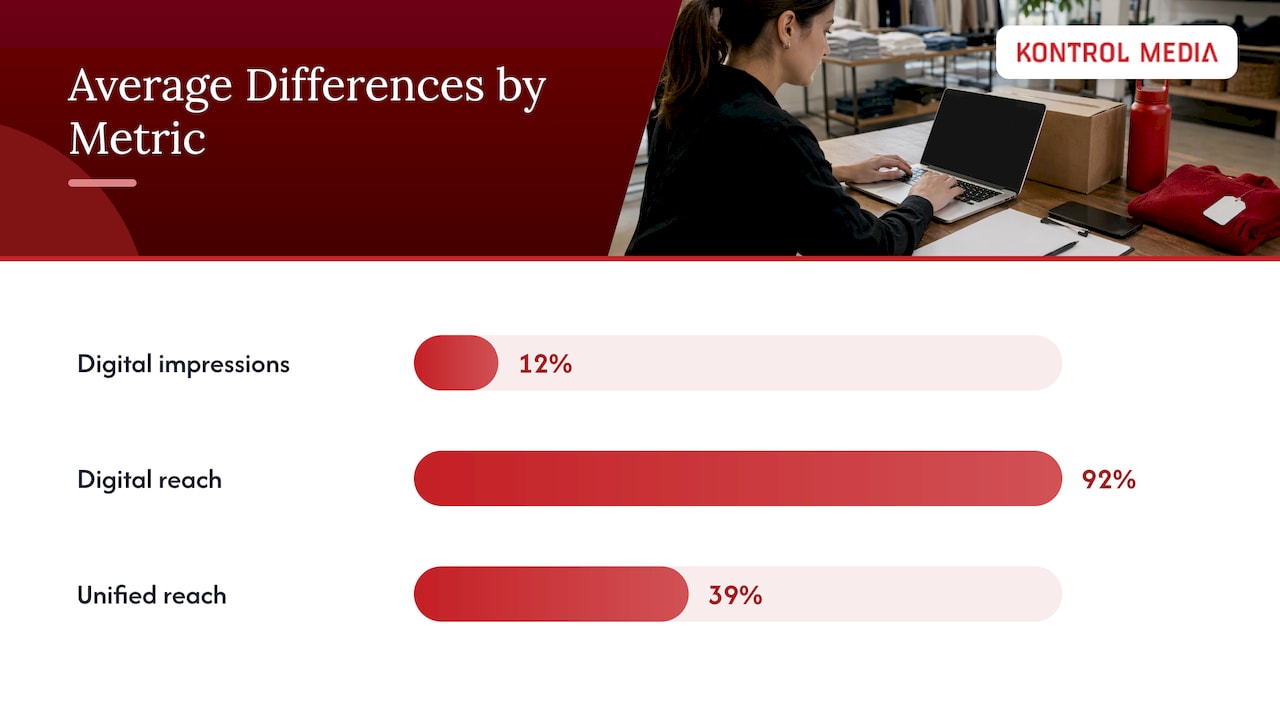
Reach and deduplication. A Warner Bros. Discovery study of 48 campaigns measured by two or more providers found digital impressions differed by 12% on average, while digital reach differed by 92% and unified reach by 39%. Impressions are the easy part. Counting unique people is where methodologies diverge.
Attribution rules. An episode of the Retail Media Breakfast Club from November 2026 gives a clean example. A brand running display and sponsored products on one network could see a single purchase credited to both campaigns, while on another network the same purchase goes only to the last touch the shopper saw. Neither report is wrong by its own rules, but the ROAS figures cannot be compared.
Comparability itself. The ANA’s Jackson Bazley told Digiday that baseline metrics must be right before anyone moves on to attribution and causality. Albertsons Media Collective’s Liz Roche warned that without transparency marketers risk false precision from numbers that look comparable and are not. Both are saying the same thing: a common foundation matters more than forcing every network to operate identically.
A working checklist for any network’s reporting
Whether you sell media or buy it, these are the questions the standards put on the table. Read them in order, because each one depends on the one before it.
- Definitions. Is an impression counted on render, and is a viewable impression counted at 50% of pixels for one second (two for video)? Are any custom thresholds disclosed?
- Invalid traffic. Is invalid traffic filtered before outcomes are calculated?
- Attribution window. What is the lookback window, and was it stated before the campaign started? Compare it to the ANA’s 14 days.
- Deduplication. Is a sale credited once or to every campaign that touched the shopper? This single answer explains most ROAS gaps.
- New-to-brand. Is the lookback for “new” customers 52 weeks, and is it measured on the retailer’s own transaction data?
- In-store sources. Where does footfall come from, and are the formulas disclosed?
- Validation. Has a third party validated the methodology, and what coverage gaps are disclosed?
If an advertiser is trying to separate real lift from credit that would have happened anyway, the next layer is incrementality. We explain how we think about it in our guide to iROAS measurement for retail media, and in tracking outcomes versus ad impressions. For the full list of numbers to put on a dashboard, see our key metrics guide.
What this means if you are building a network
A retailer or consumer business standing up a network has a rare advantage: you can design to the standards from day one instead of retrofitting. That means choosing an ad server and data architecture that can log impressions, viewability and transactions at the level the guidelines expect, writing your attribution rules down before the first campaign, and deciding early how third-party validation will work. Our build versus buy verdict on network setup walks through those choices, and the ad server comparison covers the tooling side.
Perspective
Standards are often discussed as if they were a document to be adopted. In our experience of building and operating retail and commerce media networks, they are an operating habit. A definition that lives in a PDF changes nothing. A definition that sits in the ad server configuration, the reporting template, the sales deck and the advertiser onboarding call changes everything.
That is why we push clients to treat transparency as a sales asset. When a brand asks about your lookback window, the best possible answer is a short one, given before they ask. Networks that make it easy to understand their numbers tend to earn bigger budgets, because the CMO on the other side can defend the spend internally.
The other thing we believe is that measurement and revenue belong in the same conversation. Standards tell you how to count. Someone still has to design the products, train advertisers, run the sales process and keep the data clean. We do the strategy and the hands-on work, so the standard shows up in the revenue line and not only in the documentation.
Mark Kapczynski
Turning the standards into a network that earns
Kontrol Media helps retailers and consumer businesses stand up retail and commerce media networks and then operate them, covering strategy, sales, marketing and business development. If you are designing a network and want the reporting to hold up to what brands now expect, start with standing up a retail or commerce media network. If the network exists and the job is driving advertiser revenue, see retail media network operations.

Brands and agencies that want to reach home buyers and homeowners can also work with us through the real estate channel, including advertising and outreach through agents. The details are on our real estate page.
FAQ
Is there a single official standard for retail media measurement in the US?
Not one document. The IAB/MRC Retail Media Measurement Guidelines from January 2024 are the baseline, the IAB’s in-store definitions cover physical media, and the ANA’s August 2026 framework is the current brand-side guidance. They are designed to work together, and none of them forces every network to report identically.
What attribution window should retail media use?
The IAB/MRC guidelines do not fix one number. They require that the window be empirically supported and disclosed before execution and with results. The ANA’s 2026 framework recommends a standardized 14-day lookback, which is the figure brands are likely to ask for.
How is an in-store impression different from an online one?
Online, an impression is an ad that has been delivered and begun to render, and viewability adds the pixel and time thresholds. In store, the standard works from ad play and the audience in the display’s exposure zone, with opportunity to see as the viewability proxy. Networks must disclose the footfall source and the formulas they use.
Why do two networks report different ROAS for the same campaign?
Usually because of attribution rules. One network may credit a purchase to every campaign that touched the shopper, while another gives it only to the last touch. Lookback windows and “new to” definitions also vary, which is exactly what the ANA framework aims to align.
Do retailers need third-party validation of their reporting?
The ANA framework recommends it, and the MRC’s standards give the benchmark for accredited measurement. Retailers building a network now can plan for validation from the start, which makes advertiser conversations about reporting much shorter.
Sources
- IAB/MRC Retail Media Measurement Guidelines (January 2024)
- MRC Outcomes and Data Quality Standards
- ANA Releases Framework for Retail Media Measurement Standardization, Path to Purchase Institute
- ANA continues attempt to standardize RMN measurement, Digiday
- ANA Issues Retail Media Measurement Standards Report, CMO Mag
- The Unified Reach Paradox, Warner Bros. Discovery
- Four retail media networks, four ROAS calculations, Retail Media Breakfast Club