
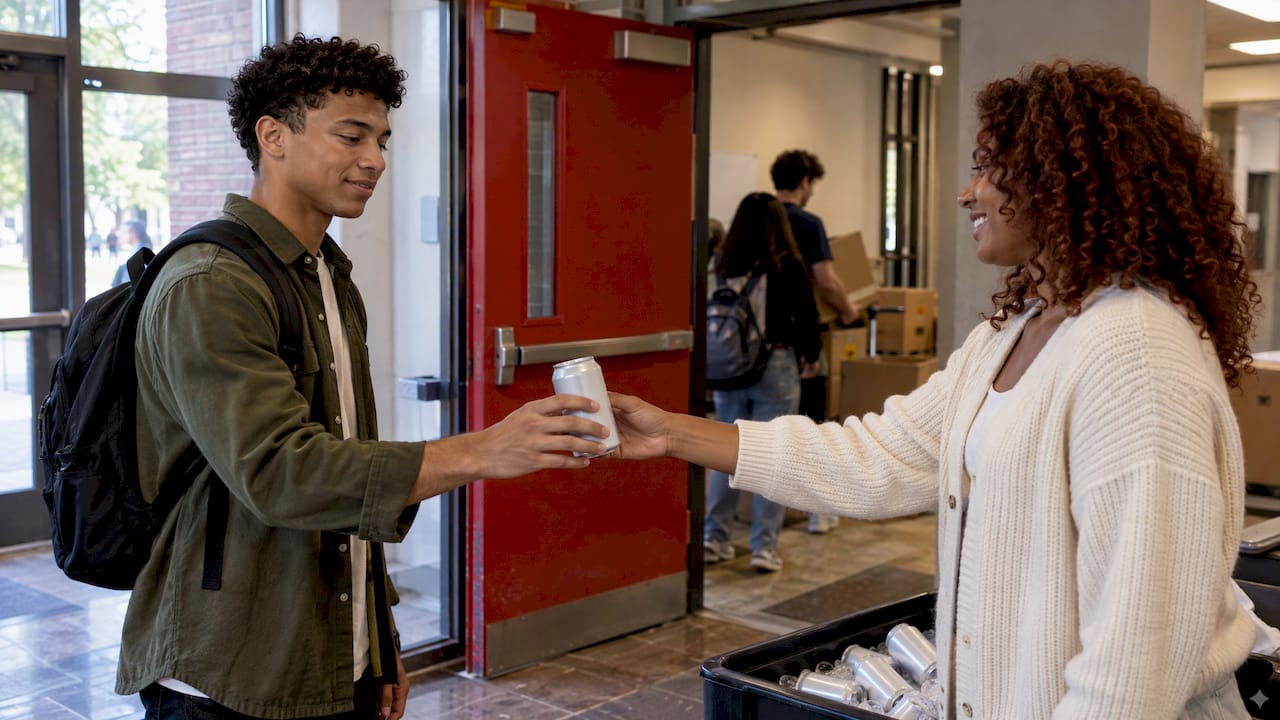

Reaching college students at scale means meeting them inside the places where they already buy, study and live, then repeating that presence across many campuses at once. Broad social buying alone rarely does it. The brands that get there pair campus presence with a retail media layer, so every activation, sample and ad connects to a purchase you can measure. Our work in retail media and commerce media is built around that idea, and it is the thread through everything below.
TL;DR
- College students are a large, valuable and elusive segment: 13.6 million students with more than $237 billion in annual spending power, according to Greenbook’s College AMPlified research.
- Scale comes from repeatable systems, not one-off events: a shared audience layer, a campus retail footprint, creator or ambassador programs and one measurement plan.
- Cost pressure shapes how students respond, so offers need to be useful, convenient and respectful of budgets.
- Measure incrementality and sales, not just impressions. Decide the test before you spend.
- A twelve-week plan, built around key campus moments, is a realistic way to move from pilot to national reach.
Table of Contents
- Why college students are hard to reach at scale
- The channels that carry a national campaign
- How to plan a scalable campaign
- A worked example of a first-semester plan
- Measuring reach, engagement and return
- Where we help
- Our perspective
- FAQ
- Sources
Why college students are hard to reach at scale
A marketer’s first instinct is to treat college students as one audience. They are not. A first-year at a large state school living in a residence hall, a commuter at a community college working twenty hours a week and a graduate student in a professional program share an age range and very little else.
The size of the prize explains why it is worth the effort. Greenbook’s College AMPlified study, run by AMP Agency with ARAMARK Higher Education and surveying more than 2,500 students aged 18 to 24, puts the US college population at 13.6 million students with spending power above $237 billion a year. The same study found that 52% view campus products and services favorably, but only 19% rate them excellent. That gap is the opening for a brand that shows up with something genuinely useful.
Three things make scale difficult.
Fragmentation. More than 3,000 campuses mean thousands of local calendars, rules and gatekeepers. A national program has to be built from local parts.
Control. Greenbook’s research describes students as wanting control over how they interact with brands, with customization, convenience and flexibility adding to perceived value. Interruption-style advertising works against that.
Money. CIRCLE at Tufts University surveyed 5,549 US adults aged 18 to 29 in early 2026 and found cost of living was college students’ top concern. 44% of current students said they sometimes or often struggle to meet basic financial needs, including 55% of Latino and 48% of Black college students. A campaign that ignores that reality reads as tone-deaf.
In practice, this means your message should lead with value, such as a free trial, a student price or a product that solves a daily problem, and your channel plan should favor places where students are already making decisions.
The channels that carry a national campaign
No single channel reaches all of these students. The workable approach is a small set of channels that each do a different job, chosen so they can be repeated campus after campus.
Social and creator content as the awareness layer
Social is where students spend their attention. In Pew Research Center’s 2025 survey, about eight in ten adults aged 18 to 29 say they use Instagram, and roughly half of that age group is on TikTok at least once a day. That makes short-form video and creator partnerships a natural way to build familiarity quickly and cheaply.
The limit of social is that it is easy to scroll past and hard to tie to a sale. Treat it as the top of the funnel and give it a partner that closes the loop.
Campus presence as the trial layer
Physical presence still matters because students are in a decision-making mode on campus: move-in, orientation, textbook purchase, game day, finals week. Sampling, signage, ambassadors and in-store displays put the product in a hand during those windows. We have written about how to approach campus advertising and about how CPG brands can reach students on campus in detail, and the same logic applies to other categories, including makeup and skincare.
The main challenge is consistency. A sampling day at one school is a story. The same sampling day at two hundred schools is an operations problem, which is why the next layer matters.
Retail media as the conversion and measurement layer
Retail media means advertising placed in a retailer’s own channels, such as its website, app, email and stores, and it is tied to that retailer’s sales data. For students, the campus bookstore and its digital storefront are retailers every student has a reason to visit. Reaching students there connects exposure to purchase, which social cannot do on its own.
We have laid out this approach in our retail media first playbook for turning campus activations into store sales, and described how brands can connect with students where they shop through the Follett Media Network. If you want the case for the network’s scale and returns, see how it drives measurable ROI across 6 million students.
Ambassadors and peer programs as the trust layer
Students trust other students. Ambassador programs give a brand a human voice on each campus and a source of content. They work best when the ambassador has a clear job, a product they would use anyway and a simple way to report results. Without those, a program becomes a cost center with a long roster.
How to plan a scalable campaign
Scale is a planning problem before it is a media problem. The sequence below is how we think about it.
1. Pick the segment, not just the age range
Decide which students you want: residential first-years, graduate students, athletes, commuters, students in a specific major. Each has different routines and budgets. A national program usually starts with one or two segments and expands.
2. Choose the moments
The college calendar is predictable. Move-in, the first weeks of term, textbook and supply buying, midterms, spring break and finals all create different needs. Our twelve-week playbook for CMOs maps a campaign to these moments so that spending lands when students are deciding.
3. Build one offer that travels
A national program needs an offer that makes sense at every campus: a trial size, a student bundle, a code that works in store and online. Local flavor goes in the creative, not in the mechanics.
4. Layer the channels
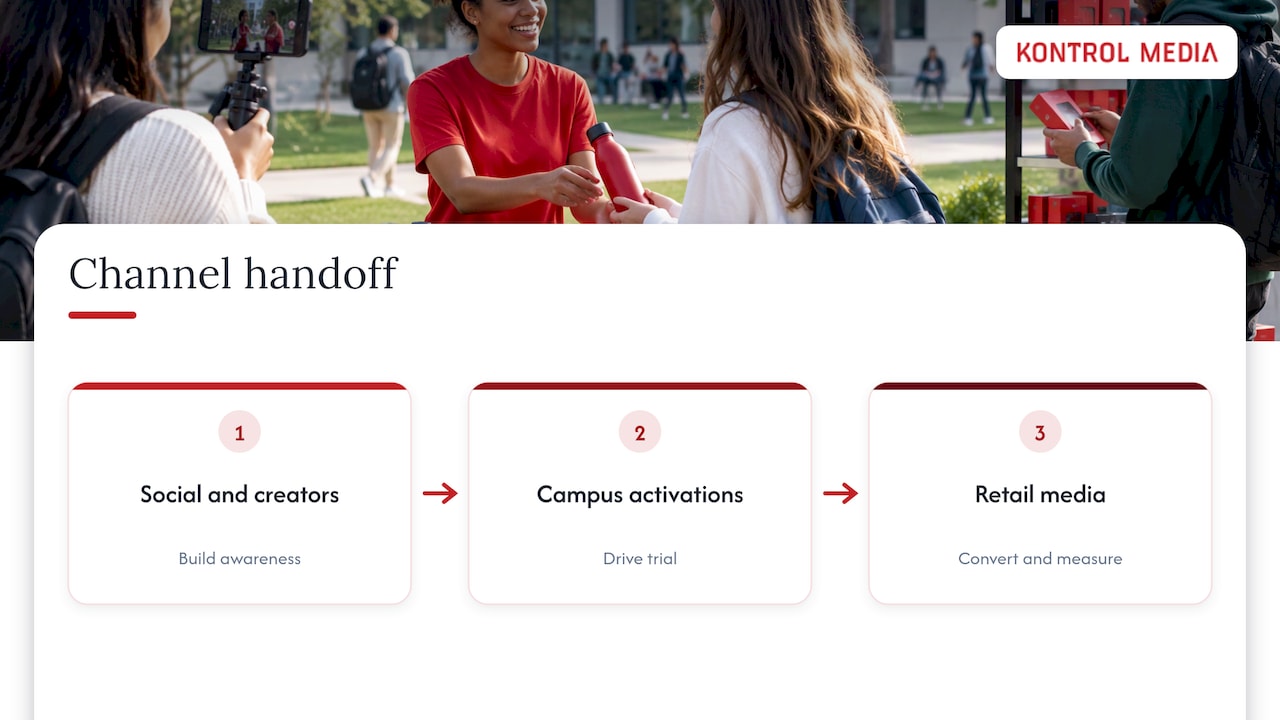
Use social and creators to build awareness, campus activations to drive trial, and retail media to convert and measure. Each layer should point to the next, so that a student who sees a creator video finds the product on the shelf or the storefront during the same week.
5. Set the test before you launch
Decide in advance what a successful result looks like and how you will separate it from normal sales. Matched campus groups, holdouts and pre-post sales comparisons all work. Our guide to measuring the ROI of marketing and advertising campaigns walks through the approach.
A worked example of a first-semester plan
This is an illustrative plan, not a client result. Suppose a beverage brand wants to reach residential first-year students in the fall.
In the weeks before move-in, creator videos introduce the product and point to a student offer. During move-in and the first weeks of term, sampling and signage put the product on campus, with a code or a shelf location that links the sample to a purchase. Across the term, retail media placements in the campus retailer’s channels reinforce the offer, and email brings students back at midterms and finals.
The brand then compares sales at campuses with the full program against comparable campuses with less activity, and reads the difference in units, repeat purchase and cost per incremental buyer. The point of the example is the structure: each channel has a job, and the measurement plan existed before the first sample was handed out.
Measuring reach, engagement and return
The fastest way to waste a college program is to report only impressions. Use a ladder of measures, each one closer to revenue.
- Reach and frequency tell you whether the message arrived, and how often.
- Engagement shows whether students cared: video completion, saves, code redemptions, sample-to-purchase conversion.
- Sales lift shows whether the program sold more than baseline, using holdouts or matched campuses.
- Repeat purchase shows whether trial turned into habit, which is where the lifetime value of a student customer sits.
Be wary of single case studies with eye-catching numbers. They show what is possible for one brand, not what your category should expect. Set your own baseline in the first semester, then improve it in the second.
Where we help
Many brands know the audience is valuable and stall on execution: too many campuses, too many vendors, no shared measurement. We work with CMOs and growth leaders to build the strategy and run the execution across marketing, sales and partnerships, including retail media and commerce media work that connects campus activity to sales.
If you are planning a national student program, our business strategy, marketing and sales services cover the plan and the hands-on delivery. If your audience question is about retailers and networks, see how we stand up a retail or commerce media network and how we run retail media network operations.
We also compare the trade-offs between buying in the campus retail channel and relying on traditional placements in Follett versus traditional media for reaching students, and we cover the typical problems CPG brands meet in reaching college students and how to solve them.
Our perspective
I have spent years watching brands treat the college student as a mood, a vibe, a poster on a dorm wall. The brands that win treat that student as a shopper with a schedule, a budget and a short list of places they actually visit.
What we have learned in retail media and commerce media applies directly. The channel that wins is the one closest to the purchase, because it is the one you can measure. When a campus activation, a creator and a retail placement all point at the same product in the same week, you stop guessing which one worked and start learning which combination works best.
The other lesson is that strategy without execution stalls, and execution without strategy burns money. That is why we do both. A CMO should not have to choose between a deck and a team that can run the program across two hundred campuses. Students reward brands that are useful, convenient and honest about value, and the operating discipline behind the program is what lets those qualities show up at scale.
Mark Kapczynski
FAQ
What is the most effective way to reach college students at scale?
Combine a social and creator layer for awareness with campus activations for trial and a retail media layer for conversion and measurement. Each channel does a different job, and together they let you connect exposure to sales. Starting with one or two segments keeps the program manageable.
Which social platforms do college-age adults use most?
In Pew Research Center’s 2025 survey, about eight in ten adults aged 18 to 29 reported using Instagram, and roughly half said they use TikTok daily. Pew’s figures cover all adults in that age range, not only enrolled students, so treat them as a starting point for your own testing.
How should brands think about students’ financial pressure?
Lead with usefulness and value. CIRCLE’s 2026 survey found cost of living was the top concern for college students, and 44% said they sometimes or often struggle to meet basic needs. Student pricing, trial sizes and clear everyday benefits land better than aspirational messaging alone.
How do you measure whether a college campaign worked?
Decide the test before launch. Compare sales at campuses with the full program against comparable campuses with lighter activity, and track redemptions, repeat purchase and cost per incremental buyer. Impressions alone cannot tell you whether the program paid for itself.
Sources
- Greenbook: College AMPlified: Decoding the Campus Experience
- CIRCLE at Tufts: The Views and Needs of College Students Ahead of the 2026 Election
- Pew Research Center: Americans’ Social Media Use 2025