


A retail media network (RMN) looks like a publisher from the outside: it sells ad space, it has an audience, and it sends invoices. But it is built on a different asset. A publisher monetizes attention it earns with content. A retail media network monetizes shoppers, purchase data and shelf position that a retailer already earns by selling products. That difference decides how you staff the network, how you price it, how you prove results and who you need to sell to. We build and run these networks, and the teams that treat them like a media company with a store attached tend to stall for exactly that reason.
One nuance up front. The IAB says that when a commerce business shows ads on its own e-commerce properties, it takes on the publisher’s role. So the point is not that an RMN never publishes ads. The point is that publishing is the second job, and the retail business underneath is the first.
TL;DR
- A publisher’s product is content-driven attention. An RMN’s product is retailer-owned shopper data, purchase records and placements tied to a sale.
- The IAB says a commerce media network assumes the publisher’s role when it displays ads on its own properties, so the roles overlap, while the businesses do not.
- RMN economics rest on a thin-margin retail core. Nielsen, citing BCG, reports 70% to 90% margins on on-site ads and 20% to 40% on off-site ads.
- Because the RMN sells the media and also reports the results, measurement and sales process need more rigor than a typical publisher program.
- If you are a retailer or consumer business, plan the network as a retail-integrated revenue operation, not as a media property bolted on.
Table of Contents
- What a publisher is, and where the comparison stops working
- Why the economics are not a publisher’s economics
- Where the ads actually run
- Retail media versus commerce media
- What it changes for how you run the network
- A worked example of the shift
- Perspective
- How we help retailers and consumer businesses
- FAQ
- Sources
What a publisher is, and where the comparison stops working
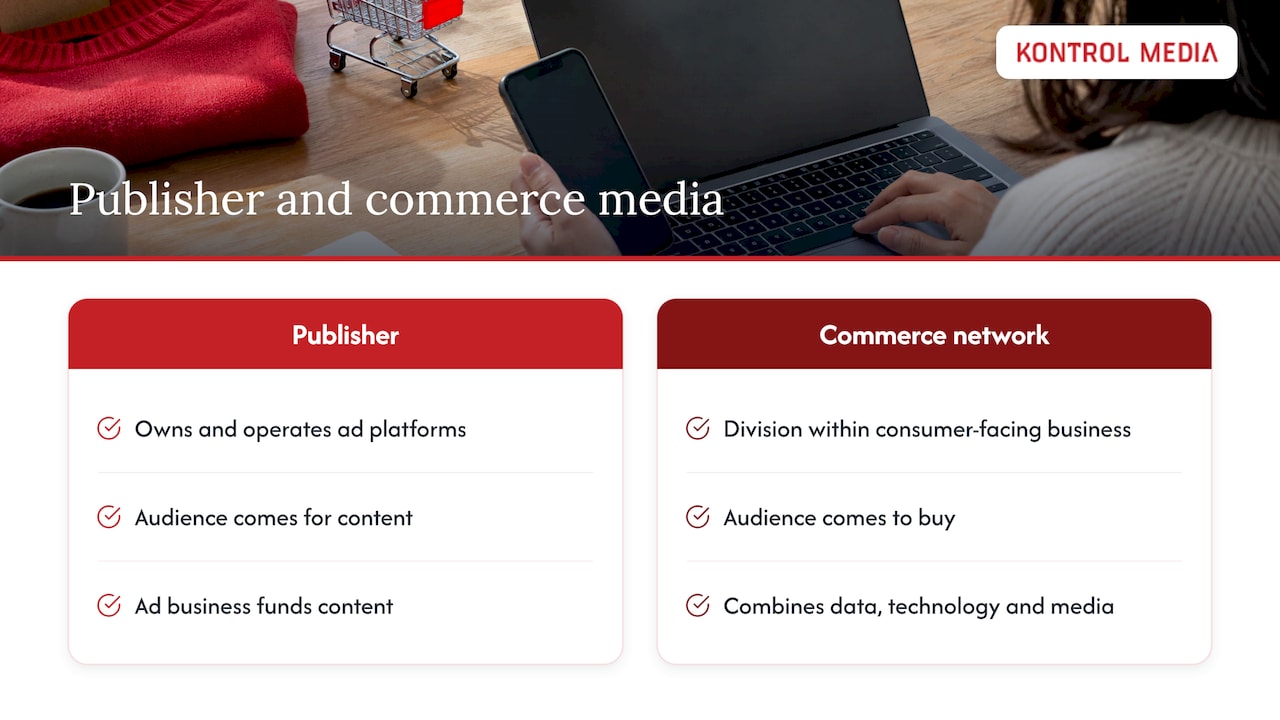
The IAB, the trade body for digital advertising in the US, describes a publisher as an entity that owns and operates digital platforms or properties where ads can be displayed. A news site, a streaming service and a gaming studio all fit. Their audience arrives for the content, and the ad business exists to fund it.
The same IAB paper describes a commerce media network as a division within a consumer-facing business that brings together data, technology and media. Read that carefully. The network is a division of something else. The parent company has a primary reason for existing, and the audience comes for that reason: to buy groceries, electronics, a flight or a mortgage.
eMarketer’s definition, as quoted by Nielsen, points the same way: an asset owned and operated by a retailer that publishes advertisements, or a third-party publisher whose ads use a retailer’s first-party shopper data. Notice that a publisher can take part in retail media too, as a channel that borrows the retailer’s data. That is a useful sign that the two categories are different things that meet at the ad slot.
Three differences that change your plan
- The audience has a different intent. Someone reading an article is browsing. Someone searching a retailer’s site is often close to a purchase. That is why retail media tends to be sold on sales outcomes, not reach.
- The data is a transaction record. A publisher infers interest from reading behavior. A retailer knows what a shopper bought. IDC’s 2026 strategic guide says retailers’ first-party customer data lets brands reach shoppers across owned properties and offsite channels, and that advertisers pay up to 7x more for targeted ads matched to customer signals during the purchase process.
- The inventory starts as the retailer’s own. PPC Land contrasts a classic ad network, which aggregates third-party publisher inventory for resale, with a retail media network, which starts from inventory and data the operator owns.
Why the economics are not a publisher’s economics
Publishers face a familiar equation: fund content with ad revenue and hope the audience grows. Retailers face another one. Grocery and general merchandise run on thin margins, and, as PPC Land notes, selling advertising against traffic that is already paid for carries almost none of the cost of goods.
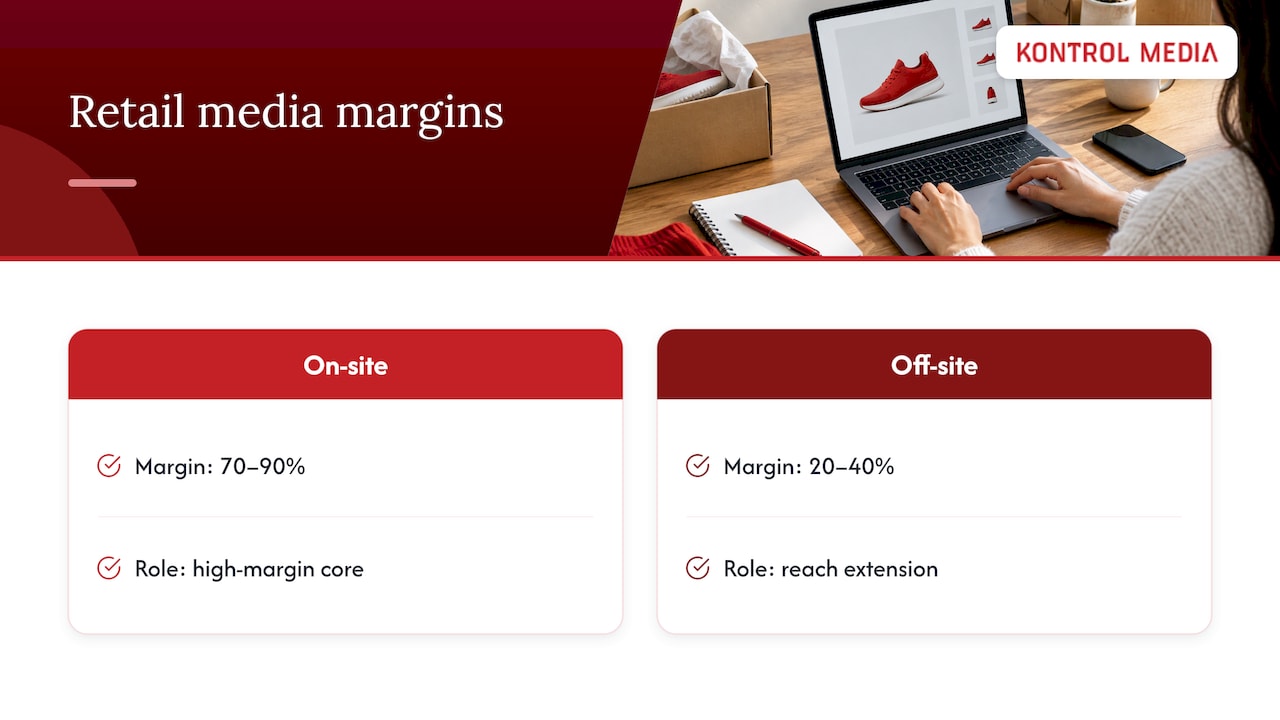
Nielsen, citing BCG, reports retail media margins of 70% to 90% for on-site ads and 20% to 40% for off-site ads. Those are the margins that explain why nearly every large retailer wants a network. They also tell you where to concentrate. On-site inventory is the high-margin core, and off-site is a reach extension that earns less per dollar.
For a CMO or a PE portfolio executive, this changes the business case. You are not building a media brand and hoping to reach scale. You are turning an existing audience and data asset into a second revenue line, and the question is how fast and how credibly you can get advertisers to fund it. Our guide on what retail media networks cost brands and retailers covers how that investment is typically framed.
Where the ads actually run
Because an RMN is not one property, it sells across several kinds of inventory. IAB Europe’s May 2026 definitions give a useful vocabulary that US teams also use, and the IAB’s US paper adds the owned and offsite split.
| Placement | What it is | Why it matters |
|---|---|---|
| On-site | Ads on the retailer’s own websites and apps, such as Sponsored Products and display or video units | Closest to the purchase; defined by IAB Europe as advertising using first-party data on the retailer’s own digital properties |
| In-store | Screens, audio, video, and static formats inside physical stores | Extends the network into the physical shopping trip |
| Off-site | The retailer’s first-party data used on third-party inventory such as social, CTV, display and digital out-of-home | Reach beyond the retailer’s own audience, with measurement tied back to sales |
The IAB’s June 2025 paper frames the same idea for commerce media in general: owned digital channels like a business’s website, app, marketing emails and loyalty platforms, physical owned channels like kiosks and signage, and offsite channels on platforms the network does not own. This is also the answer to a common question about owned media: it is any space the consumer-facing business directly controls.
The most basic example of on-site retail media, per Retail TouchPoints, is an Amazon Sponsored Product ad. Off-site advertising lets advertisers use the retailer’s first-party data to reach customers on channels the retailer does not own, with retargeting as a common case. For a deeper tour, see our breakdown of onsite, offsite and in-store retail media sales channels.
Retail media versus commerce media
The word “retail” can mislead. Travel companies, financial firms and hospitality brands also hold first-party data and run ad businesses, and the industry increasingly calls these commerce media networks. The IAB’s framework covers consumer-facing businesses broadly, and the retailer is one case.
The practical consequence for a consumer business that does not sell physical goods is good news. You do not need to be a retailer to hold the asset that matters, which is a known, consenting audience with behavior you can act on. Our guides on what a commerce media network is and on retail media strategy for non-retailers show how that plays out, and the types of commerce media network models helps you choose a structure.
What it changes for how you run the network
Treating an RMN as a publisher produces predictable mistakes. Here are the ones that matter most.
You are selling a retail outcome, not a page view
Brands buy retail media to move product. Your sales conversation is built on shopper data, category goals and closed-loop results. eMarketer’s January 2026 FAQ says the difference from traditional digital advertising lies in access to first-party purchase data: retailers know what shoppers buy, browse and add to cart, and that powers closed-loop measurement linking impressions to transactions. A rate card built around impressions undersells this.
The retail organization is part of the product
Category managers, merchandising, e-commerce, loyalty and legal all touch the network. Ad placements sit in the same space as the retailer’s own merchandising, so a network without internal alignment ends up in turf disputes. Publishers rarely have that problem. We cover the operating side in our execution-first playbook for retail media network operations.
You are the seller and the scorekeeper
Because the retailer controls both the ad server and the checkout, it can report actual sales, as PPC Land explains. That is a strength, and it also creates a trust question that advertisers raise. eMarketer notes that measurement methodologies vary across platforms, which makes cross-retailer comparison difficult.
The IAB and MRC guidelines from January 2024, again per PPC Land, call for lookback windows (commonly 3, 7, 14, 28 or 30 days) to be disclosed before a campaign starts, and for networks to state how much of attributed sales is extrapolated, since cash payments, missing loyalty scans and device privacy settings leave some buyers unidentified. A network that publishes its attribution rules early earns a faster yes from advertisers. Our piece on how to prove onsite ROAS, then scale offsite lays out that sequence.
Technology is a means, not the business
TechRepublic’s December 2025 explainer describes the stack behind an RMN: identity data such as loyalty IDs and hashed emails, controlled placements including sponsored products and category-page display, and infrastructure like identity graphs, bidding engines and clean rooms. Those pieces matter, but the winners are usually decided by who sells the inventory well and who keeps advertisers coming back. See our build versus buy verdict on network setup before you commit to a stack.
A worked example of the shift
Imagine a regional grocer with 2 million loyalty members. A publisher mindset says: we have traffic, so let’s sell banners at a CPM. A retail mindset says: a snack brand wants to win new buyers in one category, so let’s sell sponsored search on category terms, add an off-site audience of lapsed category buyers, and report sales lift against a baseline.
The second approach uses the same audience, but it sells something the brand’s finance team can reconcile. That is the heart of the “not a publisher” argument. The network’s value is the retailer’s connection to the sale, so that is what the offer, the reporting and the team should reflect.
Perspective
When someone tells us a retail media network is just another publisher, we understand the shortcut. The ad units look familiar, and the buyers are often the same media agencies. But the shortcut hides the hardest parts of the work.
The network is the spine of a retail or consumer business’s second revenue line. It has to be sold to brands with a shopper-outcome story, run with the discipline of operations, and connected to the merchants who own the shelf and the data. That is why our work sits in two places: standing networks up, and operating them so ad revenue actually shows up.
We came to this from the strategy side and the execution side at once, and we think that is the only combination that works. A deck about what your network could be does not sign the first advertiser. A sales team without a measurement story does not keep the second one. We would rather be in the room for both, with a little humor along the way, because this work goes better when people enjoy it.
Mark Kapczynski
How we help retailers and consumer businesses
If you are a retailer or consumer business that wants to launch or grow a network, our Stand Up a Retail or Commerce Media Network service builds the foundation, and Retail Media Network Operations covers running it day to day. Kontrol Media builds, operates and drives revenue and sales for retail and commerce media networks, and that is the work behind this article.
For a closer look at the full range of what we do across strategy, marketing, sales and media networks, start on our services page.
FAQ
Are retail media networks publishers?
Not in the traditional sense. A publisher’s core business is content that draws an audience. An RMN is a division of a retailer whose audience comes to shop. The IAB does say a commerce media network assumes a publisher’s role when it displays ads on its own e-commerce properties, so it performs the function without being the same kind of business.
What are examples of retail media networks?
Retail TouchPoints names Amazon Advertising, Walmart Connect, Target’s Roundel, Kroger Precision Marketing and Best Buy’s Retail Media+. eMarketer also lists eBay and Instacart among the largest US networks. Each is run by a retailer or marketplace and built on its shopper data.
What is considered owned media in this context?
The IAB defines owned channels as advertising spaces a consumer-facing business directly controls, including its website, app, marketing emails, loyalty platforms, and physical spots such as in-store kiosks and signage. Offsite placements run on external platforms the network does not own.
Why do retailers want ad networks at all?
Margin. Nielsen, citing BCG, reports retail media margins of 70% to 90% for on-site ads and 20% to 40% for off-site, set against the low margins of the core retail business. Selling ads against traffic the retailer already pays for adds revenue with little added cost of goods.
Do I need to be a retailer to run one?
No. Consumer-facing businesses with first-party data, such as travel, financial and hospitality companies, run commerce media networks. Our guide on consumer brand media network best practices is a good next read.
Sources
- IAB: Untangling the Issues in Commerce Media Networks (June 2025)
- IAB Europe: Retail & Commerce Media Definitions (May 2026)
- Nielsen: What are retail media networks (June 2024)
- PPC Land: Explaining retail media network (September 2026)
- eMarketer: FAQ on retail media networks (January 2026)
- TechRepublic: How Do Retail Media Networks Work? (December 2025)
- Retail TouchPoints: Retail Media, Everything You Need to Know (November 2025)
- IDC: The Race to Build an Advertiser-Centric Retail Media Network (May 2026)