
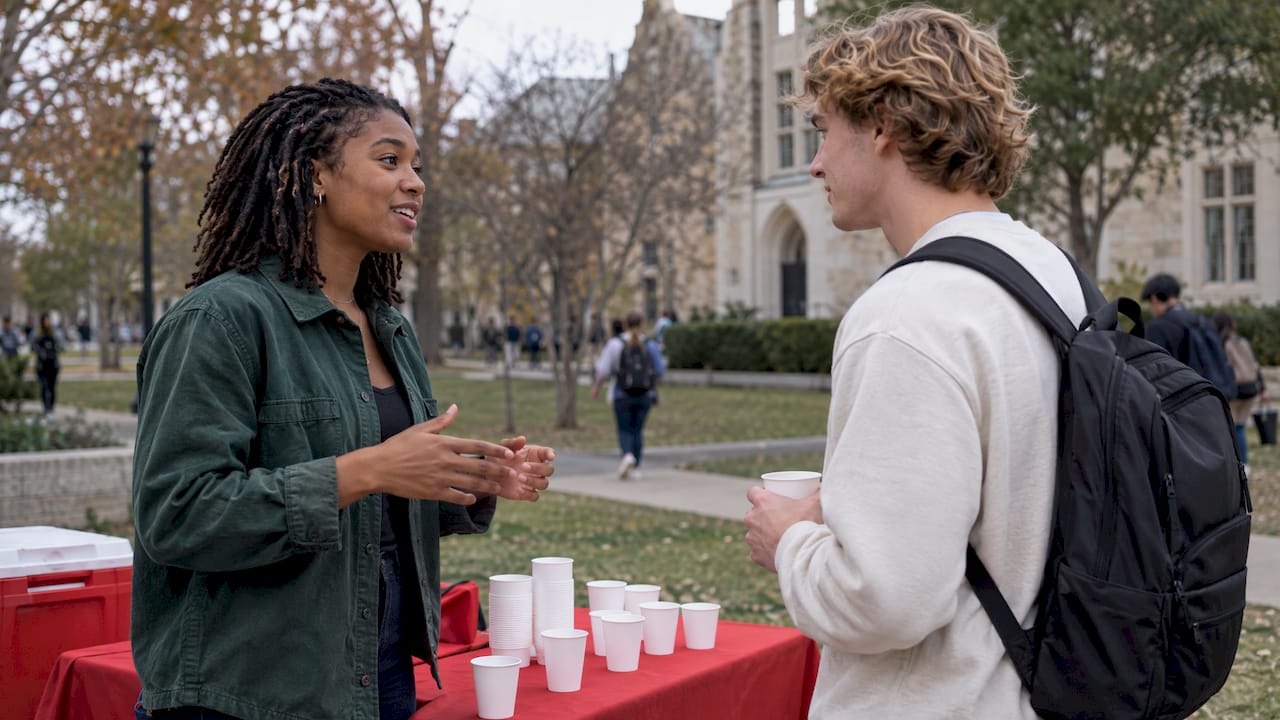

College student outreach programs are organized efforts that connect students with a campus, a service or a community, and for a marketer they are the clearest map of how students actually move through college. Universities run them to bring in prospective students, to help new ones settle, and to keep enrolled ones on track to graduation. If you lead growth at a consumer brand, a retailer or a middle market company, the same structure tells you where students are paying attention and which moments are worth showing up for. The strongest way to reach them is to build a partnership inside those moments, and then measure it like any other revenue channel. That is the work we do at Kontrol Media.
TL;DR
- Outreach programs fall into three groups: those that help students get to college, those that help them start well, and those that keep them enrolled. Each one is a recognizable moment in the student journey.
- Universities run them through offices, federal TRIO programs, nonprofits and peer-led models. The ones that work rely on consistent, personal contact rather than one-off events.
- For brands, the lesson is the same: students respond to sustained, relevant presence, not a single booth or a burst of impressions.
- Campus retail media and in-store activations let you turn that presence into measurable sales.
- We help CMOs and growth leaders design and run these partnerships from strategy through execution.
Table of Contents
- What college student outreach programs actually are
- What the most effective programs have in common
- What this means for brands that want to reach students
- Four ways to build a campus presence that lasts
- A quick comparison of approaches
- Where retailers and consumer businesses come in
- Our perspective
- How we can help
- FAQ
- Sources
What college student outreach programs actually are
The phrase covers more ground than most people expect. Search it and you will find a financial hardship office at one university, a peer coaching service at another, a service day for first-years at a third. They share one purpose: reaching students where they are and giving them a reason to engage.
The AEFP Live Handbook describes how these programs differ. Some begin in high school, some only support students once enrolled, and some span both. They may be run by colleges or by outside organizations, open to everyone or aimed at specific groups, and they range from simple increases in communication to structured supports that shape how students spend their time.
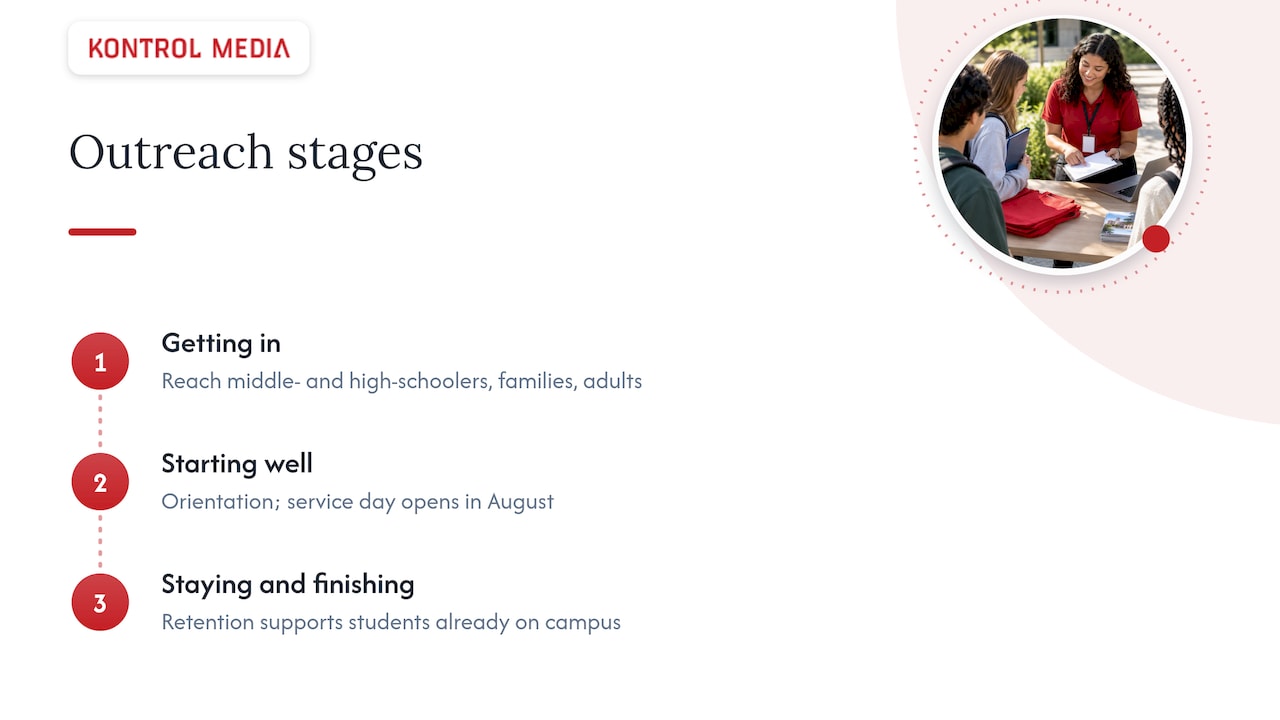
It helps to think about it in three stages.
Getting in. These programs reach middle and high school students, families and adults returning to school. The University of New Mexico’s College Enrichment and Outreach Programs are a good example: College Prep serves younger students and families with summer camps, campus tours and college-readiness programming, while the Educational Opportunity Center helps adults with admissions, financial aid and FAFSA support.
Starting well. Orientation and first-year programs fall here. Boston University’s First-Year Student Outreach Program opens with a day of service in August and continues with monthly events through the fall. It is free and folded into orientation, with students signing up through the orientation portal.
Staying and finishing. Retention programs support students already on campus. The University of Georgia’s TRIO office, for instance, runs seven federally funded programs, including Student Support Services and McNair Scholars, for first-generation, limited-income and other students.
If you came here looking to enroll in or start one of these programs for a campus, your first stop is the student affairs or access office at your institution. The rest of this guide is written for the person who wants to reach students as a brand or a business, which is where our own work sits.
What the most effective programs have in common
Researchers at Harvard’s Center for Education Policy Research note that the federal government launched GEAR UP, Talent Search and Upward Bound to expand college access, and that these programs work best when support is high quality, easy to reach and delivered consistently, with ongoing personal engagement.
Read that as a marketer and it sounds familiar. Consistency, accessibility and personal relevance are the same variables that separate a campaign that builds a customer base from one that produces a spike and a shrug.
Two more examples show the pattern. CARA’s College Allies program trains college students as Peer Leaders who reach out to peers by phone, text, virtual and in-person conversations, plus small group meetings and skill-building workshops. The message comes from someone who looks like the audience. And Boston University’s program does not end after one day: it comes back every month.
The handbook authors also observe that the most intensive programs shape how and where students spend their time, by requiring or incentivizing structured supports. For a brand, you will rarely control a student’s schedule, but you can earn a place in their routine by sitting where they already spend time and money.
What this means for brands that want to reach students
The audience is large. Federal data show that undergraduate enrollment in degree-granting institutions was 15.4 million students in fall 2021, after falling from 18.1 million in fall 2010. Enrollment figures are updated by the National Center for Education Statistics, so check its latest release before you build a market-size slide.
That is a big audience, but students are not one audience. An incoming first-year in orientation week, a transfer student, a graduate student and a returning adult learner have different needs and different spending patterns. Outreach programs are built around those differences, and your marketing plan should be too.
The mistakes we see most often come from treating campus as a media buy instead of a relationship.
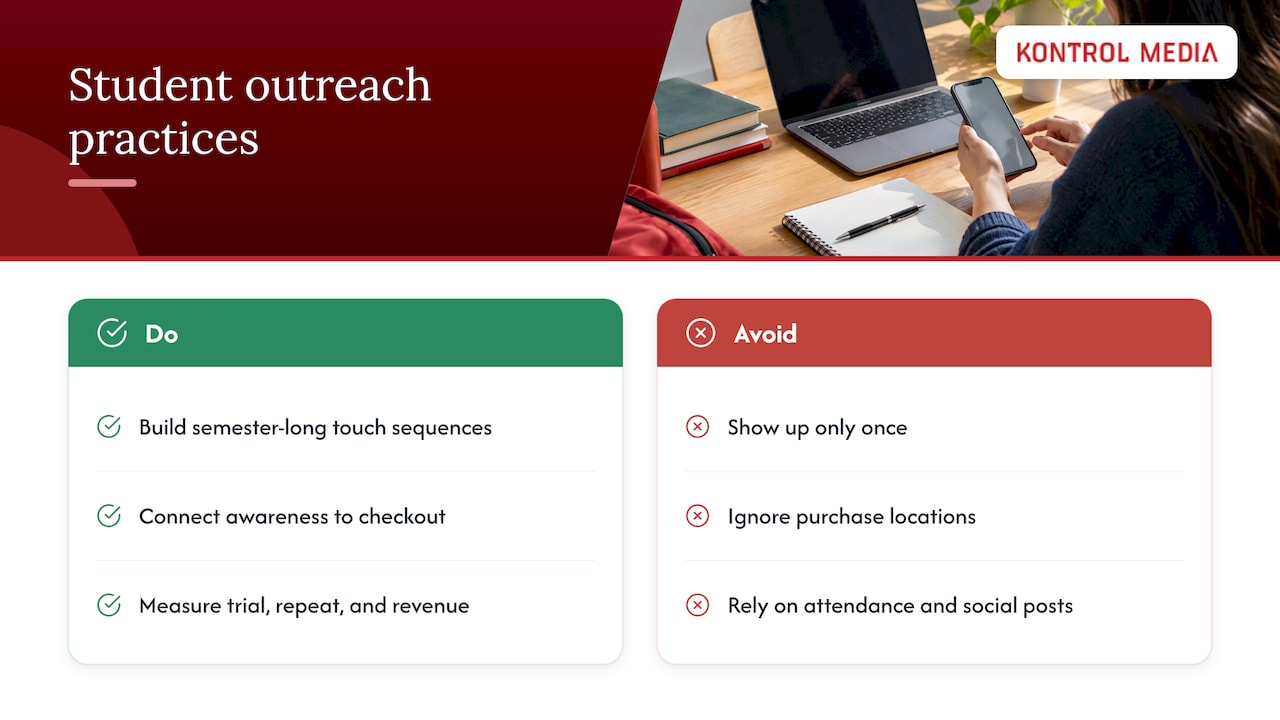
Mistake one: showing up once. A sampling table at a single event produces a good photo and little else. A sequence of touches across a semester produces a habit. The retention programs above exist because one contact is rarely enough.
Mistake two: ignoring where purchase happens. Awareness without a path to the shelf or the checkout is a cost, not a channel. Students shop on and near campus, and the moments around move-in, back to school and the holidays are predictable.
Mistake three: no measurement. Many campus activations are judged on attendance and social posts. A CMO needs to know whether the program moved trial, repeat purchase and revenue.
Four ways to build a campus presence that lasts
1. Anchor to the calendar
Outreach offices plan around a rhythm: summer orientation, a day of service before classes, fall follow-ups, spring retention. Your activations should follow the same rhythm. UNC Chapel Hill’s Service-Learning Initiative places incoming first-years and transfers into three days of community work before classes begin, which shows how much of the student relationship with a campus is set in the first days. Brands that meet students in that window are meeting them while habits are forming.
2. Use peers, not only ads
Students trust other students. Campus ambassador and peer programs carry that trust, and the success of peer leader models in education tells you why. We have written about this in our guides on how CPG brands can reach college students on campus and how makeup and skincare brands can do the same.
3. Place the message where students shop
Retail media puts your offer in front of shoppers at the moment of purchase, in store and online. For a student audience, that means a campus retail environment where the audience is concentrated and the sales data comes back to you. Our overview of connecting with college students where they shop explains the model, and the retail media first playbook shows how to turn a campus activation into store sales.
4. Plan the pilot with an end date and a number
A good pilot has a defined audience, a single hypothesis and a measurement plan agreed before launch. Our 90-day omnichannel pilot playbook for campus retailers lays out how to structure one. If you are weighing it against traditional media, the comparison in Follett versus traditional media for college students is a useful starting point for the business case.
A quick comparison of approaches
| Approach | What it gives you | What to watch |
|---|---|---|
| One-off campus event | Visibility and photos | Limited follow-through, hard to tie to sales |
| Ambassador or peer program | Trust and word of mouth | Needs steady coordination across a semester |
| Campus advertising | Reach inside the campus environment | Needs a clear call to action and measurement |
| Campus retail media | Presence at the point of purchase with sales data | Needs a partnership and an operating plan |
The options are not exclusive. The strongest programs combine two or three, sequenced across the school year. Our guide to reaching college students with campus advertising covers how the pieces fit.
Where retailers and consumer businesses come in
There is a second audience for this topic. If you own a campus store, a regional chain or any consumer business with a loyal shopper base, you hold something brands want: access to a defined audience and the first-party data that comes with it. That is the basis of a retail or commerce media network, where you sell advertising and sponsorships to brands that want to reach your shoppers.
The same discipline applies. A network that sells a single sponsorship and stops will not become a revenue line. One that builds repeatable programs, measurement and a sales motion will. Our guides to what a commerce media network is and the retail media network build versus buy decision walk through the choices.
Our perspective
Every outreach program in education begins with an honest question: who are we trying to reach, and what do they need from us at this moment? Brands often skip it. They start with the channel and work backward.
In our work with brands, retailers and media companies, the pattern is consistent. Growth comes from partnerships that give both sides something real. A student gets something useful at the right time, a brand gets a customer who remembers it, and a retailer or media owner gets revenue and data it can build on. That is the spine of a durable program, and it is why we pair strategy with hands-on execution rather than handing over a deck.
We build and operate retail and commerce media networks, we develop media partnerships, and we run the sales and marketing functions that turn a good idea into measurable growth. The campus audience is one of the clearest examples of why that matters. The opportunity is large, the moments are predictable, and the difference between a pilot that fades and a program that scales is almost always operational: who owns it, how it is sold, and how it is measured.
If you are a CMO weighing a campus program, my advice is to start small, define success in revenue terms, and plan for the second semester before you launch the first.
Mark Kapczynski
How we can help
Kontrol Media works with chief marketing officers, retailers, consumer businesses and PE portfolio companies that need to drive growth. For brands that want to reach students and other high-value audiences, we offer business strategy, marketing and sales support with hands-on execution. For retailers and consumer businesses that want to sell advertising, we stand up a retail or commerce media network and run retail media network operations.
If you want a campus program with a clear owner, a clear audience and a clear measure of success, talk to us through our website.
FAQ
What is a college outreach program?
It is an organized effort to connect students with a college or with support services. Some help prospective students apply and pay for college, some help new students transition, and others help current students persist to graduation. Many are run by the college itself, and some are run by nonprofits or funded by the federal government.
Who can take part in college student outreach programs?
It depends on the program. Federal TRIO programs often serve first-generation, low-income students and students with disabilities, as UGA’s TRIO office describes. Others, like Boston University’s first-year service program, are open to all incoming students as part of orientation. Check the eligibility rules on the program’s own page.
How can brands reach college students without a campus event?
The most direct route is a campus retail or advertising partnership that puts your message where students shop and study, followed by measurement against sales. Peer ambassador programs add trust. We cover the options in our campus advertising guide.
How should a CMO measure a campus program?
Set the metric before launch. Trial, repeat purchase and sales lift tell you more than attendance or impressions. A 90-day pilot with a defined audience and a single hypothesis gives you evidence you can take to your leadership team.
Are outreach programs only for first-year students?
No. College Possible, for example, offers coaching from junior year of high school through graduation, and programs exist for transfer students, adult learners and graduate students. A marketing plan should reflect those different groups.
Sources
- College Access (and Success) Programs, AEFP Live Handbook
- Integrated Programs, University of New Mexico College Enrichment and Outreach Programs
- First-Year Student Outreach Program, Boston University
- TRIO, UGA Office for Student Success and Achievement
- Federally Funded College Outreach Programs, Harvard CEPR
- College Allies, CARA
- Service-Learning Initiative, UNC Chapel Hill
- Report on the Condition of Education 2023, NCES
- College Possible