

The hardest problems for CPG brands in retail media are not about getting access to shoppers. They are about managing too many networks, proving that ads create sales that would not have happened anyway, and running all of it with teams that were not built for it. Brands that treat retail media as a set of operating disciplines, not a line item, tend to find these problems tractable. We build and operate retail and commerce media networks, so we see this from the retailer’s side of the table as well as the brand’s, and that view shapes everything below.
TL;DR
- Retail media is fragmented: more than 200 active networks, each with its own buying tools, formats and reporting, which makes planning and comparison slow.
- Measurement is the sharpest pain. Reported ROAS is not incrementality, and one in five surveyed marketers named incrementality as their top challenge.
- Treating every retailer the same, or running national reach for a product stocked in selected stores, wastes budget.
- Internal silos between media, sales and e-commerce teams are as damaging as external fragmentation.
- The fix is a short list of priority networks, a clear measurement method, and execution that does not depend on one stretched person.
Table of Contents
- Why the stakes are high
- Challenge 1: A fragmented landscape of networks
- Challenge 2: Internal silos that mirror the external ones
- Challenge 3: Measurement that does not match across retailers
- Challenge 4: Treating every retailer the same way
- Challenge 5: Balancing sponsored placements with the shopper experience
- Challenge 6: Connecting retail media to the rest of the plan
- Challenge 7: Running it all with a lean team
- Where we come in
- Our perspective
- FAQ
- Sources
Why the stakes are high
CPG advertisers are projected to spend nearly $59 billion on retail media in 2026, according to eMarketer forecasts cited in 2026 reporting. That is no longer an experimental budget. It is a core line that finance teams will ask to justify, and the challenges below are the reasons many brands struggle to justify it.
A quick definition for anyone new to the term: a retail media network (RMN) is the advertising business a retailer runs on its own site, app and sometimes in its stores, selling placements to brands whose products it carries. The retailer owns the shopper data and the point of sale, which is why the channel is so close to purchase. It is also why every retailer sets its own rules.
Challenge 1: A fragmented landscape of networks
The 2025 Digiday and Instacart industry report counted more than 200 active retail media networks, and it lists a fragmented marketplace among the biggest obstacles for marketers. The practical result is that a brand with national distribution may be asked to buy from a dozen or more networks, each with a different self-serve platform, minimum spend, audience taxonomy and reporting cadence.
In an IAB study of ad buyers, complexity in the buying process was the top growth challenge, cited by 69%. Buyers pointed to siloed networks, a lack of automated buying and inconsistent cross-network performance capabilities.
What fragmentation costs in practice
The cost is rarely a single bad decision. It is the accumulation of small ones: a campaign launched late because the platform required a new onboarding, a report that cannot be lined up with another retailer’s because the attribution windows differ, a budget parked on the network that is easiest to buy rather than the one that sells the most.
The response is selectivity. Rank networks against your business goals, account size, growth in each account and what each platform can actually do for you, then put most of your effort behind the few that matter. A scorecard like this is easy to describe and hard to keep current, which is where an outside operator who lives in these platforms every day earns the fee.
Challenge 2: Internal silos that mirror the external ones
The same IAB research found that internal organizational silos compound the external fragmentation: media, sales and e-commerce teams often work with different goals and budgets. A retail media dollar can sit in the trade budget, the shopper marketing budget or the e-commerce budget, depending on the brand, and each owner measures success differently.
The symptoms are familiar to any CMO. The sales team negotiates a joint business plan with a retailer that includes media commitments, while the media team plans spend independently, and the e-commerce team optimizes product pages for a different goal. Nobody is wrong, but the brand is effectively buying against itself.
A workable fix does not require a reorganization. It requires one shared plan per priority retailer, with one owner for the combined sales, media and content objectives, and one reporting view everyone accepts.
Challenge 3: Measurement that does not match across retailers
Measurement is where most CPG leaders feel the pain. In the Digiday and Instacart survey, 20% of respondents named incrementality as their top retail media challenge, and the report points to inconsistent, still-maturing measurement standards across networks.
ROAS is not incrementality
Return on ad spend (ROAS) divides attributed sales by ad spend. The problem is that a retail media ad often reaches a shopper who was already about to buy, especially in branded search, so attributed sales can look excellent while the ad added little. Incrementality asks a harder question: what would have sold without the ad?
The IAB and MRC retail media measurement guidelines explainer names three methods for isolating causal impact from baseline sales: randomized control trials, synthetic controls and matched-market tests. If you want a plain-language walk-through of how to approach attribution models for measuring lift, it covers the same families of methods. For our own take on what the term should mean when you brief a retailer, see incrementality in retail media.
A practical measurement habit
Before a campaign starts, agree with the retailer on three things: the attribution window, whether new-to-brand buyers are reported separately, and whether a holdout or matched-market test is possible. Retailers differ on all three, and the answers belong in the insertion order or the RFP. We keep a list of the questions worth asking in retail media RFP questions brands should ask, and a companion guide on the key metrics for retail media explains which numbers deserve a place on the dashboard.
Challenge 4: Treating every retailer the same way
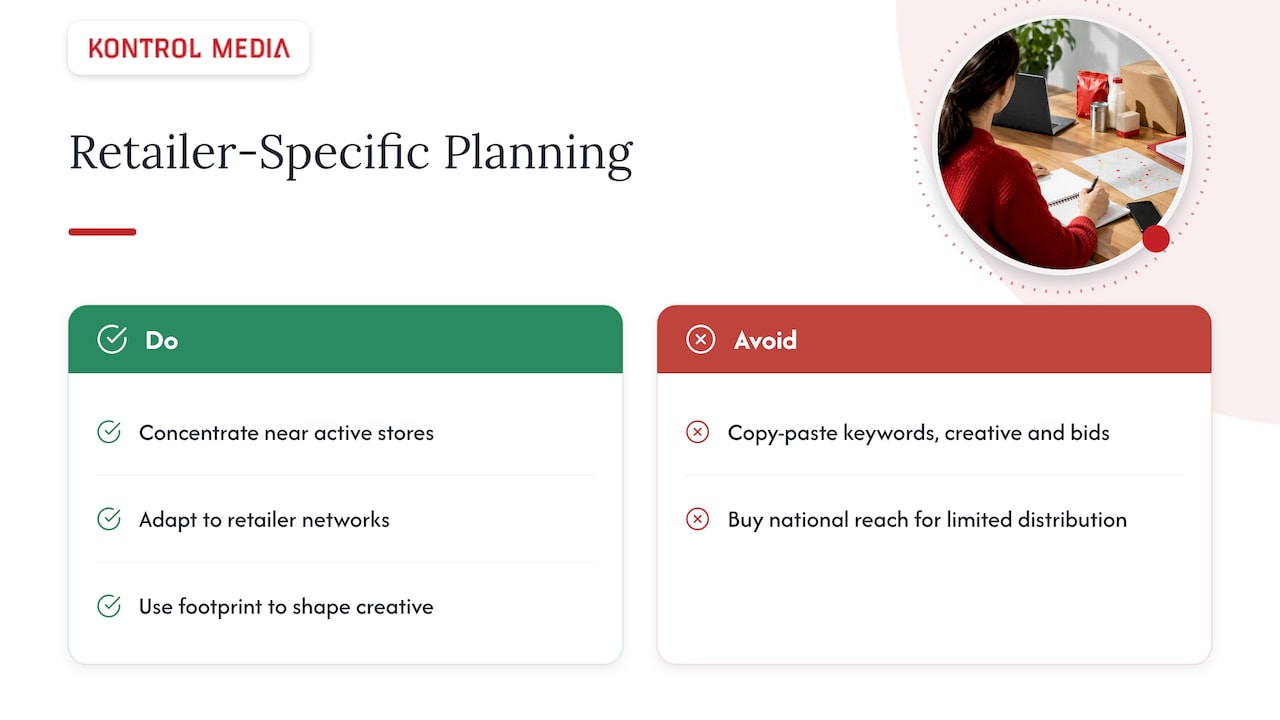
A national brand can fall into a copy-and-paste habit: same keywords, same creative, same bid logic everywhere. Shoppers and retailers do not behave identically. Some networks are search-heavy and some lean on display or off-site audiences; some retailers are strong in specific regions, formats or shopper missions.
The footprint matters most for products that are not fully distributed. ASD Market Week’s September 2026 advice is to concentrate media on ZIP codes near active stores rather than buying national reach when a product sits in selected locations. Spending to reach shoppers who cannot find the product on a shelf is one of the most avoidable forms of waste.
Two recent examples show how retailer-specific thinking works. Path to Purchase Institute reported that Danone sampled in four markets, Northwest Arkansas, North Dallas, Denver and Kansas City, where Walmart and Danone both had a strong presence, and paired the sampling with retail media, social, location-based mobile ads and upgraded product pages. In another report, PepsiCo used an exclusive online Black Friday 2025 launch across Walmart.com, Amazon and TikTok Shop as a controlled test, and the data led it to lead with taste rather than the prebiotic benefit. Both treated the retailer’s data and footprint as inputs to the creative and the plan, not as a place to drop a finished campaign.
Challenge 5: Balancing sponsored placements with the shopper experience
Sponsored listings work when they feel like part of the search. eMarketer, citing the Pentaleap CEO, reports that relevance is the condition for balancing monetization with customer experience, and gives Staples as an example of a retailer that integrates sponsored listings directly within organic results, using behavioral and contextual data to optimize placement.
For a brand, the lesson is that paid rank and organic rank feed each other. Strong reviews, complete content, availability and price all influence whether an ad converts, so a campaign that ignores the product page is paying to send shoppers somewhere that does not close the sale. Rank, content and in-stock status should be reviewed alongside the bid report, not after it.
Challenge 6: Connecting retail media to the rest of the plan
Retail media works best when it has a defined role. ASD Market Week suggests a simple division: social for discovery and brand cues, search for active category intent, retail media for close-to-purchase reinforcement, and open-web display, video or audio for reaching likely category buyers near stocked stores. When retail media is asked to do everything, it gets credit for sales that brand-building created, and the upper-funnel work gets cut at the wrong moment.
That is a marketing strategy problem more than a media buying one. It is also the point where many middle-market and private-equity-backed consumer companies get stuck, because the plan sits between the brand team, the sales team and the agency.
Challenge 7: Running it all with a lean team
Most brands do not have a dedicated retail media department. A small group, sometimes one person, is asked to manage several networks, learn each platform, reconcile reports, negotiate with retailers and report to leadership. The tools are not the only issue. The workload is.
A sensible sequence for a stretched team looks like this:
- Pick the two or three retailers that account for most of your sales and growth, and put the rest on maintenance.
- Decide how you will measure success before launch, including one incrementality test per priority retailer each year.
- Define the role of retail media in the plan, so it is not judged on goals it was never meant to meet.
- Set a weekly operating rhythm for bids, budgets, content and inventory, and a monthly one for learning and reporting.
- Decide which of these jobs stay in-house and which you hand to an operator.
The fifth step is where an execution partner changes the math. Strategy decks do not fix a weekly workload, but someone who actually runs the work does.
Where we come in
Kontrol Media combines business strategy with hands-on execution, and retail and commerce media is one of our three main lines of work. If you are a CPG brand or a consumer business, the useful starting point is usually the strategy question: which networks, which role, which measurement. For retailers and consumer companies building their own network, we stand up a retail or commerce media network and handle retail media network operations once it is live.
If the questions in this article sound like your quarter, our business strategy, marketing and sales services are the place to begin, and our consumer brand media network best practices give a feel for how we think about the work.
Our perspective
Every challenge in this article has a twin on the retailer side. Brands struggle with fragmented buying because retailers have built networks at different speeds, with different tools and different standards. Brands struggle with measurement because networks were set up to sell media first and prove it second.
We build, operate and drive revenue for retail and commerce media networks, and we also help brands reach customers through partnerships. That gives us a habit of looking at both sides of a deal before we recommend anything. A brand’s plan is stronger when it reflects what a retailer can actually deliver, and a retailer’s network is stronger when it answers the questions brands are really asking.
The brands that make progress are the ones that stop treating retail media as a pile of separate buys and start treating it as an operating system: a clear role in the marketing plan, a short list of retailers, a measurement method everyone agreed to up front, and people who run the weekly work. Strategy without execution stalls, and execution without strategy burns money. We put the two together, and we try to make the work enjoyable while we do it, because teams that enjoy the work tend to keep improving it.
Mark Kapczynski
FAQ
What is the biggest challenge for CPG brands in retail media?
Measurement is the one most often named. Reported ROAS can overstate the value of ads that reach shoppers who were already going to buy, and standards differ by network. In the Digiday and Instacart survey, 20% of respondents said incrementality was their top challenge.
Why is retail media so fragmented?
Each retailer built its own network, with its own platform, data and reporting. The Digiday and Instacart report counted more than 200 active networks. For brands, that means many buying processes and results that are hard to compare.
How can a CPG brand prove retail media drives incremental sales?
Use a test designed to separate ad impact from baseline sales. The IAB and MRC guidelines explainer names randomized control trials, synthetic controls and matched-market tests. Agree on the method and the attribution window with the retailer before the campaign starts.
How should a brand with a small team approach retail media?
Focus on the few retailers that matter most to your sales, define what retail media is supposed to do in the plan, and set a regular operating rhythm. Handing the weekly execution to a dedicated operator frees your team to concentrate on strategy and retailer relationships.
Sources
- The State of Retail Media, Digiday and Instacart Ads (December 2025)
- Why precision matters more than scale in CPG retail media, eMarketer
- Retail Media 2023: Operational Strategies for Growth, IAB
- IAB/MRC Retail Media Measurement Guidelines Explainer (January 2024)
- A Smarter Retail Media Strategy for CPG Growth, ASD Market Week
- Danone Recreates Coffeehouse Vibe at Home, Path to Purchase Institute
- How PepsiCo Used Walmart’s Data to Rethink Launch Playbook, Path to Purchase Institute
- Retail media search in 2025: Balancing sponsored ads with customer experience, eMarketer
- Marketing attribution models with GA4 and CRM, Forefront Industries