


A good retail media RFP asks every network the same questions about audience, inventory, data, measurement, pricing, operations and proof, then forces answers into a format you can compare side by side. Most networks will happily send you a deck full of reach numbers. Fewer will tell you what share of a result was actually caused by the ad. The questions below are built to surface that difference.
We work on both sides of this table, helping brands buy and helping retailers build and run networks, so we have read plenty of responses, strong and weak. What follows is the question set we would want on our own desk.
TL;DR
- Open the RFP with your own goals, audience and KPIs, so vendors answer your problem instead of pitching their package.
- Ask how data is sourced (deterministic or inferred), where it can be activated and what identifiers are used.
- Demand the on-site versus off-site split and the incrementality method, not one blended ROAS figure.
- Pin down fees, minimums, make-goods and cancellation terms, and require every answer to be labeled as standard, extra cost or unavailable.
- Score responses with weights you set before reading a single reply.
Table of Contents
- Start with your own brief, not the vendor’s menu
- Audience and reach questions
- Inventory and format questions
- Targeting and data questions
- Measurement and attribution questions
- Pricing, fees and commercial terms
- Operations, creative and support
- Proof, labeling and scoring
- Our perspective
- Where Kontrol Media can help
- FAQ
- Sources
Start with your own brief, not the vendor’s menu
The quality of the answers depends on the quality of the brief. Before you list a single vendor question, write down what you want retail media to do. The IAB Retail Media Buyer’s Guide is clear that a successful strategy starts with defining the core audience that meets your business objectives and studying how that audience behaves: typical customer journeys, categories, brands and SKUs bought or not bought, and the frequency, location and timing of purchases.
In practice, we ask clients to put six things in the opening pages of the RFP:
First, a short overview of your company, categories and distribution, including where your product is actually sold. Second, the business goal in plain language: new-to-brand customers, share gain in a category, defending a hero SKU, clearing inventory. Third, the audience you want to reach and the audience you want to exclude, such as your own existing buyers. Fourth, the KPIs, with baselines and the reporting cadence you expect. Fifth, scope, meaning which formats and channels are in play and which are out. Sixth, the budget range, timeline, submission rules and a single contact for questions.
The IAB guide adds a useful wrinkle. If the campaign is not a straight return-on-ad-spend play, you need to decide where to put media to reach the target audience, onsite or offsite. Say so in the brief. A network that knows you want awareness among lapsed category buyers will answer differently than one that thinks you want last-click sales.
Audience and reach questions
Reach claims are where RFPs most often go soft. Ask for definitions before totals.
- How many monthly active shoppers does the network have, and how many of them are logged in or identified through a loyalty program?
- How is a shopper counted, and how are people deduplicated across web, app, email and in-store?
- What is the geographic coverage, and how does it map to the markets where we have distribution?
- Which category audiences are strongest, and what share of category buyers do they represent?
- How is frequency defined and capped across channels?
If the network has a physical footprint, add questions about it: how many stores and screens, in which markets or zip codes, which store types, and chains versus independents. Ask for a store list or map so you can check the footprint against your own distribution rather than trusting a total. For screens, ask where they sit in the store, how they are measured, how uptime is monitored and what happens when a screen goes dark mid-campaign.
On customer insight, the IAB guide lists what you should expect to be offered: demographics, lifestyle or clustering, purchase behaviors, propensity-to-buy indexes and geography. Ask which of those are available at the audience level and which require a custom analysis.
Inventory and format questions
Retail media is no longer one thing. The IAB Europe 101 guide describes on-site inventory as typically including sponsored products, sponsored display, and display and video formats, while off-site inventory covers display, video, social, CTV, DOOH, digital audio and email. Proposals frequently bundle these together, so your RFP should make the vendor separate them.
Ask which placements are available on-site (search, category pages, product detail pages), in-app, in email, in-store and off-site. Ask which inventory the network owns and which comes from partners. Ask about linking policies, co-branding requirements and creative restrictions, all of which the IAB guide flags as measurement-relevant considerations.
Then ask the single most revealing inventory question: what is the performance split between on-site and off-site? On-site placements catch shoppers who are already searching your category. Off-site placements are meant to create demand but are harder to measure. When both sit under a single blended ROAS number, the on-site results are usually carrying the figure, which is why we always ask for the split before a brand signs anything. If your category is new to a network, our guide to key metrics for retail media shows which numbers to request alongside it.
Targeting and data questions
Targeting is where the retailer’s first-party data earns its price, so the RFP should be specific.
Ask what targeting types are supported: purchase-based, contextual, behavioral, demographic, geographic, lookalike, and activation of your own CRM lists. Rate each one in your RFP as a must, a should or a nice-to-have, so vendors know what carries weight. Ask how often audiences refresh, and how fast a new segment can reach the ad environment after it is created.
The Drum boils the diligence down to a handful of questions worth copying: is the data deterministic or inferred, can the network measure incrementality and not just ROAS, does it integrate with your existing planning tools, and is in-store included or still siloed. The same piece notes that many networks sell inventory while fewer sell outcomes, which is a good sentence to keep in mind while you read responses.
From the IAB guide, add these on activation and identity: which platforms are available for data activation and collaboration, how data is shared and integrated between partners, where it can be activated (in-store, offsite, video, display, DOOH, CTV, social, sponsored product), and which identifiers are used, whether a unique ID, a persistent ID or addressability. Ask what the audience match rate is for your first-party list, because a low match rate quietly shrinks every plan you build.
Privacy, clean rooms and interoperability
Data questions cut across legal, technology and commercial teams, and IAB Australia frames the core of them well: for each demand partner connection, how is audience data moving, under what contractual terms, and what downstream uses are permitted. If a clean room is involved, ask what that does to match rates on addressable inventory.
Our own list adds a few more. Can you bring CRM, loyalty or media data, and what happens to it afterward? What are the minimum audience thresholds and aggregation rules? How long is data retained, and how is it deleted? Can outputs be joined to a neutral measurement partner or a marketing-mix model, and who controls the exposure log and the conversion event? Which DSPs, agencies, identity and verification partners connect through APIs, and which features only work inside the network’s own interface?
If clean rooms are on your shortlist, read what to check before buying a retail media clean room. If you are weighing how much to share and with whom, our piece on privacy-first retailer data partnerships covers the ground rules, and data onboarding that proves match quality before scale is the practical companion.
Measurement and attribution questions
This is the section of the RFP that decides whether you can defend the spend to your CFO. Define the terms yourself, because networks do not share them. IAB Australia points out that a team planning across three or four networks is working with incompatible measurement outputs, inconsistent attribution windows and differing audience definitions, and that comparing them usually means manual reconciliation. Its practical advice is to build your own measurement framework that travels across networks, with consistent definitions of incrementality, attribution and audience quality.
Put these questions to every vendor:
- What attribution window applies, and can we change it?
- Which conversion events count, and how is new-to-brand defined?
- Which sales sources are included (online, in-store, marketplace) and which are excluded?
- How long after delivery do reports arrive, and what breakdowns are available by SKU, audience, placement and week?
- Which incrementality methods do you support (holdout, geo, conversion lift), with what minimum spend and sample?
- Can a third party validate the results?
We suggest asking vendors to describe a measurement hierarchy: delivery reporting first, attributed conversions second, audience and product diagnostics third, and causal testing on top. No single dashboard does all four jobs. If a respondent claims otherwise, that is information.
The distinction between attributed and incremental results matters enough to deserve its own homework. Our explainer on what incrementality in retail media really means and our iROAS measurement guide walk through how a holdout design turns a platform-reported ROAS into a lift figure you can trust.
Pricing, fees and commercial terms
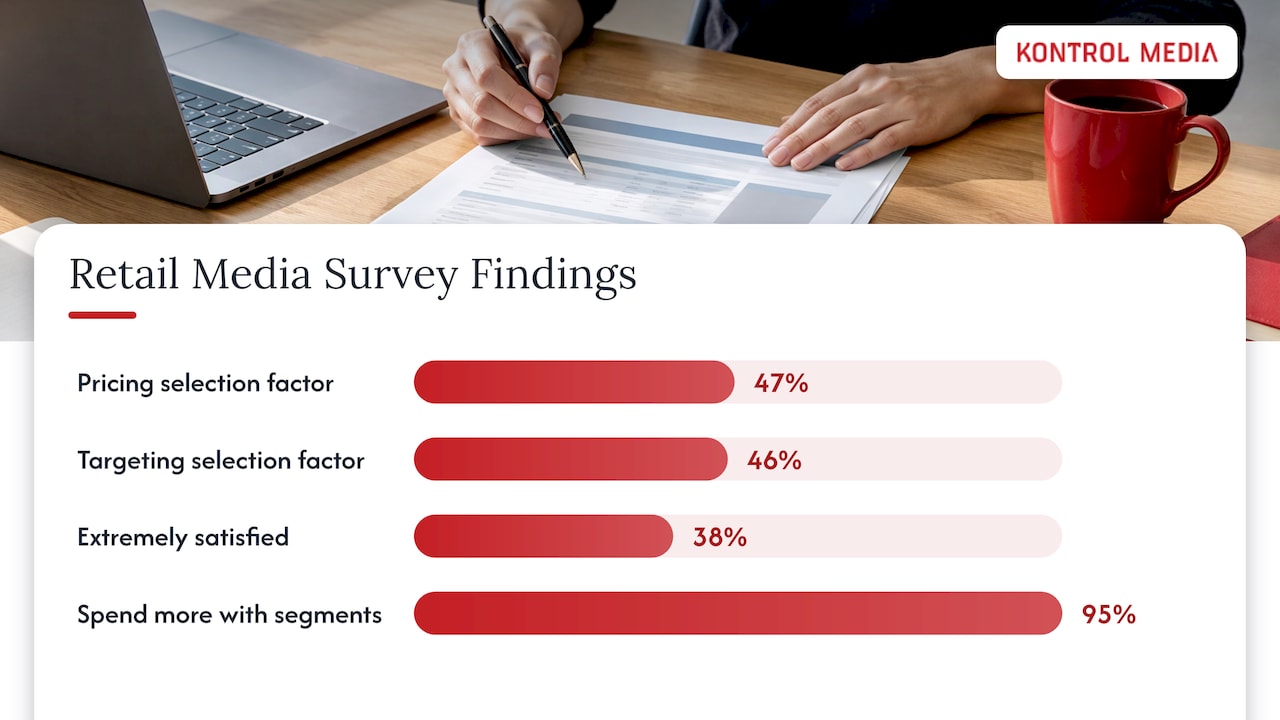
Price is a top-of-mind criterion, but it is rarely a single number. In a GrowthLoop report covered by eMarketer, pricing and fees ranked as a top partner-selection factor for 47% of respondents, with audience targeting, reach and segmentation depth close behind at 46%. The same coverage reports that only 38% of advertisers are extremely satisfied with the audiences available to them, and 95% say access to more segments would likely lead them to spend more. Cost and audience quality are being weighed together, and your RFP should do the same.
Ask for the pricing model (CPM, CPC, cost-per-action, reserved placements or fixed tenancy), minimum spend, minimum number of stores or required packages, and every fee that sits on top: platform, data, creative and measurement. Ask whether you can buy directly, programmatically or both, whether a flight can be paused, extended or adjusted mid-campaign, what make-goods apply if delivery falls short, and what the cancellation terms are.
Expect some answers to be negotiated rather than published. One public comparison of retail media platforms notes there is no public price list for one major offering and that revenue-share and partner platform fees are not public. Another notes that enterprise total cost stays custom because rate floors, implementation fees and revenue-share terms are negotiated per retailer partnership. That is exactly why the RFP should ask for the full fee schedule in writing. For context on what brands and retailers typically weigh, see our overview of retail media network cost.
Operations, creative and support
A network can have superb data and still be painful to work with. Ask whether the model is self-service, managed service or both, who the day-to-day contact is, and what the minimums and timelines are for each. Ask for trafficking timelines, creative specifications (file types, sizes, durations), the review process and how long it takes, how far ahead creative must be delivered, how quickly a campaign can launch after approval, and how issues are escalated.
If you sell through a large catalog, add product data questions. Feed management is a common operational bottleneck: you may need to map your taxonomy to the retailer’s category structure and keep pricing and inventory in sync. A clear process for product feed management will save you disapprovals and delays, and the RFP should ask how the network handles feed errors and how fast they are resolved.
Finally, ask about onboarding. Who owns each step, which standards the network follows, and what the first thirty days look like. Our guide to advertiser onboarding in retail media outlines the roles and the IAB and MRC standards a brand marketer should expect to see.
Proof, labeling and scoring
Two mechanics make responses comparable. First, ask for two relevant case studies, each with spend range, baseline, test design, sales definition and stated limitations, instead of a single headline return. Second, require a label on every answer: guaranteed, standard, available at additional cost, or unavailable. Without that, “yes” can mean four different things.
Then score. Build the scorecard before the responses arrive, so the weights reflect your goals and not the most impressive deck. A simple version gives the heaviest weight to measurement and data, then audience fit, then commercial terms, then operations, then proof. Your weights will differ, and that is the point. A launch-focused CPG brand may weight audience and inventory higher, while a team under pressure to prove efficiency may put measurement first.
Finally, run the same finalist call with each vendor, using the same scenario: your product, your budget, your KPI. Ask each to describe how they would plan, launch, measure and optimize it. The differences show up quickly.
Our perspective
We have sat on both sides of this table, and the pattern is consistent: the brands that get the most from retail media are the ones that arrive with a point of view. They know their audience, they know what a good outcome looks like in dollars, and they have decided in advance how they will test it.
An RFP is the cleanest place to express that point of view. It is also the first test of a network’s candor. When a respondent answers the incrementality question with a clear method, labels what is extra cost and shows the on-site and off-site split, you are talking to a partner. When the answers dissolve into a blended number, that tells you something too.
Our work spans building and operating networks as well as helping brands and agencies activate them, so we write these questions knowing what a good answer takes to deliver. Retail media is growing up, and the buyers who ask sharper questions are helping everyone, networks included, raise the standard. Progress here is collaborative, and we are optimistic about where it is going.
Mark Kapczynski
Where Kontrol Media can help
If you are a brand or agency preparing an RFP, or a retailer who expects to receive many of them, we can help on either side. We build, operate and drive revenue for retail and commerce media networks, and we support the strategy and execution around them. Explore how we stand up a retail or commerce media network or take over retail media network operations, and see our wider strategy, marketing and sales services.
If you are a retailer deciding whether to build the capability yourself, our build versus buy verdict is a good place to begin.
FAQ
How many questions should a retail media RFP include?
Enough to cover audience, inventory, targeting, data, measurement, pricing, operations and proof, and no more. For most brands that is roughly three to six questions per area, each tied to a decision you will actually make. Long, generic lists get long, generic answers.
What is the most important retail media RFP question?
How the network measures incrementality, and whether it will share results by on-site and off-site placement. Last-touch ROAS alone can credit ads with sales that would have happened anyway. A clear test design, such as a holdout, gives you a number you can defend.
Should I send the same RFP to every network?
Send the same core questions so answers are comparable, then add a few format-specific ones. A store-screen network needs footprint and uptime questions, while an e-commerce marketplace needs feed and sponsored product questions. Keep the scoring weights identical across all of them.
Who should be involved in writing the RFP?
Marketing, analytics, legal or privacy, and finance, at a minimum. Data questions touch contracts and compliance, and pricing questions touch procurement. Bringing them in early prevents surprises when the winning vendor sends terms.
Sources
- IAB Retail Media Buyer’s Guide (July 2023)
- IAB Europe 101 Guide to Retail Commerce Media (July 2025)
- IAB Australia: Data Sovereignty and Interoperability in Retail Media
- The Drum: A practical framework for evaluating retail media networks
- eMarketer: Slow audience delivery is costing retail media networks ad dollars
- RFP.wiki: CitrusAd vs Microsoft Retail Media
- RFP.wiki: CitrusAd vs Zitcha