


A good retail media RFP process comes down to six moves: decide which side of the value chain you sit on, write requirements around outcomes, publish a clear budget and timeline, shortlist respondents on fit, score every answer against the same criteria, and plan the transition before you announce a winner. Teams that skip the first step end up comparing products that were never meant to be compared.
I have watched retailers, brands and PE-backed consumer businesses run this process, and the pattern is consistent. The RFPs that go well are short on adjectives and long on specifics. The ones that stall are usually a recycled agency template with the words “retail media” pasted in. This guide walks through the process in the order you will actually do the work.
TL;DR
- Start with your role: a retailer building monetization needs different things from a brand buying across networks, so write the RFP for one of them, not both.
- Ask for outcomes and proof (incrementality, closed-loop sales, who makes the final ranking call), not feature checklists.
- Publish the budget structure, the timeline, the question deadline and the scoring criteria in the RFP itself.
- Score every response side by side on identical criteria, then put the finalists through a pilot or a live working session.
- Write the transition plan, data ownership terms and measurement spec into the contract before you sign.
Table of Contents
- What a retail media RFP is, and who sends one
- Step 1: Decide whether you need an RFP at all
- Step 2: Write goals and requirements around outcomes
- Step 3: Build the RFP document itself
- Step 4: Identify respondents and keep the process consistent
- Step 5: Evaluate proposals side by side
- Step 6: Cover privacy, data and measurement standards
- Step 7: Pilot, decide, and plan the handover
- Where Kontrol Media fits in your process
- FAQ
- Sources
What a retail media RFP is, and who sends one
A retail media network is a retailer’s advertising business, built on first-party shopper data and inventory that spans onsite (search, display, product ads), offsite (programmatic, social, connected TV) and in-store (screens, audio, experiential), according to The Drum’s framework for evaluating retail media networks. An RFP is the structured document you send to the parties who could help you run, buy or build that business, asking them to propose a plan and describe their capabilities.
Two very different people send them, and the confusion between the two is the most common reason an RFP fails.
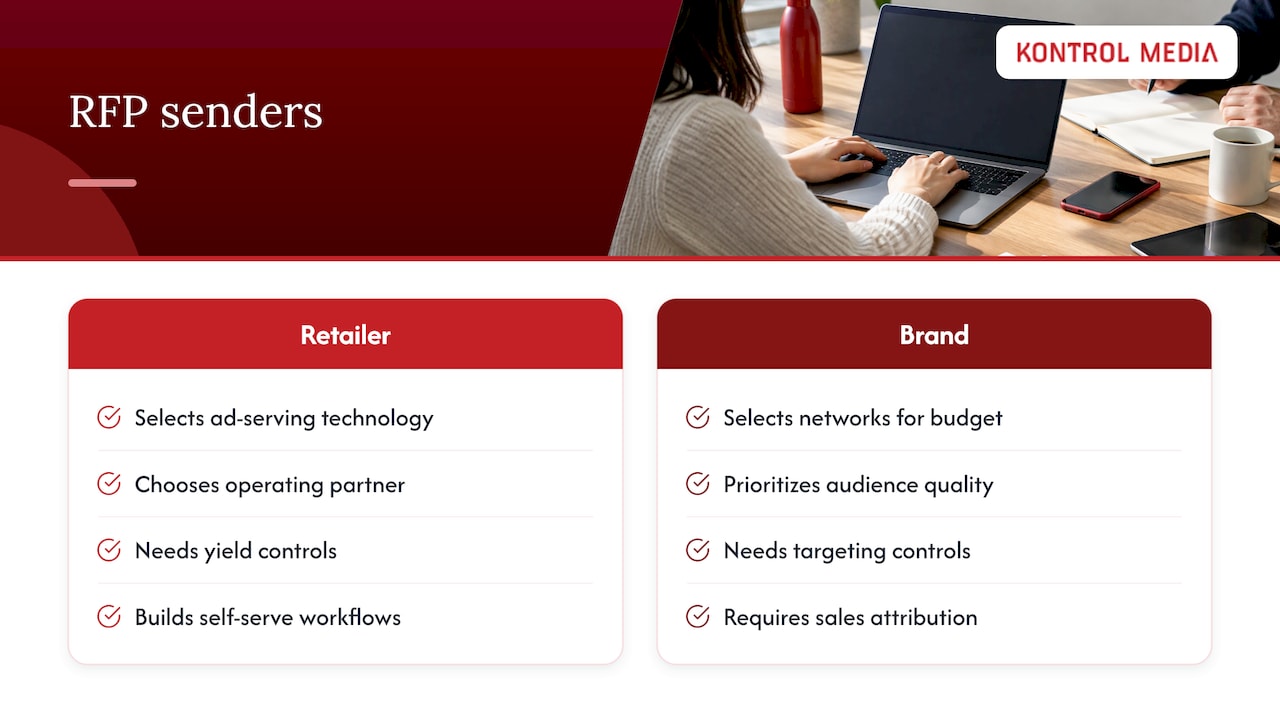
The retailer or commerce media business sends an RFP to technology vendors, operators and service partners. It is choosing ad serving, sponsored product tooling, self-serve workflows, measurement, and often an operating partner who will sell and run the network.
The brand or its agency sends an RFP to networks. It is choosing where to put budget, and it cares about audience quality, reach, targeting controls and proof that spend drives sales.
RFP Wiki makes the same distinction in its retail media vendor guide: selection should start with your role in the value chain. Retailers building monetization need ad serving, yield controls and retailer-branded self-serve workflows, while CPG brands buying across walled gardens need cross-network orchestration and consistent attribution. It also warns against comparing these products on a generic feature checklist alone.
The rest of this article leans toward the retailer and commerce media side, because that is where the process is hardest to get right. Brand-side buyers can use the same structure with a different question set.
Step 1: Decide whether you need an RFP at all
An RFP makes sense when the decision is expensive, hard to reverse, or involves several stakeholders who need a defensible paper trail. Standing up a network, replacing your ad server or hiring an operating partner all qualify.
It is not always a traditional RFP, though. When Consumer Cellular moved its $50 million retail media, paid search and paid shopping business, it skipped the traditional RFP, sent an RFI and proposal request instead, and ran a two-round review that took about 10 weeks, as Adweek reported. The lesson is not that RFIs are better. It is that the format should match how much you already know. If you are still learning what the category offers, an RFI first can save you from writing requirements you will have to retract.
If you are earlier still and unsure whether to build, buy or partner, settle that first. Our build vs. buy verdict on retail media network setup lays out the trade-offs, and it is far easier to write an RFP once that decision is made.
Step 2: Write goals and requirements around outcomes
The single most useful discipline is to state what success looks like in business terms before you list a single feature. Are you trying to reach a specific ad revenue figure in year one? Add offsite revenue? Move from managed service to self-serve? Bring in non-endemic advertisers? Each goal changes what you need.
Then translate goals into requirement areas. Based on the guidance in the research, the categories below cover what most RFPs need.
| Requirement area | What to ask | Why it matters |
|---|---|---|
| Inventory coverage | Onsite, offsite and in-store formats supported; which are live versus planned | Many networks sell inventory, fewer sell outcomes |
| Data and targeting | Deterministic or inferred audiences; privacy controls; catalog and loyalty integration | Determines targeting quality and compliance exposure |
| Operating model | Self-serve, managed service or hybrid; who staffs campaign setup and support | Sets your headcount and speed |
| Measurement | Incrementality, closed-loop sales, attribution windows, reporting depth | Decides whether advertisers renew |
| Monetization | Yield controls, pricing models, sponsored product logic | Drives your revenue per session |
| Launch effort | Time to first campaign, integration work, who does it | Affects cost and risk |
Two requirements are missing from most RFPs, according to Pentaleap’s published guidance. First, state which system makes the final ranking call in sponsored placements, and require the vendor to describe it in enough detail that a technical reviewer, not just a salesperson, could confirm it. Second, name which systems must remain independently replaceable after implementation, and require the vendor to state in contract language what happens to your data, relevance tuning and integrations if you replace any one of them. Whatever you think of any vendor, those are sound questions to put in your own document.
For measurement, ask The Drum’s questions directly: whether the data is deterministic or inferred, whether the network can measure incrementality and not just ROAS, whether it plugs into existing planning tools, and whether in-store is included or still siloed.
Step 3: Build the RFP document itself
A clear structure matters more than polish. A workable outline looks like this:
- Company background and the business problem
- Goals and success metrics
- Scope of work and requirements, split into must-have and nice-to-have
- Audience, categories and advertisers you expect to serve
- Budget structure
- Timeline and response instructions
- Evaluation criteria and weighting
- Terms, data and confidentiality requirements
The IAB’s Interactive Advertising Workflow Best Practices make a point that still holds: open communication begins with the RFP, and sharing objectives, target audience, inventory preferences and special requests beyond budget and flight dates lets respondents produce a more complete proposal. It also recommends clear formatting, specific priorities, some flexibility and a response deadline.
Budget
Give respondents a number or a range. Vague budgets produce vague proposals. Public RFPs show how specific this can be. A paid advertising RFP from a Texas food bank published in July 2025 capped the total at $290,000, inclusive of production, agency fees and related expenses, and split it across three lines of work with a ceiling on each. It also set a three-year preferred vendor relationship. The sector is different from yours, but the habit is worth copying: say what is included in the cap, split it by workstream, and state the contract term.
Separate fixed fees from variable costs such as revenue share, media pass-through and implementation. Ask every respondent to price against the same scenario so the numbers can be compared.
Timeline and response instructions
Publish the whole schedule up front. The Idaho Lottery’s 2025 advertising agency RFP is a clean model: RFP issued on March 20, a question deadline of April 7, answers posted to everyone on April 11, proposals due April 18, presentations from April 30 to May 7, a committee recommendation on May 13, respondents notified on May 15, and a new contract in place July 1. It also capped proposals at 30 pages and one submission per respondent. That is about 15 weeks from issue to contract, which is a realistic planning figure for a public body and a useful upper bound for a private business.
For most retail media decisions, plan for four to five phases: issue, questions and answers, written responses, live demos or presentations, and negotiation. Posting every answer to all respondents at once keeps the field level.
Step 4: Identify respondents and keep the process consistent
Build a longlist from three places: vendors your peers use, analyst and industry coverage, and partners who already operate in your category. Cut it to a handful of serious respondents. Writing a thorough response is expensive, and the best partners will decline a 15-company beauty contest.
Consistency is where you earn credibility with respondents:
- Send the same document, at the same time, to everyone.
- Route all questions through one contact and share answers with all respondents.
- Keep a short internal policy on who can approve pricing and who reviews each section. The IAB guidance recommends documenting the review levels needed for pricing approvals so the process stays transparent.
- Involve legal early on terms, data processing and confidentiality.
If you are a retailer trying to attract advertisers as well as choosing vendors, think about the other side of the table too. Our piece on advertiser acquisition strategies for media networks covers the demand side your chosen partner will need to help you build.
Step 5: Evaluate proposals side by side
Create a scorecard before the proposals arrive, not after. Weight the criteria according to your goals. A retailer chasing fast launch will weight implementation effort heavily. A retailer with a mature data team may weight openness and replaceability more.
A simple weighting to adapt:
| Criterion | Example weight |
|---|---|
| Measurement and proof of outcomes | 25% |
| Fit with your operating model | 20% |
| Data, privacy and integration | 20% |
| Monetization capability | 15% |
| Launch effort and timeline | 10% |
| Commercial terms | 10% |
These weights are a starting point of our own, not an industry standard. Change them to match your priorities, then lock them before you open the first response.
Watch for answers that describe a roadmap as if it were a product. The Drum puts the test plainly: networks are not interchangeable, and one that cannot explain its role beyond high intent is probably selling convenience, not outcomes. RFP Wiki suggests favoring vendors that prove closed-loop sales outcomes on the channels you require, respect your privacy constraints, and integrate with catalog and loyalty data without slowing the shopper experience.
When an answer is vague, ask a follow-up in writing and give everyone the same chance. Then hold a working session with each finalist where they show the actual workflow: campaign setup, approvals, exceptions and reporting. A demo of the real admin interface tells you more than twenty pages of prose.
Step 6: Cover privacy, data and measurement standards
In the United States, there is no single federal rule for this, so your RFP should ask respondents how they handle the state privacy laws that apply to your shoppers and how they handle consent. The IAB and Media Rating Council’s Retail Media Measurement Guidelines are the best shared reference for the measurement section. They recommend following applicable privacy regulations, safeguarding personal information with practices such as encryption and access controls, and capturing impressions, clicks, viewability and outcomes, with data-quality checks. They also describe the data sources behind measurement: transactional, loyalty and behavioral onsite or in-store data first, with ad servers, publishers and third-party measurement providers as secondary sources.
The IAB’s paper on issues in commerce media networks adds a practical flag: most networks share aggregated reports, but some reports can contain record-level data with personal information, which raises data-sharing questions. Ask each respondent exactly what advertisers receive.
Put the measurement spec in the contract, not just the proposal. It should list attribution windows, lookback logic, whether view-through counts, whether sales are reported gross or net of returns, and who audits the numbers. Your legal counsel should review the privacy and data-sharing language before you sign.
Step 7: Pilot, decide, and plan the handover
If the budget allows, run a short pilot with your top two finalists before the final award. Set success criteria in advance, such as launch speed, campaign setup time, reporting accuracy and advertiser feedback on the interface.
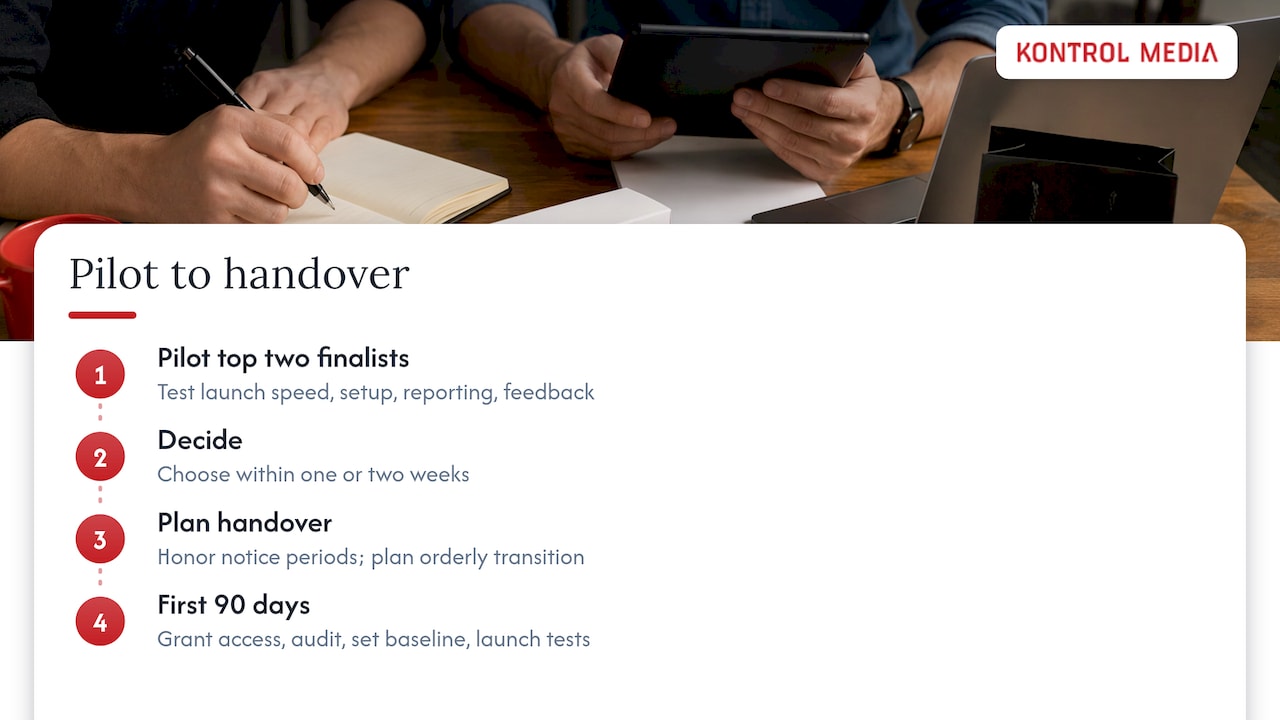
Then decide quickly. The WFA and EACA pitch guidelines recommend deciding as soon as possible after presentations, ideally within one or two weeks, telling every pitching party on the same day, and offering a debrief to those who lose. If you are replacing an incumbent, honor the notice period and outstanding orders, and ask for an orderly handover. A binding transition plan for all parties is also recommended.
Build first-90-day milestones into the award: access granted, an audit delivered, a measurement baseline set, and the first tests live. Our 90 day retail media monetization plan shows how retailers can sequence those early weeks, and the execution-first operations playbook covers what day-to-day running looks like once the contract is signed.
Our perspective: the RFP is only as good as the operating plan behind it
We have spent a lot of time on both sides of this table, and the thing we see most often is an RFP that treats a retail media network as a technology purchase. It is not. The software matters, but a network lives or dies on whether someone sells to advertisers, sets up campaigns cleanly, proves incrementality and keeps the first-party data trustworthy.
That is why we push clients to write the operating model into the RFP. Who sells? Who staffs campaign support? Who owns the advertiser relationship in year two? If the answers are “we will figure it out after launch,” the RFP has quietly moved the hardest work into the gap between vendors.
Our own view is that strategy and execution belong together. We help retailers and commerce media businesses decide how to stand up a network, then operate it and drive advertiser revenue, so the plan in the proposal turns into campaigns in market. An RFP that asks for outcomes, openness and a realistic first 90 days gives every partner, including us, the chance to show that.
Mark Kapczynski
Where Kontrol Media fits in your process
If you are a retailer or consumer business preparing an RFP, we can help before the document goes out and after the award. That means defining the business case and requirements, shaping the operating model, and then running the network once it is live. We work with chief marketing officers, PE portfolio companies and middle market and enterprise teams on business strategy, marketing, sales and retail or commerce media operations.
Start with how we stand up a retail or commerce media network, or see what retail media network operations looks like day to day. If you want to talk through your RFP, reach us through our site.
FAQ
How long should a retail media RFP be?
Long enough to be specific, short enough that a good partner will finish it. Many public RFPs cap responses, and the Idaho Lottery example above limits proposals to 30 pages. Aim for a requirements document that a busy team can answer in a couple of weeks, with must-haves clearly separated from nice-to-haves.
How many vendors should receive the RFP?
A focused group is better than a wide net. Most teams do well with a longlist drawn from peer recommendations and category coverage, narrowed to a handful of invited respondents. Fewer, better-matched respondents tend to put more effort into their answers.
Should the RFP include a budget?
Yes. State a total or a range, say what it includes, and split it by workstream, as the TAFB example does. Separate fixed fees from variable costs so proposals can be compared on the same basis.
What is the difference between an RFI and an RFP?
An RFI gathers information about what the market offers and who the credible players are. An RFP asks selected respondents for a specific proposal and price. Some brands, like Consumer Cellular in the Adweek example, use an RFI plus a proposal request in place of a traditional RFP to move faster.
What should happen right after the decision?
Tell every respondent the result on the same day, offer debriefs, and put a transition plan with first-90-day milestones into the agreement. Make sure data ownership and replaceability terms are written into the contract, not left to conversation.
Sources
- A practical framework for evaluating retail media networks, The Drum
- Best Retail Media Networks Vendors 2026: RFP Guide, RFP Wiki
- Consumer Cellular Overhauls Agency Roster, Adweek
- Five Requirements Missing From Most Retail Media RFPs, Pentaleap
- Interactive Advertising Workflow Best Practices, IAB
- Paid Advertising Request for Proposal, TAFB
- Advertising Agency Services Request for Proposals, Idaho Lottery
- IAB/MRC Retail Media Measurement Guidelines
- Untangling the Issues in Commerce Media Networks, IAB
- Client-agency relations pitch process, WFA and EACA