


Retail media creative follows one rule above the rest: the shopper already has intent, so your ad’s job is to remove friction between that intent and the purchase. Everything else in the guidelines, from a single clear message to safe zones, accessible contrast, and honest claims, serves that job. Below, we walk through what the creative includes, which specs to confirm before you build, how to adapt it for onsite, offsite and in-store placements, and how to test it so you learn something from every flight.
TL;DR
- Build for intent: one message, one focal point, a visible logo, and a call to action matched to the shopper’s stage in the funnel.
- Every retailer publishes its own specs and approval rules. Confirm dimensions, file types, file weight, video length and prohibited claims before design starts, not after.
- Onsite creative captures high-intent shoppers, offsite creative builds reach and awareness, and in-store creative must work on a screen or fixture seen in seconds.
- Test small first with A/B or multivariate variants, tie each test to a KPI, and judge creative on more than short-term ROAS.
- A creative system that is reusable across retailers saves more money than any single hero asset.
Table of Contents
- What retail media creative actually includes
- The retail media creative formats you will brief
- Specs to confirm before you design anything
- Design rules that hold across retailers
- Adapting creative for onsite, offsite and in-store
- Testing creative and measuring what worked
- A creative workflow that scales
- Our perspective on retail media creative
- Get help building the network and the creative system
- FAQ
- Sources
What retail media creative actually includes
Retail media promotes products or services inside a retailer’s ecommerce platform or physical store. The IAB Retail Media Buyer’s Guide notes that using customer data to reach shoppers who are already in a shopping mindset can raise the propensity to purchase or convert. That is the context your creative lives in. Nobody is browsing a feed hoping to be entertained; they are comparing, deciding, and often one tap from checkout.
In practice, the creative package covers several asset types: product images and titles for sponsored listings, banners for display placements, brand-page layouts, short video, takeovers, offsite social and connected TV spots, and in-store screens or printed fixtures. Each of those has a different job, a different viewing distance, and a different set of rules. Treating them as one “banner” brief is the most common reason campaigns underperform.
Why it moves performance
Creative is often the last thing a retail media plan funds and the first thing blamed when results disappoint. The evidence suggests it deserves earlier attention. An Ipsos study published in October 2026 found that high-quality creative delivers a 21% performance premium over low-quality ads among out-of-market consumers, plus a 12% lift in short-term choice among undecided shoppers. The same report argues that an industry focused only on short-term metrics like ROAS risks ignoring the compounding value of creative in building brand equity.
We agree with the spirit of that warning. Return on ad spend tells you what happened at the shelf. It does not tell you why a shopper trusted your product enough to pick it, and creative is a big part of that why.
The retail media creative formats you will brief
The IAB Europe retail media guide, drawing on IAB industry reports from 2023 and 2024, groups onsite placements into sponsored products, search ads, display banners, brand pages, video and takeovers. Offsite digital retail media uses a retailer’s first-party data to reach audiences on third-party sites, connected TV, social media and digital out-of-home.
The physical store adds another layer. The IAB DOOH and in-store playbook lists digital in-store options such as radio, DOOH screens, TVs, ATMs and hand scanners, alongside traditional placements like trolley panels, shelf booklets, gondola ends and sampling.
| Placement type | Shopper mindset | Creative priority |
|---|---|---|
| Onsite (sponsored products, search, display, brand pages) | High intent, comparing options | Clear product, price or value cue, ratings, fast path to purchase |
| Offsite (social, CTV, open web, DOOH) | Lower intent, open to discovery | Brand recognition, a story, a simple reason to look for you at the retailer |
| In-store digital and print | In aisle, moving, glancing | Large type, one idea, legible from a distance |
The IAB Retail Media Buyer’s Guide frames the split the same way: onsite ads show products and how they fit shoppers’ needs, offsite media widens a retailer’s audience to drive awareness, and in-store media reaches people in the physical store. If you want the strategic logic behind sequencing these, our piece on proving onsite ROAS before scaling offsite covers it, and the offsite retail media checklist covers the build.
Specs to confirm before you design anything
There is no universal retail media spec sheet. Each retailer, and often each placement within a retailer, publishes its own. Before a designer opens a file, confirm these items for every placement on the media plan:
- Dimensions for each banner, tile, or screen size, including separate desktop and mobile versions.
- Accepted file formats for images and video, and whether animation is allowed.
- Maximum file weight, which can be very small on some display units.
- Video duration, audio rules and caption requirements. Many in-store screens play silent.
- Safe zones, where key messaging must sit so it is not cropped by screen edges or interface overlays.
- Prohibited content, which commonly includes competitive comparisons, unapproved pricing, external web addresses and unsubstantiated claims.
- Logo and brand requirements, such as minimum logo size or required borders.
- Approval turnaround, so creative review does not eat your launch window.
Retailers differ on the details. Some require a thin border around banners so they separate from the page, some cap file weight at a few dozen kilobytes, some forbid calls to action inside video, and some ask that digital signage ads be silent and avoid flashing or pulsating effects. These are not arbitrary hurdles. They protect the shopping experience, which is the asset the retailer is selling. Read the current spec sheet from each retailer’s ad portal every time you brief, because they are revised often.
Our practical habit: build a master template with the strictest constraints from your media plan, then resize down. It is far easier to loosen a design than to rescue one built for the most generous placement.
Design rules that hold across retailers
Spec sheets tell you what will be approved. They do not tell you what will work. The following principles come from the research above and from what we see when we run networks and advise advertisers.
One message, one focal point
Shoppers scan quickly, and a crowded unit loses to a simple one. Pick the single thing you want remembered, whether that is a product benefit, an offer, or a recognizable pack, and give it a single focal point. Keep text light and the logo clearly visible. Retailers that publish best practices consistently say the same thing: simple beats clever.
This is where the subconscious side of display matters too. Retail display has to balance color, contrast and movement, which help it stand out, with clear brand integration so people remember who the ad was for. An eye-catching ad that never names the brand is a gift to the competitor in the next tile.
Match the call to action to the funnel stage
The IAB buyer’s guide stresses mapping creative content to channel KPIs across the consumer journey, with calls to action tailored to the right funnel stage. A lower-funnel sponsored product might say what the shopper gets, while an upper-funnel offsite video should do something gentler: introduce, remind, or point to where the product is sold. Pushing a hard “buy now” at someone who has never heard of you wastes the impression.
Remove friction, do not chase attention
Ryan Cook, vice president of advertising at Disco, argued in eMarketer that retail media creative is not competing for attention, because shoppers already have intent. Its job is to remove friction between intent and action. That reframes the brief. Ask of every asset: does it answer the shopper’s likely question (what is it, is it for me, is it worth it) faster than the next ad does?
In practice that means clear product imagery, ratings and reviews where the platform allows them, a believable value message, and nothing that makes someone stop and decode.
Respect accessibility and the platform
Contrast, text size and legible type are not only accessibility courtesies; they are what makes an ad readable on a small phone screen in a hurry. Avoid flashing effects, keep important content inside safe zones, and never rely on audio alone. Video on retail sites typically starts on mute, so design the first seconds to make sense without sound and add captions or on-screen text where permitted.
Keep video short and human
For food and beverage sponsored video, Walmart Connect’s guidance recommends roughly 6 to 15 seconds, with upbeat music preferred over voiceover because videos launch muted. The same analysis suggests relatable, real-life moments and product-in-use scenes raise emotional engagement. We would apply that beyond food: show the product doing its job in a believable setting.
Adapting creative for onsite, offsite and in-store
Onsite: build for the decision
Onsite creative meets shoppers who are close to buying. Lead with the product, make the benefit obvious, and use proof such as ratings. In seasonal windows, price-conscious shoppers respond to value messaging, so a holiday version of a unit should lead with value and quality rather than just festive decoration. Keep a library of seasonal variants ready so you are not rushing through approvals when a retailer’s peak period arrives.
Offsite: build for memory
Offsite creative travels beyond the retailer’s site to social feeds, connected TV and the open web. Here the shopper does not have a basket open, so the creative must carry more brand and story, then connect to the retailer. Consistency matters: if the offsite ad looks nothing like what the shopper finds on the product page, you have broken the thread. Our audience data activation playbook explains how first-party audiences get you to the right person; creative decides whether that person remembers you.
In-store: build for three seconds
In-store screens and fixtures are seen in motion, from a distance, often without sound. Use large type, a single idea, and imagery that reads at a glance. Remember that a placement in a physical environment has its own safety and content standards, so check retailer rules for flashing, audio and imagery before production, not after.
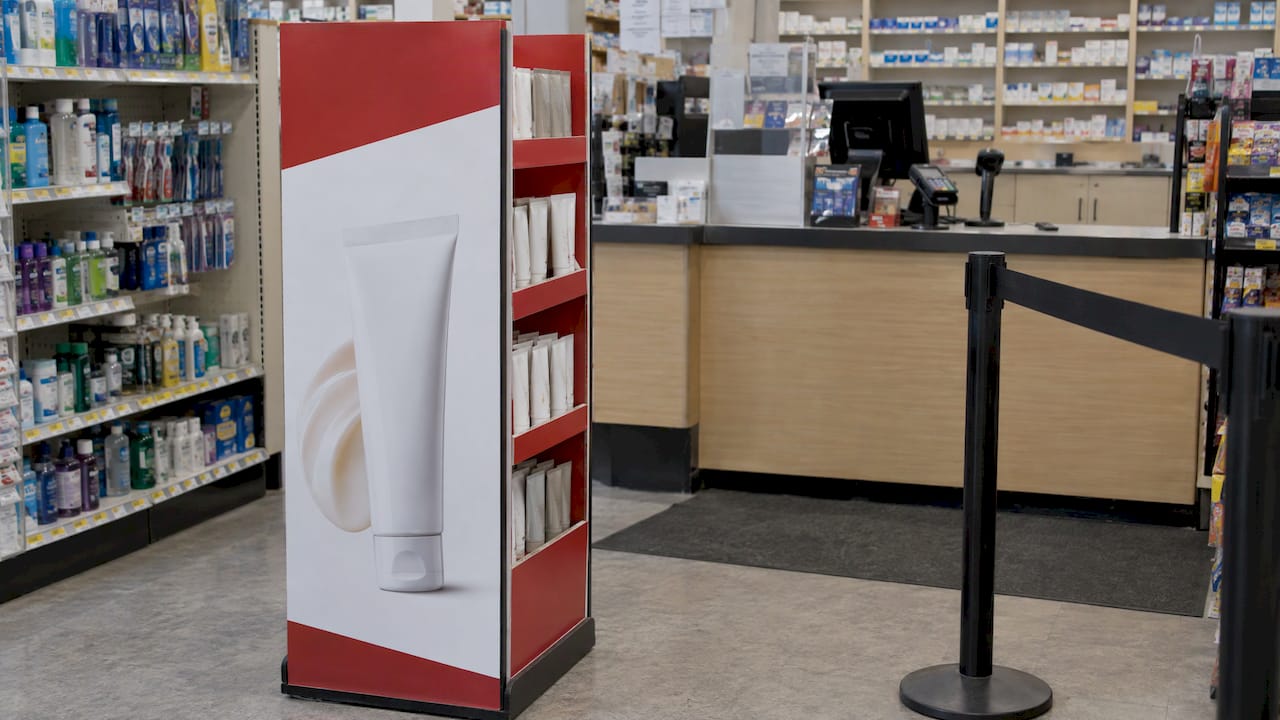
The broader point of shopper marketing strategy applies here: the creative should feel like one idea expressed differently at each point in the path, not three unrelated campaigns.
Testing creative and measuring what worked
Creative guidelines are a starting position, not a verdict. The IAB DOOH playbook advises piloting new initiatives and A/B testing at a smaller scale before a broader rollout, with KPIs set in advance. For interactive kiosks, it recommends multivariate testing of screen layout, call-to-action placement and content type to find the best-performing configuration.
A workable testing routine looks like this:
- Choose one variable at a time: headline, hero image, offer framing, or call to action.
- Set the KPI before launch. Click-through rate suits upper-funnel tests, while add-to-cart or sales lift suits lower-funnel ones.
- Run each variant long enough to reach meaningful volume, and keep audience and budget as equal as possible.
- Record the result, the hypothesis and the learning in one shared place so the next team does not repeat the test.
- Roll the winner out across similar placements and retest when the season or the retailer’s layout changes.
Measurement rules matter as well. The IAB/MRC Retail Media Measurement Guidelines define a viewable display ad as one with at least 50% of pixels visible for one continuous second, and a viewable video ad as one with 50% of pixels visible for two continuous seconds. That is a useful sanity check when a creative seems to underperform: if it is barely seen, the problem may be placement, not message. For the metrics themselves, see our guide to key retail media metrics and our iROAS measurement guide.
Teams producing many variants also lean on generative tools for drafts, resizing and copy options. If you are deciding what to automate and what to keep human, this overview of AI tools for marketers is a good place to start. Whatever the tool, a person should still check every asset against the retailer’s spec sheet and brand rules before submission.
The 2026 IAB Connected Commerce Summit framed commerce media as having moved from a test channel to a core business driver that needs proof of performance integrated across retail, media and operations. Creative testing is part of that proof.
A creative workflow that scales
Most problems with retail media creative are process problems. A few habits fix most of them:
- Brief from the media plan. List every placement, retailer and spec before design begins.
- Design modular systems. A shared set of logo lockups, product shots, headline blocks and color rules lets you assemble approved variants quickly.
- Build an approvals calendar. Retailer review takes time, and holiday periods are crowded.
- Keep a claims file. For every statement in an ad (a rating, a benefit, a comparison), store the substantiation so you can answer a reviewer immediately.
- Close the loop. Feed test results back into the next brief.
Onboarding matters here too. Our advertiser onboarding guide walks through the roles and standards that keep creative, data and measurement aligned from the first campaign.
Our perspective on retail media creative
Over the years we have sat on both sides of the table: building and running networks, and helping brands buy them. The pattern is consistent. The networks that grow ad revenue are the ones whose advertisers succeed, and advertisers succeed when creative is treated as part of the system rather than a file attached at the end.
That is why we push retailers to publish clear, current creative guidelines and to review quickly, and why we push brands to arrive with modular assets and a testing plan. Creative is the spine of the brand inside the retail environment. When the spec sheet, the approval flow and the measurement plan all point the same way, everyone takes up space together instead of tripping over each other.
We would also gently resist the habit of judging every unit by last-click return alone. Strong creative builds memory that pays off across later purchases, and a network that measures only the immediate click will undervalue the work that makes the click possible. Hands-on execution, creative included, is where strategy becomes revenue.
Mark Kapczynski
Get help building the network and the creative system
If you are a retailer designing guidelines, review flows and ad formats for your own network, or a brand trying to bring order to creative across many retailers, we can help with both the strategy and the execution. See how we stand up a retail or commerce media network and how we run retail media network operations, or talk with us about business strategy, marketing and sales support.
Tell us where your creative process breaks down, and we will help you fix the part that costs you the most.
FAQ
What are retail media creative guidelines?
They are the rules and best practices a retailer sets for ads on its properties, covering dimensions, file formats, file weight, video length, safe zones and prohibited content. They also usually include design advice such as keeping one message and a visible logo. Each retailer publishes its own, so check the current version for every placement.
Why do retailers reject retail media ads?
The usual causes are wrong dimensions or file weight, text-heavy layouts, unapproved pricing, competitive language, external links, or claims the advertiser cannot substantiate. Flashing effects and low-quality images are also common problems on in-store screens. A pre-submission checklist built from the retailer’s current spec sheet prevents most rejections.
Should onsite and offsite retail media use the same creative?
Use the same brand system but not the identical asset. Onsite shoppers are close to buying, so the ad should be product-focused and action-oriented. Offsite audiences need more brand and story, since the IAB describes offsite media as a way to expand reach and awareness. Keep the look consistent so the shopper recognizes you at both points.
How do I test retail media creative?
Start small. The IAB recommends piloting and A/B testing at a smaller scale before a broader rollout, with KPIs set in advance. Change one variable at a time, run each version long enough to collect meaningful data, and record what you learned for the next flight.
How long should retail media video ads be?
It depends on the placement, so confirm the retailer’s limits first. For food and beverage sponsored video, Walmart Connect recommends 6 to 15 seconds. Design for muted playback, with clear visuals and captions or on-screen text, because videos often launch without sound.
Sources
- IAB Retail Media Buyer’s Guide (2023)
- Ipsos Retail Media Report: Creativity Over Clicks
- IAB Europe 101 Retail Media Guide (2024)
- IAB DOOH and In-Store Retail Media Playbook (2024)
- eMarketer: Driving purchases with the right creative in retail media campaigns
- Walmart Connect: How to create watch-worthy video ads
- IAB/MRC Retail Media Measurement Guidelines (2024)
- 2026 IAB Connected Commerce Summit