
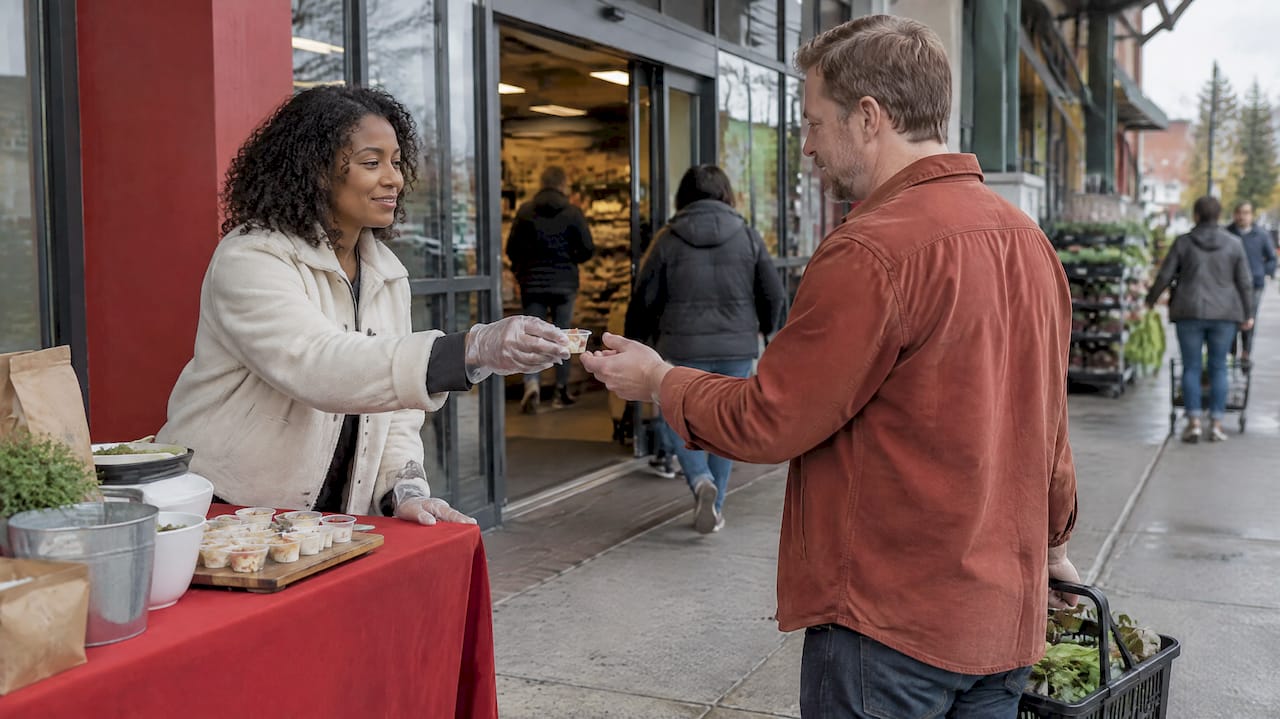

An in-store activation drives sales when it puts your product in a shopper’s hands, or in front of their eyes, at the moment they are choosing, and when you can prove the units sold would not have sold otherwise. Sampling, demos, displays, events and in-store media all qualify. The ones that pay back are planned with the retailer months ahead, verified on the floor, and measured against matched stores. This guide covers how to choose a format, run it, and prove it worked.
TL;DR
- An activation is a planned, shopper-facing moment in the store (a demo, a sample, a display, an event, in-store media) built to move trial and purchase, not just awareness.
- Pick the format from your objective: trial for new products, velocity for existing ones, retailer buy-in for new distribution.
- Space is committed through the retailer’s joint business planning, often months before creative is final, so start early.
- Verification is the weakest link: shipped displays are not the same as built displays, so plan audits from day one.
- Measure incremental lift against comparable control stores, then look past same-day sales to velocity and repeat purchase.
Table of Contents
- What an in-store activation is, and what it is not
- Why the in-store moment still pays
- Formats that drive trial, engagement and sales
- How to choose the right format
- Planning with the retailer: calendar, staffing, inventory, operations
- Connecting digital and physical touchpoints
- Verification: the weakest link
- Measuring sales lift and return on investment
- Common problems and how to fix them
- Our perspective
- Where Kontrol Media fits
- FAQ
- Sources
What an in-store activation is, and what it is not
We use the term for any planned experience that engages a shopper inside the retail environment with a specific sales outcome attached. A standard promotion is a price or offer. A standard display is a fixture. An activation wraps a reason to stop, a way to try or learn, and a path to the basket.
It helps to separate a few terms that get blurred. Shopper marketing targets the person in buying mode. It is not the same as in-store marketing, which describes a location, and it is not trade marketing, which is about selling to the retailer. The budget for it is usually split between marketing, which pays for creative and materials, and sales, which pays trade spend for space. If you want the wider framework, we cover it in our shopper marketing strategy guide.
That split matters because it tells you who must agree before anything reaches a shelf. Marketing owns the idea. Sales owns the retailer relationship. The store owns the floor. An activation fails most often in the gaps between those three.
Why the in-store moment still pays
Trade money is the big lever. CPG brands commonly commit between 11% and 27% of revenue to trade promotions, according to the Promotion Optimisation Institute as cited by Paralleldots, which makes it typically the second-largest line on the P&L after cost of goods. When that much money is already flowing into the store, the question is whether it buys attention and trial or only a spot on the floor.
There is also older evidence that point-of-purchase work can move sales without touching price. A five-year study by Point-of-Purchase Advertising International and the Advertising Research Foundation, reported by Supermarket News in 2001, looked at 94 brands in eight categories across 250 stores. It found incremental sales increases ranging from 2% to 65% without price reductions. The range is wide, and that is the honest lesson: the format is not the variable that decides the outcome. Execution and fit are.
Formats that drive trial, engagement and sales
We group formats by the job they do. Most programs combine two or three.
Sampling and demos at the shelf
Sampling and demos are the most direct trial tool for food, beverage, personal care and household products. A person invites the shopper to try, answers one question, and points to the product within arm’s reach. The test of a good demo is whether the product is on the shelf behind the table, priced clearly, and in stock.
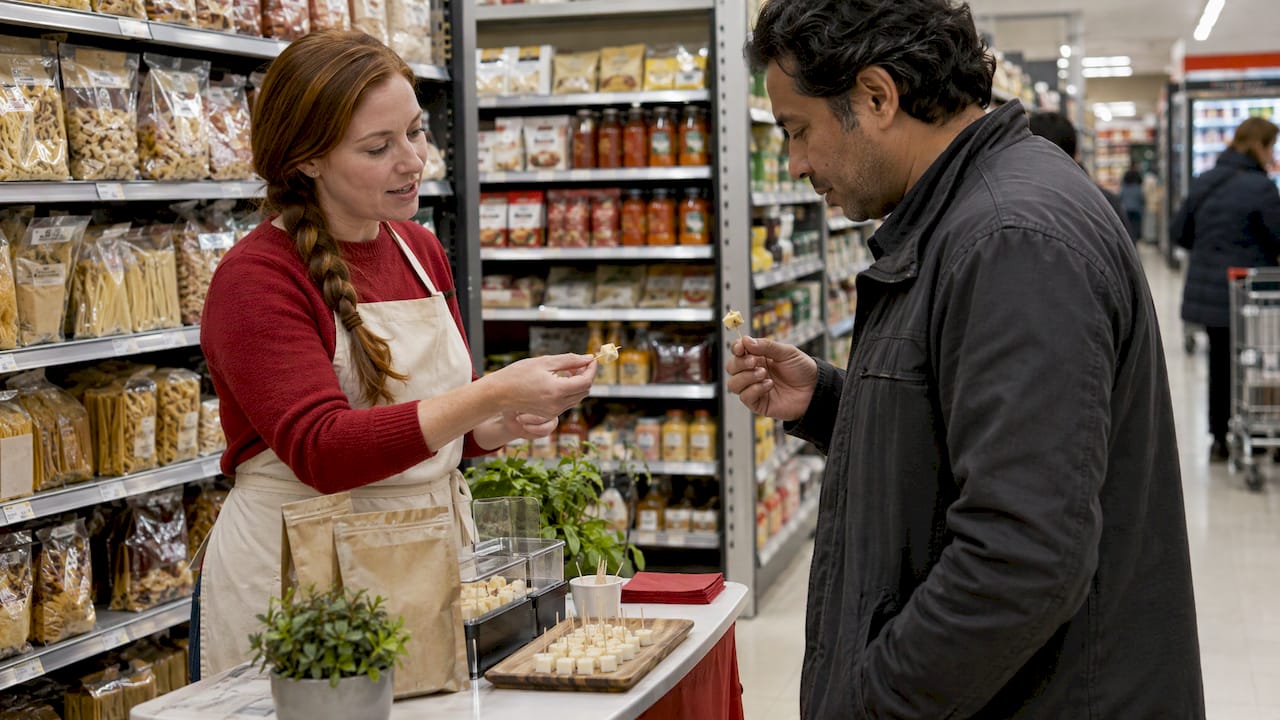
A public example comes from Walmart Connect, which reports that Mondelēz’s Ritz campaign combined 49 sidewalk events with 941 in-store demos. The case study cites 250K event impressions, a 75% year-over-year increase in average unit sales per store per day, and 20.8K more customers engaged at event activations. Those are one brand’s results at one retailer, so read them as a proof of what a coordinated program can look like, not as a benchmark to promise your own board.
Displays, endcaps and secondary placements
Displays win on visibility and interruption. They work best when there is a reason to buy now: a seasonal occasion, a new item, a bundle or a limited run. A display without a reason to look is a pallet.
They also carry the most execution risk. A retailer can confirm that display materials shipped, but shipped is not the same as built. We come back to that below.
Events, pop-ups and retailer-adjacent moments
Sidewalk events, tastings, pop-ups near the store and community or campus moments extend the activation past the aisle and drive traffic in. We have written about turning campus activations into store sales, where the activation creates the interest and the retailer’s media and offers close it.
In-store media and retail media touchpoints
Screens, shelf signage, digital endcaps, receipts, QR codes and app offers let a retailer sell attention inside its own stores, and let a brand connect that attention to purchase data. Our view of measuring in-store retail media across three touchpoints is that you should prove measurement first and scale spend second.
How to choose the right format
The best format is the one that matches the sales problem. Before picking, answer three questions: what is the objective, what is the product, and what does the retailer allow.
| Objective | Product situation | Formats that tend to fit |
|---|---|---|
| Drive first trial | New item, taste or feel matters | Sampling, demos, tastings |
| Lift velocity | Established item, shoppers know it | Displays, endcaps, in-store media, offers |
| Win distribution | Item in few doors or few facings | Demo programs with sell-through reporting, events |
| Build occasion relevance | Seasonal or usage-driven item | Themed displays, recipe or usage content, events |
| Reach a specific audience | Defined buyer segment | Retail media targeting, campus or community activations |
Then layer in channel. Grocery supports demos and big displays. Convenience favors small, fast formats. Club has its own demo infrastructure. Mass and drug each have different fixture rules and planning calendars. Ask the retailer which activations they already run and which they will fund, because a format they cannot staff or approve will not happen, however good it looks in a deck.
Planning with the retailer: calendar, staffing, inventory, operations
The plan runs backwards from the retailer’s calendar. In-store activations are planned through the retailer’s joint business planning cycle, where space is committed months before the creative is finished. If you show up with a finished idea after the plan is locked, you are asking for an exception.
Here is the sequence we would run.
Set one objective and one number
Pick a single primary outcome, such as unit sales per store per day, trial rate or incremental dollars, and decide what lift would count as success. Everything else is supporting.
Lock the store list and the control stores
Choose test stores and comparable control stores at the same time, before the activation starts. If you choose control stores after the fact, you will choose the ones that flatter you.
Staff for conversion, not headcount
Demo staff should know the product, the price, the offer and where it sits on the shelf. Trained ambassadors can help turn sampling into purchases, and demos are conversion events with trial-to-purchase outcomes you can track. A friendly person with no product knowledge hands out samples. A trained one sells.
Protect inventory and the shelf
Plan supply to the store, not just the warehouse. Make sure the item is in stock for the whole window, that the shelf tag is correct, and that the display fits the planogram. An activation that drives demand into an empty shelf is a cost, not a campaign.
Coordinate with store operations
Tell store managers what is coming, what space it needs, who is arriving and what they need. Managers who understand the plan protect it. Managers who find a display in the aisle with no warning move it.
Connecting digital and physical touchpoints
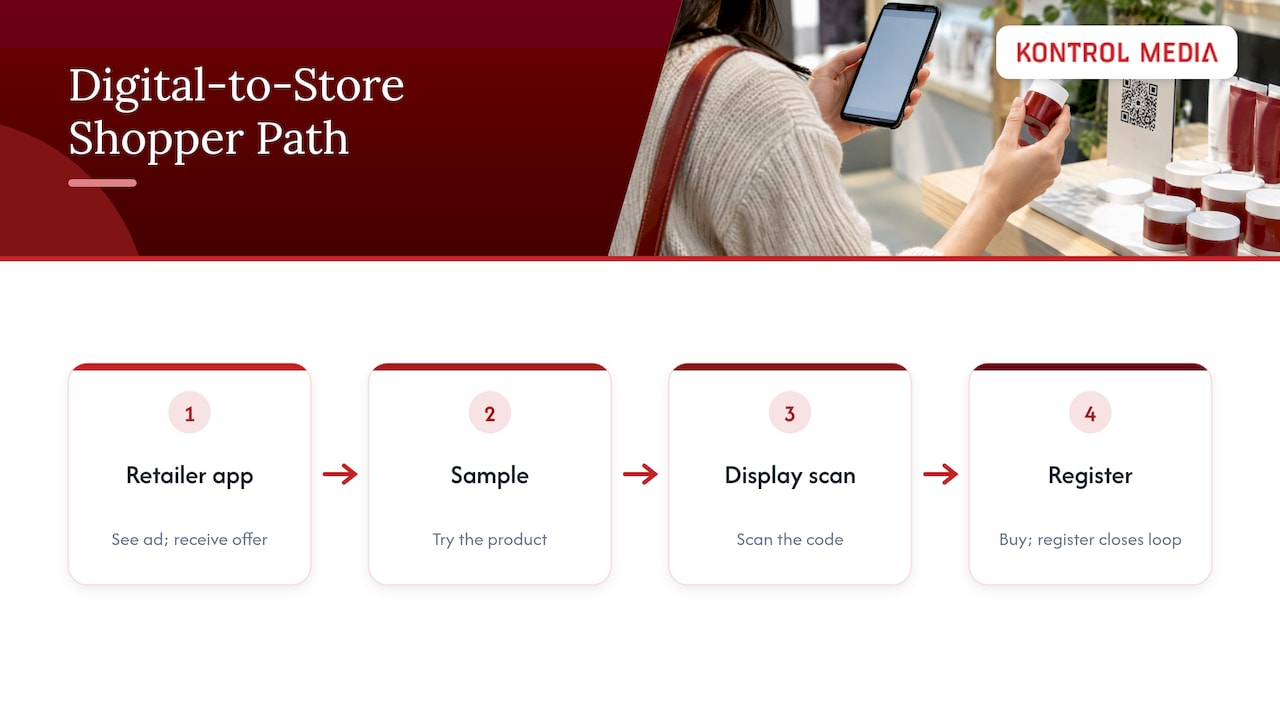
The strongest programs treat the store as one touchpoint in a chain. A shopper might see an ad on the retailer’s app, receive an offer, try a sample, scan a code on the display and buy at the register. Each step produces data, and the register closes the loop.
Two practical points. First, tie digital and physical to the same offer and creative, so the shopper recognizes it. Second, make sure the tools in the store actually work. Screens, scanners and POS systems depend on stable networks, and a retail network outage case study shows how quickly multi-site stores feel it when connectivity fails. A digital activation that is down during the weekend is a missed weekend.
On the data side, audience matching only helps if the match is good. Our notes on retail media data onboarding and audience data activation explain why we want match quality proven before spend scales.
Verification: the weakest link
Shopper marketing is unusual. It pays for physical inventory it does not control, it is executed by people it does not employ, and it then reports on results it cannot directly verify. That is why verification is the weakest link in the chain.
The fix is to build verification into the plan, not bolt it on at the end.
Start with photo audits at set points, with timestamps and store IDs, so you know whether a display was built, where, and when. Add field team spot checks in your top doors. Ask for retailer confirmation of in-store dates, and compare scan data to those dates. Where staffing is outsourced, require shift reports with trial counts and sales.
Store teams catching errors early is a discipline that retailers know well, and the thinking behind retail loss prevention by store managers applies to activations too: fix the small error on the floor before it becomes a reported failure.
Measuring sales lift and return on investment
Same-day sales are the easiest number and the least useful one. A demo that lifts sales on Saturday and nothing afterward has paid for a weekend. A demo that gets a shopper to buy again in week three has paid for a customer.
Use matched stores and a baseline
Compare test stores against similar control stores, over the same period, against a pre-period baseline. That is the core of incrementality, and we go deeper in our piece on what incrementality means in retail media. Monitor sales data before, during and after the activation, and schedule demos alongside promotions so you can see how they work together, since combining them can boost trials and first purchases.
Look past the day of the event
Track three windows: during the activation, the weeks after it, and repeat purchase. Opener, an in-store demo software company, publishes benchmark ranges for food and beverage demos, including trial rates of 5 to 10% of store traffic and trial-to-purchase conversion of 15 to 30%. These are one vendor’s figures and categories differ, so treat them as a sanity check for your own data rather than a target.
Count the indirect value honestly
Some value shows up outside the sales line: a new authorization, an added facing, a better position in the next planning cycle. Count it only when you can tie it to the program, and show it separately from the sales lift so nobody argues about the core number. For the wider method, see our guide to measuring the ROI of marketing and advertising campaigns.
A simple worked frame
Suppose a program costs a set amount, covering staff, product, travel and materials. Incremental revenue is the lift in test stores over control stores, multiplied through the activation period and the weeks after. Add repeat purchase from new buyers if you can identify them. Divide the gross profit on that incremental revenue by cost. If the answer is below one on the first read, look at conversion at the table and in-stock rates before you blame the format.
Common problems and how to fix them
The retailer plan closed before the idea was ready. Start the conversation at the beginning of the planning cycle with an objective and a flexible concept, not a finished execution.
The display shipped but never got built. Require photo verification and make one person accountable for follow-up in priority stores.
The shelf was empty. Tie the activation start to confirmed inventory and keep a minimum-stock trigger.
Staff did not know the product. Brief them with a one-page sheet: the three things to say, the price, the offer and where the product is.
Results cannot be attributed. Fix control stores and the baseline before launch, and agree the primary metric with sales and the retailer in advance.
Trade spend and marketing spend are fighting. Agree one shared scorecard so both teams are judged on the same incremental result.
Our perspective
We spend our days where brands, retailers and media meet, and the pattern is consistent: in-store activations fail on operations and measurement far more often than on creativity.
The idea is rarely the problem. What goes wrong is the handoff between the brand’s plan, the retailer’s calendar and the person standing in the aisle. Brands that win treat the store as a media channel with its own inventory, its own planning cycle and its own proof requirements.
That is why we pair strategy with hands-on execution. We think the winning move is to define the objective, plan inside the retailer’s calendar, build verification into the program, and connect store activity to retail media and first-party data so results are measurable. Measure first, then scale what is proven.
The brands we want to work with are the ones willing to be candid about what worked, and optimistic enough to keep refining it. That combination compounds quickly.
Mark Kapczynski
Where Kontrol Media fits
If you are a CPG brand, a retailer or a consumer business trying to connect in-store activity to measurable sales, we can help with strategy and with the work itself. We build and operate retail and commerce media networks, and we provide business, marketing and sales strategy with execution. We can help you set the objective, structure the retailer partnership and design the measurement.
To see how we work, explore our business strategy, marketing and sales services or read how we approach standing up a retail or commerce media network. Retailers who want to monetize their stores can also look at retail media network operations.
FAQ
What is the best in-store activation for a new CPG product?
Sampling or demos are usually the most direct way to drive first trial, because the shopper experiences the product and can buy it on the spot. Pair the activation with clear pricing and confirmed inventory. Then track both the lift during the event and repeat purchase in the weeks after.
How far in advance should we plan?
Plan on the retailer’s joint business planning cycle, where space is committed months before creative is finished. Start with the objective and a flexible concept, then lock details as the retailer confirms store lists and dates. Ask your retailer contact for their current planning calendar.
How do we know if an activation actually increased sales?
Compare test stores with matched control stores over the same period and against a pre-activation baseline. Look at sales during, shortly after and several weeks after the activation. This isolates incremental lift instead of crediting the activation with sales that would have happened anyway.
Can in-store activations work together with retail media?
Yes. In-store activity can be paired with app offers, digital screens and onsite or offsite retail media, so the shopper sees one message before, during and after the visit. Retailer purchase data can then close the loop. We recommend proving measurement on one touchpoint first.
Sources
- Shopper Marketing: How CPG Brands Plan, Fund and Prove (Paralleldots)
- Product Demos Slam Dunk with In-Store Customers (Walmart Connect)
- Setting the Standard (Supermarket News)
- A Guide to Great CPG Field Marketing Management (Promomash)
- How to Measure In-Store Demo ROI Beyond Same-Day Sales Lift (Opener)
- Retail network outage case study for multi-site stores (Tekmatik)
- Retail loss prevention: store managers fix errors (GuardEX)