

CPG brands reach college students on campus by showing up where students already live and eat, in the weeks when habits are being set, and by earning the university’s approval before a single sample is handed out. The brands that win treat the campus as a closed community, combine physical presence with peer influence, and connect every activation to a place where students can actually buy the product.
That sounds simple. In practice, it is a mix of calendar planning, institutional diplomacy and measurement discipline, and most of the failures we see come from skipping one of the three. Here is how we would approach it.
TL;DR
- Move-in and the first weeks of term are the highest-leverage window, because most grocery and a large share of hygiene and supply purchases happen after students arrive.
- Universities are risk-averse. Plan three to six months ahead, expect licensing, insurance and permit requirements, and offer the campus something of value.
- Use a surround-sound mix: sampling and tabling, dining and residence hall presence, campus media, and peer-to-peer influence, rather than digital ads alone.
- Be transparent in anything sponsored, and handle lead capture with care around student privacy rules.
- Tie every activation to a retail destination so you can measure sales, not just impressions.
Table of Contents
- Why the campus is different from any other audience
- Start with timing: the move-in window
- Get through the front door: approvals, licensing and cost
- Build a surround-sound presence
- Message by category: price and aspiration both matter
- Stay on the right side of disclosure and privacy
- Perspective: why we insist on a retail destination
- Measure what matters
- Where we can help
- A simple first-year plan
- FAQ
- Sources
Why the campus is different from any other audience
Students live, learn, eat and socialize within a few square miles. Flytedesk’s research on campus proximity describes how this density creates a culture of influence, where trends move quickly and adoption happens in packs. Physical proximity, not age or income, shapes much of what students try.
That changes how you plan. A national media buy treats 19-year-olds as one segment. A campus treats them as cohorts: a residence hall floor, a club, an intramural team, a sorority house. If a product catches on in one of those micro-communities, it often spreads organically through the next. If it never lands in one, no amount of broad reach will fix that.
It also means that despite being highly connected online, students tend to find their sense of belonging in person. Flytedesk’s 2025 student survey write-up points to dining halls, residence halls, classrooms and clubs as the primary sites of community. Those are your media channels.
Start with timing: the move-in window
If you can only do one campaign a year, make it the start of the fall term. The same Flytedesk research reports that move-in accounts for roughly $47 billion in spending, and that about 92% of grocery purchases and nearly half of hygiene and school supply purchases happen after students arrive on campus. Those figures come from a campus media company, so treat them as directional, but the pattern matches what we see: students buy staples where they land, and the brand they pick in week one often becomes the default.
This is why “first-choice” matters so much. A student who has never bought your body wash or snack bar will be choosing among whatever is in the campus store, the nearest grocery and the dorm care package. You want to be in that decision before routines harden.
A workable calendar looks like this:
- Spring before: identify target campuses, contact the relevant offices, and start applications.
- Summer: secure approvals, licenses and insurance certificates, and line up campus media and retail placement.
- Move-in through week four: sampling, tabling, residence hall and dining presence, ambassador activity.
- Midterms and winter break: replenishment messaging, promotions tied to stress and study culture.
- Spring term: a second, smaller push for trial among students who missed the first.
Get through the front door: approvals, licensing and cost
Most brand teams underestimate this step. Universities are cautious institutions, and gaining access is less about marketing than about operations. Ohio State’s sponsorship team, for example, publishes guidance on campus activations that makes clear brands are expected to align with campus priorities and bring concrete value. Insiders we respect recommend allowing at least three to six months for event planning, and a brand that offers nothing back to the campus rarely gets premium, high-traffic locations.
A few practical realities:
- Sponsorship packages are the usual route. UC Berkeley’s international office, for instance, publishes sponsor packages for the 2025-26 year that start at $1,000 and climb from there depending on access to digital channels, event tabling and pre-arrival guides. Other campuses run vendor programs or recreation sponsorships with their own price lists, so budget on a campus-by-campus basis.
- University marks need a license. If your packaging, giveaways or signage carry school names or logos, expect a separate licensing process with application fees and proof of insurance.
- Sampling can involve more than the university. Food and beverage sampling may require health permits from the local municipality, and some universities restrict uncontrolled sampling outright. Alcohol brands typically have to work through the Dean of Students or an equivalent office.
Before you commit spend, ask the campus contact three questions: who owns approvals for sampling, what is the lead time, and which locations are actually available to outside brands. Answers vary a great deal, and a wrong assumption can cost you the entire fall.
Build a surround-sound presence
Digital-only campaigns underperform on campus for a simple reason: students are surrounded by their peers, and peers are the medium. CollegeInc’s back-to-school guidance argues for a surround-sound approach that blankets a campus through dining halls, campus transit, student newspapers and conversation, so that the brand becomes part of the daily routine instead of one more ad.
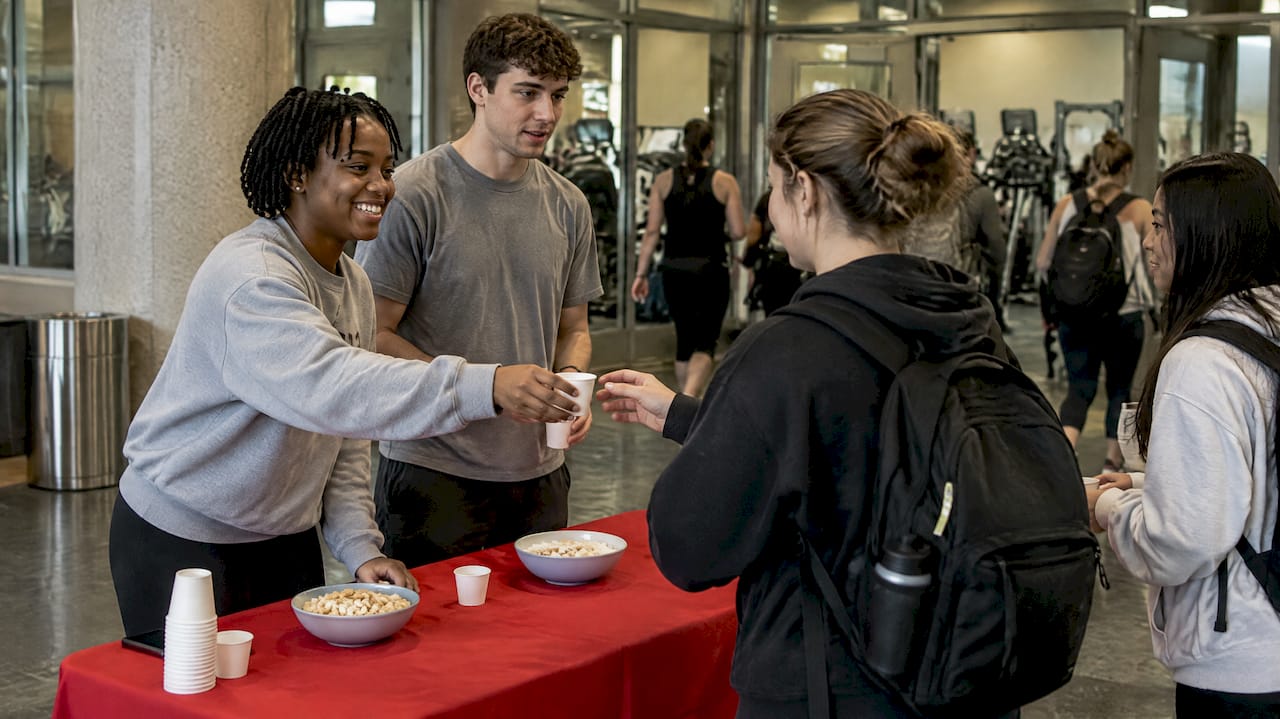
Sampling and tabling
Sampling still works for CPG because trial is the whole point. The best executions go beyond a folding table at the quad. Work with student organizations that already gather people: clubs, Greek life, intramural teams, cultural organizations, recreation centers. Auburn’s recreation and wellness department, for example, invites brands to sponsor and sample to its student base, which is the sort of owned, high-attendance environment that beats a cold booth.
Pair every sample with a reason to buy: a coupon, a QR code to a store locator, or a retailer-specific offer. A free sample with no next step is a good memory and a lost sale.
Dining halls, residence halls and campus stores
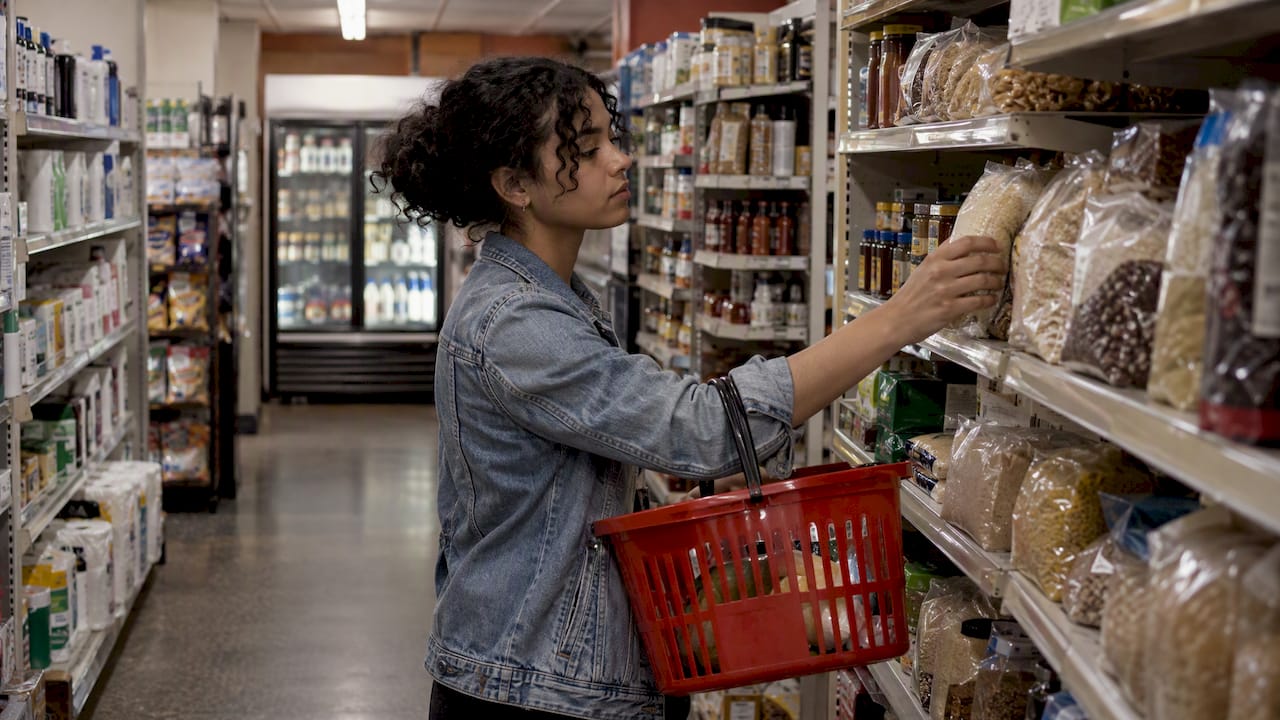
What shows up in dining and retail is often controlled by the campus food service operator or the campus store, so activations that never touch those channels can create awareness with nowhere to convert. If you want distribution, start the conversation with the retail and dining side early, in parallel with the marketing approvals.
Campus media and peer influence
Student newspapers, digital screens, transit and housing channels reach students in context. Layer on micro-influencers and ambassadors who are credible within a specific community. We have written more about this in our piece on reaching college students with campus advertising and about the role of influencer marketing in modern advertising.
Message by category: price and aspiration both matter
It is tempting to assume students only want the cheapest option. The data is more nuanced. The NACS Foundation’s Student Watch research reports that students are strongly price-conscious, with 93% calling price very important in retail decisions, yet they will spend on quality in categories such as beauty and hygiene.
For CPG, that suggests splitting your messaging by category:
- Staples and snacks: lead with value, bundles and convenience.
- Beauty, personal care and wellness: lead with look, feel and peer recommendation, and let price follow.
- Beverages: lead with social occasions, energy for study and sports, and shareable formats.
What holds across all of them is that the recommendation of a friend carries more weight than the claim of a brand.
Stay on the right side of disclosure and privacy
Two compliance areas deserve attention before your first activation.
First, advertising transparency. The FTC has published staff perspectives on advertising to young audiences noting that younger people struggle to tell organic content from promotion. College students are mostly adults, but orientation and early-start programs can include minors, and clear, plain disclosures protect trust with everyone. Make sure ambassadors and creators state the relationship in the post and out loud, not in a vague tag. Your legal counsel should review influencer and ambassador agreements before launch.
Second, student data. The U.S. Department of Education’s Student Privacy Policy Office explains FERPA and the Protection of Pupil Rights Amendment, and the latter in particular matters when marketing activities involve collecting information from students. If you use QR codes or sign-up forms, keep marketing clearly separate from any institutional content, collect only what you need, and confirm with the campus and counsel which rules apply to the specific population you are reaching.
Perspective: why we insist on a retail destination
We have watched many CPG teams run a lively campus event and then struggle to answer a basic question from finance: what did it sell? The activation was a success by every measure except the one that gets budgets renewed.
Our view is that campus work belongs inside a broader retail media and commerce plan. We operate in retail media and commerce media networks, and that background shapes how we see a campus. A campus store, a nearby grocery chain or an online retailer is a place where you can run advertising, tie it to purchase data and test what actually changes behavior. When the sampling event, the ambassador push and the on-campus placement all point to a place students can buy, measurement becomes possible, including incrementality testing against campuses where you did nothing.
We also believe in the unglamorous side of this work. Approvals, licensing, permits and retailer onboarding are not obstacles to creativity, they are the operationalization that lets creativity happen. A great idea that cannot get a table on the quad in September is just a slide.
Finally, we like the work to be fun. Students can smell a brand that is trying too hard, and they respond to ones that make a moment more enjoyable. That is true of campaigns, and honestly it is true of the planning meetings too. If you want to see how we structure this thinking, our retail media first playbook for campus activations is a good place to begin.
— Mark Kapczynski
Measure what matters
Pick a small set of metrics before the first sample goes out, and agree on them with the people who will judge the program.
| Stage | What to track | Why it matters |
|---|---|---|
| Reach | Samples distributed, events held, impressions in campus media | Confirms you showed up where planned |
| Trial | Coupon or QR redemptions, ambassador-reported trials | Shows the sample led to a next step |
| Purchase | Retailer sales lift on and near target campuses | The metric finance cares about |
| Repeat | Second purchases, loyalty or app signups | Indicates a habit, not a one-off |
Where you can, compare campuses that received the full program with similar campuses that did not. It is the cleanest way to separate your effect from the normal back-to-school surge. Our 90-day omnichannel pilot playbook for campus retailers walks through a structure for this, and our 12-week playbook for CMOs maps the key moments in the academic calendar.
Where we can help
If you are a CPG brand, an agency or a retailer that wants campus activity to translate into measurable sales, we build and run the programs behind it. That includes standing up a retail or commerce media network so your campus presence connects to purchase data, and retail media network operations to keep it performing. If you need broader go-to-market, marketing or sales support, see our consulting services.
A simple first-year plan
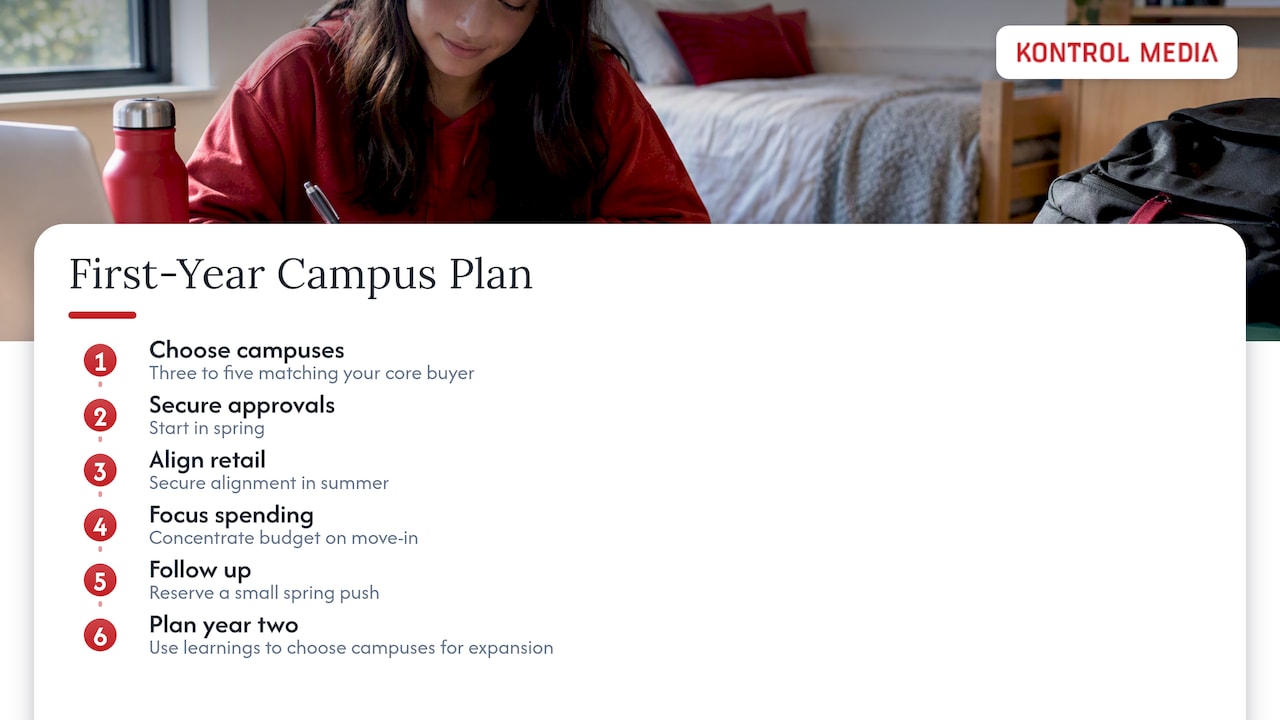
If you are starting from zero, resist the urge to cover fifty campuses. Choose three to five that match your core buyer, and run the full program on each. Start approvals in the spring, secure retail alignment in the summer, and concentrate budget on move-in. Reserve a small portion for a spring follow-up, and write down what you learn about approval timelines and costs, because that knowledge compounds. By your second year, you will know which campuses are worth expanding into and which were more effort than they were worth.
FAQ
What is the best time of year to reach college students on campus?
The start of the fall term, from move-in through roughly the first month, is the strongest window. Flytedesk’s research reports that most grocery purchases and about half of hygiene and supply purchases happen after students arrive. A smaller spring push helps catch students who missed the first one.
Do I need permission to sample products on a college campus?
In almost every case, yes. Universities set their own rules, and some restrict uncontrolled sampling entirely. You may also need municipal health permits for food and drink, plus insurance and, if you use school marks, a license. Contact the campus sponsorship or student activities office first, and start months ahead.
How much does it cost to activate on a campus?
It varies widely by school and by access. As one published example, UC Berkeley’s international office lists sponsor packages that start at $1,000 and rise with added digital and event access. Your total will also include product, staffing, permits and any campus media.
Are campus ambassadors or influencers more effective?
They do different jobs. Ambassadors tend to drive trial within a specific community, while influencers extend reach. Whichever you use, require clear disclosure of the relationship, and give ambassadors a retail destination to send people to so you can track results.
Sources
- Flytedesk: College 2025, how students shop, connect and make decisions on campus
- Flytedesk: Brand discovery as a social experience
- CollegeInc: Back to school insights
- The Ohio State University: Campus activations and sponsorships
- UC Berkeley International Office: Sponsor opportunities 2025-26
- Auburn University Recreation and Wellness: Sponsors
- NACS Foundation: Student Watch
- FTC staff perspective on advertising to kids
- U.S. Department of Education: Student Privacy