


The fastest path to a defensible retail media product is a staged six-step roadmap, and the first move is auditing your first-party data and measurement baseline before you build anything else. We walk through the stages, the measurement discipline that keeps them credible, and the governance that turns a pilot into a revenue line within 90 to 365 days.
TL;DR:
- Within 90 days, reconcile loyalty IDs with transaction data, document match rates across onsite, email, and loyalty systems, and test one clean room query.
- Target live sponsored placements by day 90, self serve booking by day 180, and standardized reporting plus an in store pilot by day 365.
- Verify early tracking with basic attribution, compare matched markets once enough regions exist, and use randomized trials for claims tied to renewals or pricing.
- Align sales and analytics around shared KPIs, require documented methods before publishing incrementality claims, and apply clean room aggregation thresholds to every advertiser query.
Table of Contents
- The Six-Stage Roadmap From Data Foundation to Optimized Scale
- Choosing the Right Measurement Method for Each Stage
- The Data Foundation: Identity, Clean Rooms, and a 90-Day Checklist
- Operating Model and Governance: Who Owns What
- Sequencing the Roadmap: What to Build Next and When
- How an Execution Partner Sequences the Work in Practice
- Fitting the Roadmap Into Existing Technology Stacks
- Keeping Stakeholders Aligned as the Roadmap Moves
- Designing for Scale Instead of Rebuilding Later
- Positioning the Roadmap Against What Advertisers Already Expect
- Managing the Risks That Stall a Retail Media Roadmap
- Five Things I’d Tell Any Retail Leader Starting This Roadmap
- How Our Team Helps You Move Through Each Stage
- FAQ
- Sources
The Six-Stage Roadmap From Data Foundation to Optimized Scale
Retail media maturity follows a predictable arc, and skipping stages is the most common reason programs stall. Each stage builds the capability the next one depends on, so the sequence matters as much as the work itself.
- Data foundation: clean, matched first-party data and a measurement baseline. Success looks like a documented identity match rate and a reporting feed advertisers trust. A 90-day milestone is a completed data audit; 180 days bring a working clean room pilot; 365 days delivers standardized reporting across onsite formats.
- Onsite activations: sponsored product and display inventory on owned digital properties. Success is measured in fill rate and advertiser renewal. Aim for live sponsored placements by day 90, a self-serve booking flow by day 180, and category-level sellout rates by day 365.
- Offsite and audience expansion: extending retailer audiences to social and open web. Success is incremental reach beyond onsite impressions. Expect a pilot partnership by day 180 and a repeatable audience export process by day 365.
- Measurement and targeting sophistication: layering lift testing and look-alike targeting onto existing campaigns. Success is a documented incrementality result advertisers can act on. This stage typically starts around month six and matures through month twelve.
- Omnichannel and in-store integration: connecting digital exposure to in-store sales and loyalty data. Success is a closed-loop sales attribution report. Most programs target a pilot by month nine and a scaled rollout by month eighteen, extending past the first-year window.
- Optimization and scale: automated bidding, cross-format packaging, and expanded advertiser self-service. Success is sustained revenue growth without proportional headcount growth.
Early stages optimize for advertiser trust and category growth; later stages optimize for conversion proof and margin. A retailer chasing awareness dollars should weight stages one through three; one targeting performance budgets needs to reach stage four fast. The full-funnel operating model treats this progression as an operating capability rather than a line item in the ad budget, which is the mindset shift that separates programs that scale from ones that plateau at stage two.
Choosing the Right Measurement Method for Each Stage
Measurement rigor should track program maturity, not outpace it or lag behind it. A stage-one pilot does not need a randomized controlled trial, but a stage-four program claiming incrementality without one is making a promise it cannot back up.
- Use fast, lower-cost attribution checks (last-touch, basic lift panels) during data foundation and onsite activation, when you are validating that tracking works.
- Move to match-market testing once you have enough stores or regions to build credible treatment and control groups, typically around the audience expansion stage.
- Reserve randomized controlled trials for claims that will anchor advertiser renewals or pricing, since RCTs isolate causal lift with the least bias.
- Apply counterfactual and model-based methods (marketing mix modeling, econometric models) when a live experiment is not feasible, but disclose the added uncertainty.
The IAB’s guidelines for incremental measurement in commerce media frame this as a hierarchy: prioritize credible counterfactuals, control for bias, and separate real signal from noise before publishing a lift number. The IAB’s advanced measurement and data collaboration guide names RCTs, match-market testing, and MMM as the standard toolkit, with clean rooms as the connective layer that makes cross-party testing possible at all.
One data point worth planning around: a Becker Friedman Institute study found that losing off-site data effectiveness raised the median cost per incremental customer by 37%, from $43.88 to $60.19. The hit lands hardest on small advertisers and categories like CPG and retail, which is exactly the audience most retail media networks are built to serve.
The Data Foundation: Identity, Clean Rooms, and a 90-Day Checklist
Everything downstream, from audience targeting to incrementality testing, depends on four technical pieces working together: identity resolution that matches shoppers across channels, a customer data platform that unifies behavioral and transaction signals, product and inventory data that ties ad exposure to what is actually in stock, and a clean room that lets advertisers and retailers test hypotheses without exposing raw customer data.
A 90-day audit should cover:
- Inventory every first-party data source and flag gaps in coverage or freshness.
- Measure current identity match rates across onsite, email, and loyalty systems.
- Standardize schema so reporting feeds from different formats speak the same language.
- Confirm clean room access and test a single advertiser query end to end.
Pro Tip: Boost match rates fastest by reconciling loyalty IDs against transaction data before chasing third-party identity graphs, and set a hard rule that no advertiser query leaves the clean room without aggregation thresholds applied.
Operating Model and Governance: Who Owns What
A roadmap without clear ownership turns into a series of one-off projects. A compact RACI keeps data, ad ops, sales, analytics, and commercial leadership pulling in the same direction instead of optimizing for conflicting goals.
- Data and engineering are accountable for identity resolution, clean room access, and reporting infrastructure.
- Ad operations are responsible for campaign trafficking, inventory management, and advertiser-facing reporting.
- Sales owns the advertiser relationship and revenue targets, and should be consulted before any measurement methodology changes.
- Analytics is accountable for measurement design and incrementality results, and must be informed of every campaign launch.
- Commercial leadership sets shared KPIs across brand, media, and sales so renewal targets and lift results are not fighting each other.
The martech playbook for full-funnel retail media recommends embedding these roles into Joint Business Planning early, so media metrics get discussed alongside category and sales goals rather than in a separate meeting nobody attends. A workable cadence runs weekly ad ops syncs, monthly performance reviews with advertisers, and quarterly roadmap gates where leadership decides what ships next. Our operations playbook covers staffing ratios and meeting structures in more detail for teams standing this up for the first time.
Sequencing the Roadmap: What to Build Next and When
Prioritization comes down to four questions: how much advertiser demand exists for a feature, how much revenue it could realistically generate, whether you can measure its impact credibly, and what it costs to operate.
- Build the data and measurement pilot first; nothing else is trustworthy without it.
- Add self-serve commercial features next, since they scale revenue without scaling headcount proportionally.
- Hold in-store and omnichannel pilots until onsite measurement is proven, because closed-loop attribution inherits every weakness in your earlier tracking.
- Sequence offsite expansion after onsite trust is established, not before.
A realistic timeline: data audit and first pilot by day 90, self-serve booking and a second advertiser cohort by day 180, in-store pilot and standardized reporting by day 365. Our 90-day monetization plan lays out a shorter-horizon version of this same sequencing for retailers trying to prove value fast.
How an Execution Partner Sequences the Work in Practice
We run this as discovery, pilot, and scale. Discovery produces a data and measurement audit with a prioritized backlog. Pilot stands up one or two advertiser partnerships with live reporting, typically staffed by a program lead, an ad ops specialist, and an analytics resource. Scale hands off a documented playbook and governance cadence to an internal team, or we continue operating it. Our retail media network operations work follows this same structure for clients building revenue-generating media partnerships from the ground up.
Fitting the Roadmap Into Existing Technology Stacks
A retail media product rarely gets a clean slate. It has to slot into an existing e-commerce platform, a loyalty system, a point-of-sale stack, and whatever ad server or demand-side platform sales already uses. The integration question is not whether these systems can connect, but whether connecting them preserves data quality.
Start by mapping where customer and transaction data already live and which systems are the system of record for each. A CDP that pulls from five sources but reconciles none of them creates more reporting disputes than it solves. The martech playbook on full-funnel retail media operations recommends consolidating taxonomies before integrating infrastructure, which sounds slower but prevents rebuilding the same pipeline twice.
Ad serving and campaign automation should connect to the clean room rather than route around it, so every measurement claim traces back to the same data lineage. Legacy point-of-sale systems are usually the hardest piece, since in-store sales data often lags online systems by days rather than hours. Building a buffer into your reporting cadence for that lag is more practical than demanding real-time in-store feeds from day one.
A custom attribution model built with privacy safeguards can bridge gaps between ad platforms and retailer data when off-the-shelf connectors fall short, particularly for retailers running a mix of legacy and modern systems during a transition period.

Keeping Stakeholders Aligned as the Roadmap Moves
Retail media touches more departments than almost any other revenue line: merchandising, IT, legal, sales, and finance all have a stake in how it runs. A roadmap that lives only in the media team’s slide deck will get overridden the first time another department needs the same data or budget.
The fix is a shared one-page view of the roadmap that every stakeholder group can point to, updated at the same cadence as the governance reviews already running for data and ad ops. Merchandising needs to see how inventory signals feed targeting. Legal needs visibility into clean room access before an advertiser ever asks. Finance needs the revenue milestones tied to the same 90/180/365 markers used internally, not a separate set of projections.
Communication works best when it is tied to decisions, not status updates. A quarterly roadmap gate, the same one used for governance, is the natural forum to bring merchandising and finance into the room, because it forces a decision on what ships next rather than a recap of what already happened. Joint Business Planning sessions are the other anchor point: when media metrics show up in the same conversation as category and sales targets, stakeholders stop treating retail media as a side project.
Designing for Scale Instead of Rebuilding Later
The features that work for a five-advertiser pilot often break at fifty advertisers. Manual campaign trafficking, one-off reporting templates, and ad hoc clean room queries all have a ceiling, and hitting that ceiling mid-quarter is more disruptive than designing past it early.
Future-proofing starts with automation that is built for the volume you expect in twelve months, not the volume you have today. Self-serve booking and standardized reporting templates are not just advertiser conveniences; they are what let a small ops team support a growing advertiser base without linear headcount growth. The optimization and scale stage of the roadmap exists specifically to catch this, which is why it is the last stage rather than an afterthought bolted onto stage one.
Format flexibility matters too. A roadmap built only for sponsored product listings will need to rework the moment video, offsite audience, or in-store media enters the mix. Building the clean room and identity layer to handle multiple formats from the start, even before every format launches, avoids a second data migration later. Measurement infrastructure should be format-agnostic for the same reason: an RCT framework built for onsite display should extend to offsite and in-store without a redesign.
Positioning the Roadmap Against What Advertisers Already Expect
Advertisers allocating budget across retail media networks are comparing your measurement rigor and reporting transparency against the networks they already work with, often the largest ones in the category. A roadmap that cannot eventually produce RCT-grade lift results or clean room collaboration will struggle to compete for budget against networks that already offer both.
This is less about matching every feature a larger competitor has and more about being credible on the metrics advertisers actually used to allocate budget: incrementality, match rates, and reporting consistency. A mid-size retailer with a rigorous stage-four measurement program can out-compete a larger network still running stage-two attribution, because advertisers increasingly ask for proof, not just reach. Albertsons Media Collective’s rollout of an in-store incrementality measurement tool in January 2026 signals where the bar is moving: retailers are building native causal measurement rather than relying on advertiser-side estimates.
Positioning the roadmap this way also means being honest internally about where gaps exist. A retailer that markets itself as having advanced measurement but cannot produce a single credible RCT result will lose advertiser trust faster than one that is upfront about being mid-roadmap and improving.
Managing the Risks That Stall a Retail Media Roadmap
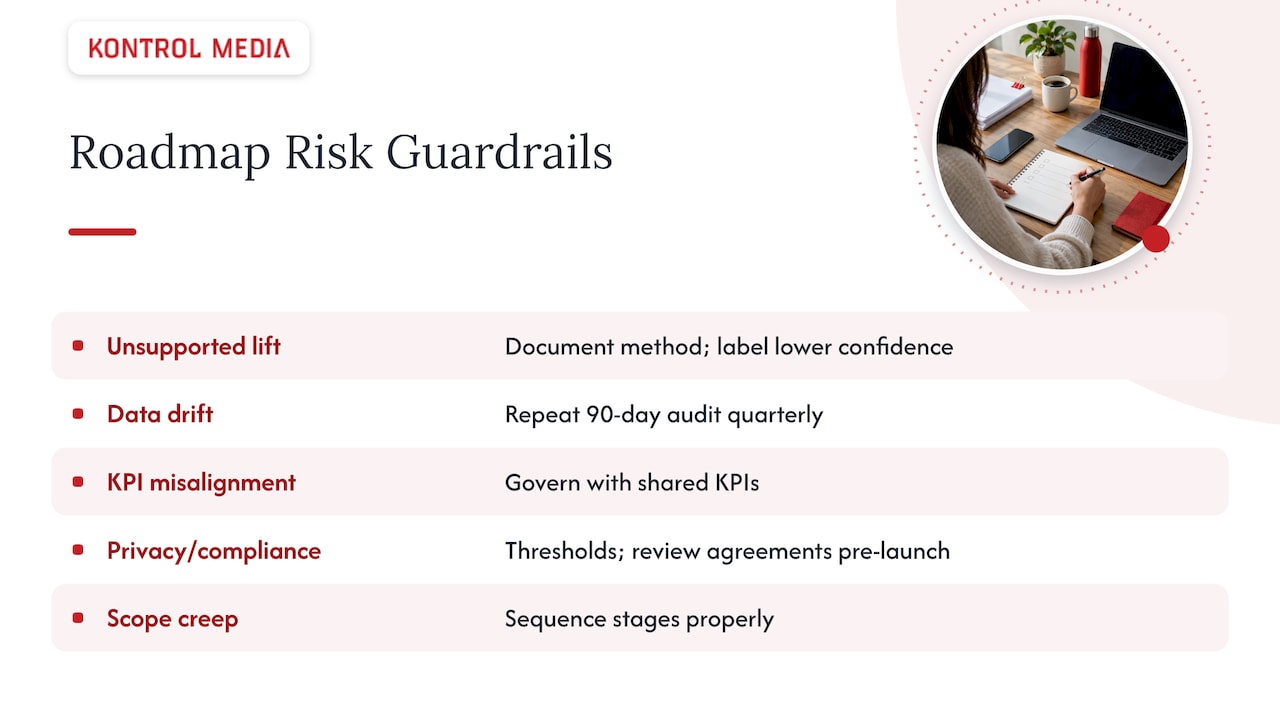
The most common failure point is not technical. It is rushing measurement claims before the data foundation can support them, which erodes advertiser trust the first time a reported lift number does not hold up under scrutiny. The mitigation is procedural: no incrementality claim ships without a documented methodology, and lower-confidence methods are labeled as such rather than presented with the same certainty as an RCT.
A second risk is data quality drift. Match rates and schema consistency degrade as new sources get added, so the 90-day audit checklist from the data foundation stage should repeat quarterly, not just once at launch. A third risk is organizational: if sales targets and measurement rigor are not governed by the same shared KPIs, sales will push campaigns the analytics team cannot defend, and the resulting disputes slow every subsequent advertiser conversation.
Privacy and compliance risk deserves its own guardrail. Clean room queries should run under aggregation thresholds by default, and every data-sharing agreement with an advertiser should be reviewed before a pilot launches, not after. Finally, scope risk: a roadmap that tries to launch stage four and stage five simultaneously to impress advertisers faster usually produces weaker results on both than sequencing them properly would have.
Five Things I’d Tell Any Retail Leader Starting This Roadmap
If I had to compress this into a checklist: sponsor measurement rigor from day one, align retail media KPIs inside Joint Business Planning rather than a separate deck, hire or assign ops talent before launching advertiser pilots, run pilots fast but resist the urge to publish lift numbers before they’re credible, and insist on incrementality proof even when a simpler metric would be easier to report. The next step for most CMOs and heads of retail media is simply running the 90-day data audit before committing to a launch date.
— Mark Kapczynski
How Our Team Helps You Move Through Each Stage
We built our consulting practice around helping retail media pilots evolve into revenue-generating programs efficiently. Where other advisory firms stop at strategy, or execution shops skip the measurement discipline entirely, we run the audit, staff the pilot, and stay through the operating phase.
- We run a 90-day data and measurement audit that supports the first stage of this roadmap.
- We staff and operate pilots directly, drawing on experience building and running retail and commerce media networks across various sectors.
- We stay through the scale phase, handing off a governance playbook or continuing to support network operations.
If you are ready to move past the planning stage, our retail media network setup service covers discovery through launch, and our team is available for a discovery call to map your roadmap against your current data maturity.
FAQ
What is a retail media product roadmap?
A retail media product roadmap is a staged plan that sequences data infrastructure, ad formats, measurement rigor, and governance so a retailer can grow from a basic onsite ad program into a scaled, omnichannel media network. It typically moves through six stages, from data foundation through optimization and scale.
How long does it take to build a retail media network?
Most programs reach a working pilot within 90 days of starting a data audit, expand onsite and offsite formats within 180 days, and reach omnichannel integration and standardized reporting by month twelve to eighteen. The exact pace depends on existing data quality and advertiser demand.
What is incrementality testing in retail media?
Incrementality testing measures whether advertising caused a sale that would not have happened otherwise, using methods like randomized controlled trials, match-market testing, or model-based counterfactuals. The IAB’s measurement guidelines recommend prioritizing methods that control for bias over simpler attribution models.
Why do clean rooms matter for retail media measurement?
Clean rooms let retailers and advertisers match data and run measurement queries without exposing raw customer information to either party. They are the technical foundation that makes advanced methods like match-market testing and RCTs possible at scale, as outlined in IAB’s advanced measurement guide.
Can a mid-size retailer compete with larger retail media networks?
Yes, when the program prioritizes measurement credibility over scale alone, since advertisers increasingly allocate budget based on proof of incrementality rather than reach. A rigorous stage-four measurement program can outperform a larger network still relying on basic attribution.
Sources
- Guidelines for Incremental Measurement in Commerce Media — IAB
- Estimating the value of offsite data to advertisers on Meta — Becker Friedman Institute (UChicago)
- Full-Funnel Retail Media Operating Model: Martech Playbook